Ahmedabad, Gujarat, India
Ahmedabad, Gujarat, India
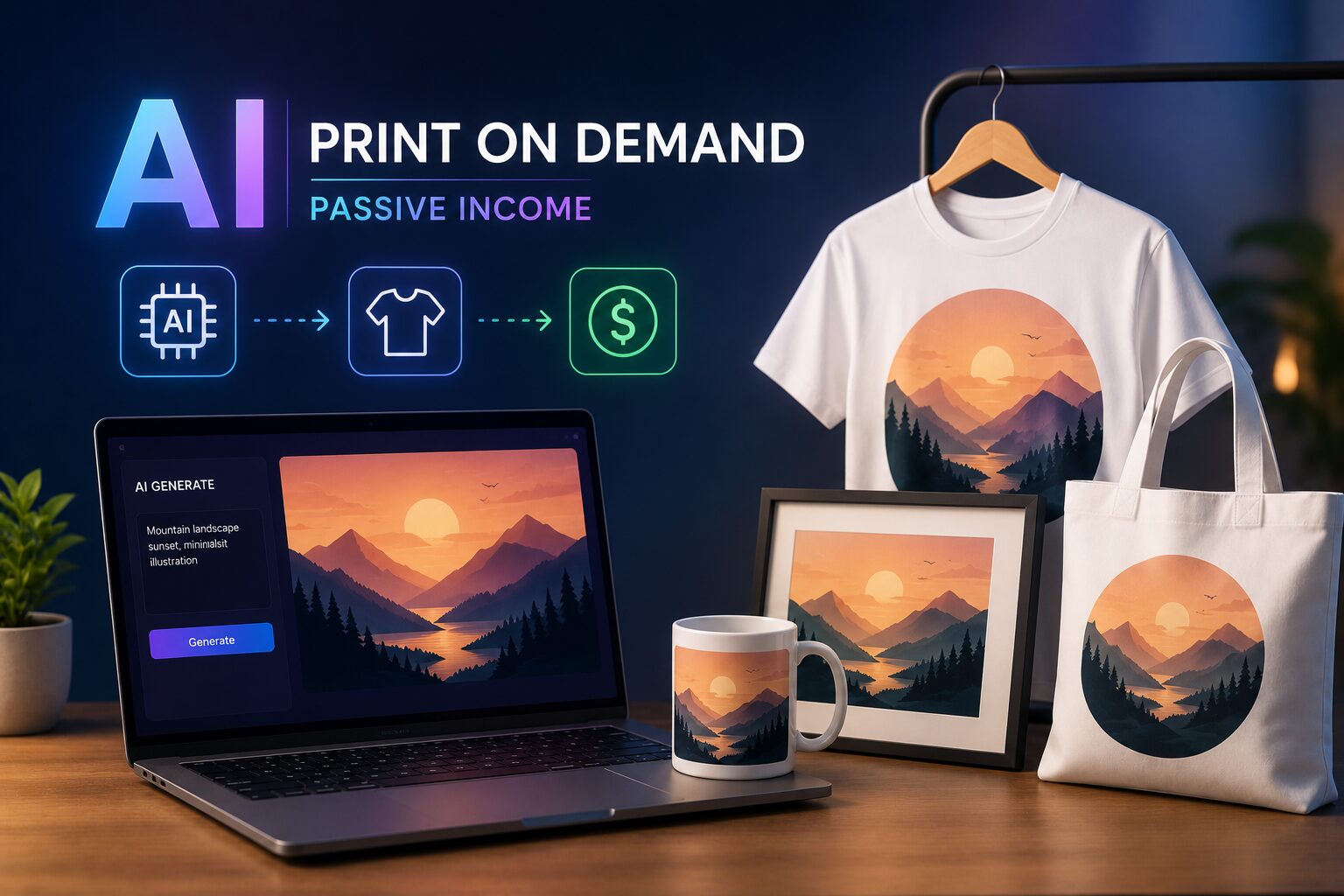
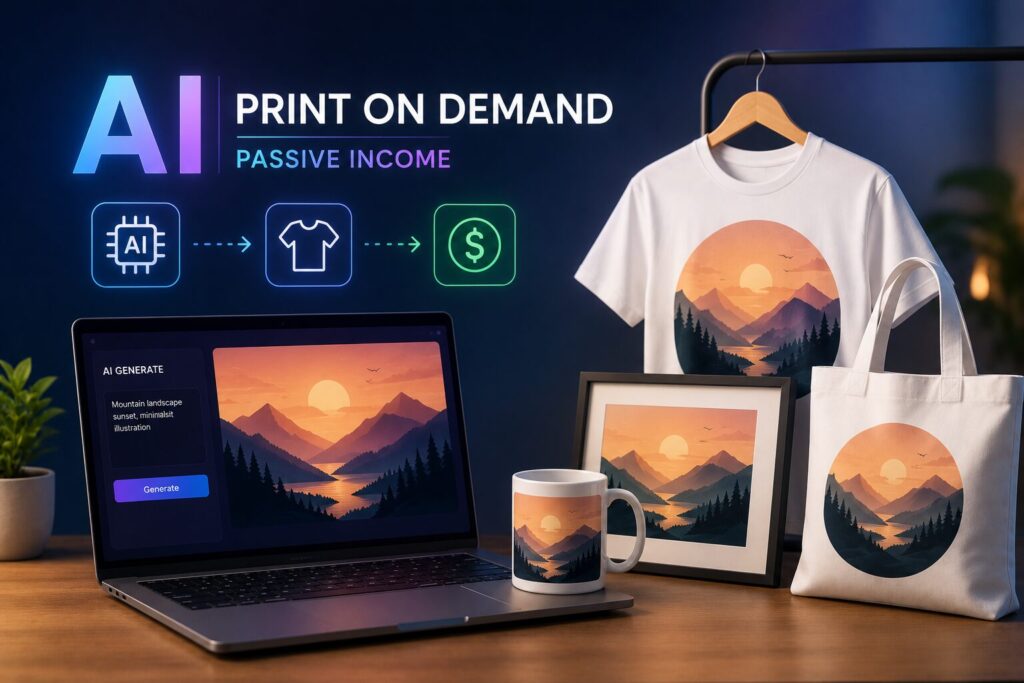
Use AI tools like Midjourney to generate stunning art, upload to Redbubble or Etsy, and start earning passive income. No design skills needed. Start today!
Disclaimer: This content is for educational and informational purposes only. Results from selling print on demand AI art vary significantly based on effort, niche, marketing, and market conditions. Past earnings or examples mentioned do not guarantee future income. Always conduct your own research before investing time or money. AICap.in is not affiliated with any print on demand platforms.
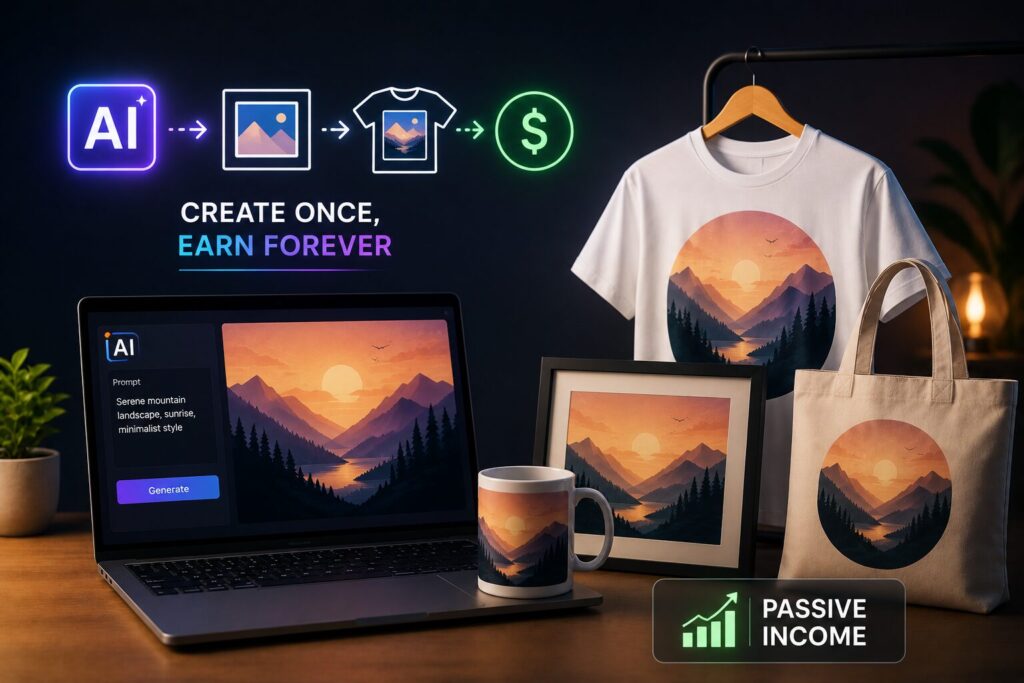
Print on demand AI art is not a side hustle in 2026 — it is a complete system. You type a prompt into Midjourney or DALL·E, the AI generates artwork in seconds, you upload it to a fulfillment platform, and the platform prints and ships when someone orders. No design skills. No upfront inventory. No shipping headaches.
This model combines two simple ideas: using artificial intelligence to generate original artwork, and uploading those designs to a platform that prints them on physical products only after a customer places an order. You create a design once, and it can sell repeatedly.
The global print-on-demand market has grown steadily, driven in part by wider adoption of AI-driven design tools. This guide gives you a practical framework to launch your first store and build from there.
Print on demand AI art means using artificial intelligence tools like Midjourney or DALL·E 3 to generate original artwork, then selling that artwork on physical products through platforms like Redbubble, Etsy, or Printful. Products are printed only when a customer orders, so you hold no inventory.
The difference between this model and traditional retail is the difference between gambling on inventory and building a system that only produces what customers actually buy.
The old way of selling merch required serious artistic ability or expensive designers. AI has changed the creation side of the equation. Here is why the combination works well right now.
No inventory costs. You pay nothing until a customer orders. You upload designs without paying for stock.
No shipping or fulfillment. The platform handles printing, packing, shipping, and customer service. You collect your royalty.
Passive by design. A single design can sell for years with no additional work. The trade-off is that most designs do not sell at all, so volume and niche selection matter.
Scalable. The more designs you upload, the more potential sales you create. AI makes it possible to generate many variations quickly, though each still requires editing and quality control.
AI-powered speed. Creating a design manually used to take hours in Photoshop or Illustrator. AI image generators produce finished artwork in seconds, though print-ready files still need post-processing.
Getting in now, with AI as a creative tool, can position sellers ahead of the curve. But this is not a guaranteed income stream. Treat it as a system to test and improve.
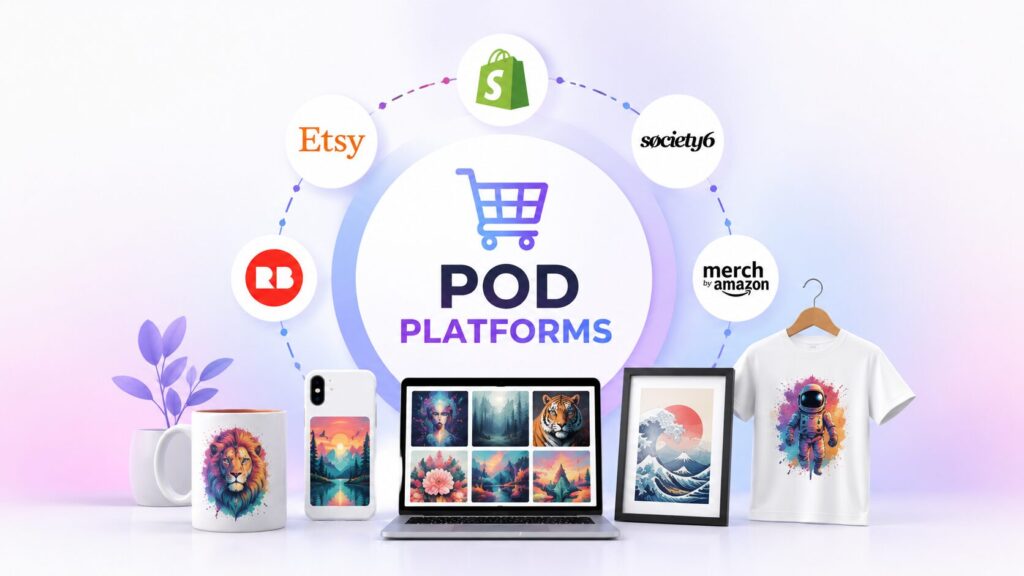
Choosing where to sell is the first real decision. Different platforms offer different traffic sources, margin structures, and content policies.
Redbubble is one of the most beginner-friendly platforms. Upload a design once and it can be applied to many product types. T-shirts, hoodies, mugs, phone cases, stickers, and notebooks are common options.
The platform has built-in organic search traffic, so your designs can be discovered without paid ads. You set your own markup on top of Redbubble’s base price. Margins vary widely by product and pricing strategy.
Practical note: Redbubble rewards upload volume, but quality and niche relevance still matter. AI makes volume easier, but the algorithm does not reward random uploads. Check Redbubble’s current content and AI policies before uploading.
Etsy has more buying intent than Redbubble. People are there to purchase, not just browse. You will face more competition, but your margins can be higher if you position well.
Fees include a $0.20 listing fee per item plus a 6.5% transaction fee, plus payment processing. Check Etsy’s Fees & Payments Policy for current rates. For fulfillment on Etsy, you connect a print provider like Printful or Printify.
Presentation matters on Etsy. Product mockups using tools like Placeit or Canva can improve click-through, but no specific percentage increase can be guaranteed.
Printful and Printify are fulfillment partners, not marketplaces. They handle printing, packing, and shipping but do not generate traffic on their own. You connect them to your own Etsy shop, Shopify store, or WooCommerce site.
The upside is control: you set prices, build your brand, and keep the customer relationship. Printful is often chosen for print consistency and its mockup generator. Printify offers multiple print providers per product type, which can help you compare costs.
Start with Redbubble if you have zero audience. Move to Etsy when you want higher margins. Build your own Shopify store when you are ready to scale.
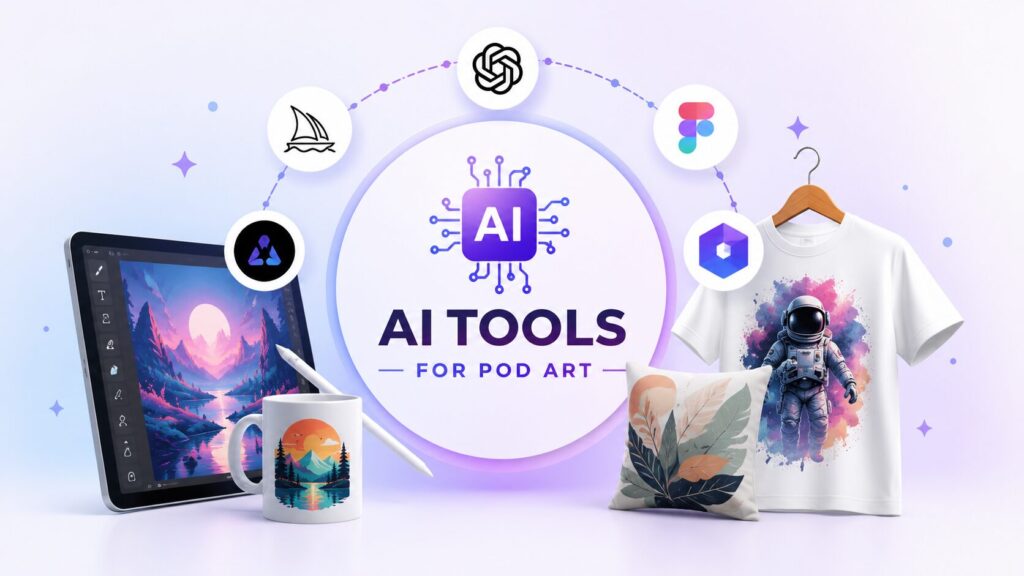
The quality of your artwork depends heavily on which tool you use. Different AI image generators have different strengths.
Midjourney is known for cinematic, painterly visuals. It excels at vintage looks and photorealistic fantasy scenes. Pricing starts around $10 per month depending on the plan. Check Midjourney’s current pricing and commercial terms directly.
Midjourney outputs can be high resolution natively, but apparel-quality files often still require upscaling.
Adobe Firefly is built on commercially safe training data and integrates with Photoshop and Illustrator. Adobe provides indemnification for eligible plans, which reduces copyright risk for commercial use. Firefly outputs can feel flatter than Midjourney, but the trade-off is legal safety. Verify current terms on Adobe’s site.
DALL·E 3 is accessible for beginners. You describe what you want in plain English, and the tool generates images. OpenAI grants commercial rights to outputs for ChatGPT Plus subscribers. DALL·E 3 can render text inside images with reasonable accuracy. Cost is part of the ChatGPT Plus subscription ($20 per month at the time of writing).
Recraft V3 generates designs with transparent backgrounds natively and produces SVG vector files that scale without quality loss. It offers a free tier with paid upgrades for commercial use. For logos, icons, or text-heavy artwork, it is worth testing.
The practical approach: Use multiple tools. Many sellers combine two to four AI tools — Midjourney for hero designs, DALL·E 3 for volume, Recraft for vector assets, Firefly for commercial-safe work.
Niches sell. Generics do not. This is the single most important concept for this business in 2026.
Identity-driven audiences. People buy POD products to express who they are. Niches tied to profession, hobby, or lifestyle identity tend to convert better than generic humor or trending meme designs.
Specific enough to avoid saturation. Fewer competing products on Amazon or Etsy for your target keyword signals opportunity. Very high competition means you are fighting for scraps.
Broad enough to sustain hundreds of designs. The best niches support multiple product types: t-shirts, mugs, tote bags, stickers, hoodies. Single-product niches cap your revenue.
Here are niche categories worth exploring, based on publicly visible marketplace demand:
Pickleball lifestyle. Pickleball participation has grown quickly in the US. The player base skews older with disposable income. Many existing designs are generic paddle graphics, leaving room for niche-down designs like pickleball mom or age-bracket humor.
Healthcare worker specialties beyond nursing. Respiratory therapists, surgical techs, radiology techs, phlebotomists, medical coders, and veterinary technicians each have dedicated professional communities. Less competition than the oversaturated nursing niche.
Homesteading and hobby farming. Sub-niches like backyard chickens, beekeeping, and canning and preserving each support hundreds of unique designs.
Niche animals. Breed-specific designs often outperform generic dog or cat designs. Golden retrievers, dachshunds, Maine Coon cats, axolotls.
Cottagecore and nature aesthetics. Works well on platforms where buyers want art prints and home decor.
Retro and vintage 70s styles. Nostalgia sells, especially on apparel.
Spend 30 minutes researching on Etsy before you generate anything. Sort by top customer reviews to see what actually sells. Look for gaps. Are there designs that could exist but do not yet?
AI gives you speed. Use that speed to test multiple niches quickly. Create 10 designs for a niche. If nothing sells in 30 days, move to the next niche.
Generating a cool image is easy. Generating a print-ready design that works on t-shirts, mugs, and stickers is harder than it looks.
POD providers typically need 300 DPI minimum. Most AI generators output around 1024×1024 at 72 DPI. You need to upscale your images, and not all upscalers preserve the crisp lines that look good on fabric.
A workflow that works:
Unless you are doing all-over prints, your design needs a clean transparent background. AI generators do not naturally do this.
Post-processing options:
This is where most beginners stumble. Your stunning AI landscape might get likes on social media but zero sales on a t-shirt.
Designs that actually sell on apparel tend to be:
Bold and readable at a distance. Someone across the room should understand the design in two seconds.
Niche-specific. A funny dog shirt loses to a funny golden retriever agility shirt.
Emotionally resonant. Makes the buyer feel something — humor, identity, nostalgia.
Seasonally aware. Halloween, Christmas, graduation, and summer themes spike during certain months.
Design for the product, not for social media likes.
You need to understand the legal side before you sell anything. The legal landscape in 2026 is still developing, but here is what you need to know.
The U.S. Copyright Office states that copyright law only protects creative works made by human beings. Purely AI-generated content is not copyrightable unless human creative input is significant enough to qualify as authorship. What counts as significant is still being clarified through ongoing guidance and litigation.
If you use AI art as raw material and then design, redraw, or direct it in a recognizable way, you may get protection for the parts you contributed.
Human creative input that may qualify includes:
Review the U.S. Copyright Office’s current guidance on AI-generated works before making decisions.
Different AI tools have different commercial use policies. Midjourney grants creator ownership with conditions for larger organizations. OpenAI provides commercial rights for ChatGPT Plus subscribers. Adobe Firefly allows commercial use of non-beta outputs with indemnification on eligible plans. Always read each tool’s terms of service carefully before selling.
Do not generate designs that copy protected characters or rely on a shaky fair use argument. Do not assume that because a tool allows commercial use, you can sell anything it generates. Do not use celebrity names, trademarked brands, or copyrighted characters in your prompts.
Your safest path is to add real creative input on top of AI outputs and avoid anything that looks like it might belong to someone else.
Realism beats hype. Etsy, Redbubble, and other platforms do not publish category-level income guarantees for POD AI art sellers.
Earnings vary widely based on niche focus, upload volume, SEO effort, pricing, seasonality, and consistency. Some sellers earn a few hundred dollars per month. Others with larger catalogs and strong niches earn more. Treat any specific income claim — including those in other guides — as an estimate rather than a promise.
A t-shirt that costs $12 to produce and ship might retail for $28 to $35. Your margin depends on your markup, but a range of $12 to $20 per sale is reasonable on many products. Volume is the key driver of profitability.
The creators who succeed are not the ones with the best designs. They are the ones who keep uploading, keep testing, keep refining their niches, and keep showing up consistently. Consistency over intensity wins over time.
You do not need an audience, design skills, or startup money. Here is a zero-experience launch playbook.
Step 1: Create a free account on a POD marketplace. Redbubble is the easiest starting point. Zero upfront cost. Zero listing fees. Create your account in under five minutes.
Step 2: Pick one niche and generate 20 designs. Do not target five niches at once. Pick one. Research the niche on Etsy first. See what designs already exist and what gaps you can fill. Use DALL·E 3 or Midjourney to generate 20 designs.
Step 3: Prepare your designs for upload. Upscale each design to at least 4000×4000 pixels. Remove backgrounds using Remove.bg or Canva. Save each file as PNG with a transparent background.
Step 4: Upload to Redbubble with SEO titles and tags. Redbubble automatically applies your design to many product types. Write a clear title that includes your niche keyword. Use all available tags. Think like a buyer.
Step 5: Share your shop link in relevant communities. Post your designs on Reddit in subreddits related to your niche. Share one design in relevant Facebook groups, then mention your shop. Do not spam. Help first, sell second.
Step 6: Repeat weekly. Upload 10 to 20 new designs every week. The algorithm rewards consistency and volume. After 30 days, evaluate what sold and double down on that niche. Treat it like a system, not a lottery ticket.
Once you have consistent sales on one platform, you can scale.
Expand to multiple marketplaces. Redbubble, Etsy, Amazon Merch, Society6 — each platform has different traffic sources and buyer behavior. List your best-selling designs across multiple platforms to maximize reach.
Connect Printful to your own Shopify store. When you are ready to build a brand, connect Printful to Shopify. You control pricing, customer relationships, and branding.
Build an email list. Collect emails from your first customers. Send monthly updates with new designs. Email marketing to existing customers typically converts better than cold traffic.
Create bundles and collections. Group related designs into collections. Bundles can increase average order value without additional marketing spend.
Scaling works through volume, platform diversification, and customer retention.
Print on demand AI art means using artificial intelligence tools like Midjourney or DALL·E 3 to generate original artwork, then selling that artwork on physical products through platforms like Redbubble, Etsy, or Printful. Products are printed only when a customer orders, so you hold no inventory.
Create a free account on Redbubble. Pick a specific niche like pickleball lifestyle or healthcare worker specialties. Generate 20 designs using DALL·E 3 or Midjourney. Upscale your images to 4000×4000 pixels with transparent backgrounds. Upload to Redbubble with SEO titles and tags. Share your shop link in relevant communities. Repeat weekly.
Etsy, Redbubble, and other platforms do not publish category-level income guarantees. Earnings vary widely based on niche selection, listing volume, pricing, SEO, seasonality, and marketing effort. Treat any specific income claim — including those in other guides — as an estimate rather than a promise. Start with a small listing set, track what sells, and scale what works.
Redbubble is best for beginners with no audience because it has built-in organic traffic. Etsy offers higher margins but requires more effort on presentation. Printful with your own Shopify store gives you maximum control and branding. Many sellers use multiple platforms over time.
Yes, with honest expectations. The market is growing, and the barrier to entry is low. But most designs do not sell, and earnings depend on niche selection, consistency, and quality control. Treat this as a skill-building business. Your first designs may not generate meaningful income, but each one teaches you how to research niches, write SEO titles, and talk to customers.
Print on demand AI art in 2026 is not a get-rich-quick scheme. It is a get-skilled-slowly system.
The tools are accessible — anyone with an internet connection can generate professional-looking artwork. The model is proven — sellers on Redbubble, Etsy, and other platforms are already earning monthly income.
The creators who succeed are not the ones with the best prompts or the most artistic eye. They are the ones who pick a niche, upload consistently, learn from what sells, and keep showing up.
Your first 20 designs probably will not change your life. But those first designs teach you how to research niches, write SEO titles, and talk to customers. Those skills apply to your next 200 designs and every store you ever build.
The only way to fail at print on demand AI art is to never start.
This guide avoids anonymous seller anecdotes and unverifiable income claims. Platform data is attributed to official or industry sources where possible. Because platform policies, fees, and market conditions change, verify current details through the links below before making business decisions.
Figures in this guide are presented only when they can be attributed to platform reports, official documentation, or industry sources. Individual results vary based on niche, effort, pricing, and market conditions. Verify specific metrics through your own testing before making decisions based on this guide.
P.S. — We publish one practical AI monetization guide every week at AICAP.in. Subscribe below — no spam, no fluff, just strategies that actually work.
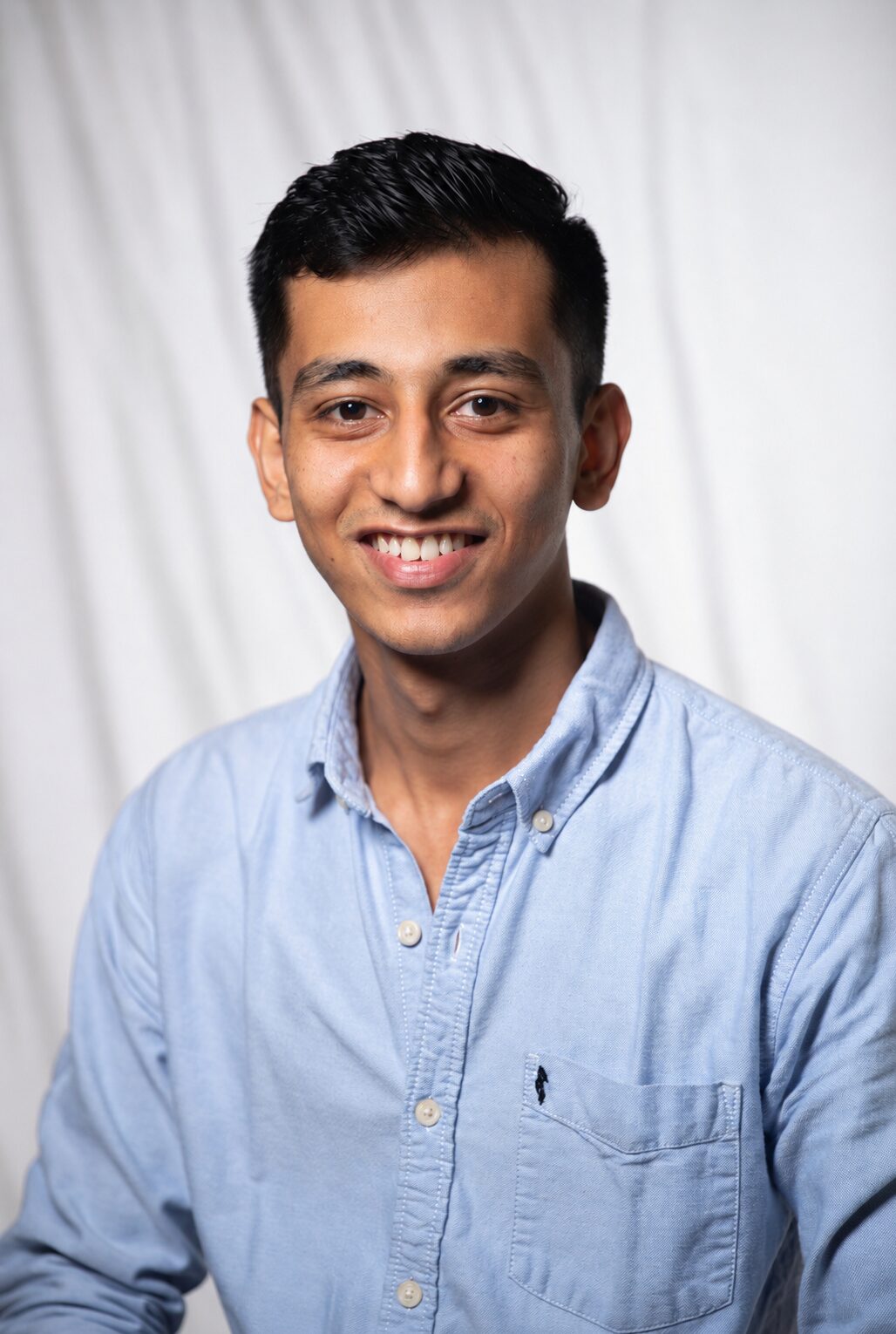
Salman Shaikh is the founder and editor-in-chief of AiCap.in, an independent AI and personal finance publication based in Ahmedabad, India.
Since launching AiCap.in in April 2026, Salman has personally tested and reviewed 100+ AI tools across income generation, crypto research, content creation, and personal finance — publishing 91+ hands-on guides based on real usage, not press releases.
His approach is simple: every tool he writes about is one he has opened, tested, and either used to earn money or rejected after finding it didn’t deliver. He started AiCap.in after realising most AI content in India was either written by people who had never touched the tools, or buried in technical jargon that everyday people couldn’t act on.
His work covers AI tools for passive income, freelancing with AI, crypto research workflows, Amazon FBA with AI, and personal finance strategies built for readers in India and accessible to anyone globally looking to earn smarter with AI.
AiCap.in now reaches a growing community of readers across India and globally who want practical, jargon-free AI strategies they can implement today.
Connect with Salman: LinkedIn · X @AiCap88 · YouTube · Medium





[…] 3 of Your Smart AI Email Marketing Funnel 2026: Set Up Your Email […]
[…] Is Micro‑SaaS With AI and Why Does It Work in […]
[…] freelance clients with ChatGPT in 2026 using exact outreach prompts — Upwork templates, cold emails, and LinkedIn DMs that […]
[…] find a service that actually pays well. If you have been searching for a real, no-fluff answer on high-paying AI Fiverr gigs 2026 — this is […]
[…] by the hour. Charge by the package. Here is why: a blog post that takes you 45 minutes with AI assistance is still worth $75–$150 to the client — because it can drive search traffic for three […]
[…] earnings data: In tested results, AI print-on-demand earned ₹31,000 (approximately $370) over 6 months with only 10 hours of setup time plus 2 hours […]
[…] Print-on-demand (POD) — selling t-shirts, mugs, phone cases through Redbubble, Printful, Merch by Amazon — has become a popular AI-powered income stream. Here, the two platforms reveal distinct strengths. […]