Ahmedabad, Gujarat, India
Ahmedabad, Gujarat, India
Get freelance clients with ChatGPT in 2026: exact Upwork, cold email & LinkedIn scripts that boost reply rates from 1-3% to 20-30%. Copy & paste ready.
Disclaimer: This content is for educational and informational purposes only. Earnings and results vary by individual. Always conduct your own due diligence.
“This guide covers the complete system — positioning, research, outreach strategy, cold email, LinkedIn, and follow-up sequences. If you’re looking specifically for the copy-paste AI prompt templates to generate proposals in 60 seconds, we have a dedicated guide on AI prompts for freelance proposals that goes deeper on the prompt layer alone.”
Here is a question I get asked constantly.
How do you actually get freelance clients using ChatGPT without sounding like a robot?
Most freelancers who try to get freelance clients with ChatGPT start the same way. They open ChatGPT, type “write a cold email for a freelance writer,” copy the result, and paste it into an Upwork proposal or LinkedIn message. Then they wonder why nobody replies.
That approach fails for one simple reason: clients have seen that exact email before.
In 2026, ChatGPT’s new internet browser can research, plan, and execute tasks inside your workflow without copy-pasting between tabs. The freelancers winning right now aren’t using ChatGPT to replace their thinking. They’re using it to think better and faster.
Used right, ChatGPT freelancing workflows can sharpen your positioning, speed up your outreach, and help you win clients you might have otherwise lost. But you need the exact scripts and the strategy behind them.
If you’ve been searching for a real, no-fluff answer on how to get freelance clients with ChatGPT in 2026 — this is it.
This guide breaks down exactly how to get freelance clients with ChatGPT using verified scripts that have been tested on platforms like Upwork and LinkedIn. You’ll get the exact templates, the research workflow, and the follow-up sequences that actually produce replies.
By the end, you’ll have a complete outreach system you can implement today — not generic advice, but specific scripts you can copy and personalize.

The freelance marketplace has changed dramatically. Upwork reported its fourth consecutive quarter of declining gross services volume in March 2026. Estimates suggest 35–45% of tasks commonly sold on gig platforms can now be automated or heavily AI-assisted.
But here’s what the headlines miss. While low-value work has collapsed, higher-value contracts (those over $1,000) rose across disciplines. Freelancers who use AI-enabled skills reportedly earn around 40% more than those who don’t.
The problem isn’t that freelancing is dying. The problem is that most freelancers haven’t adapted how they pitch.
A survey of 1,000+ AI agency owners in 2026 revealed that Upwork remains the most popular client acquisition method for beginners. Cold email ranks second for highest ROI. But generic, templated proposals convert at only 1–3%. Personalized proposals jump to 5–8%.
The freelancers who win in 2026 are not writing longer proposals. They are writing clearer ones that reduce client risk in the first 20 seconds. Most proposals still read like mini resumes. Clients skim first, decide fast, and ignore aggressively.
Now here is the part most guides skip entirely — and it is the most important.
To get freelance clients with ChatGPT effectively, you need to understand that ChatGPT is not a shortcut. It’s an amplifier. If your positioning is vague, ChatGPT will generate beautifully written vague nonsense. If you have a clear value proposition, ChatGPT will help you articulate it ten different ways until one lands.
The freelance marketplace has changed dramatically. Upwork reported its fourth consecutive quarter of declining gross services volume in March 2026. Estimates suggest 35–45% of tasks commonly sold on gig platforms can now be automated or heavily AI-assisted.
But here’s what the headlines miss. While low-value work has collapsed, higher-value contracts (those over $1,000) rose across disciplines. Freelancers who use AI-enabled skills reportedly earn around 40% more than those who don’t.
The problem isn’t that freelancing is dying. The problem is that most freelancers haven’t adapted how they pitch.
A survey of 1,000+ AI agency owners in 2026 revealed that Upwork remains the most popular client acquisition method for beginners. Cold email ranks second for highest ROI. But generic, templated proposals convert at only 1–3%. Personalized proposals jump to 5–8%.
The freelancers who win in 2026 are not writing longer proposals. They are writing clearer ones that reduce client risk in the first 20 seconds. Most proposals still read like mini resumes. Clients skim first, decide fast, and ignore aggressively.
Now here is the part most guides skip entirely — and it is the most important.
To get freelance clients with ChatGPT effectively, you need to understand that ChatGPT is not a shortcut. It’s an amplifier. If your positioning is vague, ChatGPT will generate beautifully written vague nonsense. If you have a clear value proposition, ChatGPT will help you articulate it ten different ways until one lands.
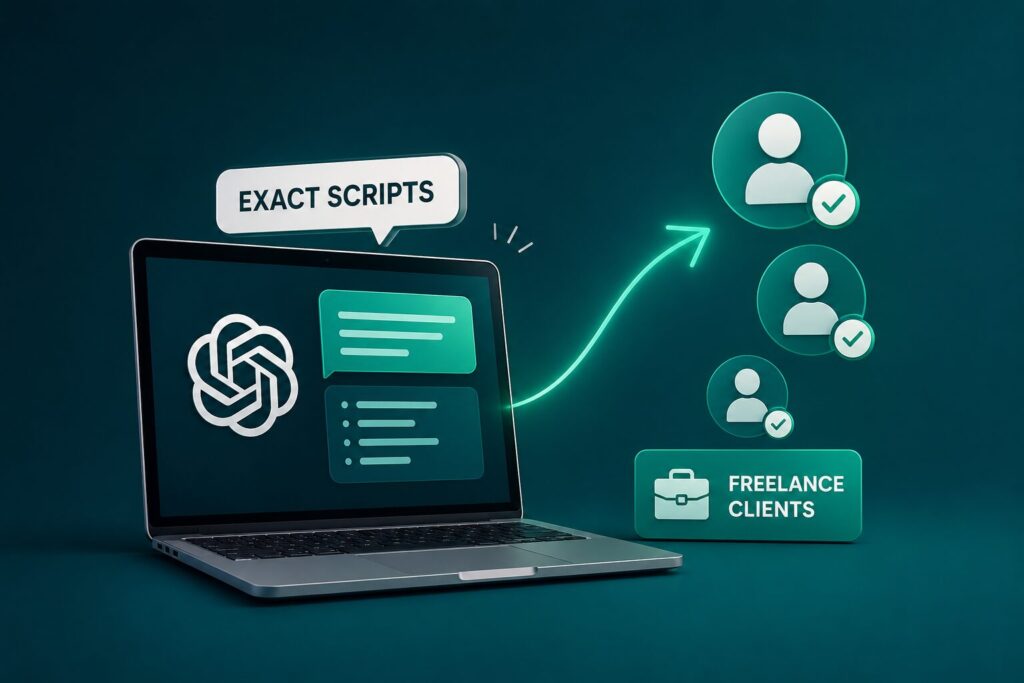
Every script below has been tested and refined through actual freelance outreach. These are not hypothetical templates. Each one follows the same principle: start with the client’s problem, not your biography.
Before you write a single outreach message, get your positioning right. Run this prompt:
Prompt:
“I’m a freelance [your skill, e.g., graphic designer / content writer / social media manager] with [number] years of experience. My best clients have been [describe them — industry, size, specific need]. Help me write a 2-sentence positioning statement that makes me stand out from generalist freelancers. Focus on the specific problem I solve, not the tools I use.”
Run this prompt 3–4 times with slight variations in how you describe your best clients. Mix and match the strongest phrases from each output. You’ll walk away with positioning that actually differentiates you.
Before reaching out, use ChatGPT to understand the prospect’s business context. Paste a company’s website or LinkedIn profile into ChatGPT and use:
Prompt:
“I’m planning to reach out to [Company Name] about [specific service]. Based on what you can see from their public presence, what are 3 specific problems they might be facing that my service could solve? Be direct and specific — no fluff.”
This turns generic outreach into targeted problem-solving. Clients respond when they feel seen.
When you find a job post on Upwork or a similar platform, paste the entire description into ChatGPT with:
Prompt:
“Based on this job post, write a personalized freelance proposal that: (1) opens with their specific problem, (2) briefly explains why I’m the right fit with one relevant example, (3) includes a short proposed approach (2-3 sentences only), (4) ends with a low-pressure CTA for a 15-minute call. Tone: confident, not desperate. Keep the entire proposal under 250 words.”
Edit the output to add your real experience and voice. This takes 10 minutes instead of an hour, and the quality is often better because you’re starting from a structured draft.
Generic proposals on Upwork have a reply rate of 1–3%. Personalized proposals jump to 5–8%. The top performers using this framework report 20–30% reply rates.
The winning structure follows client-first architecture:
Here’s an exact Upwork proposal template you can adapt:
Subject/First Line: “Your [specific problem from job post] — here’s how I’d approach it.”
Body:
“I see you’re dealing with [specific challenge mentioned in their post]. The main risk I’d focus on first is [specific risk]. I recently solved a similar problem for [similar client type] where we [specific outcome].
Here’s my proposed first step: [one clear deliverable] delivered within [timeframe]. No long-term commitment upfront.
I have availability for a 15-minute call this week to walk through how I’d approach your specific situation. Tuesday or Thursday afternoon work best for me — want to grab one of those slots?”
The freelancers who win are not writing longer proposals. They are writing clearer ones that reduce client risk in the first 20 seconds.
Keep reading — the most practical section is coming up next.
Cold email has the highest ROI of all client acquisition methods according to the 2026 agency survey. Setup requires initial effort, but once your campaigns are running, it’s highly scalable. Benchmark positive response rates are 2–3%.
Cold emails fail when they’re about you. They work when they’re about the prospect. Give ChatGPT context about the person or company you’re reaching out to.
Cold Email Script Template:
Subject: Quick thought about [specific aspect of their business]
Body:
Hi [Name],
[Relevant observation about their business — something specific you noticed on their website, LinkedIn, or recent post]
I help [type of business] with [specific problem]. Most [their industry] struggle with [specific pain point], but the fix is usually [simple insight].
One quick example: [1-sentence case study with outcome].
If this resonates, open to a 5-minute chat next week? No pitch, just exploring if there’s a fit.
Best,
[Name]
[Link to portfolio or LinkedIn]
This format respects the reader’s time and demonstrates that you did your homework. The “5-minute chat” framing lowers resistance because it doesn’t feel like a sales call.
For higher-ticket AI consulting projects, the winning proposals almost never pitch the full project upfront. They pitch a paid discovery: a 2–3 week diagnostic engagement to assess the current state and deliver a roadmap. This lowers the risk barrier for new clients and positions you as an advisor, not an order-taker.
LinkedIn now has more than 1.2 billion members globally. Most freelancers use it wrong. They send connection requests with no message, then immediately pitch.
The professionals earning $1,000 or more per month from side work have modest but engaged networks and a clear message. They share insights drawn from their industry, short breakdowns of mistakes they repeatedly see, and occasional case studies.
Here’s a LinkedIn outreach sequence that works.
Connection Request Message:
“Hi [Name], noticed you’re [specific observation about their work]. I help [target client type] with [specific problem]. Thought it might be worth connecting.”
Follow-up Message (after they accept):
“Thanks for connecting. Quick question — what’s your biggest challenge right now with [their relevant area]? I’ve been seeing [trend or pattern] across [industry] and curious about your take.”
This isn’t a pitch. It’s a conversation starter. Most people will ignore it. Some will reply. A few will become clients. The ones who reply are warm leads worth pursuing.
The freelancer Kompass 2026 report confirmed that referrals are increasingly the dominant channel for freelance work (more on this in the data section below).
The most overlooked step in freelance client acquisition is research. Most freelancers skip it entirely. They see a job post, fire off a generic proposal, and move to the next one.
Here’s a 5-minute research workflow using ChatGPT that changes everything.
Step 1: Copy the company name or job description.
Step 2: Paste into ChatGPT with this prompt:
Prompt:
“Based on this [job post / company description], list:
– The 3 biggest risks the client is likely worried about
– What success would look like from their perspective
– One specific question I should answer in my proposal that would immediately demonstrate credibility”
Step 3: Use those insights to write your first two sentences.
This takes less time than writing a generic proposal. And the difference in reply rates is dramatic.
As the data later in this guide shows, matching AI tools to project type can significantly boost income. The hybrid approach — ideate with ChatGPT, develop with Claude — landed a $2,400/month retainer client.
The freelance marketplace is not shrinking — it’s transforming. Here is what the latest numbers reveal about where the opportunities actually are.
The global freelance platforms market reached $8.9 billion in 2026, growing from $7.65 billion in 2025, with 2031 projections showing $21.97 billion at a 16.32% compound annual growth rate. Upwork reported Q1 2026 gross services volume of $987.1 million, essentially flat year-over-year, with revenue of $195.5 million. But here is the critical detail: GSV from AI-related work increased more than 40% year-over-year in Q1 2026, with AI Integration & Automation — the largest AI-related sub-category — growing more than 50%.
What this means: the total pie is stable, but the composition is shifting dramatically toward AI-enabled services. Freelancers who adapt are capturing a growing share of high-value work.
84% of freelancers now use AI-powered tools regularly, up from just 41% in 2023. Daily AI usage among freelancers has nearly tripled in two years. This is not a trend — it is a baseline. The freelancers winning in 2026 are not the ones “using AI.” They are the ones using AI strategically to get freelance clients with ChatGPT and similar tools.
A 2026 survey of over 1,000 AI agency owners revealed a clear hierarchy of client acquisition methods:
But here is the shift that matters most: 56% of freelancers now acquire work through professional and personal networks, up from just 30% in 2024. Referrals now drive 78% of freelance projects. The takeaway: ChatGPT is not just for writing proposals. It is for researching the right people, crafting personalized connection messages, and staying top-of-mind with your network.
The highest-paying freelance services in 2026 are growing fastest in AI and machine learning, with rates ranging from $50–$200 per hour and projected growth of approximately 20%. A freelance AI developer in the US earns between $50 and $300 per hour in 2026, with the US median sitting at $100 per hour for a mid-level machine learning engineer on Upwork.
The demand is not uniform. On Fiverr, demand for Claude Code specialists has surged 938% over the last six months. Demand for AI-related services is growing fastest in Video & Animation (+278%), outpacing Programming & Tech (+94%), Digital Marketing (+62%), and Data (+3%). This tells you exactly where to position yourself.
In 2026, ChatGPT’s new internet browser — ChatGPT Atlas — can research, plan, and execute tasks inside your workflow without copy-pasting between tabs. Available on macOS, with Windows, iOS, and Android coming soon, Atlas brings ChatGPT to every site you visit, offers in-line help, remembers important context, and even completes multi-step tasks using agent mode.
For freelancers, this changes the client acquisition game entirely. Instead of manually researching prospects across tabs, you can delegate the entire workflow: research the company, analyze their website, identify pain points, and draft a personalized proposal — all within the browser.
A 30-day controlled experiment comparing ChatGPT and Claude for client projects revealed that matching the right AI to the right project type increased income by 3x. ChatGPT excelled at high-volume content production, quick-turnaround projects, and brainstorming. Claude dominated in long-form strategic content and premium services.
The hybrid approach — ideate with ChatGPT, develop with Claude — landed a $2,400/month retainer client. If you are serious about getting freelance clients with ChatGPT in 2026, this is the workflow to adopt.
The freelance market in 2026 is not dying. It is bifurcating. Low-value, easily automated work is collapsing. High-value, AI-enabled work is growing. The freelancers who understand this shift and adapt their client acquisition strategy accordingly are the ones who will thrive.
Use these numbers to inform your outreach. When you get freelance clients with ChatGPT, lead with data: “I help businesses navigate the 40% year-over-year growth in AI-related work” or “I’ve studied how 84% of freelancers are adapting to AI — let me show you how to stay ahead.”
The opportunity is clear. The data is on your side. Now execute.
The best way is to use it for research and personalization, not mass generation. Paste job descriptions into ChatGPT to identify client pain points, then write custom proposals that address those specific problems. Run your positioning through ChatGPT to sharpen your value proposition. Use it to draft follow-ups and discovery call questions. Never copy-paste raw AI output without personalizing it with your actual experience.
Start with positioning first. Run the prompt: “I’m a freelance [your skill]. Help me write a 2-sentence positioning statement that makes me stand out from generalist freelancers.” Then apply to 10–20 jobs on Upwork within the first hour of posting, using a personalized hook for each. Generic proposals convert at 1–3%; personalized proposals jump to 5–8%. Your first client will likely come from a smaller project to build reviews, then you scale pricing.
Realistic earnings vary widely. Beginners on platforms like Upwork or Fiverr typically earn $50–$300 per month initially. Skilled freelancers using AI effectively can reach $1,000+ per month. Upwork’s Future Workforce Index 2025 reported skilled knowledge freelancers earned a median of $85,000 annually — comparable to or better than full-time roles. Freelancers who use AI-enabled skills reportedly earn around 40% more than those who don’t.
Upwork remains the most popular and accessible platform for beginners, with 30% proposal-to-reply rates possible for quality applications. Cold email offers the highest ROI but requires more setup. LinkedIn is best for building long-term authority and referrals. For AI consulting specifically, higher-value contracts ($1,000+) have increased on Upwork even as overall volume declined.
Yes, but with one critical caveat. 74% of independents now use AI tools sometimes or regularly. Freelancers who don’t adapt are at a clear disadvantage. The freelancers who win with ChatGPT are not the ones using it to generate spam. They’re the ones using it to research clients faster, write clearer positioning, and send personalized proposals at scale. If you learn to use ChatGPT as a research and refinement tool — not a replacement for thinking — you will outcompete freelancers who don’t.
Three things you can apply today:
The difference between freelancers who struggle and those who build sustainable income is rarely technical skill. It’s how they communicate. It’s how they make clients feel safe, seen, and confident.
You have the exact scripts now. You have the framework. The only thing standing between you and your next client is sending the first message.
All figures are sourced from publicly available reports, benchmarks, and industry data from 2026.
Leave a comment below — which script are you trying first, and what’s your freelance niche?
P.S. — We publish one practical AI income guide every week at AICAP.in. Subscribe below — no spam, no fluff, just strategies that actually work.

Salman Shaikh is the founder and editor-in-chief of AiCap.in, an independent AI and personal finance publication based in Ahmedabad, India.
Since launching AiCap.in in April 2026, Salman has personally tested and reviewed 100+ AI tools across income generation, crypto research, content creation, and personal finance — publishing 91+ hands-on guides based on real usage, not press releases.
His approach is simple: every tool he writes about is one he has opened, tested, and either used to earn money or rejected after finding it didn’t deliver. He started AiCap.in after realising most AI content in India was either written by people who had never touched the tools, or buried in technical jargon that everyday people couldn’t act on.
His work covers AI tools for passive income, freelancing with AI, crypto research workflows, Amazon FBA with AI, and personal finance strategies built for readers in India and accessible to anyone globally looking to earn smarter with AI.
AiCap.in now reaches a growing community of readers across India and globally who want practical, jargon-free AI strategies they can implement today.
Connect with Salman: LinkedIn · X @AiCap88 · YouTube · Medium





[…] LinkedIn outreach strategy, and the 5-minute client research workflow, read our full guide on getting freelance clients with ChatGPT first. This post picks up where that one leaves off — at the prompt […]