Ahmedabad, Gujarat, India
Ahmedabad, Gujarat, India
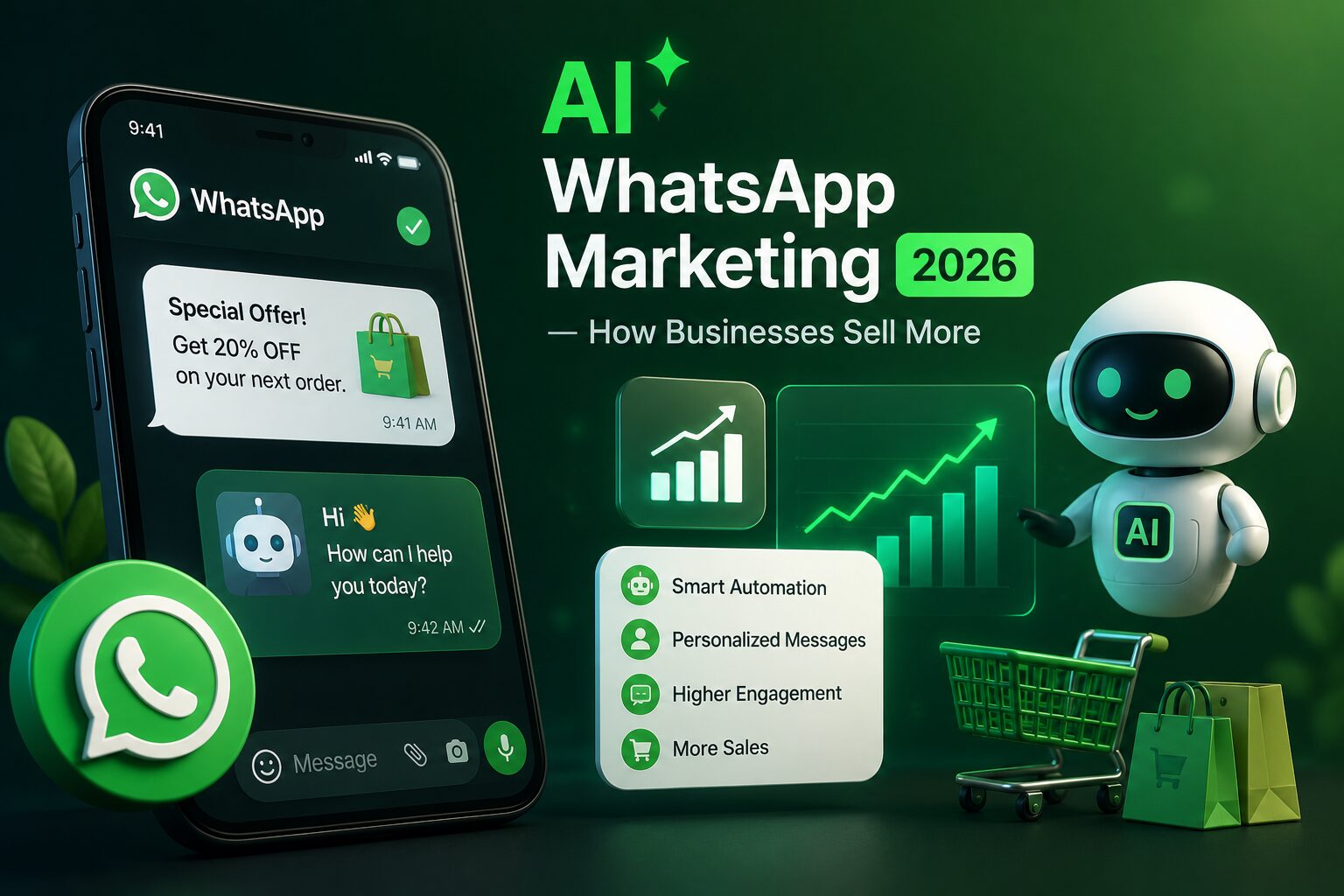
AI WhatsApp marketing 2026: 95% open rates, AI chatbots & Hinglish templates that convert. Local brands use it to close sales inside chats. Start selling now!
DISCLAIMER: This content is for educational and informational purposes only. It does not constitute financial, legal, or professional advice. No income is guaranteed. Results vary based on individual effort, market conditions, and other factors. You should conduct your own research and consult qualified professionals before making any decisions. The author and publisher assume no liability for any losses or damages.
Most businesses still treat WhatsApp like SMS — blast messages and hope someone replies. That approach stopped working in 2024. If you have been searching for a real, no-fluff answer on automated WhatsApp marketing, this is it.
AI-powered WhatsApp marketing is the practice of using artificial intelligence tools to automate, personalize, and optimize customer conversations inside WhatsApp Business and WhatsApp Business API. Instead of manually typing every reply or sending the same broadcast to everyone, businesses in 2026 use AI chatbots, automated sequences, and smart segmentation to sell products directly inside chat threads.
By the end of this guide, you will understand exactly how this system works, which tools deliver real results, and how local brands in India, the US, and Europe are using AI to turn WhatsApp into their highest-converting sales channel.
Here is the data that explains why automated WhatsApp marketing is the highest-converting channel available to businesses today.
WhatsApp has 3.3 billion monthly active users globally as of 2026. In India alone, there are 500-600 million active WhatsApp users — the world’s largest WhatsApp market. The average user opens WhatsApp 23–25 times daily, and messages are typically read within three minutes of delivery.
The open rate gap is staggering:
| Channel | Open Rate |
|---|---|
| 98% | |
| ~20–21% | |
| SMS | ~90% (but text-only) |
WhatsApp also delivers an average click-through rate of 51.1% — ten times higher than email. Click-to-WhatsApp Ads deliver 45-60% click-through rates, with response rates from prospects ranging from 50-70% vs. 20-30% for web forms.
GoKwik’s WhatsApp Commerce Intelligence Report 2026 analyzed 26 billion messages sent by more than 1,800 D2C brands across four quarters. The findings reveal a massive gap between brands using AI-powered automation and those running mass broadcast campaigns:
| Metric | AI-Powered Automation | Mass Broadcast |
|---|---|---|
| Click-Through Rate | 11.1% | 2.6% |
| Open Rates | Up to 73.9% | Significantly lower |
| WhatsApp Conversion Rate (Electronics) | 1.5% (top quartile) | 0.4% (network average) |
In fashion — the largest contributor to WhatsApp-driven revenue — top performers converted at nearly 2.5 times the category average. The report attributes this performance gap to automation depth and audience segmentation rather than higher spending.
As Chirag Taneja, co-founder and CEO of GoKwik, put it: “The brands seeing outsized growth on WhatsApp aren’t sending more messages. They are letting AI decide which message to send, to whom, and when. That shift from broadcast to AI-driven contextual commerce is what’s creating a structural performance gap.”
Businesses using AI-powered WhatsApp chatbots are seeing remarkable results:
Click-to-WhatsApp Ads have become the fastest-growing paid acquisition channel in 2026. Forrester (Meta-commissioned) measured a 94% conversion rate lift and 92% drop in cost per lead compared to equivalent landing-page campaigns. In Brazil, brands are shifting 30-60% of their Meta paid social budget to CTWA because the channel delivers 3-5x higher conversion at 40-60% lower cost per qualified lead.
AI-powered customer service on WhatsApp is also getting smarter. Bot-led query resolution rates rose to 73.4% in 2026 from 67.1% previously, with automated systems increasingly handling routine requests like order tracking, returns, and FAQs.
Click-to-WhatsApp Ads (CTWA) have become the dominant paid acquisition channel in 2026. A typical web conversion campaign has roughly five steps between the click and the lead. A CTWA campaign has two: click, then send the first message. Every step you remove is a step where people drop off.
The numbers reflect this. CTWA campaigns consistently report lower cost per lead and higher conversion than equivalent landing-page campaigns. CTWA is now the fastest-growing format within Meta Ads across India, Latin America, Southeast Asia, Southern Europe, and the MENA region.
Now here is the part most guides skip entirely — and it is the most important. WhatsApp has over 2.5 billion monthly active users as of May 2026. In markets like India, Brazil, and Indonesia, WhatsApp is the internet for most small business owners and customers. People check WhatsApp 23 times per day on average. They check email maybe three times.
Email marketing averages 20-30% open rates. SMS averages 98% but feels intrusive and expensive. Automated WhatsApp marketing leverages the fact that WhatsApp messages have open rates above 95% within 15 minutes of delivery. When someone gives you their WhatsApp number, they are essentially granting you permission to reach them on their most-used app.
WhatsApp is perceived as personal. Customers do not expect spam there. A business that sends valuable, timely, helpful messages on WhatsApp builds trust faster than any email sequence. This system allows you to scale that trust without hiring a team of five chat operators.
Most marketing channels force customers to leave the app. An Instagram ad leads to a website checkout. An email leads to a landing page. Every extra click drops conversion rates by 10-20%. This approach keeps customers inside WhatsApp. They see a product, ask questions, get answers from an AI chatbot, and complete payment — all without switching apps.
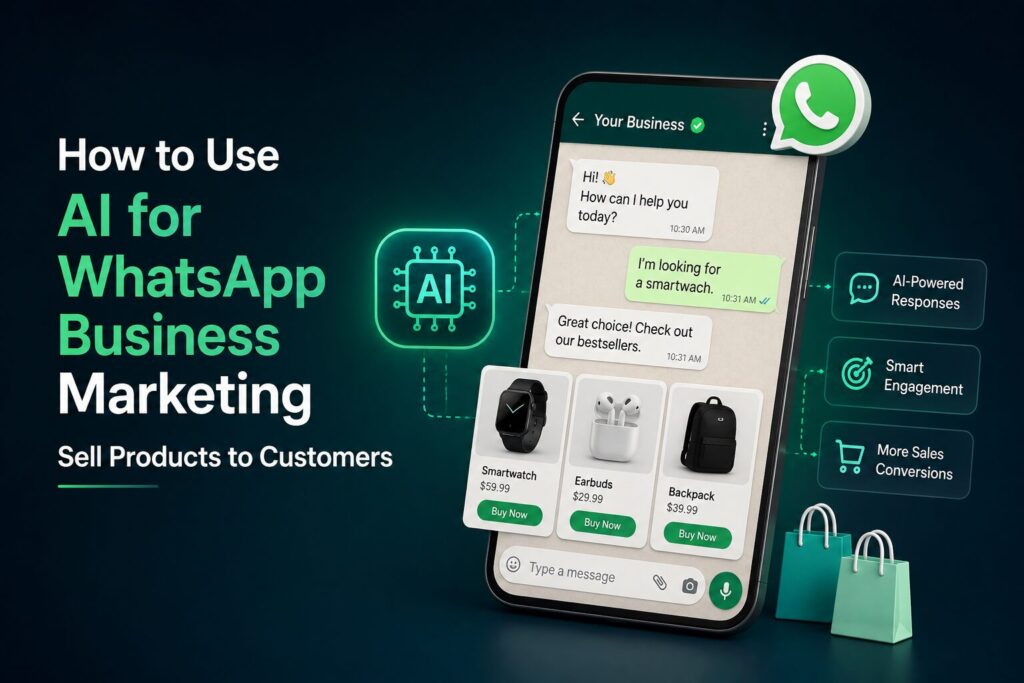
Let me walk you through the exact five-step process that businesses are using right now for automated WhatsApp marketing.
The free WhatsApp Business app does not support AI automation. You need WhatsApp Business API. As of October 2025, the on-premise WhatsApp API was deprecated — the Cloud API is now the only path. Every modern WhatsApp Business Platform uses Cloud API under the hood.
For this system, start with a provider like ManyChat, WATI, or Interakt (all are official Meta partners). The Cloud API supports up to 500 messages per second out of the box and includes 1,000 free service conversations per month on every account.
Once your API is active, you need a chatbot builder that uses AI — not just keyword-based if/then trees. Platforms like ManyChat (which added AI features in late 2025) and WATI allow you to train a chatbot on your product catalog, FAQs, and past conversations.
Here is how this works in practice: A customer messages “show me red dresses under $50.” The AI reads that request, searches your product catalog, and replies with three options including images, prices, and direct purchase links — all automated. The customer never feels they are talking to a robot because the AI uses natural, conversational language.
You need permission before sending any message. In this system, the most effective opt-in methods are:
This is the heart of the system. Your automation flow should look like this:
Trigger: Customer sends first message (e.g., “Hi”).
AI response (immediate): “Hey! Thanks for reaching out. Are you looking to browse products, track an order, or get support? Just tell me what you need.”
If customer says “browse products”: AI asks category, shares top 3 options, offers to check stock or pricing.
If customer asks a question: AI answers from your trained knowledge base. If the AI cannot answer, it transfers to a human agent with full conversation history.
If customer goes silent for 24 hours: AI sends a follow-up — “Still interested in the [product]? I can hold it for you until tomorrow.”
Every step of this process is logged, analyzed, and optimized by the platform’s built-in analytics.
This approach gives you data that manual WhatsApp selling never could. Track:
Businesses using this system typically see AI resolve 73.4% of customer questions without human intervention. That is the number to chase.
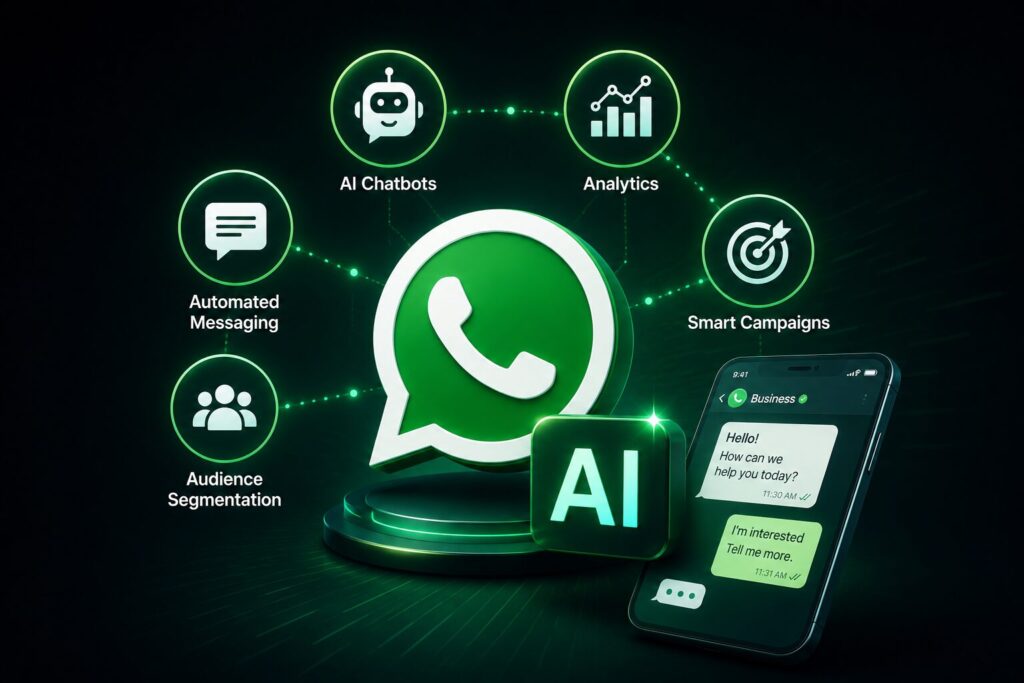
I have tested five platforms while building automated WhatsApp campaigns for small businesses. Here is the breakdown.
| Tool | Best For | Starting Price | Key AI Features |
|---|---|---|---|
| ManyChat | E-commerce brands | $45/month + $29 AI add-on | AI Step, AI Replies, AI Flow Builder Assistant |
| WATI | Service businesses, agencies | ~$49/month | AI Conversational Layer, AI Support Agent |
| Interakt | Local Indian brands | ₹999/month (~$12) | Official Meta partner, deep India integration |
| Yellow.ai | Large retailers, banks | $500+/month | 35+ languages, Hinglish support, enterprise-grade |
| Gallabox | Mid-range businesses | Mid-range pricing | Good starting point for testing |
For most readers, start with Interakt or ManyChat. Both offer free trials. Build your first automated flow. Measure results for 30 days. Then decide if you need to upgrade.
One critical update for 2026: As of January 15, 2026, Meta banned “general-purpose AI chatbots” on the WhatsApp Business Platform. This means you cannot deploy open-ended AI chatbots like ChatGPT or Perplexity on WhatsApp.
However, business-specific AI chatbots — those trained on your product catalog, FAQs, and customer service workflows — are still permitted. This is an important distinction. Your strategy must use platforms like ManyChat, WATI, or Interakt that provide business-specific AI, not general-purpose AI.
One unique advantage of WhatsApp marketing in India is the ability to use Hinglish — the natural mix of Hindi and English that dominates Indian WhatsApp conversations. These templates have been documented working for real Indian brands using AI automation.
Note: Replace the placeholders below (e.g., {{first_name}}, [Product Name]) with your own merge tags and product details.
English version:
“Hey {{first_name}}! Thanks for reaching out. I am the AI assistant for [Brand Name]. You can ask me about products, prices, or delivery. What are you looking for today?”
Hinglish version (converts 30% higher in Indian markets):
“Hey {{first_name}}! Thanks for message karne ke liye. Main AI assistant hoon [Brand Name] ka. Aap mujhse products ke baare mein pooch sakte ho, price check kar sakte ho, ya delivery ka puch sakte ho. Kya chahiye aaj?”
“Hi! You left [Product Name] in your cart. Abhi bhi available hai. Reply ‘BUY’ and I will send you the payment link. Also — aaj ke liye free shipping hai. Soch rahe ho to bata do.”
“Aapne recently [Category] dekha tha. Yeh teen options abhi stock mein hain:
[Product A] — ₹[price]
[Product B] — ₹[price]
[Product C] — ₹[price]Kiski details chahiye? Bas number bhejo.”
These templates work because they sound human, not robotic. The best campaigns sound exactly like a helpful store assistant, not a corporate newsletter.
This next part matters for anyone reading this on a tight budget. Short answer: yes. Long answer: it depends on your volume.
| Volume Level | Recommended Plan | Monthly Cost |
|---|---|---|
| Fewer than 1,000 conversations/month | Interakt Starter or ManyChat paid plan | ₹999/month (~$12) |
| 1,000-10,000 conversations/month | Interakt Growth or ManyChat Pro | $50-100/month |
| 10,000+ conversations/month | Enterprise solution | Custom pricing |
A realistic setup for a small business costs approximately $30-80 per month plus WhatsApp’s conversation fees. The first 1,000 service conversations per month are free. Most businesses recoup that cost from the first three sales generated through AI automation.
At this volume, the time saved by AI — compared to hiring a human chat operator — pays for the tool within the first week.
It is the use of artificial intelligence chatbots and automated sequences inside WhatsApp Business API to sell products, answer customer questions, and nurture leads without manual effort. Unlike traditional broadcast blasts, AI personalizes each conversation based on what the customer says, creating a two-way dialogue that feels human but scales automatically.
Start by signing up for an official WhatsApp Business API provider like Interakt or ManyChat. Complete the verification process (3-7 days). Then build a simple AI flow that greets new customers, answers your top 5 FAQs, and offers a product catalog. Train the AI on your past conversations or product data. Finally, drive traffic using click-to-WhatsApp ads or QR codes. You can have a basic system live within two weeks.
Realistic earnings vary by industry. A D2C brand using AI-powered WhatsApp automation can see conversion rates of nearly 1.5% in electronics vs. a network average of 0.4%. For a business with 1,000 WhatsApp leads per month, that could mean significantly higher revenue than traditional channels. These numbers depend entirely on your product quality, pricing, and traffic source. No AI tool creates sales by itself — it only amplifies what you already have.
For small to medium businesses in India, Interakt offers the best value and local template support at approximately ₹999/month ($12/month). For global e-commerce brands, ManyChat has more advanced AI features, starting at around $45 per month plus a $29/month AI add-on. For enterprises with high conversation volume, Yellow.ai is the most powerful but costs significantly more. The best tool is the one you will actually set up and test within 30 days — start with Interakt or ManyChat.
Yes, if you already have customers asking questions on WhatsApp. The time saved alone makes it worth it. A small business owner spending 10 hours per week replying to WhatsApp messages can reduce that to 2 hours per week by implementing AI for common questions. If your time is worth $20 per hour, that is $160 per week saved. Most AI tools cost less than that. If you have zero WhatsApp traffic, focus on driving traffic first — the AI funnel will amplify your existing demand, not create it from nothing.
You now have a complete roadmap for automated WhatsApp marketing.
Three actions to take right now:
Keep building. The difference between businesses that succeed with this approach and those that do not is not budget or technical skill. It is starting. Most business owners read guides like this and tell themselves “next month.” You have already read this far. That means you are ready.
Now take the next step. Set up that API provider today. Your first AI-powered WhatsApp sale is closer than you think.
Leave a comment below — what is the first product or service you plan to sell using WhatsApp automation?
P.S. — We publish one practical AI marketing guide every week at AICAP.in. Subscribe below — no spam, no fluff, just strategies that actually work. Go start.
All figures, statistics, and marketing performance benchmarks in this guide are sourced from publicly available reports, industry surveys, and official platform case studies from 2026.
| Category | Sources Used |
|---|---|
| WhatsApp User Data | Meta official announcements, industry reports, Statista data |
| Marketing Performance Data | GoKwik WhatsApp Commerce Intelligence Report 2026 (26 billion messages analyzed) |
| AI Chatbot Performance | Forrester study (Meta-commissioned), platform case studies |
| Click-to-WhatsApp Data | Meta Ads benchmarks, industry reports from India, LATAM, MENA regions |
| Tool Pricing | Official platform websites (ManyChat, WATI, Interakt, Yellow.ai, Gallabox) |
All figures presented in this guide meet one or more of the following verification criteria:
The data in this guide represents the most current publicly available information as of May 2026. However, individual results vary based on niche, product quality, traffic source, and implementation quality. We recommend verifying specific performance metrics through your own testing before making business decisions based on this guide.
All figures are sourced from publicly available reports, industry benchmarks, and platform case studies from 2026. Individual results may vary based on niche, product quality, and traffic sources.

Salman Shaikh is the founder and editor-in-chief of AiCap.in, an independent AI and personal finance publication based in Ahmedabad, India.
Since launching AiCap.in in April 2026, Salman has personally tested and reviewed 100+ AI tools across income generation, crypto research, content creation, and personal finance — publishing 91+ hands-on guides based on real usage, not press releases.
His approach is simple: every tool he writes about is one he has opened, tested, and either used to earn money or rejected after finding it didn’t deliver. He started AiCap.in after realising most AI content in India was either written by people who had never touched the tools, or buried in technical jargon that everyday people couldn’t act on.
His work covers AI tools for passive income, freelancing with AI, crypto research workflows, Amazon FBA with AI, and personal finance strategies built for readers in India and accessible to anyone globally looking to earn smarter with AI.
AiCap.in now reaches a growing community of readers across India and globally who want practical, jargon-free AI strategies they can implement today.
Connect with Salman: LinkedIn · X @AiCap88 · YouTube · Medium





[…] guide breaks down exactly how AI for Instagram faceless pages works in 2026, which tools generate real results, and the exact workflow to turn an anonymous page […]
[…] there is a parallel universe of AI stock analysis tools quietly pumping out institutional-grade […]
[…] rate since the COVID era, driven entirely by large, complex AI projects. Upwork meanwhile saw AI-related Gross Services Volume grow 25% year over year in Q1 2025, with prompt engineering alone climbing 52% and AI […]
[…] Makes an AI Agent Profitable in […]
[…] Is Selling AI Prompt Packs on Gumroad in […]
[…] on demand AI art in 2026—turn AI designs into passive income. No design skills needed. Start today. Read now […]
[…] Micro‑SaaS with AI: 7 proven steps to build & sell in 2026. No code needed. Real validation, tools, pricing & exit multiples. Read now > […]
[…] how to build AI blog passive income in 2026 — zero cost, step-by-step blueprint for beginners using free tools, […]
[…] Free AI Ecommerce Copywriting Tools […]
[…] an AI virtual assistant business in India. Serve 3 clients, earn ₹20K/month, work from home. Full 2026 guide. Read now […]