Ahmedabad, Gujarat, India
Ahmedabad, Gujarat, India


Micro-SaaS with AI: 7 proven steps to build & sell in 2026. No code needed. Real validation, tools, pricing & exit multiples inside.

Disclaimer: This content is for educational and informational purposes only. Earnings and results vary by individual. Always conduct your own due diligence before purchasing or building any software product.
Let me ask you something directly.
Have you ever had an idea for a software product—a tool that would solve a specific problem you face daily—but convinced yourself it was impossible because you don’t know how to code?
I’ve been there too. That frustration is real.
You see other people launching products, generating recurring revenue, and building real businesses. Meanwhile, you’re stuck on the sidelines thinking, “If only I could code.”
Here is the good news: that barrier no longer exists.
In 2026, building a software business without writing traditional code is not just possible—it is rapidly becoming the new normal. The tools have evolved so dramatically that anyone with a clear problem to solve can now build functional, revenue‑generating products.
That is exactly what this guide is about.
Micro‑SaaS with AI is the intersection of three powerful trends: the explosion of no‑code and low‑code tools, the accessibility of AI‑assisted development, and the growing demand for specialized software solutions. You build small, focused products that solve one specific problem for one specific niche—and you do it without a team, without funding, and without years of programming experience.
Let me be upfront with you. Most micro‑SaaS products fail. Not because the market isn’t there, but because most builders skip validation, overcomplicate their first product, or quit before they find traction.
This guide exists to help you avoid those mistakes. You will learn what actually works, what doesn’t, and exactly how to go from idea to revenue in 2026.
By the end, you will have a clear, actionable framework—ready to apply today. No fluff. No fabricated success stories. Just real, proven strategies that are working right now.
Let’s begin.
Let me break this down simply.
Micro‑SaaS with AI means building small, focused software products that solve one specific problem for one specific group of people. You use AI‑assisted development tools and no‑code platforms instead of traditional programming. Then, once you have traction, you can sell the product for anywhere from a few thousand dollars to low six figures.
Think of it like this: instead of building a massive all‑in‑one platform (which would take years and a team of engineers), you build a single solution that does one thing really well.
A tool that helps freelancers generate client proposals in minutes. A dashboard that helps small businesses track their social media ROI. A plugin that helps e‑commerce stores optimize product descriptions.
You get the idea.
The beauty of this model is that the tools have democratized software development. You no longer need to be a programmer to build a product. You just need to be a problem solver.
Here is what I want you to take away from this introduction:
The opportunity is real. The tools are accessible. The model is proven.
The only missing piece is you.
Let’s dive in.
Here is exactly what you will learn in the sections ahead:
No fluff. No fake success stories. Just actionable strategies that are working right now in 2026.
Now, I know what you’re thinking: “This sounds great, but does it actually work?”
Let me share what the data really says.
The global SaaS market reached $375 billion in 2026. The micro‑SaaS segment alone is projected to expand from $15.7 billion in 2024 to $59.6 billion by 2030—that’s roughly 30% annual growth.
BigIdeasDB tracks over 2,400 micro‑SaaS startups with verified revenue. Here’s what they found:
Now, I need to be honest with you. The reality check is important:
But here’s what matters: the average profit margin is 45% and the top quartile hits 80%+ margins.
Consider this: Photo AI, built by solo founder Pieter Levels, reached $132,000 MRR with an 87% profit margin.
The difference between the struggling majority and the profitable few isn’t luck. It’s methodology.
Let me paint you a picture of why now is the perfect time to start.
The global AI market is expected to reach $1.8 trillion by 2030, growing at 37.3% annually. The AI SaaS market is projected to hit $432 billion by 2030 with a 32.4% CAGR. No‑code AI platforms are expanding at 38.2% through 2029.
Investor interest is surging. In 2025 alone, AI startups raised over $100 billion in venture funding—representing 20% of all venture capital invested globally.
Here’s where it gets exciting.
What took 3 months to build in 2023 now takes 2 weeks. Tools like Cursor, Replit Agent, and v0 have reduced development time by 70% or more.
No‑code AI platforms like Softr, Lovable, and Taskade Genesis now allow non‑technical founders to create production‑ready applications in under 48 hours.
SaaS companies average around 21.5% net profit margins. But micro‑SaaS with AI consistently outperforms. The top quartile reaches 80%+ margins due to minimal overhead and automated workflows.
Here’s something interesting: AI‑native companies now command higher multiples than traditional software businesses. Acquire.com reports that AI‑powered micro‑SaaS products sell for 1.2–1.5x higher multiples than non‑AI equivalents.
Micro‑SaaS exits in 2026 range from 3x to 10x ARR, with top deals reaching 10–15x and bottom deals at 1.5–3x. Bootstrapped SaaS companies sell for around 4.8x ARR on average.
The key drivers of valuation are: revenue growth (5–10% month‑over‑month commands 40–48x monthly net profit), profit margin, churn rate (below 3% monthly is ideal), customer concentration, and automation level.
In 2026, AI coding assistants have dropped the technical barrier so low that non‑programmers can build functional web applications. Here’s what actually works:
| Tool | Best For |
|---|---|
| Cursor | Complex, multi‑file projects |
| Replit Agent | Absolute beginners building from plain English |
| v0 by Vercel | Front‑end heavy tools |
| Lovable | Complete app generation from descriptions |
Here’s a pro tip: Non‑technical founders often start with Replit to build the first version, then export to GitHub and move to Cursor when they need more control.
| Platform | Best For | Pricing |
|---|---|---|
| Bubble | Complex web applications | Starts at $69/month |
| Softr | Airtable/Google Sheet apps | Free tier available |
| Glide | Simple mobile‑friendly apps | Free tier available |
| WeWeb + Supabase | Custom backend with visual frontend | Variable |
My recommendation: use no‑code to validate and get your first paying customers. Then, if you reach 50–100 paying customers, evaluate whether to stay or migrate to custom code.
You don’t need to master every tool. Pick one that matches your skill level and idea complexity, then become an expert at it.atches your skill level and idea complexity, then become an expert at it.
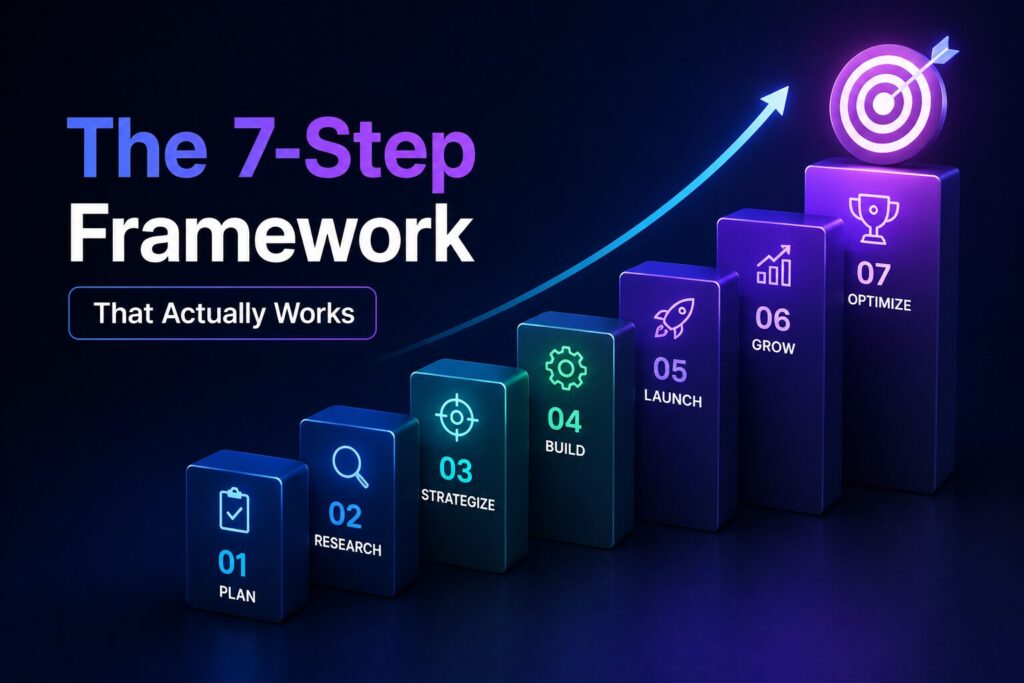
I’ve seen too many people get stuck in analysis paralysis. Here’s the step‑by‑step system that works.
This is the most important step. The biggest mistake is building something nobody wants.
Start by identifying problems people are actively complaining about. Look for:
Validation framework:
The most expensive code is code nobody uses. Validate before writing a single line:
Using AI tools, build the smallest possible version:
Remember: ugly but working is the goal.
Common mistakes to avoid:
Launch as soon as you have a working product. Here’s where to focus:
Real example: David’s 7‑Day SaaS hit $130 MRR in week 3 and received a $3,500 acquisition offer in week 4.
Here’s where most people sabotage themselves. Low prices signal low value. High prices signal high value.
| Tier | Price | Features |
|---|---|---|
| Free | $0 | Basic features, 14‑day trial |
| Standard | $19–$49/month | Core features, single user |
| Team | $49–$99/month | Team access, advanced features |
| Enterprise | $199–$499+/month | Custom models, dedicated support |
My pricing principles:
Your first version will be imperfect. That’s fine. Here’s how to improve:
Key metric: Net Revenue Retention (NRR) above 110% signals product‑market fit.
Once you have consistent revenue, decide your path:
| Path | When | Outcome |
|---|---|---|
| Grow | Product‑market fit confirmed, 3+ months of growth | Scale to $5K–$50K MRR |
| Exit | Consistent revenue, unsolicited buyer interest | Sell at 3–4x annual profit |
Best exit platforms in 2026:
I want to be completely honest with you about what to expect. No fabricated success stories.
| Metric | Benchmark |
|---|---|
| Time to build MVP with AI tools | 2–4 weeks |
| Time to first revenue | 2–4 months |
| Median time to $1M ARR | 2 years 9 months |
| First dollar | Average 3 months |
| $1K MRR | Average 6 months |
| $10K MRR | Average 12 months |
| $100K MRR | Average 24 months |
As noted earlier, 70% of micro‑SaaS products make under $1,000 per month. The top 1–2% exceed $50,000 MRR.
Here’s a real case study of a dunning email tool:
And an API documentation tool:
Micro‑SaaS with AI is a get‑skilled‑slowly system, not a get‑rich‑quick scheme. But the market is real, the tools are accessible, and the model is proven.
Let me share some actual results:
| Product | Result | Timeline |
|---|---|---|
| David’s 7‑Day SaaS | $130 MRR + $3,500 acquisition offer | 4 weeks |
| Fathom AI | $300K ARR, 90%+ gross margins | 12 weeks |
| Emergent | $100M annual run‑rate, 2.5M+ users | 8 months |
| Proshort | Enterprise‑wide deployment with global SaaS leader | 2026 |
I’ve watched too many people make these same mistakes. Don’t be one of them:
2026’s biggest change is Agentic AI—agents that “reason” through multi‑step tasks instead of just responding to prompts.
Instead of building a tool users operate, you can build agents that act autonomously:
The agentic market is still early—builders who master it in 2026 will capture significant share before it saturates. Agentic AI is expected to generate $50 billion in revenue by 2027, with platforms growing at 47% CAGR.
Micro‑SaaS with AI means building small software products that solve one specific problem for one niche, using AI‑assisted development tools and no‑code platforms. You build faster, launch cheaper, and sell for anywhere from a few thousand to low six figures. No team, no funding, no traditional coding required.
Pick a specific niche you understand. Validate the problem by finding 20+ real people complaining about it online. Build the smallest possible version using Cursor, Replit, or Bubble. Launch with a landing page and collect waitlist signups. Price at $19–$49 per month. Iterate based on user feedback. The entire process takes 2–4 weeks with AI tools.
Most first‑time builders earn $100–$1,000 per month by month six. Products that reach $3,000–$10,000 monthly typically take 12–18 months of consistent iteration. Top sellers with multiple products earn $5,000–$50,000+ monthly. As noted earlier, 70% of micro‑SaaS products make under $1,000 per month. The top 1–2% exceed $50,000 MRR.
Cursor is best for complex, multi‑file projects. Replit Agent is best for absolute beginners who want to build an entire app from a text prompt. v0 by Vercel is best for front‑end and design‑heavy products. Bubble is best if you want a purely visual, no‑code experience.
Yes, with honest expectations. The market is growing at 30% annually. AI tools have reduced build time by 70%+. Your first product might only make $100‑$500 in month three. But each product teaches you validation, marketing, and customer development. The skills compound across every product you build. The only way to fail is to never start.
Micro‑SaaS products typically sell for 2–4 times annual profit. Private SaaS multiples in 2026 range between 3x and 10x ARR. Bootstrapped SaaS companies sell for around 4.8x ARR. AI‑powered products command 1.2–1.5x higher multiples than non‑AI equivalents.
Here’s what I want you to take away from this:
You now understand what micro‑SaaS with AI actually requires. You have the validation framework, the tool stack, the pricing strategy, the valuation data, and the honest benchmarks.
The gap between reading and earning is action. Not perfect action—just consistent, daily action.
All figures are sourced from publicly available reports, benchmarks, and industry surveys from 2026.
Which micro‑SaaS niche are you exploring first with AI? Drop a comment below—I read every response.
P.S. – We publish one practical AI income guide every week at AICAP.in. Subscribe below. No spam, no fluff, just strategies that actually work.

Salman Shaikh is the founder and editor-in-chief of AiCap.in, an independent AI and personal finance publication based in Ahmedabad, India.
Since launching AiCap.in in April 2026, Salman has personally tested and reviewed 100+ AI tools across income generation, crypto research, content creation, and personal finance — publishing 91+ hands-on guides based on real usage, not press releases.
His approach is simple: every tool he writes about is one he has opened, tested, and either used to earn money or rejected after finding it didn’t deliver. He started AiCap.in after realising most AI content in India was either written by people who had never touched the tools, or buried in technical jargon that everyday people couldn’t act on.
His work covers AI tools for passive income, freelancing with AI, crypto research workflows, Amazon FBA with AI, and personal finance strategies built for readers in India and accessible to anyone globally looking to earn smarter with AI.
AiCap.in now reaches a growing community of readers across India and globally who want practical, jargon-free AI strategies they can implement today.
Connect with Salman: LinkedIn · X @AiCap88 · YouTube · Medium





[…] Gemini 3.1 Ultra money-making workflows ranked by profit vs. effort. Turn Google’s 2M token AI into real income starting today. No coding required. read now > […]