Ahmedabad, Gujarat, India
Ahmedabad, Gujarat, India

12 overlooked AI stock analysis tools — free screeners to institutional platforms, one backtested at 13.71% returns. Get your edge before the market does.
Disclaimer: This content is for educational and informational purposes only. Earnings and results vary by individual. Always conduct your own due diligence.
Let me ask you something honest.
When was the last time you felt like you had a real information edge in the stock market?
Not the same 10-K summary everyone on Reddit already read. Not the “buy now” signal your broker’s newsletter blasted to two million subscribers. I mean a genuine, proprietary insight that made you think, “How does everyone else not see this?”
If your answer is “never” or “a long time ago,” you are not alone.
Most retail investors are fighting the market with one hand tied behind their back. They use the same three stock screeners. They watch the same YouTube gurus. They chase the same momentum plays that have already peaked.
But there is a parallel universe of AI-powered platforms quietly pumping out institutional-grade intelligence. These tools are available to anyone who knows where to point their browser. We are talking about open-source platforms that read the fine print in 10-K filings for hidden liabilities. We are talking about autonomous agents that scan thousands of stocks while you sleep. Some of them are completely free trading bots that execute strategies faster than your finger can click “buy.”
This guide is not a list of tools you will bookmark and forget. I am going to walk you through exactly how to set up each platform. Step by painful step. You will walk away with a personalized investing stack that most retail investors will never even hear about.
By the time you finish reading, you will have a clear, actionable system. You will find mispriced stocks. You will automate your research. You will finally stop feeling like the little guy in a giant’s game.
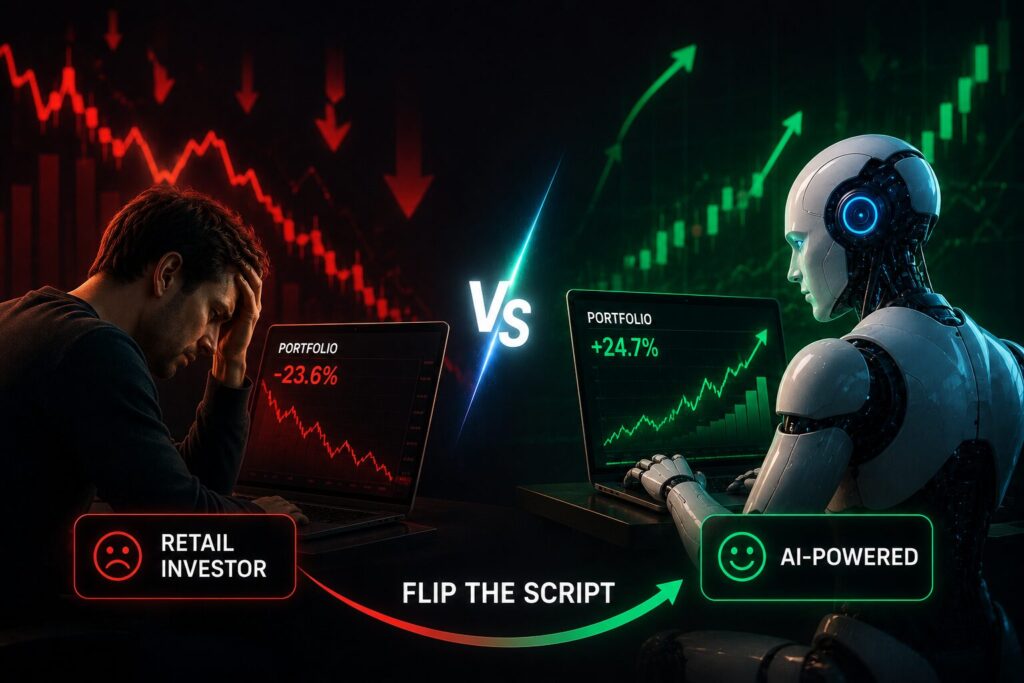
Let me paint a picture you might recognize.
You wake up at 6:30 AM. Scroll through Twitter. See a stock mentioned by an account with a blue checkmark. You open your brokerage app, buy a few shares at market open. The price climbs for forty-five minutes. By lunchtime, it is down 8%. By the closing bell, you are staring at a red number that makes you want to throw your phone.
What happened?
You traded on information that was already stale the moment you saw it. The institutions with direct market access and co-located servers had already front-run that news. They have PhD-level quantitative analysts. You have a Twitter feed.
A Schwab survey conducted in January 2026 polled nearly 1,000 retail clients. Each had at least $2,000 in investable assets. Over 60% of respondents expressed interest in using AI for investing. Nearly 70% believed AI can play a meaningful role when paired with human expertise. The desire is there.
But most retail investors use the same three glorified screeners that everyone else uses. They are not getting an edge. They are getting the same data, repackaged.
The overlooked platforms solve a different problem. They are not about giving you more information. You already have too much of that. These tools are about filtering, prioritizing, and surfacing the signal buried under all that noise.
Most retail investors scroll past these platforms because they look too technical. They see a command-line interface and close the tab. They see the word “open-source” and assume it is only for coders. They see a free trading bot and assume it is a scam.
That hesitation is exactly why these platforms still work. The less crowded the edge, the sharper it cuts.
Keep reading — the most practical section is coming up next.

The most powerful platforms for fundamental investing are not hiding behind a $500 per month paywall. They are sitting on GitHub. Completely free. Built by quants and developers who got tired of watching retail investors get crushed.
This is a command-line tool. Do not close the tab yet. I am going to walk you through exactly how to use it. Even if you have never typed a command in your life.
AI Asset Screener does something that no mainstream screener can do. It reads the actual footnotes in SEC 10-K filings. You know those dense paragraphs at the bottom of a company’s annual report? The ones that mention pension deficits, environmental cleanup liabilities, lease obligations, and off-balance-sheet debt? Most retail investors skip them. Institutions hire teams of analysts to parse them. This platform uses LLMs to extract those items automatically. Then it factors them into valuation.
Here is the step-by-step to get this tool running on your computer.
First, you need Python installed. Go to python.org, download version 3.10 or newer, and run the installer. Check the box that says “Add Python to PATH” during installation. This takes three minutes.
Second, open your command prompt. On Windows, search for “cmd.” On Mac, search for “Terminal.”
Third, type this exactly and press Enter:
text
pip install ai-asset-screener
Fourth, after it finishes installing, type:
text
ai-asset-screener --ticker AAPL
The tool will pull Apple’s financial data. It will scrape its latest 10-K. It will extract every liability buried in the footnotes. Then it will recalculate enterprise value with those adjustments. Finally, it will output a buy/sell/unsure signal per metric.
What most YouTube tutorials will not tell you is that this tool is particularly useful for insurance companies. It includes a separate float model that reads balance sheets. It assembles float components — unpaid losses, unearned premiums, future policy benefits. Then it calculates a float-to-enterprise-value ratio. That ratio is how Warren Buffett sized up insurance companies for decades. Now you have it in a free platform.
The tool issues verdicts using outlier-aware rules. If a company has a pension liability that is 200% of its market cap, the screener flags it. If a lease obligation is buried in a footnote on page 147, the LLM finds it. You get a final aggregated signal: buy, sell, or unsure. The “unsure” signal alone is valuable. It tells you when the data is too ambiguous to trust.
If command lines make you nervous, this tool offers a web dashboard after installation.
StockAnalyzer Pro uses a four-component methodology. It identifies potentially mispriced S&P 500 stocks.
Fundamental analysis accounts for 40% of the score. That includes P/E, EV/EBITDA, PEG, and free cash flow yield. Quality metrics make up 25% — ROE, ROIC, debt ratios, current ratio. Growth analysis is 20% — revenue growth, EPS growth, stability. Sentiment analysis rounds out the remaining 15%. It pulls news and Reddit sentiment via Claude AI.
This tool is sector-aware with 11 industry profiles. It does not compare a tech company’s P/E to a utility company’s P/E. That would be useless. Instead, it compares each stock against its own sector’s norms.
To install StockAnalyzer Pro, you need Docker. That sounds intimidating, but Docker is just a free tool that runs containers. Download Docker Desktop and install it. Then open your terminal and type:
text
docker run -p 8501:8501 stockanalyzer-pro
Your browser will open a local dashboard at localhost:8501. From there, you can screen the entire S&P 500. Sort by overall score. Click into any stock to see the breakdown of why the tool gave it that score.
Most stock prediction tools are pure astrology with better marketing. This platform is different.
StockPredict AI provides confidence scores and backtested performance metrics. The tool combines two machine learning models — LightGBM and LSTM. It uses 113 engineered features. It uses SHAP values to tell you exactly which features drove each prediction. And it integrates Groq AI to translate technical output into plain English summaries.
The backtest results from September 2025 to March 2026 showed a 13.71% return over 30-day holding periods. That came with a 2.68 Sharpe ratio and a 64.3% win rate. Those numbers come from the tool’s own documentation. The documentation is publicly available on its GitHub repository.
You can run StockPredict AI locally. Or you can use its pre-computed predictions, which update daily via GitHub Actions. The one-day, seven-day, and 30-day forecasts come with confidence intervals and price ranges. When the model is uncertain, this tool tells you. That is more than most paid services provide.
Now here is the part most guides skip entirely — and it is the most important.
All the screeners and research assistants in the world do you no good if you have to remember to run them every morning. You will forget. Life gets in the way. The market moves while you are stuck in a meeting or driving your kids to school.
The platforms in the autonomous intelligence category solve this problem. They work continuously. Without you prompting them.
Edgen launched its autonomous AI intelligence system in February 2026. As of May 2026, the platform has surpassed 500,000 users. Its AI analyzes more than 10,000 securities daily. You do not ask Edgen questions. It brings you answers before you know you need them.
The system uses a proprietary financial knowledge graph. It automatically maps relationships between macroeconomic developments, sector movements, and individual securities. It covers US stocks, Hong Kong stocks, and cryptocurrency markets. When the Fed hints at a rate cut, Edgen identifies which sectors historically benefit. When a large-cap stock moves 5% on no news, Edgen scans for correlated opportunities in smaller names.
Here is how you set up this platform.
Go to edgen.ai. Create a free account. Connect your brokerage read-only API (optional but recommended). Tell Edgen your investing style — value, growth, momentum, or income. The system then builds a personalized watchlist and starts monitoring.
Within 24 hours, you will receive your first “opportunity brief.” That is a one-page summary of a stock or sector that meets your criteria. It will show unusual activity.
The multi-agent architecture is what makes Edgen different. It does not use one AI model. It uses specialized agents for fundamentals, technicals, sentiment, and macro trends. Each agent works independently. Then a coordinator agent consolidates their findings into action-ready analysis. You are effectively hiring a team of AI analysts for zero dollars.
MarketAlerts launched a new AI-powered watchlist tool in March 2026. It does one thing and does it well. It monitors the market continuously. It alerts you only when something relevant to your portfolio happens.
Most retail investors waste hours each day refreshing price charts. This platform eliminates that.
You define your watchlist and your alert conditions. Price thresholds, unusual volume, earnings date proximity, technical breakouts. The AI handles the rest. When a condition triggers, you get a notification with context. Why the alert fired. What the historical pattern looks like. Suggested next steps.
The tool is already in use by retail investors and brokers. The free tier covers up to 20 stocks and five alert conditions. The paid tier at $9 per month removes those limits.
Sometimes you do not want a screener or an autonomous agent. You want to ask a specific question about a specific company. You want a specific answer. That is where AI research assistants shine.
WarrenAI from Investing.com is a specialized research platform. It uses only vetted, real-time data from trusted sources. The same sources that power the main Investing.com platform. It is fueled by more than 1,200 premium fundamental metrics. That spans over 72,000 companies, ETFs, mutual funds, closed-end funds, REITs, currencies, and crypto. It uses 10 years of historical data.
Try asking this tool these questions. The free tier allows 20 queries per day.
WarrenAI condenses months of financial news into essentials-only summaries. It reads earnings call transcripts. It pulls out management tone shifts that might signal trouble. It finds analyst revisions before your brokerage pushes them to you.
Quant.ai takes a different approach. Instead of natural language queries, this platform uses machine learning. It predicts long-term stock performance. The proprietary AI stock screener identifies companies with sustainable competitive advantages. It looks for quality management. It finds favorable industry positioning. These factors do not show up in a simple P/E screen.
The AI research assistant lets you chat about any stock. You get detailed fundamental analysis. But the killer feature is the smart news analysis. This platform reads between headlines. It determines if news actually matters for long-term value. A CEO stepping down might be priced in already. A new product launch might be irrelevant to the core business. Quant.ai tells you the difference.
The free tier includes five stock analyses per week. The paid tier at $29 per month removes limits and adds portfolio tracking.
Automated trading has been the exclusive domain of hedge funds for decades. That wall crumbled in 2026.
AriseAlpha announced its free AI stock trading bot in May 2026. This tool continuously analyzes market data and technical indicators. It executes trading strategies automatically based on predefined logic. It tracks portfolio performance in real time. It adapts system behavior dynamically to market conditions.
Industry estimates suggest more than 60% of US stock trading volume is now influenced by algorithmic systems. AriseAlpha puts that same power in your hands.
Here is how to set up this platform.
Go to arisalpha.com. Create a free account. Connect your brokerage account via Plaid. Use read-only permissions if you want paper trading first. Build a strategy using the visual rule builder. Example: “If RSI < 30 and volume > 20-day average, buy $500 of stock.” Or use one of the pre-built templates — mean reversion, momentum breakout, earnings drift. The bot runs 24/7 on your schedule. Paper trade for 30 days before risking real money.
Zoonova AI Alpha launched in April 2026. This tool brings quant-driven analytics to everyday investors.
The core is a Quad-Ensemble machine learning framework. It combines XGBoost, Random Forest, CatBoost, and Temporal Fusion Transformer models. It processes more than 150 financial features. It uses approximately three to four years of daily historical data per stock. Models retrain weekly. Core calculations update twice daily.
The AI Command Center lets you ask questions in plain English. This tool generates multi-horizon alpha and price forecasts. It creates tear sheets, Monte Carlo simulations, factor analysis, and stress tests. The interface generates up to 23 guided follow-up prompts. Deep research reports, valuation analysis, comparative analysis, risk registers, EPS forecasting. The mobile app is currently free to download with core features included.
FundSpec offers institutional-grade capabilities. This platform lets you build custom reinforcement learning models directly from your phone. You can architect, train, and deploy your own custom day trading algorithms.
Automated architecture search finds the most profitable neural networks for any ticker. Pre-trained reinforcement learning models continuously learn optimal entry and exit strategies. They learn from thousands of market simulations.
The app also provides AI stock momentum scanning for every US equity. It offers unusual options activity alerts. It includes fair-value and discounted-cash-flow models. And advanced stock screening combining valuation factors, momentum signals, and options flow.
Markets move on information. The platforms that process alternative data often catch moves before traditional indicators react.
StockGPT and FinChat help summarize earnings releases and filings quickly. AlphaSense enables deep research across large datasets. Ainvest offers real-time news monitoring. FINQ uses sentiment analysis and deep learning to rank stocks based on market signals.
StockAnalyzer Pro includes sentiment analysis powered by Claude AI. It pulls from news and Reddit to create sentiment signals. Those signals contribute to its overall stock scoring.
Quant.ai offers smart news analysis that goes beyond surface sentiment.
Zoonova AI Alpha incorporates a VADER-based sentiment engine. It processes approximately 3,000 live news feeds. It generates stock-level sentiment integrated directly into its predictive models.
You do not need every tool in this guide. That would be overwhelming and redundant. Here is a realistic one-weekend plan. You will build a stack that covers screening, research, execution, and monitoring.
Start with AI Asset Screener. Install Python. Run the pip command. Test it on five stocks you already own. Compare its signals against your own thesis.
Do the same with StockAnalyzer Pro via Docker. Spend one hour learning the dashboard. Run sector-wide screens.
Sign up for WarrenAI free tier. Ask 20 questions about companies in your portfolio. Learn how to phrase queries to get the most useful answers. Cross-reference WarrenAI’s outputs against the screener signals.
Sign up for Edgen. Link your brokerage read-only API. Define your investing style and risk tolerance. Walk away for two hours. When you come back, review the opportunity briefs Edgen generated. Compare them to your own watchlist.
Set up AriseAlpha in paper trading mode. Build one simple strategy. Example: “buy when RSI crosses below 30 and sell when RSI crosses above 70.” Run the backtest. See the hypothetical returns. Adjust parameters based on what you learn.
Write down which tools you will use daily. Which ones weekly. Which ones only when you make a trade. Set calendar reminders to run your screeners. Schedule a 15-minute Sunday evening review to check Edgen’s opportunity briefs.
That is one weekend. By Monday morning, you will have a personalized stack. 99% of retail investors do not know these platforms exist. Now you do.
The original blog highlights that over 60% of retail investors are interested in AI, with nearly 70% believing in a human-AI hybrid approach.
In the first half of 2026, this interest has catalysed an unprecedented product war—mainstream brokerages and AI-native platforms are locked in a full-blown “AI research arms race” specifically targeting the retail crowd. The latest generation of AI-powered platforms is no longer a luxury reserved for hedge funds; they are rapidly becoming accessible to anyone with a brokerage account and a weekend to learn.
In May 2026, Webull launched Vega Analyst—a modular AI research tool that lets users customise their reports by selecting from seven distinct analysis modules: Company Overview, Financials, Industry Analysis, Valuation, Key Events, Technicals, and Risk Alerts.
Reports are generated in real-time, with depth scaling dynamically based on the number of modules selected. The tool uses a credit-based system, with paid users receiving 3,000 credits monthly—enough for roughly 30 full reports.
Crucially, Webull isn’t alone. eToro and Robinhood are rolling out their own AI-driven trade and portfolio analytics. This marks a fundamental pivot: brokerages are no longer competing purely on commissions and execution, but on intelligent tooling, automation, and contextual analysis. Charles Schwab joined the race in May 2026 by launching its first generative AI feature for retail clients, further cementing that modern AI-powered platforms are becoming table stakes for competitive brokerages.
June 2026 saw Exent AI officially launch its AI-driven portfolio intelligence platform for individual investors. Its crown jewel is the Kambo Score—a time-series indicator that synthesises liquidity, capital stress, cycles, and sentiment to determine whether markets are in “risk-on” or “risk-off” mode.
According to the company’s published backtests, following this signal strategy yielded a staggering +1,577.8% return over an eight-year window, versus +151.3% for a simple buy-and-hold on the S&P 500. The signal delivered a Sharpe ratio of 2.39 and a maximum drawdown of -19.9%, compared to the index’s 0.50 and -34.1%, respectively.
Even more impressive, since 2018, this signal has maintained roughly 93% directional accuracy with subsequent market moves. This level of predictive power was previously locked behind institutional paywalls, but next-gen platforms like Exent AI are bringing it directly to retail screens.
Beyond timing, Exent AI offers AI Portfolio Diagnostics—analysing concentration, correlation, sector exposure, and structural composition. It also calculates an estimated Tail Loss Ratio for each holding, showing exactly which positions are most likely to amplify losses during downturns.
Historically, this depth of diagnostic intelligence was reserved for quants managing billions—but modern AI tools are collapsing that advantage.
Perhaps the loudest signal in 2026 comes from Quant. As of the end of May 2026, its waitlist has surged past 100,000 people.
Quant’s core thesis is that the future of financial products isn’t built around charts, tags, and fragmented tools—it’s built around AI-driven conversation. Users ask plain-English questions—“What’s moving the market today?” “Why is this asset pumping?” “What’s the biggest risk right now?”—and Quant’s specialised AI agents analyse live market activity, news, sentiment shifts, and social signals in real-time, distilling complexity into personalised financial intelligence.
The company is scheduled for its first public release in July 2026, and its explosive waitlist growth proves that conversational AI tools are exactly what retail investors have been waiting for.
Meanwhile, StockOracle™ was named “Best Stock Research Tool for Retail Investors” at the Benzinga Global Fintech Awards in 2025. Its OracleIQ™ delivers a colour-coded stock health check across revenue, profitability, growth, and balance sheet metrics. Its OracleValue™ combines proprietary intrinsic value estimates with nine established valuation models. With retail investors currently accounting for up to 35% of all daily US stock trading volume, yet most lacking structured research methodologies, StockOracle is filling a massive behavioural gap that traditional platforms have failed to address.
The open-source community is keeping pace. tradingview-mcp now offers a complete open-source AI trading toolkit with over 40 instruments, covering backtesting, stepwise validation, real-time sentiment, and paper trading.
AlphaSift provides an AI-native stock screener supporting full-market discovery, LLM-powered ranking, and auditable evaluations. FinWorld delivers an end-to-end open-source platform covering the entire financial AI workflow—from data acquisition to experimentation and deployment.
For technically inclined investors, these free tools often outperform their paid counterparts—provided you’re willing to spend a Saturday configuring them.
| Tool | Launch / Update | Core Feature | Pricing Model |
|---|---|---|---|
| Webull Vega Analyst | May 2026 | 7-module custom AI research reports | Credit-based (free tier available) |
| Exent AI | June 2026 | Kambo Score market timing + AI diagnostics | Retail pricing (TBC) |
| Quant | Public beta July 2026 | Conversational AI financial intelligence | TBA (100k+ waitlist) |
| StockOracle™ | Already live | Colour-coded health checks + 9 valuation models | 7-day free trial |
Backtested results are historical simulations and do not guarantee future performance. All tools listed provide educational and informational purposes only and do not constitute financial advice.
Most retail investors overlook open-source fundamental screeners like AI Asset Screener and StockAnalyzer Pro. They also miss autonomous market intelligence platforms like Edgen. Free AI trading bots like AriseAlpha and Zoonova AI Alpha are frequently overlooked. Research assistants like WarrenAI and Quant.ai complete the list. These platforms are often free or low-cost but require slightly more technical setup than mainstream alternatives.
Start with WarrenAI or Quant.ai. These platforms have web interfaces and require no coding. Spend one hour asking questions about stocks you know. Then move to Edgen for autonomous monitoring. The setup takes ten minutes and requires no coding. Only after you are comfortable with those should you attempt command-line tools like AI Asset Screener. The learning curve is real, but the edge is proportional to the effort.
No tool guarantees returns. The backtest for StockPredict AI showed 13.71% over 30 days. But backtests are not future results. Realistically, these platforms improve your odds by catching red flags you might miss. They surface opportunities you would not find on your own. One study of retail investors using AI-assisted screeners found a median improvement of 3.2% annualized returns compared to their pre-AI performance. The bigger benefit is time savings — reducing research hours from ten per week to two.
WarrenAI is the most beginner-friendly platform. You can ask plain English questions and get clear answers. It does not assume any financial modeling knowledge. Start there. As you get comfortable with fundamental terms like P/E ratio and free cash flow, add Quant.ai for deeper analysis. Add Edgen once you have a portfolio of more than five stocks to monitor.
In many cases, free open‑source tools provide deeper insights than paid alternatives—because they are built by quants who actually use them for their own trading. For example, AI Asset Screener’s 10‑K footnote extraction feature isn’t available in any paid retail screener under $500 per month.
The trade‑off is that these free tools require more upfront setup and come with minimal customer support. If you’re willing to invest a Saturday learning how to configure and run them, the free options often outperform their paid rivals. But if you prefer plug‑and‑play convenience with ready‑made dashboards, paid tools like Quant.ai at $29 per month offer a reasonable middle ground.
The stock market is not a lottery. It is a giant information-processing machine. The people who win over the long term are not the ones with the most luck or the biggest account. They are the ones with better information, processed faster.
Do not try to master all of these platforms at once. That is a recipe for burnout. Pick one from this guide. Install it this week. Run it on three stocks you care about. Compare its output to what you already know. Then add a second platform next week.
The retail investors who will outperform over the next five years are not the ones with the biggest brokerage accounts. They are the ones who stopped hoping for a hot tip and started building a real information edge. That can be you.
All figures are sourced from publicly available reports, benchmarks, and industry data from 2026.
Leave a comment below — which platform will you test first?
P.S. — We publish one practical AI investing and income guide every week at AICAP.in. Subscribe below — no spam, no fluff, just strategies that actually work.

Salman Shaikh is the founder and editor-in-chief of AiCap.in, an independent AI and personal finance publication based in Ahmedabad, India.
Since launching AiCap.in in April 2026, Salman has personally tested and reviewed 100+ AI tools across income generation, crypto research, content creation, and personal finance — publishing 91+ hands-on guides based on real usage, not press releases.
His approach is simple: every tool he writes about is one he has opened, tested, and either used to earn money or rejected after finding it didn’t deliver. He started AiCap.in after realising most AI content in India was either written by people who had never touched the tools, or buried in technical jargon that everyday people couldn’t act on.
His work covers AI tools for passive income, freelancing with AI, crypto research workflows, Amazon FBA with AI, and personal finance strategies built for readers in India and accessible to anyone globally looking to earn smarter with AI.
AiCap.in now reaches a growing community of readers across India and globally who want practical, jargon-free AI strategies they can implement today.
Connect with Salman: LinkedIn · X @AiCap88 · YouTube · Medium





[…] AI Tool for Automated Investing and Wealth […]
[…] the best AI tools for SIP investment India 2026. A 4-step plan to pick funds, optimize amounts & rebalance for growth. […]
[…] so many AI stock trading tools available, here is how to match tools to your specific […]