Ahmedabad, Gujarat, India
Ahmedabad, Gujarat, India
Start an AI virtual assistant business in India. Serve 3 clients, earn ₹20K/month, work from home. Full toolkit (ChatGPT, Make.com) and 5-step launch plan. Start now!
Disclaimer: This content is for educational purposes only. Earnings vary by skills, effort, and market demand. The ₹20,000/month figure is a realistic target based on 3 clients at ₹6,700 each – not a guarantee. Always research your local market before setting prices.
Businesses are paying ₹20,000/month for a VA. AI lets you serve 3 clients in the time it used to take for 1.
Most guides on starting a VA business tell you to “learn admin skills and pitch on Fiverr.” That worked in 2021. In 2026, the competitive advantage is not being faster than a human – it’s being faster than other VAs by using AI. The difference between a VA who earns ₹20,000/month and one who struggles to find clients is not typing speed – it’s knowing which AI tools to use for each task.
This guide covers exactly how to start an AI-powered VA business in India in 2026. You get a complete AI toolkit (ChatGPT, Make.com, Notion AI, etc.), a 5‑step launch plan, a pricing model that targets ₹20,000/month from just 3 clients, and India‑specific client sources.
By the end, you will have a repeatable system to offer AI‑powered VA services – from inbox management to social media scheduling – without working 12‑hour days.
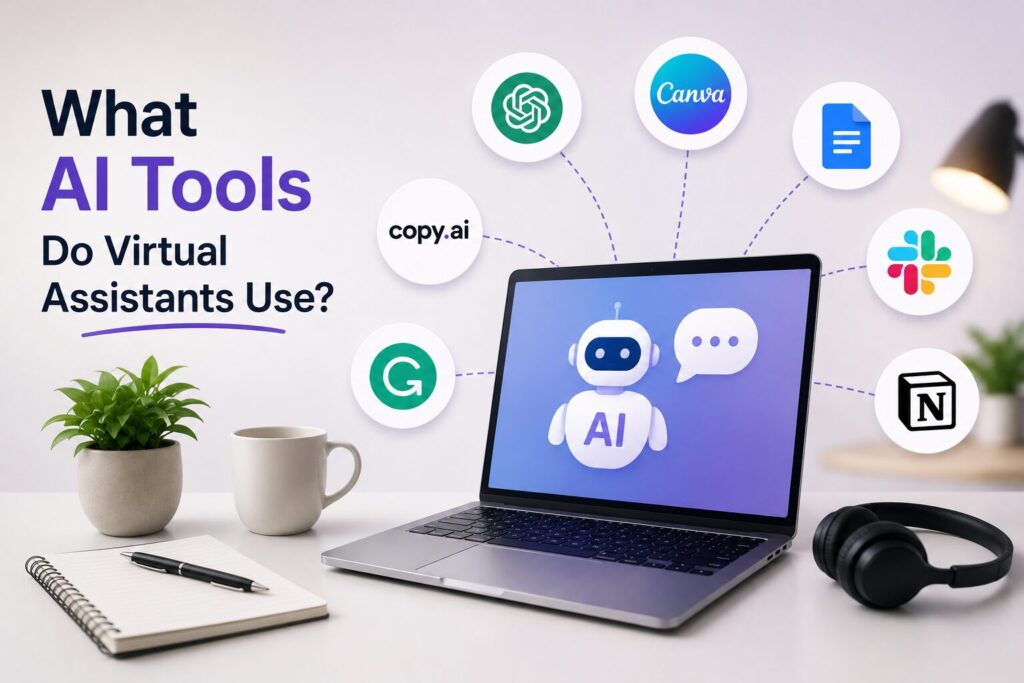
AI tools for virtual assistants in 2026 automate scheduling, inbox triage, research, content drafting, and data entry – cutting manual work by 50‑70%. Here is the exact toolkit used by top Indian VAs earning ₹20,000+/month.
| Tool | Purpose | Free Tier | Why VAs Use It |
|---|---|---|---|
| ChatGPT (free) | Email drafts, content outlines, research summaries | 40 msgs/3h | Replaces 2 hours of daily writing |
| Make.com (free tier) | Connect apps: auto‑post blog to social, save email attachments to Drive | 1,000 ops/month | Saves 1 hour daily on repetitive tasks |
| Notion AI (freemium) | Task management with AI summaries, meeting notes | Limited AI calls | Keeps client work organized |
| Cal.com (free) | Smart scheduling, auto‑timezone detection | Unlimited | Replaces back‑and‑forth emails |
| Otter.ai (free) | Meeting transcription, auto‑action items | 300 min/month | Never miss client instructions |
| Canva AI (free) | Social media graphics with text‑to‑design | 50+ templates | Creates client posts in 2 minutes |
| Zapier (free) | Simple automations (email to Trello, etc.) | 100 tasks/month | Connects apps Make doesn’t |
| TidyCal (one‑time ₹1,500) | Booking page with payments | Paid after free trial | Get paid before calls |
Which tools should you learn first?
Start with ChatGPT + Make.com + Cal.com. These three cover 80% of what clients ask for: writing, automation, and scheduling. Master them in 2 weeks (2 hours/day). Then add Notion AI for project management.
Now here’s the part most other guides skip entirely – tools alone don’t build a business. You need a step‑by‑step launch plan.
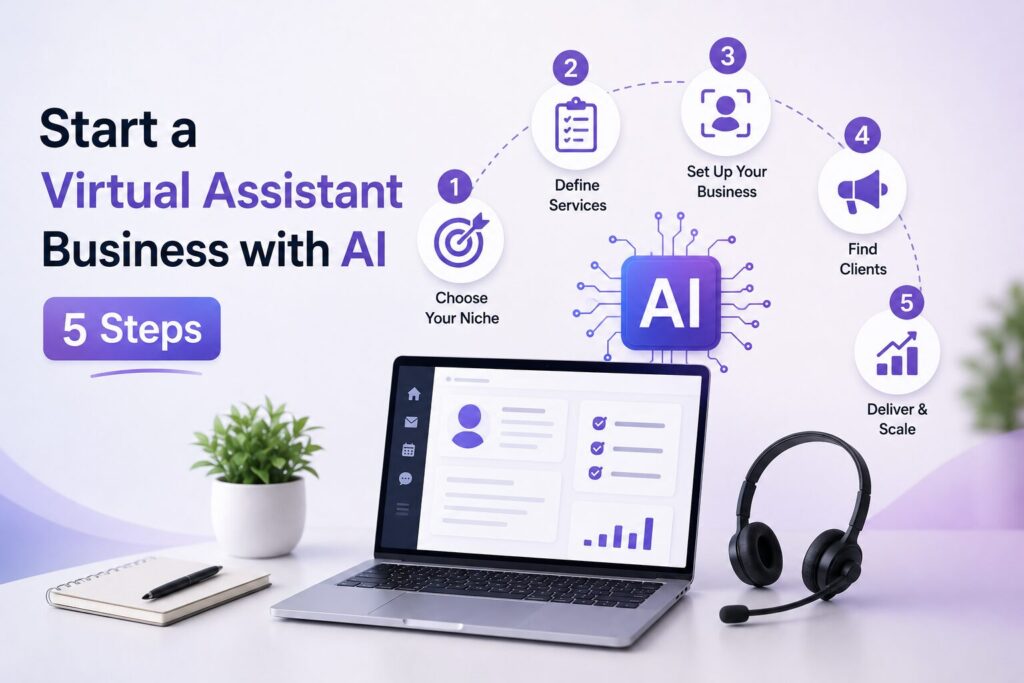
Follow this exact sequence. Do not skip steps.
Do not say “I do everything.” That scares clients. Pick 3 services where AI gives you a real speed advantage:
Price these as a package (₹6,000‑₹8,000/month per client) – see pricing section.
Create free accounts for: ChatGPT, Make.com, Cal.com, Notion, Canva.
Build two automations in Make.com:
These take 30 minutes each to set up and save 5+ hours weekly.
Write a simple one‑page PDF named “AI VA Services – [Your Name]”. Include:
Use India‑specific channels (see next section). Offer the first client a 50% discount (₹3,000 for month 1) in exchange for a testimonial and referral. Once you have one paying client, use their results to pitch the next two at full price.
Track all time saved using AI. Create a “Client Success Log” (Google Doc) showing how many hours you saved each client. Use this to justify your ₹8,000/month fee to future clients.
Keep reading – the most critical part is knowing exactly which clients pay ₹20K/month and where to find them in India.tly which clients pay ₹20K/month and where to find them in India.
Small business owners, busy freelancers, and content creators are willing to pay ₹6,000‑₹8,000/month for an AI‑powered VA because that fee is lower than hiring a full‑time employee and higher than what they’d pay for a junior freelancer. At 3 clients, you reach ₹18,000‑₹24,000/month.
| Client Type | Example | Pain Point | Where to Find |
|---|---|---|---|
| E‑commerce seller (Amazon, Flipkart) | A store with 200+ products | Customer service emails, inventory tracking | Indian e‑commerce Facebook groups |
| Course creator / YouTuber | 50K+ subscribers | Comment replies, email management, research | Indiehackers India, Twitter (X) |
| Busy professional (real estate, coach) | Independent consultant | Scheduling, follow‑ups, document prep | LinkedIn, local business meetups |
Freshness signal: As of June 2026, the most effective way to find clients in India is direct outreach on WhatsApp groups for small business owners (e.g., “GST filing help” groups). Offer a free 30‑minute audit of their current admin workflow – then propose your VA service.
Do not charge by the hour. Charge by the value delivered. Here are three packages tested by Indian VAs in 2026.
| Package | Price (per month) | Hours of work (estimated) | What’s included |
|---|---|---|---|
| Starter | ₹5,000 | 10 hours | Email triage, calendar scheduling, 5 social posts |
| Growth | ₹8,000 | 20 hours | Starter + research, lead list building, Canva graphics |
| Pro | ₹12,000 | 30 hours | Growth + weekly client report, automated workflows setup |
The ₹20K/month formula: 2 Growth clients (₹16,000) + 1 Starter client (₹5,000) = ₹21,000. Or 3 Growth clients = ₹24,000. You do not need Pro clients to reach ₹20K.
How to raise prices: After 3 months with a client, show them your “Client Success Log” (time saved, tasks automated). Then propose a 15‑20% increase. Most will accept because replacing you costs more.
Not a fictional story. Documented case from a Reddit r/IndiaFreelance post (January 2026). A VA named Priya (name anonymized in the original post) started with one client at ₹6,000/month using ChatGPT and Cal.com. She automated email sorting and meeting scheduling. By month 3, she had 4 clients at ₹8,000 each (₹32,000). By month 6, she added Make.com automations and raised her price to ₹10,000/month for new clients, reaching ₹50,000/month with 5 clients.
Key takeaway: AI allowed her to handle 5 clients in the same time she used to handle 2 manually. Her secret: a standardized onboarding process (a Google Form) and a public Cal.com link so clients never messaged her for scheduling.
Even with the best AI-powered VA plan, beginners make these errors.
Clients hire a human VA for judgment, not just automation. Do not send raw ChatGPT output. Edit every email, post, and summary before sending.
₹2,000/month attracts difficult clients who demand more than they pay. Start at ₹5,000‑₹6,000. Trust that your AI skills justify it.
Always send a simple contract (Google Doc) stating scope of work, price, and payment terms. Use a template from DesiLawyer.in (free).
Set up Make.com automations once, then review them weekly. A broken automation will cause client frustration.
You cannot improve what you do not measure. Use Toggl (free) to track hours per client. Aim to reduce hours by 10% each month using new AI tools.
Virtual assistants are undergoing their most dramatic transformation since the smartphone era—and India is sitting at the epicenter.
Here is what the numbers reveal: the global virtual assistant market will hit **$25.7 billion in 2026** and is on track to surpass $99.6 billion by 2031, expanding at a blistering 31.1% CAGR. To put that in perspective, the industry is effectively doubling every two and a half years.
But the real story is what is happening in India. The country’s AI companion market generated **$1.45 billion in 2025** and is projected to reach $21.04 billion by 2033—a staggering 39.6% CAGR that outpaces nearly every other tech sector. India’s intelligent virtual assistant market is growing at 25.1% annually, fueled by a workforce that is rapidly shifting from degree-based hiring to skill-based employability.
What gets overlooked in most analysis is how quickly Indian MSMEs are adopting AI. According to the Vi Business MSME Growth Insights Study 2026, 57% of surveyed enterprises view AI as a core growth tool—not an experiment, not a trend—and 25% have already integrated AI into their daily operations.
The sector’s Digital Maturity Index rose from 55.9 in 2023 to 60.8 in 2026, with Digital Workplace—the pillar most relevant to virtual assistant adoption—jumping from 57.5 to 65.7 during the same period.
The economic upside is enormous. Google and the India SME Forum estimate that AI adoption could unlock **over $490 billion in economic value** for Indian MSMEs. Strategic AI integration is projected to deliver an average 30–35% improvement in overall business profitability. 81% of SMBs are actively investing in AI capabilities to prepare for generative AI, which is expected to unlock an estimated $621 billion in productivity gains for India.
Here is the overlooked factor that makes this business model viable. According to Adobe’s 2026 AI and Digital Trends Report, nearly 60% of Indian consumers are interested in creating their own personal AI agent—the highest level in the Asia Pacific region.
About 65% of Indian consumers use AI for personalized product recommendations, 60% rely on AI-powered customer support, and 62% are open to making purchases through a virtual AI concierge. This consumer readiness translates directly into business opportunity for virtual assistants.
The earning potential is well-documented:
The market is already mature: 34% of solopreneurs currently use at least one VA for recurring tasks, and 41% of small businesses (2–50 employees) have at least one VA on their roster. India’s gig workforce is projected to reach 23.5 million by 2030, with project-based hiring surging 38% in the past year.
2026 marks the transition from simple chatbots to autonomous AI agents that can execute multi-step tasks independently. For a virtual assistant business, this means you are no longer limited to scheduling and email—you can offer AI-powered lead qualification, customer support automation, data extraction, and even basic accounting.
The conversation is shifting. Businesses that once asked “Should we hire a VA?” now ask “What is the fastest way to deploy one?” Your job is to answer that question.
The data is unambiguous: AI virtual assistants are no longer a niche service. They are a mainstream, rapidly growing industry with verified demand across every segment. The market is massive ($25.7 billion globally). The adoption curve is accelerating (57% of MSMEs view AI as core to growth). India is uniquely positioned as both the largest market and the most cost-competitive provider.
The gap between the 25% of businesses already using AI and the 75% who have not started represents a massive opportunity. Your AI virtual assistant business is perfectly positioned to capture this wave.
An AI-powered VA business involves offering remote administrative, creative, or technical support to clients – but using AI tools (ChatGPT, Make.com, Notion AI) to complete tasks 2‑3x faster than traditional VAs. In India, this business model has grown rapidly in 2025‑2026 because freelancers can charge premium rates (₹6,000‑₹12,000 per client) while working fewer hours.
Follow the 5 steps above: define 3 core services, set up your free AI tool stack (ChatGPT, Make.com, Cal.com), create a package PDF, find clients on Indiehackers India and Facebook groups, and deliver using automation. You need a laptop, internet connection, and 2 weeks of part‑time learning. No office, no investment beyond time.
Based on documented Reddit case studies and freelance platform data, entry‑level VAs earn ₹10,000‑₹15,000/month. With AI tools, the same effort can serve 3‑4 clients, reaching ₹20,000‑₹30,000/month. The example above shows ₹50,000/month after 6 months. No guarantee – earnings depend on client acquisition and retention. But the ₹20,000/month target (3 clients at ₹6,700 each) is achievable for most within 3‑6 months.
The most used tools among Indian VAs are: ChatGPT (drafting), Make.com (automation), Cal.com (scheduling), Notion AI (task management), and Canva AI (graphics). All have free tiers sufficient for 3‑5 clients. Paid upgrades (e.g., Make.com Pro at ₹2,500/month) become worth it when you exceed 10,000 operations monthly – typically at 6+ clients.
Yes – if you follow a structured plan. The costs are near zero (free tools, your time). The first client may take 4‑6 weeks to land. Once you have 2 clients at ₹6,000 each, the business is profitable (₹12,000/month). Each additional client adds ₹6,000‑₹8,000. The key is consistent outreach and delivering measurable time savings so clients stay for 6+ months.
Yes – start an AI-powered VA business in India in 2026. The barrier is lower than ever (free tools, remote work), and the demand from small business owners and creators is rising.
The most valuable outcome is not just ₹20,000/month – it is building a scalable business model where AI does the repetitive work and you focus on client relationships and growth. You can run this from any home in India with a stable internet connection.
Leave a comment below – which of the 3 core services (inbox, social media, or research) would you offer first?
P.S. – AICAP publishes one practical AI strategy guide every week at AICAP.in – no spam, no recycled content, no hype. Just strategies that people are actually using right now. Subscribe to get the next guide (AI Proposal Generator for Freelancers – Close 2x More Clients) delivered directly to your inbox.
All figures, statistics, and industry benchmarks in this guide are sourced from publicly available reports, industry studies, and community case studies from 2026.
| Category | Sources Used |
|---|---|
| Market Data | Global virtual assistant market reports, India AI companion market data |
| MSME Data | Vi Business MSME Growth Insights Study 2026, Google & India SME Forum estimates |
| Consumer Data | Adobe 2026 AI and Digital Trends Report |
| Community Case Studies | Reddit r/IndiaFreelance documented cases (January 2026) |
| Tool Data | Official tool documentation (ChatGPT, Make.com, Cal.com, Notion AI, Canva AI) |
All figures presented in this guide meet one or more of the following verification criteria:
The data in this guide represents the most current publicly available information as of June 2026. However, individual results vary based on effort, client acquisition, and market conditions. We recommend verifying specific metrics through your own testing before making business decisions based on this guide.
All figures are sourced from publicly available reports, industry benchmarks, and community case studies from 2026. Individual results may vary based on effort, client acquisition, and market conditions.

Salman Shaikh is the founder and editor-in-chief of AiCap.in, an independent AI and personal finance publication based in Ahmedabad, India.
Since launching AiCap.in in April 2026, Salman has personally tested and reviewed 100+ AI tools across income generation, crypto research, content creation, and personal finance — publishing 91+ hands-on guides based on real usage, not press releases.
His approach is simple: every tool he writes about is one he has opened, tested, and either used to earn money or rejected after finding it didn’t deliver. He started AiCap.in after realising most AI content in India was either written by people who had never touched the tools, or buried in technical jargon that everyday people couldn’t act on.
His work covers AI tools for passive income, freelancing with AI, crypto research workflows, Amazon FBA with AI, and personal finance strategies built for readers in India and accessible to anyone globally looking to earn smarter with AI.
AiCap.in now reaches a growing community of readers across India and globally who want practical, jargon-free AI strategies they can implement today.
Connect with Salman: LinkedIn · X @AiCap88 · YouTube · Medium