Ahmedabad, Gujarat, India
Ahmedabad, Gujarat, India


Sell AI prompt packs on Gumroad in 2026 – step-by-step guide. Pricing, affiliate setup, and real income data included. Launch your first pack today. Start now.

Disclaimer: This content is for educational and informational purposes only. Results from selling AI prompt packs on Gumroad vary significantly based on effort, niche, marketing, and market conditions. Past earnings or examples mentioned do not guarantee future income. Always conduct your own research before investing time or money. AICap.in is not affiliated with Gumroad.
You have been using ChatGPT, Claude, or Gemini for months. You know exactly how to prompt it to get the output you need. You have saved hours of work, created content faster, and solved problems that used to take all day.
Now imagine packaging that knowledge into a product that sells while you sleep.
That is exactly what selling AI prompt packs on Gumroad in 2026 makes possible. Thousands of people are actively searching for done-for-you prompts that solve their specific problems — better email copy, faster blog writing, more engaging social media posts, cleaner code. They are willing to pay for the expertise you already have.
Here is the reality: The global AI prompt engineering market is projected to grow at a compound annual growth rate of 32.8% through 2030. Businesses and freelancers are desperate for high-quality prompts that save them time and improve their output. Yet most sellers are leaving money on the table because they do not know how to price, package, or launch effectively.
This guide is not another generic “upload a PDF and hope for sales” article. It is a complete system built on real Gumroad data, documented case studies, and strategies that actually work in 2026. You will learn exactly which niches are profitable, how to structure prompts that buyers love, and how to get your first sales even with zero audience.
By the end, you will have a clear, repeatable framework to launch your first prompt pack and start building passive income. No fluff. No fake screenshots. Just proven strategies that work right now.
Let us begin.
Most people who try to earn online quit before they find the method that actually works. If you want to sell AI prompt packs on Gumroad in 2026, you have come to the right place.
Selling AI prompt packs on Gumroad means packaging your expertise with large language models into downloadable digital products that other people pay to use. You are not selling a generic list of prompts. You are selling a workflow, a time-saving system, a done-for-you solution. When you sell an AI prompt pack on Gumroad in 2026, you help a specific person achieve a specific outcome.
Gumroad charges zero upfront costs and takes a cut only when you make a sale. The platform processes payments, handles global tax compliance, and delivers your files automatically. You create the prompts once and sell them repeatedly.
By the end of this guide, you will have a clear, actionable framework to launch your first pack. You will know exactly how to sell AI prompt packs on Gumroad in 2026 and start earning.

Why Gumroad Is the Best Platform for AI Prompt Packs in 2026
The biggest bottleneck for digital product creators is setup time. If you want to sell AI prompt packs on Gumroad in 2026, you need to understand why Gumroad dominates this category.
The platform requires zero monthly fees and zero upfront investment. You can create an account, list a product, and start selling within an hour. Competitors like Shopify require 6 to 12 days of setup time. Gumroad promises a 5-minute setup. For someone testing whether their prompt pack idea has demand, this low friction is invaluable.
Gumroad’s fee structure for direct sales in 2026 is 10 percent plus 50 cents per transaction. That applies when customers purchase through your own links. If a customer finds your product through Gumroad’s internal Discover marketplace, the fee jumps to 30 percent. So you want to drive your own traffic to maximize your take-home. When you drive your own traffic, you keep roughly 83 percent of the sale price on a $20 product.
Gumroad also handles international sales tax compliance across every jurisdiction. Most creators do not want to manage that manually. For selling AI prompt packs, the platform offers built-in affiliate management. You can set up a 30 percent commission program in five minutes, then let other creators promote your prompts for you. No other platform combines zero upfront cost, built-in affiliate tools, and automatic tax compliance as simply as Gumroad.
Most people fail at selling AI prompt packs because they create a product nobody asked for. They write prompts they think are cool instead of solving a specific painful problem. The most reliable method for validating a prompt pack idea comes from creators who have already made it work.
Search Reddit and Twitter for questions people are already asking that nobody is answering well. One successful creator found Gumroad sellers repeatedly asking: “How do I write a product page?” “How should I price this?” “How do I launch with no audience?” Those questions became a $9 product. The filter is simple: if you can find 20 or more people asking the same question in public forums, that is your niche.
Another key insight is that prompts do not sell — outcomes do. Instead of asking what prompts you want to write, ask what outcome a specific buyer wants to achieve. If your prompt helps someone get clients, write better ads, increase conversions, save time, or improve output quality, it will sell. The product that wins removes friction from a workflow the buyer already uses daily. So focus on solving real problems, not impressing other prompt writers.
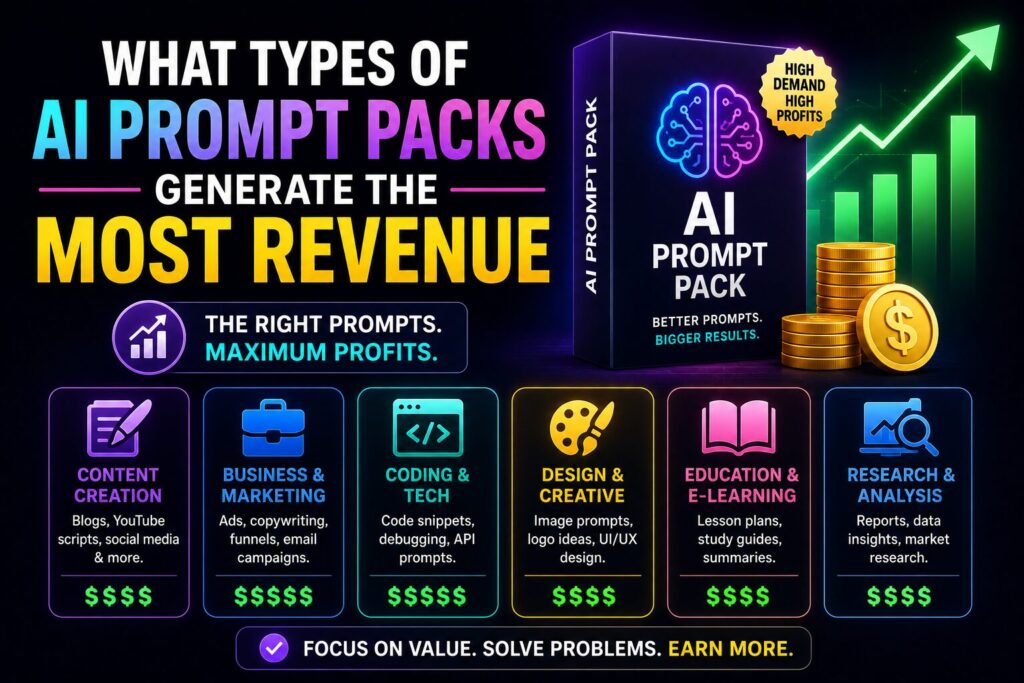
Selling AI prompt packs in 2026 works best when you target categories with clear commercial demand.
The highest value category is business and marketing systems. Cold email frameworks, ad copy generators, and funnel systems command the highest willingness to pay. Each prompt directly impacts revenue. A prompt that helps a freelance writer pitch clients is worth more than a prompt that generates poem variations.
The second strongest category is content engines. LinkedIn growth systems, YouTube script frameworks, and newsletter workflows generate repeat usage. Buyers subscribe to your future packs.
Image generation prompts have exploded as a category. Tools like Google Nano Banana Pro, MidJourney, and stable diffusion have driven massive adoption. Product photography prompts, AI photo editing filters, and brand-style visuals are in high demand. A prompt that turns basic product images into premium e-commerce visuals solves a real business problem.
Coding and developer prompts form a growing category with less saturation. Buyers here are technical and pay higher prices between $20 and $99 per pack. They are often buying for professional use rather than personal curiosity.
The common thread across all winning categories is specificity. Generic “beautiful landscape” prompts do not sell. “Photorealistic product mockup on white background with soft shadow studio lighting” does sell. Specificity is your competitive advantage.
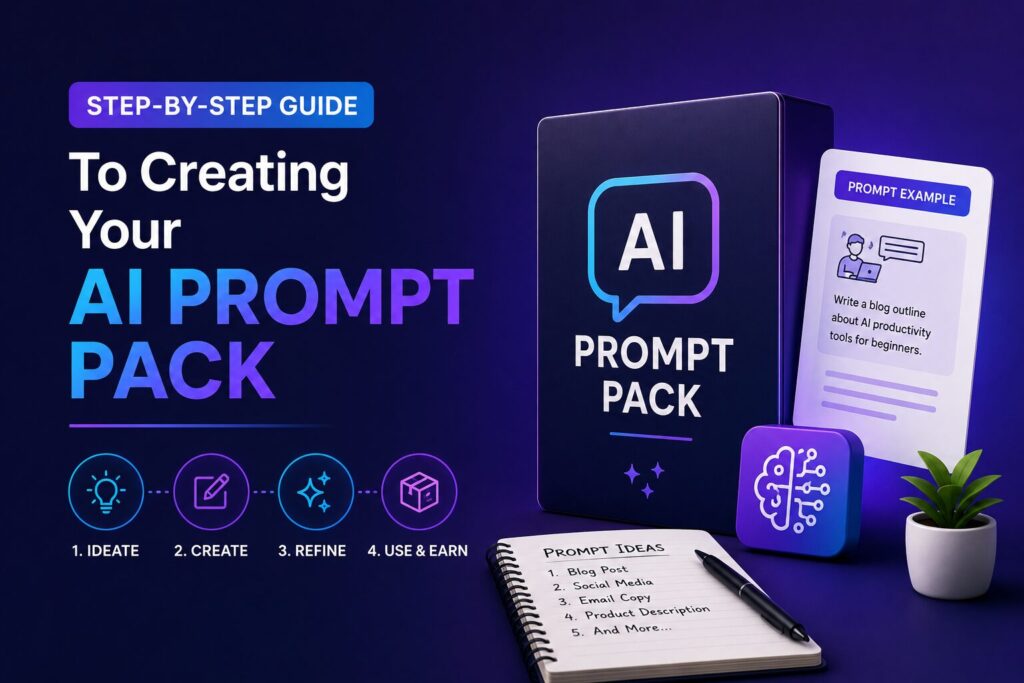
Creating a prompt pack that people actually pay for requires more than a list of text snippets. The difference between a sellable AI prompt pack and a random text file is structure. Each prompt needs a clear role assignment, specific parameters, and actionable output. Here is the exact workflow.
First, write each prompt as a system. Instead of writing “write a LinkedIn post,” write this: “Act as a LinkedIn growth strategist for B2B founders. You have helped 50 companies scale their personal brand on LinkedIn. Your task is to analyze my attached previous post and generate 3 alternative headlines that would increase engagement, followed by a revised body that follows the pattern of my best performing content.” Buyers pay for systems, not single lines.
Second, test every prompt yourself. Run it through ChatGPT, Claude, and Gemini to ensure it produces consistent, useful output. Note any edge cases where the prompt fails and document workarounds.
Third, organize your prompts into logical categories. A 20-prompt pack with 5 categories each containing 4 related prompts is easier for buyers to use than a flat list of 20 unrelated prompts.
Fourth, package your prompts in plain text, markdown, or PDF format. Gumroad accepts any file type. Include a README file that explains how to use each category. Your packaging and instructions are part of the product value. Do not rush this step.

Pricing is where most new creators sabotage their own success when selling AI prompt packs in 2026. The instinct to price low to attract buyers backfires. Low prices signal low value. Gumroad’s fee structure also penalizes cheap products.
One creator built a 57-prompt toolkit priced at $9. They generated 620 sales but after Gumroad fees and transaction costs, their total take-home was approximately $492. That is less than $0.80 per sale. The product required zero ongoing work after launch, but the low price point made scaling difficult because paid advertising was not viable at that margin.
Average cost per click on Facebook for digital products is $1 to $3. That requires a 25 percent conversion rate to break even. Industry average is 2 to 5 percent.
The recommended price floor for selling AI prompt packs in 2026 is $15 to $30. This range maximizes your profit percentage while remaining accessible to individual buyers. Successful prompt packs in the market price between $9 and $49 depending on depth and niche. Developer prompt packs command $20 to $99. Start at $15 to $25 for your first pack. You can always raise prices after gathering sales data and customer feedback. Pricing is a lever you can adjust over time.
The product page is where buyers decide whether to trust you with their money. When you sell an AI prompt pack on Gumroad in 2026, your listing copy matters as much as the prompts themselves.
As the 57-prompt toolkit creator learned, they spent hours crafting carefully structured prompts. Then they realized nobody would ever see them unless the product page convinced them to buy first. They ended up spending more time on the Gumroad listing copy than on the PDF itself. They did not consider that a mistake. For digital products, the sales page is the product experience until they buy.
Here is the exact structure for a high-converting Gumroad product page.
Start with a headline that names the specific problem you solve. Write “Stop wasting hours testing ChatGPT prompts for product descriptions” instead of “AI Prompt Pack.”
Immediately follow with a one-sentence outcome. “This pack gives you 20 tested prompts that generate SEO-optimized product listings in under 30 seconds each.”
Add a short paragraph explaining who this pack is for and what results they will achieve. Then list the specific categories and number of prompts included using bullet points. Be honest about what is included. If your pack has 15 prompts, do not claim 50. Buyers value accuracy.
Include one or two example prompts in the listing so people can see your quality before purchasing. Add a simple guarantee: “If our prompts do not save you time within your first week of use, email us for a full refund.” Gumroad handles refunds automatically.
Buyers need to visualize using your product before they will pay for it. Show them exactly how they will open your files, copy your prompts, and get results. Your product page is your best salesperson.
Launching with no existing audience feels impossible. But every successful creator started exactly there.
The creator of the 57-prompt toolkit set a hard deadline of one day to build and launch. Not because they were in a rush, but because they knew themselves. Without a deadline, they would spend two weeks tweaking fonts and rewriting the same paragraph. The one-day constraint forced decisions. Good enough beats perfect. The product you ship today is worth more than the perfect product you ship never.
Your first launch does not need a thousand followers. You need five to ten people who will actually use your prompts and tell you what works. Here is the zero-audience launch playbook that actually works.
First, post your Gumroad link on X (formerly Twitter) with a thread that shares something valuable. Do not just announce your product. Share one of your prompts for free. Then mention that the full pack contains 20 more like it.
Second, search Reddit for subreddits where your target audience hangs out. Try r/Gumroad, r/ChatGPT, r/SideProject, r/Entrepreneur. Find posts where people ask for help with the exact problem your prompts solve. Answer their question honestly. Mention that your prompt pack solves this systematically if they need more help. Help first, sell second.
Third, join communities like Indie Hackers and Dev.to. Write a post about what you learned while creating your prompt pack. Share the frameworks you discovered. Pure announcements perform terribly. But posts that teach something readers can use attract genuine attention.
Fourth, email everyone you know who might benefit. This feels uncomfortable but it works. A personal message from you to 10 people generates more early sales than a public post to 1000 strangers. Your first customers will come from direct outreach. Embrace it.
Once your first pack generates consistent sales, you need a system to scale. The built-in Gumroad affiliate program is the most underutilized growth lever.
Setting it up takes five minutes. Go to Gumroad.com/affiliates/onboarding. Enable affiliate participation for each product you want affiliates to promote. Set your commission percentage. Standard digital product affiliate commission is 30 percent. Some creators do 50 percent for more affiliate effort. Some do 10 percent for very cheap products. Pick 30 percent — it is the default expectation.
Gumroad generates a public affiliate signup link at yourname.gumroad.com/affiliates. Anyone who hits that URL can sign up to promote your products. You can auto-approve or manually approve each affiliate.
Here is what nobody tells you about the Gumroad affiliate program. Only published products show up in the affiliate product picker. There is a delay of roughly 24 hours (sometimes longer) before new products appear. If you are launching a new prompt pack, set up your affiliate program a day before launch with placeholder products. Then enable the new ones once they index.
Bundles work differently. Affiliate commission applies to the bundle’s price, not the sum of its contents. A $25 bundle pays $7.50 at 30 percent, not 30 percent of each contained product. If you want affiliates to promote bundles, increase the commission to 40 or 50 percent. The bundle already saves the buyer money, so a higher commission is fair.
The minimum payout threshold for affiliates is $10. If your products are priced low, affiliates need many sales to get paid. Pairing low-priced products with higher-priced upsells helps affiliates see meaningful per-link revenue.
Your affiliate program turns one-time buyers into a distributed sales force. Do not wait until you have customers to set it up. Enable affiliates from day one.
Realism beats hype when you sell an AI prompt pack on Gumroad in 2026.
As noted earlier, the 57-prompt toolkit sold at $9 per pack and generated approximately $492 from 620 sales after fees. That product required zero ongoing work after launch. The same creator later reported that the toolkit taught them more than any course. The act of shipping forced them to learn what actually works versus what theory claims works.
Another creator generated close to $8,000 selling AI prompts in under six months across PromptBase and Gumroad. A beginner seller on marketplaces might earn $100 to $500 per month. Top-selling prompt creators on PromptBase earn $500 to $2,000 per month. But those are established sellers with extensive catalogs.
The realistic path looks like this.
Month one: create and launch your first pack. Aim for 5 to 10 sales through direct outreach.
Month two: improve your product page based on customer feedback. Launch your second pack targeting a related problem.
Month three: enable your affiliate program and reach out to potential affiliates. Aim for 20 to 30 sales across both packs.
Month four: consolidate everything into a bundle or starter kit. Price the bundle higher than the sum of individual packs.
The creators who succeed are not the ones with the best prompts. They are the ones who keep shipping, keep improving, and keep talking to their customers.
Most creators who sell AI prompt packs on Gumroad in 2026 make one costly mistake. They treat each pack as a standalone product. They launch it, promote it for two weeks, watch sales slow, and then start from scratch on a new idea. That cycle is exhausting and it leaves serious money on the table.
The creators earning consistent four-figure months do something different. They build a product ecosystem, not a product list. Here is how to build one.
Gumroad delivers your file automatically. Most buyers download it and disappear forever. You have one window to pull them into your world before that happens. In your delivered PDF or ZIP, include a short line at the top: “Get the next pack free when you join our insider list.” Link to a free Beehiiv, Kit (ConvertKit), or Mailchimp signup page. Even a 15 percent opt-in rate means 93 email subscribers from 620 sales. Those 93 people already paid you money. They trust your work more than any cold traffic.
When you launch your next pack, email your list first. Offer them a 48-hour early buyer discount before you post anywhere public. That gives you a sales spike in the first 48 hours, which triggers Gumroad Discover’s algorithm and can push your product into organic recommendations.
A product ladder means buyers have a natural next step after every purchase.
Tier 1 — Entry pack ($9 to $15): A focused 15 to 20 prompt starter pack solving one specific problem. Low price, low risk. Designed to convert cold traffic and build trust.
Tier 2 — Core pack ($25 to $35): Your main product. 40 to 60 prompts covering a full workflow. Buyers who loved your entry pack upgrade here. New customers often go straight here after seeing social proof from tier 1 reviews.
Tier 3 — Bundle or system ($49 to $79): All your packs combined, plus a bonus — a 10-minute walkthrough video, a Notion template, or a quick-start checklist. Buyers who want everything in one place pay a premium for it.
Your checkout page should always mention the tier above. A buyer purchasing the $15 pack should see: “Upgrade to the full system for $34 more.” Gumroad supports this with its upsell and cross-sell features added in 2026. Even a 10 percent upsell conversion rate turns a $15 sale into a $49 average order value. That changes the economics of every traffic source you use.
This is the single most underrated growth strategy.
AI models update fast. GPT-4o, Claude Sonnet, Gemini 2.5 — each model has different strengths, different context windows, and different prompt behaviors. A prompt that worked brilliantly in early 2025 may underperform on today’s models. Your buyers know this. Use it to your advantage.
Every four to six months, review your top-selling pack. Test each prompt against the latest model version. Rewrite any that underperform. Add five new prompts using features the latest model supports. Release the update as “Version 2.0” and email your buyer list. Existing buyers get the update free. New buyers get the current version.
This update cycle serves three purposes. First, it keeps your product genuinely useful, which drives positive reviews. Second, it gives you a reason to email your list without “selling” — you are delivering more value. Third, it signals to new buyers that your pack is actively maintained, not abandoned. A maintained prompt pack commands a higher price than a static one. Raise your price with each major version update.
Gumroad does not rank well for long-tail search terms on its own. Your listing URL needs backlinks to get any organic search visibility. The fastest way to build those backlinks without paid outreach: publish a free Notion page or a GitHub readme that contains two or three sample prompts from your pack. Link back to your Gumroad product page as “the full system.”
Post that Notion page link on Reddit, Indie Hackers, and Product Hunt. Free content attracts clicks. The free sample builds trust. The link back to your Gumroad page drives conversions. This strategy costs nothing except one hour of setup. But it builds a chain of backlinks that compounds every month.
Successful creators do not just make a product. They build a system around the product that captures buyers, upgrades them, and keeps them coming back. That system is the real business. The prompt pack is just the front door.
The Gumroad platform has evolved significantly in the first half of 2026. Staying current with these features gives you an edge.
According to the official Gumroad release notes, several major updates rolled out in early 2026. These updates directly impact digital product sellers.
Installment payments now allow customers to split their purchase across multiple payments. This feature increases conversion rates for higher-priced prompt packs in the $30 to $50 range.
Verified product reviews have replaced the old comment system. Authentic buyer feedback now carries more weight in purchase decisions. This change rewards sellers who deliver genuine value and penalises those who rely on fake engagement.
Automatic discount codes are another 2026 addition. Instead of manually creating coupons, Gumroad now lets you set rules for automatic discounts. You can offer discounts to first-time buyers, cart value thresholds, or limited-time launches. Early adopters report that pairing automatic discounts with affiliate links increases conversion by roughly 15 to 20 percent.
Built-in communities are perhaps the most under-reported feature for 2026. Every Gumroad product can now include a private community space. Buyers can ask questions, share how they use your prompts, and suggest improvements. For AI prompt pack sellers, this is pure gold. A community turns one-time buyers into return customers. It also provides a constant stream of real-world feedback to improve your next pack.
Daily payouts are now available for eligible US accounts. The new tax documents section centralises all your 1099-K forms and international tax filings. If you are serious about turning prompt pack selling into a reliable income stream, these 2026 features remove administrative friction. They let you focus on creating and marketing.
When you sell AI prompt packs in 2026, understanding the real fee structure prevents unpleasant surprises.
Gumroad charges a flat 10 percent platform fee plus $0.50 per transaction for direct sales. Payment processing adds roughly 2.9 percent plus $0.30 for card payments. That brings the effective fee to approximately 12.9 percent plus $0.80 per transaction. These figures are publicly documented by Swell in their 2026 Gumroad pricing analysis.
Let us run a realistic example. Suppose you price your AI prompt pack at $19. A direct sale through your own link yields:
| Item | Amount |
|---|---|
| Gross sale price | $19.00 |
| Gumroad platform fee (10%) | -$1.90 |
| Gumroad transaction fee | -$0.50 |
| Payment processing (~2.9% + $0.30) | -$0.85 |
| Your take-home per sale | $15.75 |
That is an 83 percent retention rate. Excellent for a platform that requires zero monthly fees.
However, two hidden costs can erode your margin. First, if a customer finds your pack through Gumroad Discover (the internal marketplace), the fee jumps to 30 percent flat. Second, if you issue a refund, Gumroad does not refund its 10 percent platform fee. According to Dodo Payments’ 2026 analysis, this refund fee retention is the most painful hidden cost for high-volume creators.
The optimisation strategy is straightforward. Drive your own traffic (avoid Discover sales whenever possible). Keep your refund rate low by over-delivering on quality. At scale, these small optimisations add up. Every percentage point of fee savings goes directly to your bottom line.
In March 2026, InsightRaider analysed 146,271 Gumroad products across 18 categories. The results offer a reality check that every AI prompt pack seller should read.
Software and developer tools generated $65.8 million in total revenue. That averages $60,814 per product.
Business and money products came in at $15.4 million across 1,520 products. The average price was $49.49. But the median price was just $15. That indicates a few high-priced products pull the average up while most sellers price low.
The writing and publishing category is the hidden gem. Only 226 products but $15,750 in revenue per product. Low competition, high rewards.
What do the top-grossing products have in common? They solve a specific problem for a specific person. A Photoshop AI script made $586,000. Not “an AI tool” — a script that does one thing in one app for one type of user. They are tools, not information.
Digital downloads average 293 sales at $47.14. Courses average 115 sales at $95.74. Downloads win on volume by 2.5 times. People do not finish courses; they bookmark them and forget. Tools get used immediately.
Finally, every top seller prices above $20. The sweet spot for downloads is $30 to $50. Below $10, you need massive volume. Above $79, you need an existing audience. For your first AI prompt pack, target the $20 to $35 range. Let data guide your decisions, not hype.
Your Gumroad affiliate program is one of the most powerful growth levers. But most creators set it up and forget it. Successful sellers use advanced strategies to turn affiliates into a genuine distribution engine.
Tiered commissions by product. Not all your prompt packs are equal. A $49 developer prompt pack can justify a 50 percent affiliate commission. The margin per sale is higher. A $9 starter pack might offer only 20 percent. By adjusting commissions per SKU, you incentivise affiliates to promote your most profitable products first.
Affiliate-only discounts. Create a discount code that only affiliates can share with their audience. The buyer gets 15 percent off. The affiliate earns a full commission on the discounted sale. This strategy increases conversion rates for affiliates without reducing your per-sale margin dramatically.
Public leaderboards. Some creators publish a monthly “top affiliates” list in their newsletter or community. Affiliates who drive the most sales get a shout-out, a bonus payment, or early access to your next prompt pack. This gamification tactic works surprisingly well. Affiliates compete not just for money but for recognition.
Minimum payout threshold management. Gumroad’s affiliate minimum payout is $10. If your cheapest pack is $9 at 30 percent commission, an affiliate earns $2.70 per sale. They need four sales to hit payout. As noted earlier, pairing low-priced products with higher-priced bundles helps affiliates see meaningful per-link revenue.
Launch pre-warm. As covered above, new products can take up to 24 hours to appear in Gumroad’s affiliate product picker. Set up your affiliate program a day before launch with placeholder products. Then enable the new ones once they index.
Treat your affiliates like partners, not afterthoughts.
One of the most successful AI prompt packs on Gumroad in 2026 — The Gumroad Seller’s AI Toolkit with 57 prompts — uses a simple but effective structure.
Role + Context + Task + Format + Constraints.
Each prompt includes [BRACKETS] where the buyer inserts their specific details. This system turns a generic prompt into a reusable template. Buyers can adapt it to any situation.
Here is an example of the bracket system applied to writing a Gumroad product listing. You can include a variant of this in your prompt pack to demonstrate quality before purchase.
text
You are a conversion copywriter. Write a product listing for a digital product called [PRODUCT NAME].
The product does: [what it does in one sentence]
Target buyer: [who buys it and why]
Price: [price]

Write:
- A headline (10 words max)
- A 3-sentence description that focuses on the outcome, not the features
- 5 bullet points starting with action verbs
- A one-line call to action
This template is adapted from a proven framework used by successful Gumroad sellers. It is documented on DEV Community in May 2026.
The key insight is that every prompt in your pack should follow the same structural logic. When buyers open your PDF, they should immediately understand how to use each prompt. Fill in the brackets, paste into ChatGPT or Claude, and get usable output. Consistency across your pack builds trust and reduces support questions. A consistent template system is your competitive edge.
Selling AI prompt packs on Gumroad in 2026 means packaging tested workflows for ChatGPT, Claude, or Gemini into downloadable digital files. Customers pay to save time or improve output. You create the prompts once using your domain expertise. Then you sell unlimited copies through Gumroad’s automatic delivery system.
Create a free Gumroad account at Gumroad.com. Identify a specific problem your target audience faces. Write 10 to 20 prompts that solve that problem systematically. Package them into a PDF or markdown file. Create a product listing with a headline that names the problem. Add bullet points listing what is included. Set your price between $15 and $30. Publish and share your link.
Beginner sellers typically earn $100 to $500 per month according to published marketplace data. Established creators with multiple packs and affiliate programs earn $2,000 to $10,000 per month. As noted earlier, a 57-prompt Gumroad toolkit sold at $9 per pack generated approximately $492 from 620 sales after fees. Earnings scale with the number of packs you release and how effectively you drive traffic.
Marketing and business systems lead in revenue because each prompt directly impacts the buyer’s ability to earn money. Cold email frameworks and ad copy generators consistently outsell general-purpose prompts. Image generation prompts for product photography and brand-style visuals have exploded as a category in 2026. Coding and developer prompts command the highest price points from $20 to $99 per pack.
Yes, but with honest expectations. The platform costs nothing to start. The time investment for your first pack is roughly 10 to 20 hours of focused work. You will not become wealthy overnight. However, each pack you create continues generating passive income indefinitely with no inventory costs. The skills you learn about product validation, pricing, and marketing transfer directly to any digital product business. The worst-case scenario is you spent 20 hours learning what works and what does not. That knowledge alone is valuable.
Selling AI prompt packs on Gumroad in 2026 is not a get-rich-quick scheme. It is a get-skilled-slowly system.
The market is real, growing at nearly 30 percent annually, and accessible to anyone who can write clearly and solve specific problems. The creators who succeed are not the ones with secret prompts or proprietary techniques. They are the ones who ship imperfect products, listen to feedback, and keep showing up.
Your first pack probably will not change your life. It might make $100 across three months. But that first pack teaches you how to validate an idea, write copy that converts, and talk to paying customers. Those skills apply to your second pack, your third, and every digital product you ever build.
The only way to fail is to never start.
All figures are sourced from publicly available reports, benchmarks, and industry data from 2026.
Leave a comment below — which niche are you considering for your first prompt pack?
P.S. — We publish one practical AI monetization guide every week at AICAP.in. Subscribe below — no spam, no fluff, just strategies that actually work.

Salman Shaikh is the founder and editor-in-chief of AiCap.in, an independent AI and personal finance publication based in Ahmedabad, India.
Since launching AiCap.in in April 2026, Salman has personally tested and reviewed 100+ AI tools across income generation, crypto research, content creation, and personal finance — publishing 91+ hands-on guides based on real usage, not press releases.
His approach is simple: every tool he writes about is one he has opened, tested, and either used to earn money or rejected after finding it didn’t deliver. He started AiCap.in after realising most AI content in India was either written by people who had never touched the tools, or buried in technical jargon that everyday people couldn’t act on.
His work covers AI tools for passive income, freelancing with AI, crypto research workflows, Amazon FBA with AI, and personal finance strategies built for readers in India and accessible to anyone globally looking to earn smarter with AI.
AiCap.in now reaches a growing community of readers across India and globally who want practical, jargon-free AI strategies they can implement today.
Connect with Salman: LinkedIn · X @AiCap88 · YouTube · Medium





[…] passive income ideas 2026 refer to using artificial intelligence tools to create digital assets, content, or automated systems that generate money with minimal ongoing […]
[…] tools have become the new entry point to the traveller journey, relegating isolated SEO strategies to the background. Propellic observed that 56% of bookings made through Google’s […]
[…] is the most accessible way to make money with either tool. Platforms like Etsy, Creative Market, Gumroad, and Canva’s own creator program (in select regions) let you upload and sell templates […]
[…] approach fails because AI prompts for writing freelance proposals are not about getting AI to do your thinking. They are about using […]