Ahmedabad, Gujarat, India
Ahmedabad, Gujarat, India
AI voice cloning for YouTube in 2026: how to clone your own voice and stay monetized. YouTube deleted 16 channels with 4.7B views for doing it wrong.
Disclaimer: This content is for educational and informational purposes only. Earnings and results vary by individual. Always conduct your own due diligence. AICAP.in is not affiliated with YouTube, ElevenLabs, or any tool mentioned in this guide.
Here is a question that keeps coming up in creator forums.
Can you actually make money on YouTube using an AI clone of your own voice?
The short answer is yes, in many cases. The longer answer is where things get complicated — and where creators run into trouble.
YouTube has placed AI at the center of content moderation, creator monetization, and audience experience. AI voice cloning is no longer a fringe experiment; it is a mainstream production tool. But with mainstream adoption comes scrutiny.
This guide walks through how to clone your own voice for YouTube, which tools are used for monetization-safe workflows, and why some faceless channels lose revenue — so you can avoid the same mistakes.
AI voice cloning for YouTube is the process of using machine learning models to create a digital replica of a human voice. For creators, this typically means uploading 30 seconds to 30 minutes of your own speech, training a model, and then generating narration using that synthetic voice.
The difference between voice cloning and standard text-to-speech matters. Standard TTS pulls from a library of pre-recorded voices that belong to strangers. Voice cloning that uses your own voice creates a synthetic version of you. That distinction matters when YouTube’s review team evaluates your channel.
As of 2026, YouTube’s current monetization pages do not state that AI voiceovers are automatically ineligible. The bigger issues remain originality, authenticity, viewer value, and whether the channel looks repetitive or mass-produced.
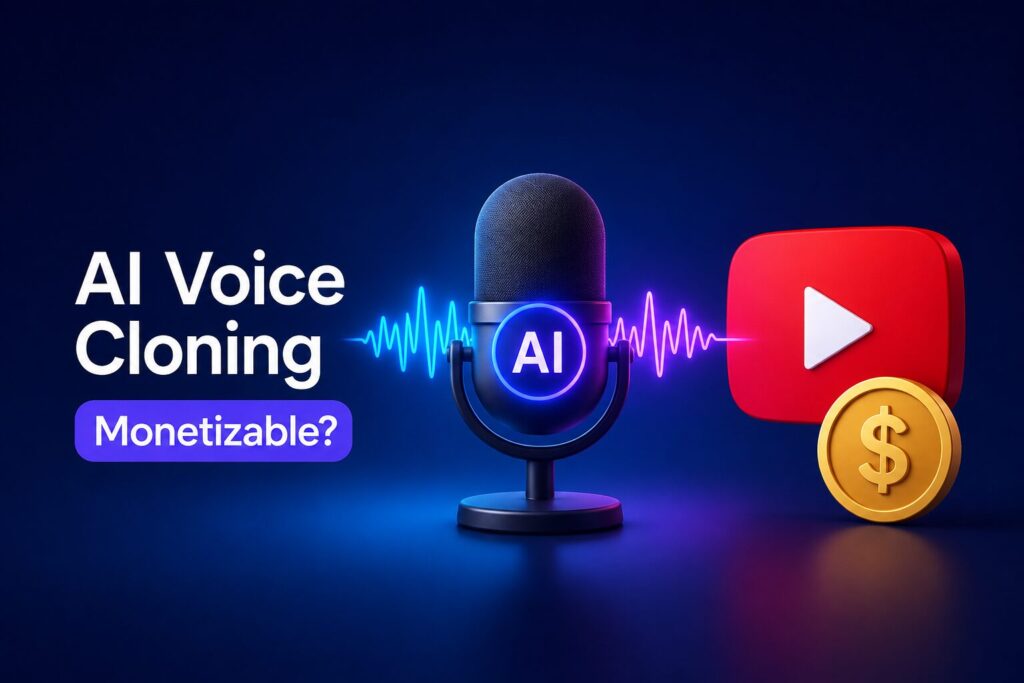
Yes, this technology can be monetized. But that answer becomes misleading if you stop there.
YouTube’s monetization guidance is centered on whether content is original, authentic, valuable to viewers, and not mass-produced or repetitive. The platform has not banned AI-generated content from monetization. What YouTube requires is that content provides value to viewers.
In July 2025, YouTube clarified its “inauthentic content” policy to explicitly target channels that churn out templated, low-effort videos at scale. The platform has since taken action against channels that fit this description, though the specific number of channels removed and total views affected is not something we can independently verify here. Refer to YouTube’s official blog and policy pages for current enforcement examples.
Google and YouTube have drawn a line between “AI-assisted creativity” and “AI-generated spam.” Voice cloning sits on the assisted side when used correctly.
Monetization eligibility depends on value, commentary, transformation, and adherence to reused content rules. Faceless channels are not banned, but low-effort automation without unique value is at risk.
The real question is not “Did I use AI voice cloning?” It is “Would a human reviewer think this is valuable, or just more spam?”
Cloning your own voice for YouTube is straightforward in 2026. Here is the actual process.
You need high-quality source audio. Use a decent microphone in a quiet room. Record 5 to 30 minutes of speech. Read from a script that covers various sounds, emotions, and pacing.
Most platforms accept audio files between 30 seconds and 2 hours. ElevenLabs’ Instant Voice Cloning works from as little as 30 seconds of audio. Professional Voice Cloning uses longer samples for more accurate results. Check each platform’s current requirements directly.
The platform processes your audio, typically taking 10 to 60 minutes. Then generate test samples. Listen carefully. Adjust parameters if available.
Paste your script. Generate the audio. Listen again. Does it sound like you? Does it carry your natural inflections?
Download the audio file. Import it into DaVinci Resolve, Premiere Pro, Final Cut, or your preferred editor. Sync with visuals. Publish.
The quality of synthetic narration varies by tool, sample quality, and script. There is no universal retention figure that applies to all faceless videos. Judge your own output by testing and reviewing analytics.
Not all voice cloning tools are equal. Some fit monetization-safe workflows. Others risk flagging. Here is what is commonly used.
ElevenLabs is widely considered a leader in AI voice realism. Its models support expressive audio tags for emotional control across many languages. In early 2026, ElevenLabs announced a major funding round, which was widely reported by tech and business press. Check ElevenLabs’ official site and reputable news sources for current valuation and feature details.
ElevenLabs has also operated a voice marketplace that pays voice owners when their voices are licensed. The exact payout figures change over time — check ElevenLabs’ official announcements for current numbers.
Pricing tiers vary. Free tiers typically do not include commercial use rights. To use generated audio commercially, you generally need a paid plan. Verify current pricing and licensing on ElevenLabs’ site before publishing.
Resemble AI is used for storytelling, documentaries, and long-running series. It offers emotional control, voice cloning, and workflows intended to maintain a consistent brand voice.
Murf AI prioritizes speed, simplicity, and studio-style production, which suits corporate and documentary faceless channels.
VEED integrates voice cloning directly into its video editor. Users record a short sample to create a personal voice profile for use across their videos. VEED’s cloning is integrated into the editing workflow, which can help non-technical users.
The safer approach treats synthetic narration as one tool inside a clearly original production system, not as a shortcut for scraping scripts or recycling source material.
Faceless YouTube AI channels have had monetization suspended when old policies around reused and repetitive content are applied at scale. YouTube’s detection systems in 2026 can spot patterns behind mass-generated videos.
YouTube’s 2026 strategy draws a hard line. The platform flags inauthentic content as anything that looks mass-produced, templated, or machine-made without real human effort.
You are in danger if your channel relies on:
The problem is rarely the voice alone. The real issues are copied or weak scripts, repetitive templates, low variation across uploads, poor transformation of source material, and a channel that looks mass-produced.
Here is what YouTube calls inauthentic content in practice:
Template clones with tiny swaps. If you can generate 50 versions of the same video by swapping nouns, you are in the danger zone. Example: a channel posting daily “Amazing Facts About [Country]” videos using identical scripts with only place names changed.
Regurgitated or read-aloud content. Content pulled from other sources and read back with no original perspective triggers scrutiny. Reading Wikipedia articles over stock footage with an AI voice and no added analysis is a fast track to demonetization.
Slideshows with filler visuals. If visuals do not support a real narrative or explanation, reviewers flag it as low-effort. Generic stock photos cycling while an AI voice reads facts, with no teaching or storytelling, will not survive review.
Voice cloning is not the violation. Lack of originality is.
YouTube is not banning voice cloning. It is banning low-effort mass production. AI-assisted videos are monetization-safe when you follow these rules.
Rule 1 — A human drives the creative decisions. You choose the angle, tone, and structure. Use AI to generate script drafts, then heavily modify them and add your personal perspective.
Rule 2 — Add real commentary or critique. Not just facts — your take on them. Each video should demonstrate clear human judgment, intent, or value.
Rule 3 — Each upload provides a distinct experience. Viewers must notice the difference between your videos. A consistent format is fine. Publishing the same format with no new substance is the problem.
Rule 4 — Disclose when required. YouTube requires disclosure when content includes realistic synthetic media that could mislead viewers. Cloning your own voice for voiceovers generally does not require disclosure, but check YouTube’s current policy for the latest rules.
Rule 5 — Use premium tools, not free TTS. Free AI voice tools may not grant commercial rights and can create monetization risk. Choose a voice system that supports a clearly original, well-produced video.
This section needs to be crystal clear. Cloning someone else’s voice for YouTube monetization is almost always a violation.
Using AI to replicate a real artist’s voice without permission violates policy, even if you disclose the AI use. Impersonating a real person’s voice without authorization violates impersonation or deceptive practices rules.
YouTube has introduced likeness detection tools that allow creators to identify videos where their face or voice appears altered or generated by AI. The system, modeled conceptually on Content ID, scans newly uploaded videos for visual or audio matches linked to enrolled creators.
If a third party uploads a video using an AI version of your voice without permission, YouTube’s system can flag it for review and possible removal. In some jurisdictions, platforms are legally required to act on harmful synthetic content reports within specific timeframes.
If you want to use voice cloning for YouTube, clone your own voice. Not a celebrity’s. Not another creator’s. Yours.
If you are exploring voice cloning for YouTube, the scale of what is happening in 2026 is worth a closer look.
The global voice cloning market has been projected to grow steadily through 2030, with some industry reports citing compound annual growth rates in the range of 25 to 30 percent. The AI voice generator market, which underpins voice cloning, is also projected to expand significantly. Specific figures vary by research firm and methodology — check the original reports if you want exact numbers.
What is driving this growth? Three factors.
First, deep learning algorithms have matured to the point where cloning accuracy is close to indistinguishable from the original speaker in many cases. Second, the rise of short-form video and the “audio-first” trend in digital publishing have created demand for synthetic voices. Third, SaaS-based audio platforms have made the technology accessible to anyone with a laptop and a minute of audio.
For YouTube creators, this means the barriers to entry are lower than ever — but so is the competition. Adopting synthetic narration is no longer a futuristic experiment; it is a mainstream production strategy.
YouTube has rolled out disclosure labeling for AI-generated and altered content, which directly affects anyone using synthetic narration.
Creators must declare when their videos use synthetic media, including AI-generated voices, in certain situations. For standard content, a label may appear in the expanded description box. For sensitive topics like political news, financial advice, health updates, or election-related material, a more prominent badge may be displayed on the video player itself.
The platform has clarified what counts. Using an artificial voice to narrate a fictional story may require a label, while using a voice modulator for creative comedic effect may not. Creators who consistently fail to disclose may face content removal, manual labeling by YouTube, or suspension from the YouTube Partner Program. Review YouTube’s current disclosure policy for the exact requirements.
Channels that voluntarily add AI disclosure labels in non-required categories sometimes report higher engagement, though specific percentage gains vary and should be measured against your own analytics.
Additionally, YouTube now allows users to request removal of AI-generated content that simulates an identifiable individual, including their face or voice. Rights holders may be able to claim ad revenue from synthetic vocal matches rather than relying on slow DMCA takedowns. The message is clear: clone responsibly, disclose transparently, and monetize legitimately.
Earnings from AI voice cloning vary widely. There is no universal income figure that applies to every creator.
A channel with a dedicated audience in a high-CPM niche like personal finance, history, or technology can generate meaningful ad revenue, but the actual amount depends on views, watch time, RPM, sponsorships, and affiliate revenue. YouTube does not publish category-level income guarantees for AI voice channels.
Some published reports have covered individual creators building AI-assisted YouTube channels, but we do not repeat specific named examples or dollar figures here unless they can be verified through a primary, linkable source. Treat any specific income claim — including those in other guides — as an estimate rather than a promise.
What can be said with confidence:
The takeaway is that the model can work, but results are driven by the same fundamentals as any YouTube channel: strong ideas, consistent output, and audience value.
Predictions about the future of AI voice cloning vary. Some creators believe demand for authenticity will push audiences back toward human-narrated content. Others expect large media companies with industrial-scale production pipelines to dominate AI-assisted content.
Whether those predictions are right or wrong, one thing is clear: the tools are more powerful than ever, the policies are clearer than ever, and the model works for creators who approach it with care.
The question is not whether this technology can make money. The question is whether you will use it in a way that keeps your channel compliant and valuable to viewers.
AI voice cloning for YouTube is the process of creating a digital replica of a human voice using machine learning, then using that synthetic voice for YouTube narration. Creators typically upload recordings of their own speech to train a model, which then generates voiceovers in their voice.
Record 5 to 30 minutes of clean audio using a decent microphone in a quiet room. Upload to a platform with commercial use rights on its paid plans. Train the model. Generate your voiceover. Import into your video editor. Ensure your full video includes original commentary, unique value, and human creative direction. Avoid templates, repetitive formats, and mass-production workflows. Check YouTube’s current monetization and disclosure policies before publishing.
Earnings vary dramatically based on niche, audience size, watch time, RPM, sponsorships, and content quality. YouTube does not publish category-level income guarantees for AI voice channels. Treat any specific income claim — including those in other guides — as an estimate rather than a promise. Start with a small channel, track analytics, and scale what works.
The best tool depends on your workflow. ElevenLabs is widely used for realism and expressive control. Resemble AI is used for storytelling. Murf AI is used for corporate and documentary work. VEED integrates cloning into its video editor. In all cases, verify that your plan includes commercial rights before publishing. Free tools may not grant commercial rights and can create monetization risk.
Yes, if you treat it as a production tool, not a replacement for creativity. This technology works when you use it to scale original ideas, not to avoid doing original work. Beginners who succeed start with strong scripts, add genuine commentary, vary their formats, and never clone someone else’s voice. Beginners who fail copy existing content, use free TTS without commercial rights, and upload many nearly identical videos. The tool is not the problem. The method is.
Three things you can apply today:
Start with your own voice recording. Five to 30 minutes of clean audio is enough to begin with most platforms.
Invest in a tool with commercial rights. Check the current pricing and licensing terms on the platform you choose. Do not assume free tiers include commercial use.
Add human value to every video. Original scripts, personal commentary, unique perspectives, and varied formats keep you compliant.
Synthetic narration in 2026 is not a shortcut. It is a power tool. Use it to amplify your voice, not to replace it. Use it to scale what you already do well. Use it to reach more viewers with the same authentic perspective.
The difference between creators who earn and those who get demonetized comes down to one question: does your content have a human at the center? If the answer is yes, the platform is more likely to reward you. If the answer is no, YouTube’s detection systems will eventually find you.
This guide avoids anonymous seller anecdotes and unverifiable income claims. Platform data is attributed to official or industry sources where possible. Because YouTube policies, tool pricing, and market conditions change, verify current details through the links below before making business decisions.
Figures in this guide are presented only when they can be attributed to platform reports, official documentation, or industry sources. Individual results vary based on niche, effort, pricing, and market conditions. Verify specific metrics through your own testing before making decisions based on this guide.
P.S. — We publish one practical AI income guide every week at AICAP.in. Subscribe below — no spam, no fluff, just strategies that actually work.

Salman Shaikh is the founder and editor-in-chief of AiCap.in, an independent AI and personal finance publication based in Ahmedabad, India.
Since launching AiCap.in in April 2026, Salman has personally tested and reviewed 100+ AI tools across income generation, crypto research, content creation, and personal finance — publishing 91+ hands-on guides based on real usage, not press releases.
His approach is simple: every tool he writes about is one he has opened, tested, and either used to earn money or rejected after finding it didn’t deliver. He started AiCap.in after realising most AI content in India was either written by people who had never touched the tools, or buried in technical jargon that everyday people couldn’t act on.
His work covers AI tools for passive income, freelancing with AI, crypto research workflows, Amazon FBA with AI, and personal finance strategies built for readers in India and accessible to anyone globally looking to earn smarter with AI.
AiCap.in now reaches a growing community of readers across India and globally who want practical, jargon-free AI strategies they can implement today.
Connect with Salman: LinkedIn · X @AiCap88 · YouTube · Medium





[…] AI voice quality is finally good enough.Two years ago, text‑to‑speech sounded robotic. Today, […]
[…] Freelance Service #6: AI Voice Cloning & Voiceover […]
[…] #3: Voice Cloning Royalties — Getting Paid Every Time Someone Uses Your […]
[…] #2 – Using bad AI voices.The free voice in your browser‘s TTS sounds robotic. Viewers leave. Invest your ElevenLabs free […]
[…] 2025, Podcastle launched Asyncflow v1.0 featuring 500 lifelike AI voices and unlimited custom voice cloning options. Speechify introduces AI Podcast Publishing, converting documents and written content […]