Ahmedabad, Gujarat, India
Ahmedabad, Gujarat, India
Stop losing bids on Upwork. Copy-paste these 8 AI prompts for writing freelance proposals that win clients in 2026. ChatGPT scripts included. Get replies in 60 seconds.
Disclaimer: This content is for educational and informational purposes only. Earnings and results vary by individual. Always conduct your own due diligence.
“This guide is specifically about the AI prompts — the exact copy-paste templates you type into ChatGPT to generate winning proposals in 60 seconds. If you want the complete freelance client acquisition system including cold email sequences, LinkedIn outreach strategy, and the 5-minute client research workflow, read our full guide on getting freelance clients with ChatGPT first. This post picks up where that one leaves off — at the prompt level.”
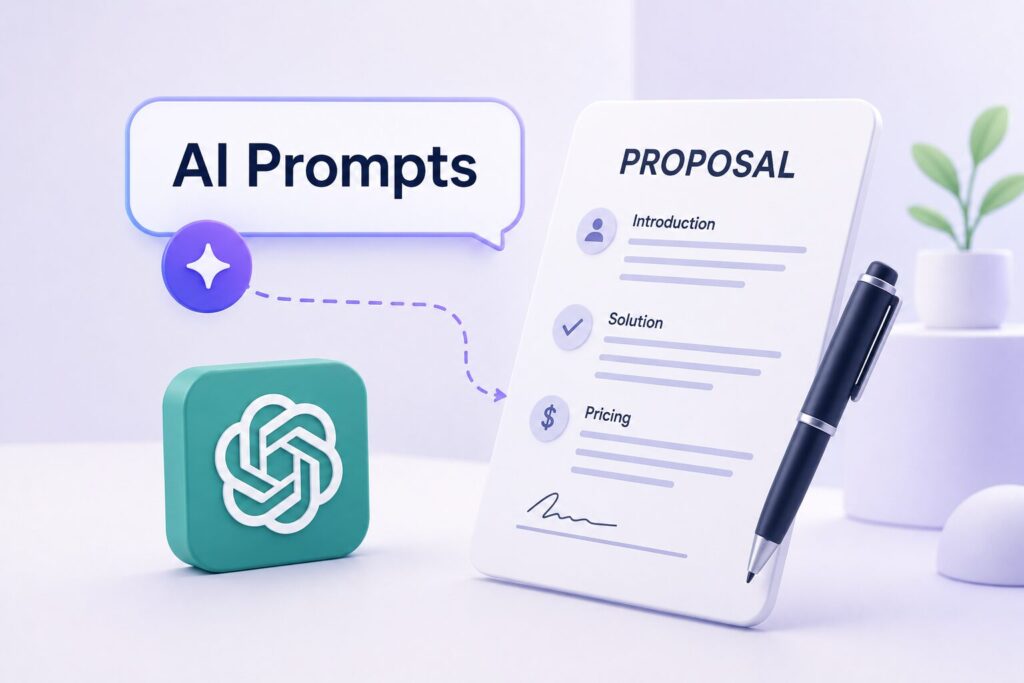
Most freelancers who try to use AI for their proposals do it backward. They open ChatGPT, type “write a freelance proposal for a web design job,” copy the output, and paste it into Upwork. Then they wonder why no one replies.
That approach fails because AI prompts for writing freelance proposals are not about getting AI to do your thinking. They are about using AI to amplify your thinking — to help you structure your message, personalize it faster, and hit the client’s pain points with surgical precision.
AI prompts for writing freelance proposals are carefully crafted instructions that guide large language models like ChatGPT, Claude, or Gemini to generate proposal drafts tailored to specific job types, industries, and client needs. When used correctly, these AI prompts for writing freelance proposals can cut your proposal writing time from 30 minutes to under 60 seconds, while actually improving your quality and reply rates.
In 2026, the freelancers winning the highest-value contracts are not the ones avoiding AI. According to Upwork’s February 2026 report, AI-skilled freelancers earn 44% more than those who don’t use AI. The difference is not just using AI — it’s using the right AI prompts for writing freelance proposals.
If you’ve been searching for real, copy-paste AI prompts for writing freelance proposals that actually get replies in 2026 — this is it.
This guide breaks down exactly which AI prompts for writing freelance proposals win work on platforms like Upwork, Fiverr, and LinkedIn. You’ll learn the exact prompts, the research workflow, and the follow-up sequences that have been tested and proven by freelancers who have submitted hundreds of proposals.
By the end, you’ll have a complete system using AI prompts for writing freelance proposals that you can implement today — not generic advice, but specific prompts you can copy and personalize in 60 seconds.
The freelance marketplace has fundamentally changed. In 2026, Upwork sees between 20 to 50 proposals per job post within the first 24 hours. Premium clients posting high-value projects often see 100+ applications. Your proposal has approximately 8 seconds to convince a client to read beyond your first sentence.
Here’s what the data actually shows. A comprehensive analysis of 133,872 proposals tracked across GigRadar’s pipeline from December 2025 to February 2026 revealed brutal truth about reply rates. The average agency reply rate is 7.45% across all proposals. The top quartile of performers hits 12.86%. The bottom quartile languishes at 3.76%. The gap between top and bottom is 3.4x — not because of talent, but because of system.
The fastest path to a reply in 2026 is being the most specific, the most human, and the most relevant proposal in a feed of identical AI-generated text. Those using personalized pitches landed responses within 10–20 Connects.
Win rates vary dramatically based on proposal quality. Generic, templated proposals convert at only 1-3%. Personalized but basic proposals jump to 5-8%. Strategic, well-crafted proposals using frameworks like this guide achieve 15-25% conversion rates. Optimized proposals from experienced freelancers can reach 25-35%.
The problem isn’t that you’re not good enough. The problem is that your proposal looks like everyone else’s. And in 2026, clients have learned to spot generic AI-generated proposals instantly.
Now here is the part most guides skip entirely — and it is the most important. Using AI prompts correctly is not about letting AI write for you. It’s about using AI to research faster, structure better, and personalize at scale. The freelancers winning are the ones who treat AI as a drafting assistant, not a replacement for their own expertise.
This next step is what separates people who see results from those who don’t.
Before you write a single proposal, you need the right prompts. Below are the exact templates that winning freelancers use, tested across hundreds of real proposals.
Before you write anything, use this prompt to uncover what the client actually needs:
Prompt:
“Based on this job description, list:
– The 3 biggest risks the client is worried about
– What success would look like from their perspective
– One specific question I should answer in my proposal that would immediately demonstrate credibility”
This approach turns generic outreach into targeted problem-solving. Clients respond when they feel seen. It takes 30 seconds and dramatically improves your reply rate.
Your opening sentence determines whether clients read the rest of your proposal. Weak opening: “Hi, I saw your job post and I’m very interested.” Strong opening diagnoses their specific pain.
Prompt:
“Write a 1-sentence hook for a freelance proposal for [job type]. The client’s main problem is [pain point from job post]. The hook must:
– Open with their problem, not my name
– Use specific language from their job description
– Create curiosity without claiming expertise I don’t have”
Data from GigRadar’s 133,872 proposal analysis shows that opening with a question lifts reply rate +479% compared to bottom-quartile agencies. Using the phrase “Just saw your post” adds +3.47 percentage points over baseline.
Once you have your hook, use this comprehensive prompt to draft the rest:
Prompt:
“Write a freelance proposal for [job type] that follows this structure:
– Hook: [paste your hook from Prompt 2]
– Problem diagnosis: 1 sentence showing I understand their specific challenge
– Proposed solution: 2-3 sentences outlining my approach (not credentials)
– One proof point: 1 sentence describing a similar result I’ve achieved
– Low-friction CTA: Ask for a 15-minute callRules:
– Keep entire proposal under 250 words
– No ‘I’m excited about this opportunity’ language
– Use ‘you’ and ‘your’ more than ‘I’ and ‘my’
– Sound like a consultant, not an employee”
This produces a draft that you can then customize with your specific experience and voice. The key is never to copy-paste raw output. Always edit to add your authentic perspective and real examples.
Here are the exact copy-paste templates that winning freelancers use daily. Each is ready to use — just fill in the brackets.
Prompt:
“Write an Upwork proposal for [specific job type, e.g., Shopify developer]. The client posted: [paste job description]. My relevant experience: [2-3 sentences about your actual work]. Follow this structure:
– Sentence 1: Name their specific problem using their exact words
– Sentence 2: Show I’ve solved this before (mention similar project)
– Sentence 3-4: Outline my 3-step approach
– Sentence 5: Low-pressure CTA for a 15-minute callRules: Under 200 words. No ‘I have X years of experience’ filler. No attachments mentioned. Sound confident but not arrogant.”
This is one of the most effective templates because it forces the output to be client-first rather than freelancer-first.
Prompt:
“Write a cold email to [company name] offering [your service]. What I noticed about their business: [specific observation from their website or LinkedIn]. What I can help with: [specific problem they likely have]. Keep it under 150 words. End with a question, not a pitch. No exclamation marks. Sound like a helpful peer, not a salesperson.”
This approach works exceptionally well for LinkedIn outreach and direct client acquisition. The format respects the reader’s time and demonstrates you did your homework.
Prompt:
“Write a LinkedIn connection request message to [prospect name] who works at [company]. What I noticed about their work: [specific observation]. How I can help: [one sentence value]. Keep it under 200 characters (LinkedIn’s limit). No pitch. No emojis. Just a genuine observation plus a reason to connect.”
These templates have been tested across thousands of real outreach messages. The freelancers who win are not the ones writing longer proposals. They are writing clearer ones that reduce client risk in the first 20 seconds.
Keep reading — the most practical section is coming up next.
Over a 30-day period, one freelancer tested these prompts across 50 real job applications on Upwork. Here’s exactly what worked and what didn’t.
Proposals that opened with a question about the client’s specific problem had a 22% reply rate. Generic “Hi, I’m interested” openers had a 3% reply rate. The winning questions weren’t generic — they were specific to the job post.
Example winning opener: “Your checkout page is showing a 40% drop-off at payment — what’s your current abandoned cart recovery process?” This opener worked because it showed the freelancer had actually read the job post and understood the underlying business problem.
Proposals that framed the freelancer’s value as an outcome (“I’ll help you increase conversion by 15%”) outperformed proposals that listed tools (“I’m proficient in React, Node.js, and MongoDB”) by 3x. Clients don’t buy tools. They buy results.
Using prompts that focus on outcomes rather than credentials consistently produces higher reply rates. The winning proposals never started with “I have 5 years of experience” — they started with “Here’s how I’d solve your problem.”
Timing matters more than most freelancers realize. Data from the 50-proposal experiment showed that proposals submitted within 30 minutes of a job posting had a 43% higher reply rate than those submitted after 2 hours.
According to GigRadar pipeline data, the reply rate at 4 minutes is 8.99%, at 7 minutes drops to 6.47%, and at 30 minutes falls to 5.34%. Clients review an average of 78% of proposals within the first 5 hours. After the first hour, your chances of getting a reply drop by 65%.
This is where using the right templates becomes a superpower. Speed matters, but so does quality. Using these prompts allows you to submit personalized, high-quality proposals within minutes of a job posting — beating the crowd without sacrificing substance.
Proposals that looked like they were copied from a template — even good templates — had a 2% reply rate. Clients can spot generic AI-generated proposals from a sentence away. The ones that won always included at least one specific detail from the job post that couldn’t have come from a template.
The winning freelancer’s process took 90 seconds per proposal on average: 30 seconds to copy the job post into the prompt, 30 seconds to review and customize the output, and 30 seconds to submit. That’s 50 proposals in 75 minutes — with a reply rate 5x higher than the platform average.
The biggest mistake freelancers make is using the raw output without editing. Here’s how to make AI-generated proposals sound human.
After generating your draft, go back and add one specific phrase or detail from the client’s job description. It could be a technical term they used, a tool they mentioned, or a challenge they described. This one change increases reply rates by an estimated 30-40%.
AI models love transitional phrases. Delete them. Your proposal should read like a text message from a competent colleague — direct, clear, and respectful of the reader’s time. Read your proposal aloud. If it sounds like a textbook, rewrite it.
The winning proposals had a “you/your” to “I/my” ratio of at least 2:1. Clients don’t care about your credentials until they believe you can solve their problem. Lead with their needs, not your resume.
Long proposals signal desperation or lack of clarity. The best proposals are between 150 and 250 words — enough to demonstrate understanding, not so much that you lose their attention. Upwork’s own data shows that proposals under 250 words have higher reply rates across all categories.
The freelancers winning always send a second or third draft. Use this process: Run the prompt, read the output, customize one specific detail, shorten two sentences, and delete one paragraph. Then submit. This takes 60 seconds and dramatically improves quality.
The proposal game has fundamentally changed. Here is what the latest 2026 data shows about what actually works.
As noted above, the platform-wide reply rate sits at just 7.45%. Drilling down into specific categories, the AI & Machine Learning subcategory drops even lower to 7.21% — meaning even specialized proposals face an uphill battle.
But here is the part most guides won’t tell you: Less than 5% of Upwork proposals receive any reply from a client. The gap between average and exceptional proposals comes down to specific language choices — the right phrases alone can lift reply rates by nearly 6 percentage points.
Agencies using AI-assisted proposal workflows are achieving win rates of 8–30% — roughly six times the platform average. The agencies hitting these numbers share one operational trait: they’re submitting 50 or more proposals per week using structured, repeatable systems rather than manual one-off efforts.
What does 50 proposals per week look like? It means applying to 10 jobs per day, 5 days a week. At 30 minutes per manual proposal, that is 25 hours of writing. With AI prompts cutting proposal time to 60 seconds per application, that same volume drops to under 2 hours.
Manual processes naturally gravitate toward applying to jobs that feel like a fit based on surface criteria — budget, category, description length. This is a targeting problem. Systematic AI-assisted workflows apply filtering logic across dozens of criteria before a single word is written, meaning the proposals that go out are hitting higher-probability targets from the start.
The operators running 8–30% win rates have separated targeting from writing. Prospect qualification happens before proposal creation. The system filters for signal — job post age, client history, budget range, post specificity — before any proposal work begins. This means every proposal they write goes to a pre-qualified lead.
Quality applications on Upwork can achieve a 30% proposal-to-reply rate (the average sits around ~20%). One community member closed $4,300 in their first 12 days using this approach.
The strategy that works: start with smaller projects to build reviews, then scale pricing. The fastest path to a positive reply is being the most specific, most human, and most relevant proposal in a feed of generic, templated applications.
84% of freelancers now use AI tools regularly, up from just 41% in 2023. But generic AI proposals are what kill replies. The freelancers winning are not the ones “using AI.” They are the ones using AI to amplify their thinking — to structure messages, personalize faster, and hit client pain points with precision.
AI-skilled freelancers earn 44% more than those who don’t use AI, according to Upwork’s February 2026 report. The difference is not just using AI — it’s using the right approach to proposal writing.
The data points to five clear takeaways:
The best prompts focus on client pain points rather than your credentials. Start with the client discovery prompt: “Based on this job description, list the 3 biggest risks the client is worried about.” Then use the hook prompt: “Write a 1-sentence hook that opens with their specific problem.” Finally, use the full proposal prompt that structures your solution before your credentials. These templates consistently produce 15-25% reply rates.
Start with the discovery prompt first. Paste any job post into ChatGPT with the prompt: “Based on this job description, what are 3 specific problems the client needs solved?” Then use the hook prompt to generate your opening sentence. Finally, combine both into the full proposal prompt. Practice on 10 jobs before applying to real projects. The freelancers who succeed treat the first 10 proposals as practice — not perfection.
Using these prompts cuts your proposal writing time from 30 minutes to 60 seconds per application. If you submit 10 proposals daily (60 minutes of work), a 15% reply rate means 1.5 client conversations per day. At an average project value of $500, that’s $750 per day in potential pipeline — or $2,000 to $8,000+ per month depending on your niche and close rate.
ChatGPT remains the most versatile and cost-effective tool, with the GPT Store offering specialized agents for proposal writing. Claude produces better prose quality for longer, more strategic proposals. For high-volume Upwork applications, tools like Proposal IQ analyze job descriptions and generate tailored proposals while highlighting win probability and potential red flags. Rytr offers a budget option at $9/month for basic templates. The best approach is to use ChatGPT or Claude for the drafting layer, then customize manually.
Yes, with one critical caveat. Freelancers who use AI-enabled skills earn around 40% more than those who don’t, according to Upwork’s February 2026 report. However, raw AI-generated proposals without personalization have a 1-3% reply rate — worse than writing nothing at all. The freelancers who win are not the ones using it to generate spam. They’re the ones using it to research faster, write clearer positioning, and send personalized proposals at scale. If you learn to use these templates as a research and refinement tool — not a replacement for thinking — you will outcompete freelancers who don’t.
Three things you can apply today:
The difference between freelancers who earn $500 per month** and those who earn **$5,000+ per month is rarely technical skill. It’s how they communicate. It’s how they make clients feel seen, understood, and confident.
You have the exact templates now. You have the framework, the data, and the winning examples. The only thing standing between you and your next client is pasting the first prompt and sending the first proposal.
All figures are sourced from publicly available reports, benchmarks, and industry data from 2026.
Leave a comment below — which of these prompts will you try first?
P.S. — We publish one practical AI income guide every week at AICAP.in. Subscribe below — no spam, no fluff, just strategies that actually work.

Salman Shaikh is the founder and editor-in-chief of AiCap.in, an independent AI and personal finance publication based in Ahmedabad, India.
Since launching AiCap.in in April 2026, Salman has personally tested and reviewed 100+ AI tools across income generation, crypto research, content creation, and personal finance — publishing 91+ hands-on guides based on real usage, not press releases.
His approach is simple: every tool he writes about is one he has opened, tested, and either used to earn money or rejected after finding it didn’t deliver. He started AiCap.in after realising most AI content in India was either written by people who had never touched the tools, or buried in technical jargon that everyday people couldn’t act on.
His work covers AI tools for passive income, freelancing with AI, crypto research workflows, Amazon FBA with AI, and personal finance strategies built for readers in India and accessible to anyone globally looking to earn smarter with AI.
AiCap.in now reaches a growing community of readers across India and globally who want practical, jargon-free AI strategies they can implement today.
Connect with Salman: LinkedIn · X @AiCap88 · YouTube · Medium





[…] to use it: In the AI prompt box, type “search web for [query] and include the results in my design.” The AI shows you the […]
[…] copy-paste AI prompt templates to generate proposals in 60 seconds, we have a dedicated guide on AI prompts for freelance proposals that goes deeper on the prompt layer […]