Ahmedabad, Gujarat, India
Ahmedabad, Gujarat, India

Save 10–15 hours weekly with 10 AI workflows for travel bloggers in 2026. From automated itineraries to viral Reels—free tools included. Start now.
Disclaimer: This content is for educational and informational purposes only. Earnings and results vary by individual. Always conduct your own due diligence.
You have spent hours researching destinations, drafting blog posts, editing photos, and creating social media content. Then you look at the clock and realize you have barely made a dent in your to-do list. This is not sustainable. And it is not necessary in 2026.
The solution is building automated content systems that handle the repetitive work so you can focus on storytelling and audience connection. Instead of using one AI tool sporadically, these systems chain multiple tools together to handle entire content production pipelines from start to finish.
According to the 2026 WeTravel Annual Travel Trends Report based on analysis of 1.3 million travellers and responses from more than 400 global companies, 42% of operators report that AI speeds up research and itinerary creation, while 41% see it as a way to reduce time-consuming manual administrative tasks. A Propellic report estimates that non-click searches will reach nearly 60% by 2025, causing organic traffic declines of 15% to 25% for many travel sites, and more than 55% of travel keywords ranking on the first page now trigger a Google AI Overview.
This guide breaks down exactly 10 AI workflows for travel bloggers that are working in 2026 — verified tools, real platforms, and step-by-step sequences you can implement today.
By the end, you will have a complete automation playbook for your travel blog, saving 10 to 15 hours per week while publishing more content than ever.
Here is the core idea: you become the architect of an automated content system, not the worker bee executing every task manually.
AI workflows for travel bloggers are interconnected sequences of AI-powered tools that automate repetitive tasks — research, writing, image editing, video creation, scheduling, and analytics — so you can focus on what actually matters: storytelling and audience connection. Instead of using one AI tool sporadically, these systems chain multiple tools together to handle entire content production pipelines from start to finish.
The difference between using AI tools sporadically and building an AI workflow is the difference between saving 10 minutes per task and saving 10 hours per week. A workflow is not a single tool. It is a system where each tool feeds the next one.
The short answer: because the travel blogging landscape has fundamentally changed. Generic, impersonal articles like “10 things to see in…” rarely earn attention or trust anymore. Travel blogs are evolving into something different—they remain valuable, but they are no longer a mass format that works for every destination and every audience.
AI (including Google AI Overviews and Gemini) is reducing clicks to websites. AdSense no longer performs as it once did. Long and “heavy” articles are rarely read. Attention is captured primarily through Reels, Shorts, and long-form travel video series. Text remains an exclusive medium — for trust, context, and planning.
AI tools have become the new entry point to the traveller journey, relegating isolated SEO strategies to the background. Propellic observed that 56% of bookings made through Google’s AI mode were completed directly on owners’ websites, while OTAs captured less than 10%. Google and AI search engines are now prioritising user experience, with reviews, user-generated content, and traveller testimonials becoming crucial.
Here is what is actually happening in 2026: travellers are becoming co-creators of their trips. According to the WeTravel report, 30% of advisors now see clients arriving with AI-generated itineraries for review, and 23% share specific AI-sourced recommendations they want included. If your travel content is not optimised for AI discovery, you are invisible.
This next section is what separates travel bloggers who grow from those who burn out.
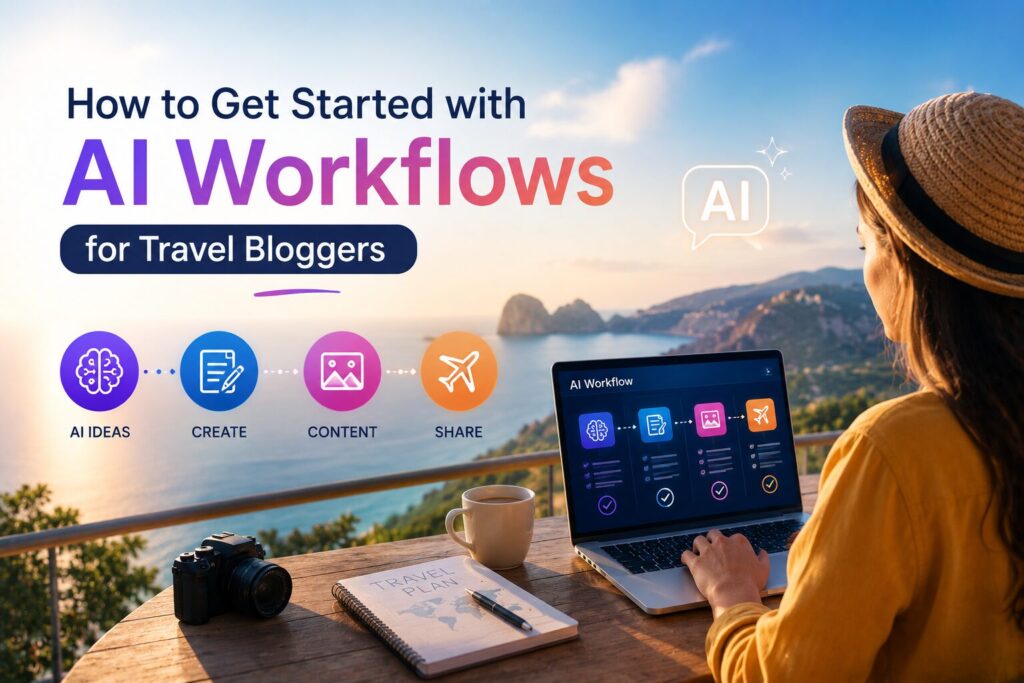
You do not need to be technical to implement AI workflows for travel bloggers. Here is the exact process.
Step one: Audit your current content production process. Track everything you do for one week. Write down every task — research, writing, editing, image creation, video editing, scheduling, analytics. Identify which tasks take the most time.
Step two: Pick one workflow from this list. Do not try all ten at once. Choose the workflow that solves your biggest bottleneck. If you struggle with video editing, start with Workflow #4. If SEO is your problem, start with Workflow #2.
Step three: Set up the tools for that workflow. Most AI tools have free tiers. ChatGPT has a free tier. CapCut AI has a free tier. Canva has a free tier. Use free versions until you prove the workflow works for you.
Step four: Run the workflow for two weeks. Measure your time saved. According to documented case studies, marketers using AI-powered automation tools report saving 10 to 15 hours per week. If you are not saving time, adjust the workflow or try a different one.
Now here is the part most guides skip entirely — the actual step-by-step AI workflows for travel bloggers that are generating real results in 2026.
This is the most powerful new AI workflow for travel bloggers in 2026. Instead of manually researching and building itineraries, you let AI convert social media inspiration into structured travel plans.
How this workflow works:
Step 1: Save Instagram Reels or YouTube videos that showcase destinations, accommodations, or experiences you want to feature.
Step 2: Use Alike’s AI travel assistant Eia (launched April 2026) which accepts input directly from Instagram Reels and YouTube videos and converts saved content into structured trip itineraries. Multiple users can collaborate on itineraries in real time.
Step 3: The AI extracts destination signals, accommodation ideas, and activities, then converts raw inspiration into structured travel plans that can be edited.
Step 4: Tripadvisor’s experimental AI planning tool (partnering with Nvidia, Nebius, and Nexla) also takes influencer videos and finds locations and experiences featured in the video, cross-referencing them with travel data to create personalised, ready-to-book itineraries.
Why this workflow saves time: Instead of spending 2 to 3 hours manually researching and structuring an itinerary, you spend 10 minutes inputting social media links and letting the AI do the heavy lifting. As noted earlier, 42% of operators report AI speeds up research and itinerary creation.
Tools needed: Alike’s Infinity platform (free tier available), Tripadvisor’s AI planning interface (in beta as of March 2026), or Expedia’s Trip Matching feature.
Pro tip: Once the AI generates the itinerary, add your personal experience and insider tips. AI handles the skeleton; you add the soul.
Writing blog posts is the biggest time sink for most travel bloggers. The average blog post now takes over 4 hours to write. This workflow cuts that time in half.
How this workflow works:
Step 1: Use ChatGPT, Claude, or Gemini to brainstorm blog post ideas based on destination trends and audience questions. Perplexity is particularly useful for getting quick answers on destination and travel trends, especially when you need up-to-date information.
Step 2: Generate a detailed outline with subheadings, key points, and suggested keywords. AI writing assistants like ChatGPT, Claude, Jasper, and Rytr can help brainstorm ideas, generate outlines, write first drafts, or even adapt tone for different audiences.
Step 3: Write the first draft using AI. Tools like ChatGPT can quickly draft blog posts, destination guides, email newsletters, and social media posts, captions, or video scripts for Reels. Provide simple prompts such as “Write a blog about the best time to visit Greece” or “Turn my recent trip experience into a destination guide”.
Step 4: Run the draft through Grammarly or QuillBot for proofreading to make it clearer and polish the final draft.
Step 5: Use AI for SEO keyword research. ChatGPT and Perplexity suggest relevant keywords and search-friendly titles more quickly than you could manually.
Why this workflow saves time: You can take rough notes from a recent trip, itinerary highlights, or frequently asked questions and transform them into structured content within seconds. What used to take 4 hours now takes 60 to 90 minutes.
The critical rule: You must always review AI-generated content carefully from the perspective of human sensibility, and be sure the content is correct. AI drafts; you verify, fact-check, and add your unique voice.
You do not always have the perfect photo for every blog post or social media graphic. This workflow solves that problem by creating professional travel visuals on demand.
How this workflow works:
Step 1: Open CapCut’s AI Image generator. AI Image for Travel means turning destination ideas into visuals with AI so you can plan, promote, and remember trips.
Step 2: Craft a detailed travel prompt. Start with a prompt and let it build the scene — sunrise balloons over Cappadocia, Kyoto alleys after rain, or a clean Amalfi itinerary cover — then dial in style, mood, and composition. Pick an intent (social story, itinerary header, blog hero), set the look (photorealistic, illustration, collage), and add context (season, time of day, landmarks, camera angle).
Step 3: For portrait shots with your face, use Gemini AI Travel Photo Generator in Dreamina. Upload one clear portrait. Your face stays true while the environment updates realistically — lights, shadows, and depth all cohere. Specify time of day (golden hour or blue hour), weather, and colour grade to match your vibe.
Step 4: Export assets for social or blogs in the correct formats — 9:16 Stories, 1:1 Posts, 4:5 Feed, 16:9 Thumbnails — without manual cropping.
Why this workflow saves time: Instead of spending hours searching stock photo sites or waiting for perfect weather conditions, you generate exactly what you need in minutes. Teams like CapCut work because prompts, adjustments, and export live in one place, so a whole travel series stays consistent.
Pro tip: Use photorealistic style for realistic previews and hotel marketing, illustration for itinerary maps and packing lists, and collage for journals and posters.
In 2026, short-form video is not “promotion” — it is the primary way people discover new travel vloggers and bloggers. This workflow turns raw footage into publish-ready Reels in minutes, not hours.
How this workflow works:
Step 1: Upload your raw travel footage to CapCut. CapCut has evolved far beyond a simple TikTok editor and now sits at the centre of the mobile AI video creation movement, with AI-powered captions, beat syncing, automatic cut generation, and template systems.
Step 2: Turn on auto-subtitles. For TikTok and Reels workflows, auto-subtitles plus noise reduction plus automatic scene detection dramatically reduce editing time.
Step 3: Use AI beat sync to automatically match cuts to music. CapCut’s AI beat sync detects rhythm and times transitions to the beat.
Step 4: For creators wanting rapid turnaround social video production with minimal editing friction, the Captions app is one of the strongest AI-native mobile-first tools currently available in 2026.
Step 5: Export directly from the tool with the correct aspect ratio for each platform. CapCut handles vertical 9:16 for Reels and Shorts automatically.
Why this workflow saves time: What used to take 2 to 3 hours of manual editing now takes 15 to 30 minutes. The best AI video maker tools can turn a simple idea into a polished, publish-ready short video in minutes.
Pro tip: Use CapCut’s template system. One of the fastest ways to create Reels is to find a template that matches your aesthetic and replace the media with your footage. The tool handles transitions, text placement, and music sync automatically.
Posting consistently across Instagram, TikTok, YouTube Shorts, Facebook, Pinterest, and LinkedIn is overwhelming. This workflow automates the entire posting schedule.
How this workflow works:
Step 1: Use AI to generate platform-specific captions. Tools like ChatGPT can turn one blog post into multiple social media posts, captions, or video scripts for Reels.
Step 2: Feed all your content into an AI social media management platform. AI social media automation platforms can handle content creation, scheduling, engagement, trend scouting, and analytics — with step-by-step workflows for each platform.
Step 3: Let AI determine optimal posting times. Instead of relying on surveys or assumed patterns, AI scheduling tools analyze real clicks across billions of links to suggest optimal posting times based on your audience’s specific behaviour.
Step 4: The AI automatically schedules posts at optimal times using past engagement data and audience activity patterns. It monitors performance metrics like likes, shares, reach, clicks, and conversions in real time.
Why this workflow saves time: AI is now a core requirement in the social media marketing workflow. By automating the mundane, like scheduling and basic reporting, you free up your time to focus on what AI cannot do: building genuine human connections and crafting a unique brand narrative.
Pro tip: AdaptlyPost, launched in May 2026, enables creators to plan, generate, and auto-publish content across 9 platforms including Instagram, TikTok, LinkedIn, and X using built-in AI writing and agentic AI workflows.
If you want to grow your travel blog beyond English-speaking audiences, you need content in multiple languages. This workflow handles translation and cultural adaptation automatically.
How this workflow works:
Step 1: Write your original blog post in your primary language (English, for example).
Step 2: Use DeepL or Google Translate AI to generate a first-pass translation into target languages (Spanish, French, German, Japanese, Chinese, etc.).
Step 3: Run the translated content through Grammarly or LanguageTool in the target language to catch errors.
Step 4: For truly professional results, use Jasper with its Brand Voice feature. Jasper’s Brand Voice feature learns your tone and style from your existing content, so everything you create feels cohesive and professional — while still sounding like you — even across multiple languages.
Why this workflow saves time: Manual translation at $0.10 to $0.20 per word adds up quickly for a 2,000-word blog post — $200 to $400 per post. AI translation costs pennies. The trade-off is quality, so always have a native speaker review critical content.
Pro tip: Yanolja Next introduced EEVE ROSETTA, a travel-focused translation model, in February 2026. For travel-specific vocabulary and context, specialised translation AI outperforms general-purpose tools.
Travel videos need narration, but not everyone has a professional voice or a quiet recording space. This workflow creates natural-sounding voiceovers in minutes.
How this workflow works:
Step 1: Write your voiceover script. You can use ChatGPT to draft narration based on your blog post or itinerary.
Step 2: Paste the script into ElevenLabs, Play.ht, or Murf. These AI voice generators produce human-quality narration with natural pacing, intonation, and emphasis.
Step 3: Select a voice that matches your brand — warm and friendly for family travel content, professional and polished for luxury travel.
Step 4: Adjust speaking rate and add pauses. The best AI voice tools allow you to control pacing, add emphasis on specific words, and insert natural breathing pauses.
Step 5: Sync the generated audio with your video in CapCut or Descript. Descript is particularly useful because it synchronises the voiceover to your video timeline automatically.
Why this workflow saves time: Recording and editing voiceover manually takes 1 to 2 hours for a 5-minute video. AI voiceover takes 5 to 10 minutes. For creators working across TikTok, Instagram Reels, and YouTube Shorts, AI voice tools are no longer experimental novelties — they are becoming embedded within the everyday language of content production itself.
Pro tip: For travel videos that will be translated, record the voiceover once in English, then use AI to generate voiceovers in other languages using the same script translated by DeepL. The voice can stay consistent while the language changes.
Email newsletters remain one of the highest-ROI channels for travel bloggers. This workflow turns one blog post into a week’s worth of newsletter content.
How this workflow works:
Step 1: When you publish a new blog post, feed the URL into an AI newsletter tool like Mailchimp’s AI assistant or ConvertKit’s AI features.
Step 2: The AI extracts key points and automatically generates:
Step 3: Review and personalise. Add a personal note or behind-the-scenes detail that only you can provide. AI handles the structure; you add the humanity.
Step 4: Set up automated sequences. When a new subscriber joins, AI can automatically send them your most popular posts based on their interests.
Why this workflow saves time: Instead of spending 2 to 3 hours crafting each newsletter, you spend 20 to 30 minutes reviewing and personalising AI-generated drafts. Jasper is especially helpful when you have the details of a trip but need help turning them into something engaging — you can drop in notes and Jasper can turn them into friendly descriptions, helpful travel tips, and follow-up emails.
Pro tip: Use Jasper to tailor your messaging for different types of subscribers, whether you are working with adventure travellers, luxury seekers, or budget backpackers.
You cannot grow your travel blog if you do not know what is working for other successful travel creators. This workflow automates competitor research and trend detection.
How this workflow works:
Step 1: Use Semrush or Ahrefs AI to analyse competitor domains. Identify which keywords are driving traffic to their blogs and which content formats are performing best.
Step 2: Use Perplexity AI to ask questions like “What are the emerging travel trends in [destination] for 2026?” This tool provides quick, up-to-date answers on destination and travel trends, making it valuable for staying ahead of the competition.
Step 3: Set up Google Alerts with AI-powered filters to monitor specific keywords and competitor mentions.
Step 4: Use BuzzSumo AI to identify which travel topics and formats are generating the most social media engagement.
Why this workflow saves time: Manual competitor analysis — reading blogs, checking social media, tracking keywords — takes 5 to 10 hours per week. AI tools compress research into faster cycles. Instead of reacting to changes, you can act with agility, responding to what is happening in real time.
Pro tip: Travel content that speaks directly to day trips, quick getaways, or weekend itineraries gives AI clearer signals about who your destination is for and how it should be recommended. Use AI to identify which micro-niches are underserved in your destination.
Posting content is not enough. You need to know what is working and what is not. This workflow turns raw analytics into actionable insights.
How this workflow works:
Step 1: Connect your Google Analytics, social media accounts, and email platform to an AI analytics tool like Tableau AI, Looker Studio, or a specialised travel analytics platform.
Step 2: AI automatically monitors engagement metrics like likes, shares, reach, clicks, and conversions in real time, generating reports that you can act on.
Step 3: AI identifies patterns in audience behaviour. Which topics drive the most traffic? Which posting times generate the highest engagement? Which email subject lines have the best open rates?
Step 4: Use those insights to inform your content strategy. AI can even suggest adjustments to your content calendar based on real-time performance data and audience signals, automating everything from scheduling to asset creation and optimisation.
Why this workflow saves time: Instead of spending 3 to 5 hours each week manually pulling reports and trying to spot patterns, AI does it in seconds. This allows you to act on insights immediately rather than spending hours buried in spreadsheets.
Pro tip: Look for platforms that offer agentic AI integration. AdaptlyPost’s agentic AI workflows can automatically adjust posting schedules and content formats based on real-time performance data without manual intervention. based on real-time performance data without manual intervention.
The AI landscape for travel bloggers has shifted from experimental to essential. Here is the raw data driving that shift — and what it means for your workflow.
71% of travel creators now use AI tools in their processes, according to the 2026 Travel Creator Economy Report from Travel Massive, which surveyed 500 creators across 56 countries. Among full-time creators, 14% now earn $75,000+ per year. Affiliate marketing adoption jumped 15% year-over-year to 61% of creators.
GetYourGuide’s Spring 2026 Travel Experience Trend Tracker adds a critical insight: profitable operators — those with margins above 20% — are about 25% more likely to be actively using AI compared to non-profitable ones. And 50% of profitable operators say AI is “very effective” for their business — among non-profitable operators, that number drops to 38%. The data suggests a clear pattern: AI adoption correlates with profitability.
Here is the shift that should change how you structure every piece of content: 53% of travellers now use AI tools for destination research, and 33% specifically use it to discover experiences. 69% used at least one AI tool when planning their most recent trip — and they rated it more helpful than friends, colleagues, or influencers.
The catch? Only 17% actually book through AI. Discovery happens in AI. Conversion still happens on your site. This means your job is not to compete with AI — it is to be found by it. If your content is poorly structured, AI tools won’t surface you.
Bloggers using AI technologies report 70% time savings in content creation and 150% increase in publishing frequency while maintaining quality. One documented case shows a travel blogger using just three AI tools growing revenue 3.5x in six months and 13x over seven months — all while working a full-time job and blogging only a few hours per night.
AI Travel Twins: Alike launched “Eia” in April 2026 — an AI travel twin that accepts input directly from Instagram Reels and YouTube videos, converting saved content into structured trip itineraries. Multiple users can collaborate on itineraries in real time. For travel bloggers, this means your video content can now directly feed into itinerary creation workflows.
Browser-Based Itinerary Generation: Academic research introduced “Roamify” in 2026 — a browser extension that converts live travel blogs and articles into structured multi-day itineraries using large-scale web scraping and neural summarisation. This points to a future where your existing blog posts automatically become interactive planning tools.
AI Agents for Full Automation: Antradus AI Lite now generates full SEO-optimised articles and matching images directly inside the WordPress post editor. AI Traffic Booster acts as an agent that researches keywords, writes blog posts, optimises on-page SEO, and auto-publishes social content — all tailored to your travel brand.
The data tells a clear story. AI is no longer optional for travel bloggers who want to compete. The creators pulling ahead are not using AI to replace their voice — they are using it to amplify their reach, save time on repetitive tasks, and structure their content so AI discovery tools can find it.
Structure your content for AI discovery. Use AI to handle the 70% of work that does not require your unique perspective. And reserve your creative energy for what algorithms cannot replicate: the visceral, unscripted human experience that turns readers into loyal followers.
AI workflows for travel bloggers are interconnected sequences of AI-powered tools that automate repetitive content creation, editing, scheduling, and analytics tasks. Instead of using one AI tool sporadically, these systems chain multiple tools together — for example, from social media inspiration to AI-generated itinerary to AI-written blog post to AI-edited Reel to AI-scheduled social posts.
Pick one workflow from this list that solves your biggest bottleneck. If video editing is your struggle, start with Workflow #4 (AI video editing for Reels). If writing takes too long, start with Workflow #2 (AI content writing). Most AI tools have free tiers, so you can test before committing financially. Run the workflow for two weeks, measure time saved, then add a second workflow.
Case studies on AI-powered automation consistently show 10 to 15 hours saved weekly for marketers who adopt these workflows. For travel bloggers specifically, these tools reduce time spent on tasks such as research, drafting, editing, planning, and promoting. With repetitive tasks automated, bloggers can dedicate more time to storytelling and audience engagement.
For writing and SEO: ChatGPT, Claude, Jasper, Perplexity. For video editing: CapCut (best overall AI video generator app) and Captions (best for rapid mobile-first editing). For image generation: CapCut AI Image and Gemini AI Travel Photo Generator in Dreamina. For social media scheduling: AdaptlyPost (AI-first scheduling with agentic AI) and Rebrandly AI scheduling tool. For voiceover: ElevenLabs and Play.ht.
Yes, but with clear expectations. AI workflows for travel bloggers are worth it because the travel blogging industry faces catastrophic saturation in 2026 with 25 million creators producing 6.7 billion posts for 2.5 billion readers — a 2,680:1 ratio creating a 98% failure rate for new entrants. Without automation, you cannot compete. AI does not replace your unique voice and experience — it amplifies them by handling the repetitive work. Start with one workflow, prove it works, then scale.
The 10 AI workflows for travel bloggers in this guide represent the most effective automation strategies available in 2026. Travel blogs are evolving, and only structured, AI-optimised, genuinely useful content survives.
The travel bloggers who win in 2026 are not the ones with the most time or the biggest budgets. They are the ones who build intelligent AI workflows that handle the repetitive work so they can focus on what AI cannot replace: real experience, genuine storytelling, and human connection. The best time to build your first AI workflow was six months ago. The second best time is right now.
All figures are sourced from publicly available reports, benchmarks, and industry data from 2026.
Leave a comment below — which AI workflow for travel bloggers are you trying first?
P.S. — We publish one practical AI guide every week at AICAP.in. Subscribe below — no spam, no fluff, just strategies that actually work.

Salman Shaikh is the founder and editor-in-chief of AiCap.in, an independent AI and personal finance publication based in Ahmedabad, India.
Since launching AiCap.in in April 2026, Salman has personally tested and reviewed 100+ AI tools across income generation, crypto research, content creation, and personal finance — publishing 91+ hands-on guides based on real usage, not press releases.
His approach is simple: every tool he writes about is one he has opened, tested, and either used to earn money or rejected after finding it didn’t deliver. He started AiCap.in after realising most AI content in India was either written by people who had never touched the tools, or buried in technical jargon that everyday people couldn’t act on.
His work covers AI tools for passive income, freelancing with AI, crypto research workflows, Amazon FBA with AI, and personal finance strategies built for readers in India and accessible to anyone globally looking to earn smarter with AI.
AiCap.in now reaches a growing community of readers across India and globally who want practical, jargon-free AI strategies they can implement today.
Connect with Salman: LinkedIn · X @AiCap88 · YouTube · Medium





Workflow #4 about AI video editing really caught my eye — I’ve been manually chopping up travel footage for Reels and it’s honestly killing my productivity. The viral Reels part is what gets me though, because not everyone knows that turning static photos into video actually performs way better on Instagram and TikTok right now. That’s where ImageToVideoAI comes in handy; it converts photos into cinematic videos using 14 different AI models, and you get free credits on signup without needing a credit card, so it pairs nicely with the editing workflow you described. Worth checking out if you’re already doing the video-first strategy.
This was a really interesting and practical read. I liked how the article presents AI workflows as a way to reduce repetitive work rather than replace the personal experience and creativity that make travel content valuable. The idea of connecting different tasks—such as research, content creation, video editing, social media scheduling, and analytics—into one workflow makes a lot of sense for travel creators who are managing everything themselves. I also appreciated the reminder that AI can help with the structure and efficiency, while the human perspective is still what gives travel content its authenticity. A very useful guide for anyone looking to work smarter in the travel content space
Thanks, sdiviyashree! Really appreciate your thoughtful comment. You’ve perfectly captured the core message—AI as an enabler, not a replacement. That authenticity piece is everything in travel content. Glad you found it useful!
This is a really helpful and practical guide! The AI workflows are explained clearly, making it easier for travel bloggers to save time and create better content.
Thank you so much! I’m really glad you found it helpful. That’s exactly what I was hoping for—making the process simpler and more efficient for fellow creators. Appreciate your support!