Ahmedabad, Gujarat, India
Ahmedabad, Gujarat, India
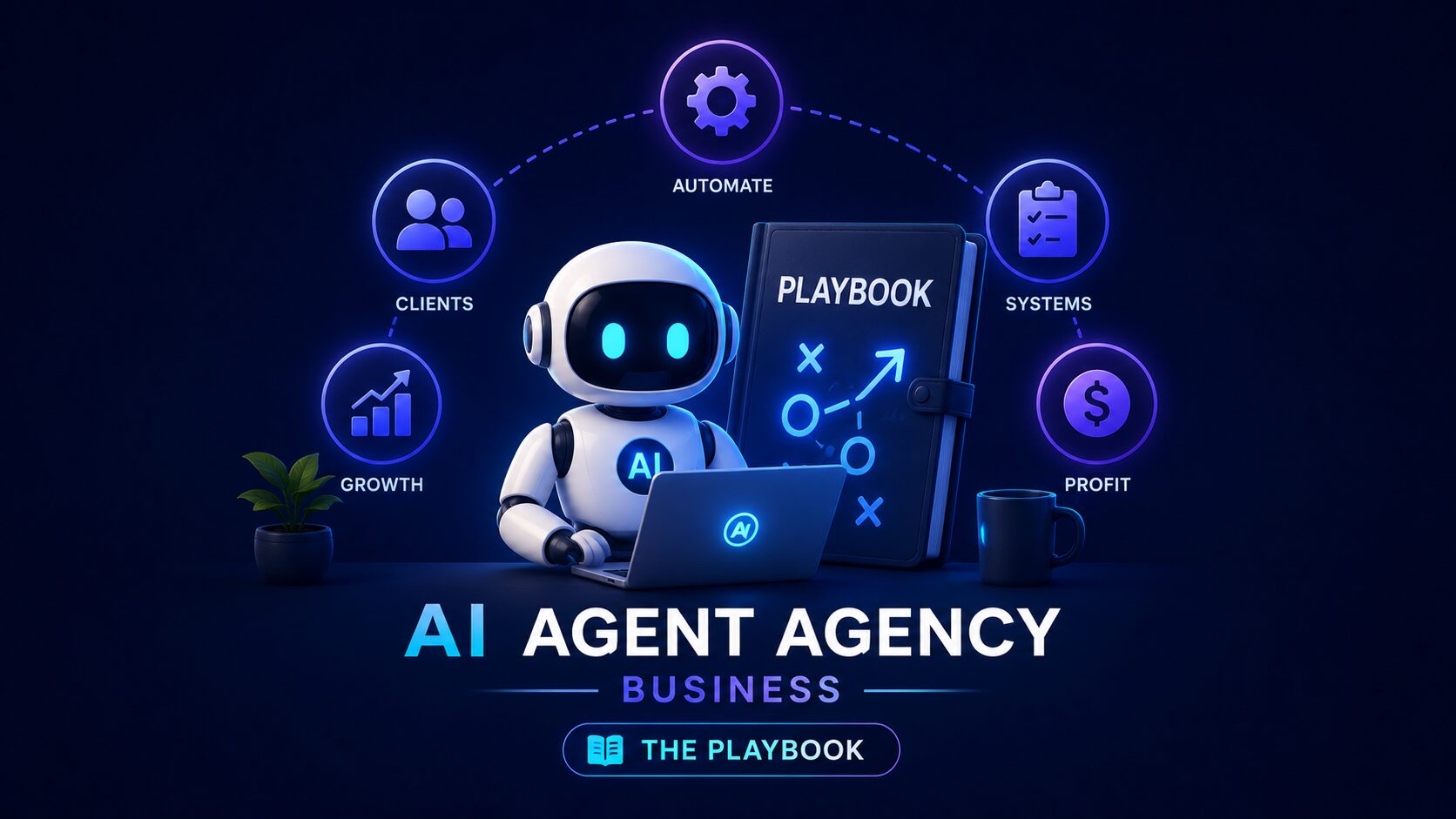
Launch an AI agent agency business in 2026 with zero coding. Real pricing, client acquisition scripts, and no‑code tools to scale from solo to $160K/month. Start today.
Disclaimer: This content is for educational and informational purposes only. Earnings and results vary by individual. Always conduct your own due diligence before committing time or money. AICAP.in is not affiliated with any platform or framework mentioned in this guide.
You have heard the hype about AI agents replacing jobs. What fewer people talk about is the service opportunity between the hype and the reality. Businesses know they need AI agents, but many have no idea how to build, deploy, or maintain them.
An AI agent business is a service firm — or a solo operation — that builds, deploys, and manages autonomous AI agents for other companies. Instead of selling a software license, you sell the agent as a service. Industry analysts sometimes call this “Agents as a Service” (AaaS).
This is not limited to chatbots. AI agents reason, plan, and execute multi-step tasks across software applications. A customer support agent that resolves tickets without human intervention. A data extraction agent that pulls information from invoices and enters it into a CRM. A lead qualification agent that researches prospects and drafts personalized outreach.
This guide combines two angles that are often covered separately: the business models that generate revenue, and the agency-side operational playbook for scaling past solo work. It covers how to start, what to charge, which tools to use, and how to move from your first client to a repeatable operation.
Realistic expectations up front: results depend on your niche, effort, and execution. This guide does not promise a specific income figure. Treat pricing ranges as market reference points, not guarantees.
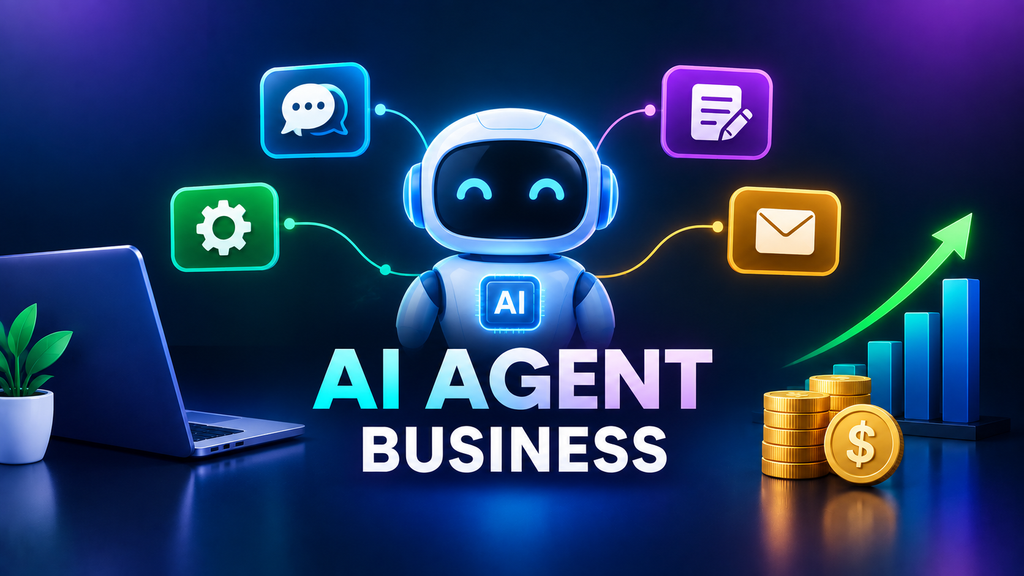
An AI agent business is a service operation that designs, builds, deploys, and maintains autonomous AI agents for clients. The deliverables vary, but they share a common trait: the agent performs work that previously required a human to do manually.
Common examples include:
The business can be run solo, as a freelancer, or scaled into an agency. The model you choose determines your pricing, your client relationships, and how much of the work is repeatable versus custom.
The distinction matters because it defines the value you sell.
| Feature | AI Agents | AI Assistants |
|---|---|---|
| Primary goal | Execute complete tasks from a high-level goal | Respond to individual user prompts |
| Mode of operation | Proactive and autonomous | Reactive; waits for a command |
| Execution | Plans and executes multi-step workflows | Handles simple, single-turn tasks |
| Human involvement | Minimal; loops you in for decisions | Required for every interaction |
| Example use case | Orchestrating a product launch across marketing, sales, and fulfillment | Drafting an email or summarizing a document |
A chatbot answers questions. An agent completes tasks. That is the value proposition clients are paying for.
The market data below is drawn from publicly reported analyst forecasts. Because these figures are projections and change as research firms update their models, verify current numbers through the original sources before making business decisions.
Market sizing. Analyst reports have placed the global AI agents market at approximately $8 billion in 2025, with projections around $11.78 billion for 2026 — a compound annual growth rate in the mid-40s percent range. Longer-term forecasts from the same research firms project the market reaching into the hundreds of billions of dollars by the mid-2030s.
Enterprise adoption. Gartner has projected that a significant share of enterprise applications — cited at around 40% — will include task-specific AI agents by the end of 2026, up from a low single-digit percentage in 2025. IDC has projected that the number of AI agents in use worldwide could exceed 1 billion by 2029.
The deployment gap. McKinsey research has found that while a majority of organizations are experimenting with AI agents, far fewer have scaled to production. Multiple surveys have placed successful production deployment at well under half of pilot programs. This gap is the practical opportunity for service providers.
Analyst caution. Gartner has also projected that a substantial share of agentic AI projects may be paused or cancelled by the end of 2027 due to rising costs, unclear business value, or insufficient risk controls. This is not a reason to avoid the market — it is a reason to focus on reliability and measurable outcomes rather than hype.
The takeaway for anyone starting an AI agent business: the demand exists, but so does a deployment gap. Your job is to close that gap for clients who cannot close it themselves.
Each model below is a distinct way to generate revenue. Most successful operators start with one and expand over time.
You build one specialized agent and charge a monthly access fee to multiple customers. This is the most “product-like” model — closest to a SaaS business, but built on an agent.
How it works: Choose one narrow, repeatable problem. Build an agent that solves it. Package access as a subscription. The narrower the problem, the stronger the product. A prospecting agent built for one specific industry outperforms a generic prospecting tool because the language, workflow, and output format are tailored.
Pricing reference: Monthly subscriptions in the $100–$500 range are common for niche agents, depending on the value delivered.
Trade-offs: Higher upfront build cost. Slower time-to-first-revenue. But once running, subscriptions generate recurring revenue without requiring new sales for every dollar.
You build custom agents for individual businesses and charge project fees, often followed by a maintenance retainer.
How it works: A client has a specific workflow they want automated. You scope it, quote it, build it, deploy it, and hand it over (or maintain it ongoing).
Pricing reference: Market rates on freelance platforms commonly range from $500–$2,000 for a simple workflow automation, $2,000–$10,000+ for more complex integrations, and hourly rates in the $20–$60 range for ongoing contracts. These vary widely by platform, niche, and client size.
Trade-offs: Higher per-client revenue. Requires sales and scoping skills. Each project is somewhat custom, which limits leverage compared to subscription products.
You build agents or AI-powered services under your own brand, or under a client’s brand, and resell them. Common examples include AI-built websites, AI-generated content services, and AI-assisted marketing services.
How it works: You use agents to do the delivery work, then sell the output under a service brand. The client does not need to know or care that an agent did the work — they care about the result.
Pricing reference: Monthly retainers in the $500–$3,000 per client range are common for white-label service arrangements. Ten clients at $1,000 per month would represent $10,000 in monthly recurring revenue, though reaching and retaining ten clients is the hard part.
Trade-offs: Strong recurring revenue potential. Requires client management and quality control. The white-label framing means your brand, not a tool’s brand, carries the trust.
You use agents to produce content at scale — articles, newsletters, social posts, video scripts — and monetize through sponsorships, affiliate revenue, or your own products.
How it works: The agent handles research, drafting, formatting, and scheduling. You handle editorial direction, quality review, and sponsor relationships.
Pricing reference: Content operations vary enormously. Some solo operators generate meaningful sponsorship revenue from niche newsletters. Others use agent-produced content to feed their own products. There is no universal income figure.
Trade-offs: Requires editorial judgment to maintain quality. Platforms including Google Search and YouTube have explicit policies against mass-produced, low-value content, so quality control is essential. This model is not passive — the human review step is where the value is added.
You offer agent setup as a service on freelance marketplaces like Fiverr and Upwork, or directly to small businesses.
How it works: Clients come with a specific task they want automated. You build a small agent or workflow, deliver it, and either close the project or convert to a retainer.
Pricing reference: Fiverr and Upwork data have shown a broad range for AI and automation services — from roughly $75 to $500+ per project for smaller engagements, with hourly rates spanning a wide band. Chatbot development, workflow automation, and NLP projects each have their own typical price points.
Trade-offs: Lowest barrier to entry. Fastest path to first revenue. But project work does not scale the same way subscriptions do — you trade time for money until you productize.
You do not need to be a developer to start an AI agent business. The proven path is freelancer → consultant → agency partner. Here is the progression.
Most people fail because they try to launch a full agency before landing a single client. Start by solving one repetitive workflow for one business. Prove the concept at a small scale before building anything larger.
Choose an industry you know or where people waste time on repetitive tasks. Talk to potential clients. Discover what drains their day, then build a simple offer around that one painful workflow. Do not build a solution looking for a problem.
You do not need LangChain or custom code for your first client. No-code platforms like n8n, MindStudio, or Make can build autonomous workflows that reason, decide, and act without touching code.
You might do a free or discounted first project to build proof. Get a testimonial. Watch referrals follow. Business owners care about outcomes — lead with clear time or cost savings, not with “AI.”
Once you have delivered three to five client projects, document your workflows, build templates, and start charging premium rates. The business scales through repeatable patterns, not custom work for every client.
This section covers the tools most often used for rapid prototyping without writing code.
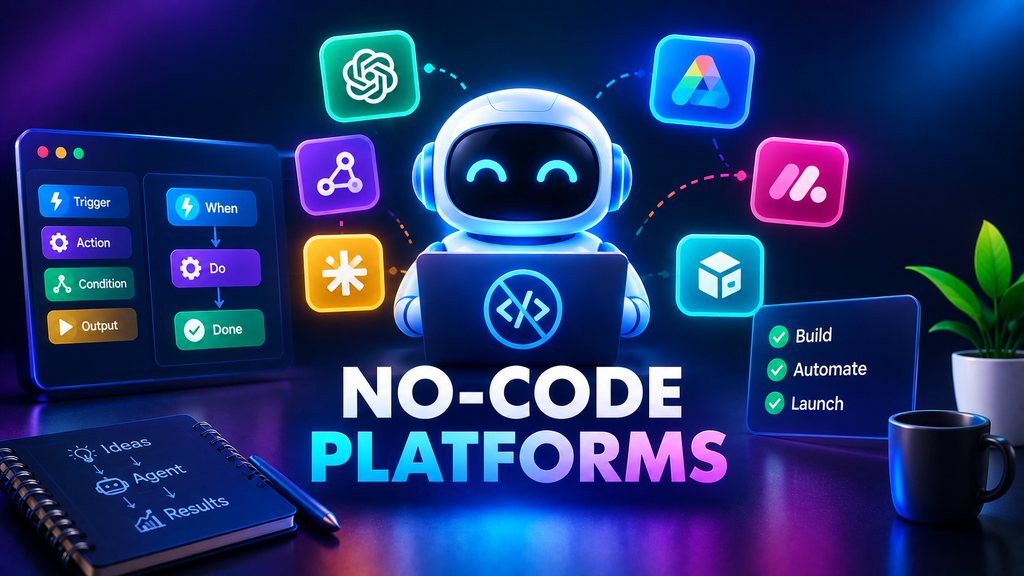
MindStudio is a no-code platform built specifically for creating AI agents. It offers a visual interface, access to a large library of AI models from OpenAI, Anthropic, Google, Meta, and Amazon through a unified interface, and an AI-powered architect feature that can auto-generate agent structures from text descriptions. Most users build a functional agent in 15 minutes to an hour.
Toolhouse is a no-code platform focused on natural-language agent creation. You describe each operation with clear inputs and outputs, and it integrates with tools like Gmail, Zapier, and Pipedream. Pre-built templates ease onboarding.
n8n is a workflow automation platform with native AI agent nodes that let you build multi-agent systems with tool calling and chain LLMs. It uses a fair-code license, which allows self-hosting for free with unlimited workflows. It bridges the gap between no-code simplicity and full programming power.
Make released an AI Agents app in early 2026 that lets users build, test, and deploy AI agents directly in the scenario builder. It includes tools and knowledge bases for more complex automation.
Voiceflow is a no-code conversational AI platform for teams building agents across chat and voice channels. Its core strength is a visual drag-and-drop flow builder for conversation logic. It supports knowledge base integration and LLMs from OpenAI and Anthropic.
Suggested path: Start with MindStudio for visual building or Toolhouse for natural-language description. Once you understand the workflow, graduate to n8n or Make for more complex multi-agent systems.
Once you outgrow no-code tools, these frameworks are commonly used in enterprise and production contexts.
LangChain / LangGraph are among the most-adopted AI agent frameworks in enterprise environments. LangChain leads on orchestration flexibility and MCP maturity. LangGraph is often used for stateful, multi-step agent workflows.
CrewAI is purpose-built for role-based multi-agent collaboration, where you define agents with specific roles, goals, and backstories.
LlamaIndex is used heavily for retrieval-heavy RAG (retrieval-augmented generation) applications.
Production platforms. Build-only frameworks handle agent construction but do not cover deployment, monitoring, versioning, rollback, or governance. Teams often have to build that infrastructure themselves, or use agentic-native production platforms that ship these capabilities as part of the product.
What actually blocks scaling. LangChain’s 2026 survey of practitioners found that a significant share cite quality and reliability as the top barrier to scaling agents — not framework selection or model capability. The tool matters less than the operational discipline around it.
Pricing is where many operators get stuck. Below are reference ranges drawn from publicly visible market data. Treat these as starting points, not fixed rules.
| Project Type | Price Range | Typical Timeline |
|---|---|---|
| Simple single-workflow automation | $500 – $1,000 | 3–5 days |
| Multi-workflow systems with integrations | $1,800 – $3,600 | 1–3 weeks |
| Complex AI agents with custom training | $3,600 – $9,600 | 2–4 weeks |
Monthly retainers. Basic monitoring plus bug fixes typically runs $180–$300 per month. Full managed service with prompt tuning and error handling commonly runs $500–$1,500 per month.
Context on in-house costs. Hiring an in-house AI specialist often costs $80,000–$180,000 per year plus overhead. This is why agency pilots in the $5,000–$20,000 range are often a lower-risk entry point for businesses exploring AI agents.
The estimation rule. AI automation projects consistently take longer than estimated because of unpredictable API behaviors, LLM output inconsistencies, and client data that is rarely as clean as described. Many experienced operators add 30–40% to their initial time and cost estimates as a buffer.
The difference between a prototype and a production agent is operational infrastructure. Most AI agent pilots never reach production because they stop at “impressive demo.” Here is what separates the two.
Use a no-code workflow tool for simple builds. Create a trigger (webhook, schedule, email), add an AI agent node, connect tools (HTTP request nodes for APIs), and define the output destination. First-time builds of a simple agent can take 30–45 minutes once you know the platform.
Production agents need failure modes designed in. When an API returns an error, does the workflow silently drop the message? That is a failure. Build retry logic with exponential backoff, dead letter queues for failed messages, and human escalation paths for low-confidence outputs.
Every serious client should ask: “Show me your monitoring dashboard.” What matters is per-execution logs, error rates, latency percentiles, and alerting on failures. The specific tool matters less than the practice — treat the workflow like a service, not a script.
No documentation, no runbook, no transition plan is a failure mode. When the workflow breaks six months after delivery, you are paying to remember what you built. Build documentation into your delivery process from day one.
Marketing matters at every stage. If leads are not coming in, there is no business. Here are four channels that work.
Highest time commitment, lowest friction, fastest cash. Buyers on these platforms are actively searching for automation help. Create a strong profile and send short proposal videos. Many operators land their first client here.
Medium cost, high skill, scalable. One system can send 20 or 2,000 emails per day depending on infrastructure. The first campaign is typically the worst performer — iterate weekly. Keep subject lines specific, focus on measurable outcomes, and reference something concrete about the recipient.
A note on proof: only cite results you can actually verify. Do not claim client outcomes you have not delivered. Fabricated proof will damage your reputation and, in some cases, violate platform policies.
Low cost, compounding authority. Answer real questions, post solutions, and DM people who need help. Provide value first. Do not pitch in your first interaction.
Higher barrier, higher upside. Keep messages short, specific, and proof-driven — but only with real proof.
A legitimate structure:
“Hi {Name} — I help {niche} automate {specific pain} with a small agent. Here’s how it works for one workflow: {one-sentence description}. If that’s relevant, happy to send a 5-minute breakdown. No pitch.”
Start with friends, former colleagues, and your email or phone contacts. Do not hard-sell. Start conversations. Ask for advice and referrals. Be transparent about where you are in your business.
Mistake 1: Trying to automate everything at once. Beginners often try to build a single agent that does everything. Start with one bounded task and perfect it before moving to the next.
Mistake 2: Not reviewing agent outputs. Some operators assume the agent’s work is done once it is built. That is how errors compound. Your role shifts from doing the work to reviewing the work. Set aside daily review time, then shift to weekly as reliability is proven.
Mistake 3: Using the wrong platform for your skill level. A beginner who chooses a developer-focused framework will struggle and likely abandon the effort. Start with no-code visual builders. Graduate to code-based platforms only when you have specific needs the visual builders cannot meet.
Mistake 4: Ignoring API costs. Some agents can consume more in API calls than they generate in revenue if not managed carefully. Monitor token usage. Choose efficient models for simple tasks. Set spending limits.
Mistake 5: Pricing based on hours instead of outcomes. The most successful operators price based on value delivered, not time spent. An agent that saves a client 10 hours of work per week has a value that is not tied to how many hours you spent building it.
Mistake 6: Over-promising on delivery timelines. AI projects are unpredictable. Under-promise on timelines and over-deliver on quality.
An AI agent business is a service operation that builds, deploys, and manages autonomous AI agents for clients. Instead of selling a software license, you sell the agent as a service — handling discovery, architecture, deployment, monitoring, and ongoing maintenance. Revenue comes through subscriptions, project fees, retainers, or white-label services.
Start as a freelancer solving one problem for one client. Pick a niche you understand. Use no-code tools like n8n, MindStudio, or Make to build your first agent. Overdeliver for your first client (possibly at a discount). Get a testimonial. Then systematize and scale. Do not try to launch a full agency before landing your first paying client.
Earnings vary widely. A solo freelancer charging $500–$1,000 per simple project can build a modest monthly income with a steady client pipeline. An agency with retainer clients at $1,500–$3,000 per month per client has more leverage but requires more infrastructure and sales effort. There is no universal income figure. Treat any specific claim — including those in other guides — as an estimate rather than a promise.
For no-code rapid prototyping: MindStudio (visual builder), Toolhouse (natural language), n8n (production-ready workflows with AI agent nodes), and Make (built-in AI Agents app). For custom development: LangChain/LangGraph (orchestration), CrewAI (multi-agent collaboration), and LlamaIndex (RAG-heavy applications). For production deployment: agentic-native platforms that ship the full stack from build to governance.
Yes, with realistic expectations. Analyst forecasts show meaningful market growth and enterprise adoption is still in early stages. However, many AI automation projects fail in production, and the gap between pilot and deployment remains wide. Your value as a service provider is not just building agents — it is building agents that stay running. Master error handling, monitoring, and documentation. That is what clients actually pay for.
The AI agent business is not a trend. It is a structural shift in how software and services are delivered. Analyst forecasts point toward significant market growth and broad enterprise adoption over the next several years. The service providers who learn to build, deploy, and manage AI agents reliably will capture value between the technology and the businesses that need it.
Five things to take away:
Start as a freelancer solving one problem for one client. Do not build an agency before you have delivered results.
Use no-code tools for your first agent. Thirty minutes to a working prototype changes everything.
Charge project-based for the initial build, then move to retainer for monitoring and maintenance.
Master production infrastructure — error handling, monitoring, documentation — before you scale.
Pick a niche. The service providers winning in 2026 are specialized, not generalist.
The window for early-mover advantage is open. The market is growing. Most businesses still cannot get agents into production reliably. That gap is your business.
This guide avoids anonymous seller anecdotes, fabricated case studies, and unverifiable income claims. Market data is attributed to publicly reported analyst forecasts where possible. Because platform policies, pricing, and market conditions change, verify current details through the links below before making business decisions.
Figures in this guide are presented only when they can be attributed to analyst forecasts, platform reports, or official documentation. Individual results vary based on niche, effort, pricing, and market conditions. Verify specific metrics through your own testing before making decisions based on this guide.
P.S. — We publish one practical AI guide every week at AICAP.in. Subscribe below — no spam, no fluff, just strategies that actually work.

Salman Shaikh is the founder and editor-in-chief of AiCap.in, an independent AI and personal finance publication based in Ahmedabad, India.
Since launching AiCap.in in April 2026, Salman has personally tested and reviewed 100+ AI tools across income generation, crypto research, content creation, and personal finance — publishing 91+ hands-on guides based on real usage, not press releases.
His approach is simple: every tool he writes about is one he has opened, tested, and either used to earn money or rejected after finding it didn’t deliver. He started AiCap.in after realising most AI content in India was either written by people who had never touched the tools, or buried in technical jargon that everyday people couldn’t act on.
His work covers AI tools for passive income, freelancing with AI, crypto research workflows, Amazon FBA with AI, and personal finance strategies built for readers in India and accessible to anyone globally looking to earn smarter with AI.
AiCap.in now reaches a growing community of readers across India and globally who want practical, jargon-free AI strategies they can implement today.
Connect with Salman: LinkedIn · X @AiCap88 · YouTube · Medium





[…] MCP hit 97 million installs in 2026 — the fastest adopted AI protocol ever. Complete guide to Model Context Protocol adoption, security, and use cases. read now> […]
[…] AI tools that work while you sleep in 2026 — 7 real automation platforms tested in April. Start earning passive income without manual work. […]
[…] survey of 1,000+ AI agency owners in 2026 revealed that Upwork remains the most popular client acquisition method for […]