Ahmedabad, Gujarat, India
Ahmedabad, Gujarat, India
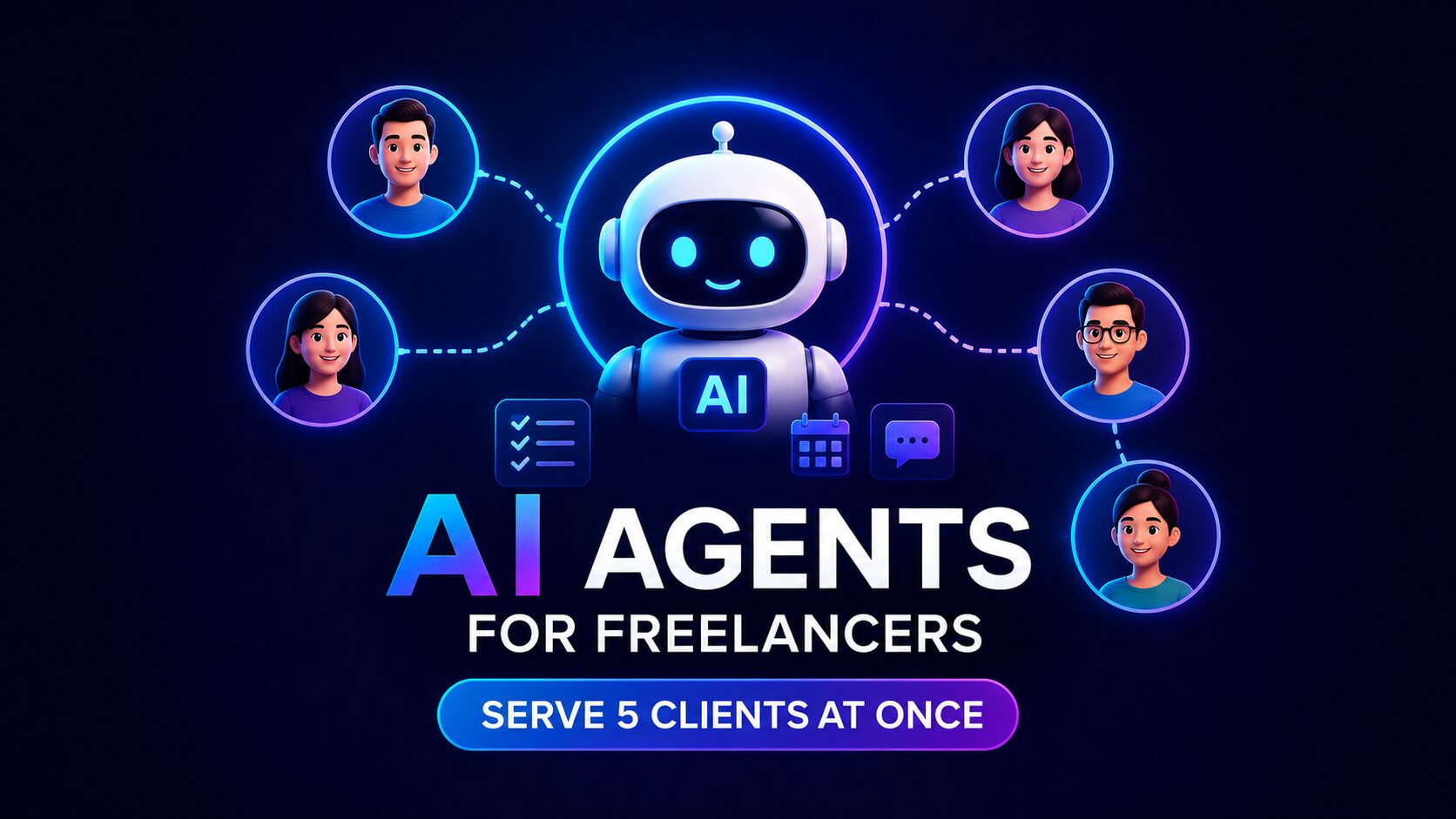
AI agents for freelancers: scale solo, 5+ clients, no code. Real 2026 workflows, earnings data & no-code platforms. Start today.
Disclaimer: This content is for educational and informational purposes only. Earnings and results vary by individual. Always conduct your own due diligence before committing time or money.
Most freelancers who try to scale hit the same wall. You want to take on more clients. But more clients mean more hours. More hours mean burnout. And burnout means you stop.
That wall is real. Upwork data from 2025 shows that average freelancer proposal win rates sit at just 5-12%, with only 2% of freelancers exceeding 80% success rates amid intense bidding competition. The average freelancer isn’t failing because they lack skill. They are failing because they lack leverage.
Agent-based workflows change that equation entirely. In 2026, the global AI agent market is worth $11.78 billion, growing at a compound annual rate of 46.61% and projected to reach $251.38 billion by 2034. Gartner reports that by the end of 2026, 40% of business applications will have AI agents handling specific tasks — up from less than 5% in 2025. This is not a future trend. This is happening right now.
This guide breaks down exactly how agent-based systems can help you serve 5, 10, or even 20 clients at once without adding a single hour to your workday. You will learn which no-code platforms actually work, how to set up your first agent in under an hour, and what results real freelancers are seeing in 2026. By the end, you will have a clear, actionable framework to scale your solo business — no coding required.
Here is the distinction most people miss. A chatbot answers questions. An AI agent completes tasks.
AI agents for freelancers are autonomous digital workers that can plan, execute, and report back without constant human supervision. Unlike simple automation tools that follow rigid scripts, AI agents can make decisions, adapt to new information, and work across multiple tools simultaneously. PwC’s 2026 AI Performance Study found that 74% of AI’s economic value is being captured by just 20% of organizations — and those leaders are 2.8 times more likely to have increased the number of decisions made without human intervention.
So what can these systems actually do? Consider a freelance social media manager. Without agents, she manually researches trends, writes captions, designs graphics, schedules posts, responds to comments, and analyzes performance. With one agent handling research and drafting, another managing scheduling, and a third handling basic client communication — her workload per client drops from 10 hours per week to 2.
A concrete example from 2026: a developer using ClawWork — a freelancing extension built on the OpenClaw ecosystem — reported earning $15,000 in just 11 hours by using agent-based systems to handle research, drafting, coding, design, and delivery across multiple client projects simultaneously. The developer focused only on the 20% requiring human judgment: understanding client needs and ensuring quality. The systems handled the rest.
The architecture is straightforward. You define a goal for the agent. The agent breaks that goal into steps. It executes each step using tools you connect — email, calendar, CRM, document storage, APIs. When it hits a decision point it cannot resolve, it flags you for input. Otherwise, it runs autonomously.
The freelance economy is shifting beneath your feet. Upwork’s February 2026 skills report shows AI-related freelance skills grew 109% year-over-year, with AI integration skills up 178% and AI chatbot development up 71%. Demand is exploding, but the nature of that demand is changing.
Consider what a freelancer faces in 2026. Template-based proposals on platforms like Upwork yield reply rates of just 2-5% and win rates of only 1-2%. Personalized proposals perform better with reply rates between 8% and 30%, but personalizing each proposal takes time — time you do not have when serving multiple clients. Meanwhile, the B2B sales environment shows that just 2% of sales are made on the first contact, making persistence and follow-up essential. Doing all of this manually while managing client work is impossible at scale.
Agent-based systems solve this by handling the work around the work. An AI agent can draft personalized proposals based on your past wins, track which proposals get responses, and automatically follow up with leads you would otherwise lose.
A freelance brand designer documented their numbers publicly: in 2024, they served three to four clients at a time, billing around $150,000 per year. In 2025, they added AI to their workflow — not as a gimmick but as actual production infrastructure. They now serve fifteen to twenty concurrent clients, their annual revenue hit $720,000, and they work fewer hours than before. They did not hire a team. They just got very good at using agent-based workflows.
The market context reinforces why this matters. The AI agent platform market is projected to increase by $31.46 billion at a CAGR of 41.5% from 2025 to 2030. By 2027, IDC predicts the number of enterprise agents will grow tenfold, and the number of token and API calls will grow a thousandfold. By 2029, there will be more than 1 billion AI agents in use worldwide — 40 times the number in 2025. The infrastructure is being built. The freelancers who adopt it first will capture disproportionate value.
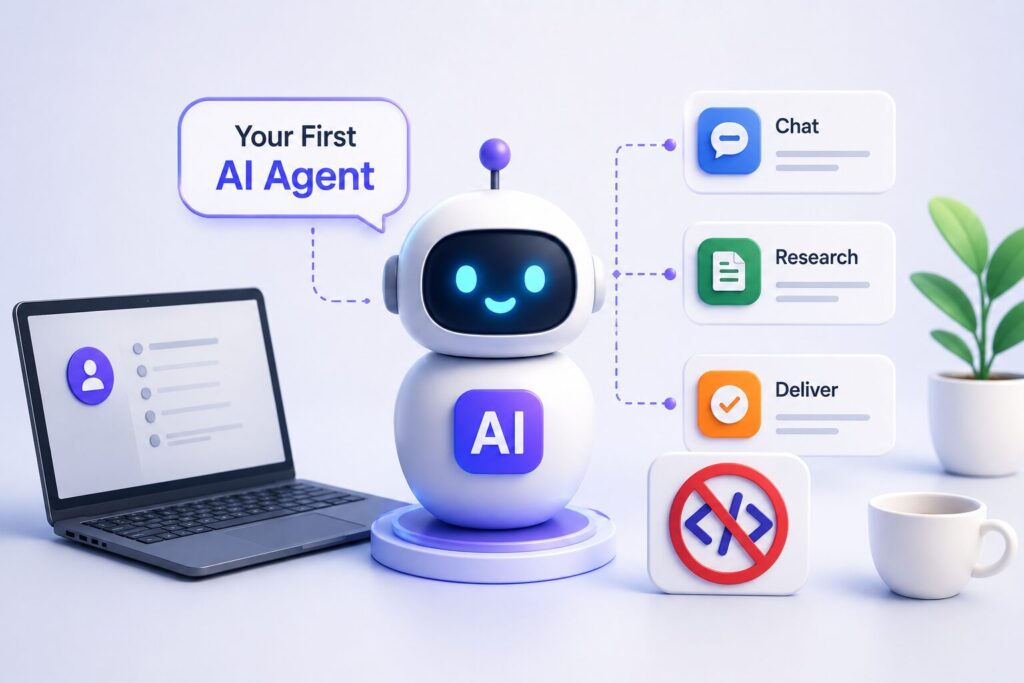
You do not need a computer science degree. You do not need to write Python. The platforms available in 2026 allow any freelancer to build functional systems using plain English descriptions.
Here is the step-by-step process that has worked for hundreds of freelancers documented in 2026.
Look at your past month of client work. What task did you do more than 10 times? Proposal writing? Research? Data entry? Client follow-up? Report generation? That task is your first automation candidate. Do not start with your most complex task. Start with a bounded, repeatable process that takes you 15-30 minutes each time.
The table below lists the platforms with proven track records in 2026. For your first agent, prioritize platforms with visual builders and pre-built templates over those requiring API knowledge.
This is the key insight that separates successful agent builders from frustrated ones. You do not configure the agent by checking boxes. You describe what you want in plain English. For example: “Create an AI agent that monitors my Gmail for new client inquiries, drafts a personalized response based on my past successful proposals, and adds the client to my follow-up calendar for 3 days if no response is received.” The platform translates your description into an agent workflow.
Run your agent on 5-10 test inputs before deploying it with real clients. Review every output. Refine your description based on what the agent gets wrong. This refinement loop usually takes 2-3 iterations before the agent performs reliably.
Once your agent works consistently, turn it loose on real work. Set aside 15 minutes each day to review what the agent produced. Over time, you will trust it more and review less. One freelance agency owner documented reducing their review time from daily to weekly after three months of consistent agent performance.
The entire process from first description to deployment typically takes 2-4 hours for a simple agent. For more complex agents with multiple steps and tool integrations, plan 6-10 hours. Compare that to the dozens of hours you will save each month once the agent is running.

Not all AI agent platforms are created equal. Some require extensive coding knowledge. Others produce unreliable outputs. Based on publicly documented usage data from 2025 and 2026, here are the no-code platforms that consistently work for freelancers.
| Platform | Key Feature | Starting Price | Best For |
|---|---|---|---|
| MindStudio AI | Visual interface, no coding required | Free tier available | First-time freelancers |
| Toolhouse | Plain English descriptions or templates | $10/month | Non-technical users |
| Lyzr Agent Studio | Low-code/no-code enterprise platform | $19/user/month | Multi-client freelancers |
| Alludium | “Agent Operating System” via conversation | Launching March 2026 | Teams and individuals |
| Nexus | Visual builder, 4,000+ app integrations | Contact for pricing | Freelancers with complex workflows |
MindStudio AI is widely cited as the best option for freelancers building agents without coding. Its visual interface allows teams to create, test, and deploy custom agents without engineering support. The platform handles content creation, data extraction, and customer support workflows effectively. Freelancers using MindStudio AI report that their first functional agent typically takes under two hours to build.
Toolhouse takes a different approach. Instead of a visual builder, it allows users to create agents using plain English descriptions or pre-built templates. The platform handles the underlying infrastructure, making AI development accessible to non-technical users including entrepreneurs, teachers, and freelancers. A free tier is available for getting started, with paid plans starting at $10 per month.
Lyzr Agent Studio offers a low-code and no-code platform specifically designed for enterprises but fully accessible to freelancers. The platform allows both technical and non-technical users to create AI-powered solutions for sales, marketing, HR, and finance automation. Starting price is $19 per user per month, making it accessible for freelancers with consistent work.
Alludium launched its AI Agent platform to the public in March 2026, expanding access beyond early design partners. The product is described as an “Agent Operating System” for building and managing custom AI agents through conversation, without writing code. It is positioned for individuals and teams that want to deploy agents that can take actions across workplace tools and workflows.
Nexus by Y Combinator-backed founders gives enterprises the infrastructure to build their own agents reliably — no code required. The visual builder includes AI actions, web search, data extraction, and integration with over 4,000 business apps. While targeted at enterprises, freelancers with multiple clients will find the integration depth valuable.
For freelancers just starting with agent-based workflows, the recommended stack is: start with MindStudio AI or Toolhouse for your first simple agent. Once you understand the workflow, graduate to Lyzr or Alludium for more complex multi-agent systems.
The numbers coming out of 2026 are striking. But they are not hype. They are grounded in documented workflows and publicly shared results.
A freelance brand designer scaled from $150,000 serving three to four clients to $720,000 serving fifteen to twenty concurrent clients after integrating agent-based workflows. The key was not working more hours. The key was delivering the same quality of work in a fraction of the time and charging based on value rather than hours.
A developer using OpenClaw agents reportedly earned $15,000 in 11 hours by handling multiple client projects simultaneously. The workflow involved agents handling research, first drafts, code generation, and asset creation while the developer focused on client understanding, creative decisions, and quality control. At $15,000 for 11 hours of focused work, that is roughly $1,360 per hour of the freelancer’s time. Even accounting for preparation time before those 11 hours, the economics are transformative.
An AI-powered agency model cited in Y Combinator’s Spring 2026 Request for Startups suggests a solo developer running an AI-powered content agency with ten clients at $3,000 per month** would generate **$360,000 in annual revenue. Operating costs are minimal because the systems handle most of the execution.
The demand signals support these results. Upwork’s data shows AI integration skills grew 178% year-over-year, meaning clients are actively seeking freelancers who can build and deploy AI agents. The supply of freelancers with these skills has not kept pace with demand, creating a pricing advantage for early adopters.
Freelancers who fail almost always start by trying to build a single agent that does everything. This never works. The correct approach is to start with one bounded task — proposal drafting, client follow-up, data extraction — and perfect that agent before moving to the next task.
Some freelancers assume that once the agent is built, they never need to look at its work again. This is how errors compound. AI agents make mistakes. The freelancer’s role shifts from doing the work to reviewing the work. Set aside daily review time. Over time, as the agent proves reliable, shift to weekly review. But never eliminate review entirely.
A freelancer with no coding experience who chooses a developer-focused framework like LangChain will struggle and likely abandon the effort. Start with no-code visual builders. Only graduate to code-based platforms once you have specific needs the visual builders cannot meet.
AI agents can draft proposals, but they cannot build relationships. The freelancers who succeed use the time saved to invest more deeply in client communication, strategic thinking, and creative work that only humans can do. If you use AI agents to isolate yourself from clients, you will lose clients. Use them to free time for better human work.
The AI agent market is not just growing — it is reshaping how businesses buy freelance services. Here is what the latest numbers reveal about where the opportunities actually are.
Fiverr’s 2026 Business Trends Index — drawn from millions of searches across the platform from November 2025 to April 2026 — reveals exactly where the money is moving. Demand for Claude Code specialists has surged 938% over the last six months. Businesses are seeking freelancers who can use this AI coding tool to automate workflows, build AI agents, and ship products faster.
The ripple effect is equally striking. Searches for related AI automation services are also exploding: n8n AI automation (+125%), which connects apps and AI models into automated workflows, along with vibe coding (+61%), and AI voice agents (+49%).
“Freelancers are bridging the gap between businesses that experiment with AI and those that are meaningfully adopting it,” said Elliott Johnson, founder of EKB Labs and an AI consultant on Fiverr. “Anyone can spin up a prototype now, but there’s a massive gap between that and something that actually holds up. Most businesses are finding out the hard way that closing that gap takes real expertise.”
The lesson is clear: general AI skills are not enough. The premium is on specific, high-demand capabilities like Claude Code, n8n automation, and vibe coding. Freelancers who specialize in these areas are entering markets where demand far exceeds supply.
Here is a finding that may surprise you: despite AI’s reputation as a backend efficiency tool, businesses are currently deploying it fastest on the front end in content production and customer-facing workflows. Demand for AI-related services is growing most in Video & Animation (+278%), outpacing Programming & Tech (+94%), Digital Marketing (+62%), and Data (+3%) by a significant margin.
What this means for freelancers: the most immediate and tangible application of AI is not in backend systems — it is in what customers actually see. Freelancers who can combine AI video generation, animation, and content production with human oversight are capturing premium rates in a market where demand is growing nearly three times faster than any other category.
A 2026 survey of 300 companies, with 23 actively building AI agents, reveals a clear pattern: the majority are turning to outside help rather than developing capability in-house. The breakdown is instructive:
| Development Source | Percentage |
|---|---|
| Agencies or consultancies | 57% |
| Internal teams | 21% |
| Freelancers | 13% |
Note: The remaining 9% used other methods such as hybrid internal-external teams or had not yet determined their approach.
The 13% freelancer share represents a meaningful slice of the market outside traditional agency relationships. With only 23 of 300 surveyed companies currently building AI agents at all, the market is still in its earliest stages. The competitive advantage for early movers is real and measurable because most competitors have not even started.
For freelancers and independent consultants, this 13% market share in AI agent development is a signal to build this capability now. The demand is already there. The constraint is the supply of credible providers, not client interest.
The adoption numbers look enormous on paper, but the ground truth is rougher. According to Zapier’s State of Agentic AI report, 72% of companies have an AI agent running — but only 31% have one in full production. Most are still experimenting.
Gartner warns that over 40% of agentic AI projects will be cancelled by 2027 due to runaway costs, unclear value, and inadequate risk controls. When a project does work, the median payback period sits at 5.1 months.
This is a critical insight for freelancers. Businesses are eager to adopt AI agents, but many are failing at implementation. The freelancers who succeed will not just build agents — they will build agents that actually work in production.
A 2026 benchmark called the Remote Labour Index (RLI) tested whether AI systems can truly replace human freelancers. The dataset includes 240 real freelance projects across 23 categories, representing more than 6,000 hours of human labour valued at over $140,000.
The results: the highest-performing model achieved an automation rate of just 2.5% — meaning it produced work comparable to human freelancers on only a handful of projects. Other leading systems scored between 0.8% and 2.1%. In practical terms, more than 97% of the projects were not completed at a level that would be accepted by a paying client.
The study found recurring weaknesses: incomplete or truncated outputs, corrupted files, poor professional quality, and inconsistencies across assets. For freelancers, this is validation. AI agents are not replacing you. They are tools that require your judgment, your quality control, and your ability to deliver work that a client will actually accept.
Freelancers who use AI strategically can reclaim 6 to 10 hours per week of non-billable time. That is not a productivity hack — it is the difference between being stuck at 3-4 clients and scaling to 15-20.
A key insight from the data: freelancers succeed with AI at more than triple the rate of corporate employees because they can redesign how they work the moment they touch the tool. No IT approvals. No change management. Just a direct line between learning a new capability and applying it to client work.
The 2026 AI agent landscape offers five clear opportunities for freelancers:
The freelance market in 2026 is not dying. It is bifurcating. Low-value, easily automated work is collapsing. High-value, AI-enabled work is growing. The freelancers who understand this shift and adapt their service offerings accordingly are the ones who will thrive.
The opportunity is clear. The data is on your side. Start building your first AI agent today.
AI agents for freelancers are autonomous digital workers that can plan, execute, and report back without constant human supervision. Unlike chatbots that respond to inputs with pre-programmed answers, AI agents have memory, use tools across multiple platforms, and execute multi-step workflows independently. A chatbot answers a question. An AI agent completes a task — drafting proposals, managing follow-ups, generating reports, or extracting data — from start to finish.
Start by identifying one repetitive task you do at least 10 times per month. Choose a no-code platform like MindStudio AI or Toolhouse. Describe your desired agent in plain English. Test with 5-10 non-critical inputs. Refine your description based on what the agent gets wrong. Deploy and monitor daily for the first week. Most freelancers go from first description to deployed agent in 2-4 hours for simple tasks.
As detailed above in the “Real Results” section, documented cases include a brand designer scaling from $150,000 to $720,000 annually, a developer earning $15,000 in 11 hours using agent-based workflows, and a solo agency model generating $360,000 per year with ten clients at $3,000 per month. Earnings vary by niche, client type, and pricing model, but the consistent pattern across documented cases is significant revenue growth without proportional time increase.
MindStudio AI is the most frequently recommended platform for first-time freelancers. Its visual interface allows you to create, test, and deploy custom agents without engineering support. Toolhouse is an excellent alternative if you prefer describing agents in plain English rather than using a visual builder — its free tier is available for getting started. Both platforms have documented success with freelancers in 2026.
Yes, provided you start with the right expectations. The global AI agent market is growing at 46.61% annually, and Upwork data shows AI-related freelance skills grew 109% year-over-year. Demand far exceeds supply. The upfront investment — 2-4 hours to build your first simple agent — pays back within days as you reclaim time spent on repetitive tasks. The freelancers who adopt this technology in 2026 will have a significant competitive advantage over those who do not.
AI agents for freelancers are not a futuristic concept. They are working today for freelancers who have embraced them. The three most actionable takeaways from this guide:
The difference between freelancers who scale and freelancers who burn out is not talent or work ethic. It is leverage. Agent-based workflows provide that leverage. You now have the roadmap. The only missing piece is action.
All figures are sourced from publicly available reports, benchmarks, and industry data from 2026.
Leave a comment below — which task will you automate first?
P.S. — We publish one practical AI income guide every week at AICAP.in. Subscribe below — no spam, no fluff, just strategies that actually work in 2026.

Salman Shaikh is the founder and editor-in-chief of AiCap.in, an independent AI and personal finance publication based in Ahmedabad, India.
Since launching AiCap.in in April 2026, Salman has personally tested and reviewed 100+ AI tools across income generation, crypto research, content creation, and personal finance — publishing 91+ hands-on guides based on real usage, not press releases.
His approach is simple: every tool he writes about is one he has opened, tested, and either used to earn money or rejected after finding it didn’t deliver. He started AiCap.in after realising most AI content in India was either written by people who had never touched the tools, or buried in technical jargon that everyday people couldn’t act on.
His work covers AI tools for passive income, freelancing with AI, crypto research workflows, Amazon FBA with AI, and personal finance strategies built for readers in India and accessible to anyone globally looking to earn smarter with AI.
AiCap.in now reaches a growing community of readers across India and globally who want practical, jargon-free AI strategies they can implement today.
Connect with Salman: LinkedIn · X @AiCap88 · YouTube · Medium





[…] new AI agent tools just launched (including “Show Me The Money” & GoNeuron) that can earn […]