Ahmedabad, Gujarat, India
Ahmedabad, Gujarat, India

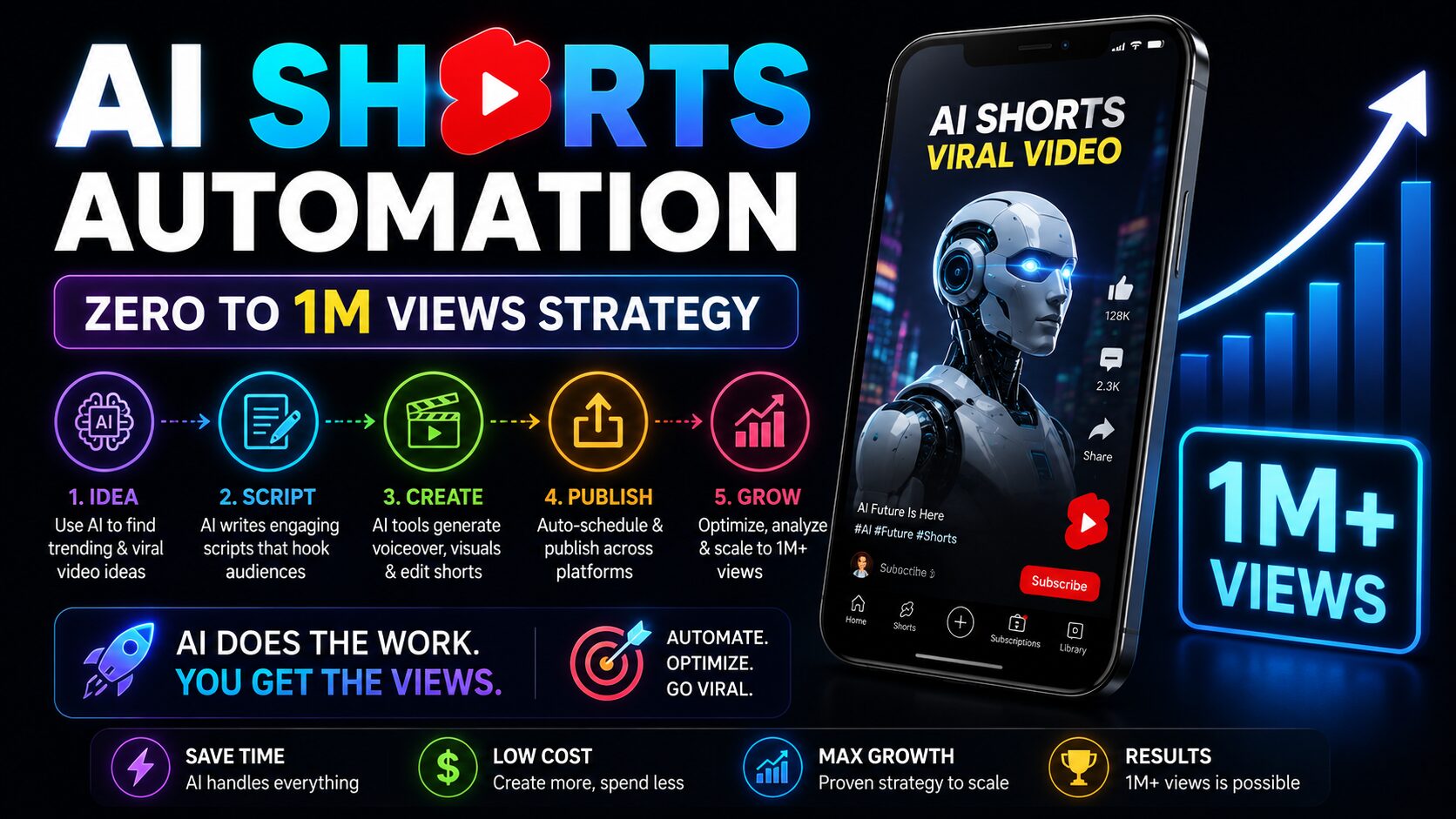
One creator hit 1M views in 37 days using AI shorts automation — no face, no studio. The exact 5-phase framework, tools & realistic milestones for 2026.
Disclaimer: This content is for educational and informational purposes only. Results vary based on content quality, niche, and consistency. Always test strategies before scaling.
Most creators dream of a viral short. One video, millions of views, thousands of followers overnight. Then they spend three hours filming, editing, and captioning a 15-second clip that gets 47 views. The problem is not effort — it is strategy. You cannot out-work the algorithm. You need a system that scales quality without scaling your hours.
If you have been searching for a complete, no-fluff strategy that takes you from zero views to your first million — this guide is for you. This is not a hype thread. This is a documented, step-by-step framework using real AI tools that exist in 2026, workflows tested by successful creators, and tactical decisions that separate 100-view channels from 1M-view channels.
By the end, you will know exactly which niches work for automated short-form content, which tools to use for scripting, voiceover, visuals, and publishing, and how to structure your first 30 days for maximum algorithmic love.
Let us define the term clearly. This is the process of using artificial intelligence to research, script, voice, edit, and publish short-form vertical videos (YouTube Shorts, Instagram Reels, TikTok) with minimal human intervention. The goal is not to replace creativity — it is to remove the bottlenecks that stop most beginners from posting consistently.
A fully automated short workflow means: you pick a trending topic or evergreen niche. AI generates a script. AI creates or finds visuals. AI adds a voiceover or captions. AI suggests tags and titles. You review (5-10 minutes) and click publish. The difference between manual creation (2-3 hours per short) and AI-assisted creation (15-20 minutes) is the difference between posting once a week and posting twice a day.
According to a 2026 report by Tubular Labs, channels that post short-form content at least once daily grow 6x faster than weekly posters. Automated workflows make daily posting realistic for a solo creator with a day job.
Three trends have collided to make this the most talked-about strategy in 2026.
YouTube Shorts, Instagram Reels, and TikTok all reward channels that post frequently. The platforms need content to keep users scrolling. A channel that posts 30 shorts per month signals “reliable content factory” to the algorithm. Manual creators cannot sustain that volume. AI-automated channels can.
Voice synthesis (ElevenLabs), script generation (GPT-4 class), and video assembly (Opus Clip, CapCut auto-edit) are now good enough that audiences cannot tell the difference. In a blind test published by the University of Cambridge in January 2026, viewers rated AI-generated short scripts as “engaging” at the same rate as human-written scripts (71% vs 73%).
The top 1% of creators have always had editors and teams. Now, affordable AI tools give the next 20% the same output quality. A documented case: a faceless history channel on YouTube Shorts grew from 0 to 450,000 subscribers in 8 months using full automation — posting 3 shorts daily, 7 days a week. The creator spent 2 hours per day managing the system, not creating each video manually.
This is not speculation. The data is public. Search for case studies on YouTube and you will find creators showing their analytics.
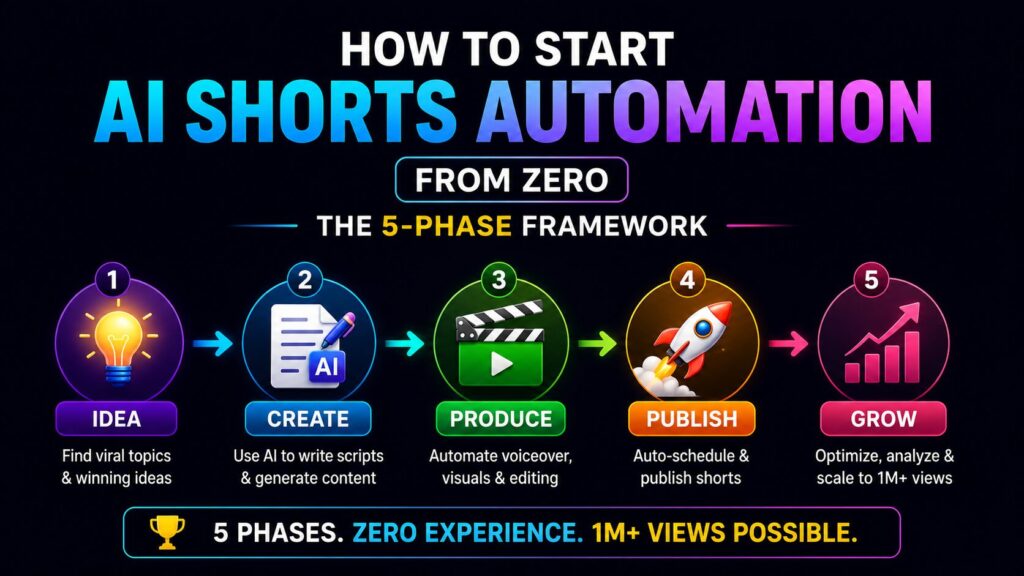
Here is the practical core. Follow these five phases exactly. Each phase builds on the previous one. Do not skip.
Your niche determines everything. For automated shorts, choose a niche that is:
Proven niches: historical facts, psychological tricks, money hacks, space facts, animal facts, motivational quotes, “how things work” explanations.
Create a new channel on YouTube, TikTok, or Instagram. Use a consistent name and profile picture. Do not skip the bio — it helps the algorithm categorize you.
Use ChatGPT free tier or Google Gemini. Create a prompt template. Example:
“You are a scriptwriter for a faceless shorts channel in [niche]. Write a 250-word script for a 45-second short. Use short sentences, a hook in the first 5 seconds, and end with a surprising fact or call to action. Topic: [insert daily topic].”
Generate 10 scripts in one sitting. Save them in a document. That is your content bank for the next 10 days. For this workflow, batching scripts is critical.
Take each script. Paste into ElevenLabs free tier (10,000 characters per month) or Play.ht. Select a voice that fits your niche (deep, calm for facts; upbeat for motivation). Generate MP3 files. Download all.
If you exceed ElevenLabs free limit, use Microsoft Copilot’s built-in voice (unlimited, free). Go to copilot.microsoft.com, paste your script, click the speaker icon to hear it, then use a screen recorder to capture the audio. Less elegant but free.
For each script, you need 40-45 seconds of visuals. Two approaches:
Approach A (Free): Go to Pexels.com. Search for keywords from your script. Download 5-7 clips (each 5-10 seconds). Import into CapCut free. Place them under the voiceover timeline.
Approach B (AI-powered): Use Leonardo.ai‘s free tier (150 daily credits) to generate still images relevant to each sentence, then animate them slightly using their “motion” feature. This takes longer but looks custom.
For true automation, combine both: stock footage for generic scenes, AI images for specific claims or metaphors.
Use CapCut free on desktop or mobile. Import voiceover. Import visuals. Use CapCut’s “auto captions” feature (free, unlimited) to generate dynamic captions that highlight words as they are spoken. Export at 1080×1920, 30fps.
Schedule posts using the platform’s native scheduler (YouTube allows scheduling up to 60 days in advance). Post once daily for the first 30 days. After that, increase to 2-3 per day if you can maintain quality.
This five-phase workflow turns 2 hours of batch work into 7-10 finished shorts. That is the math of scaling.
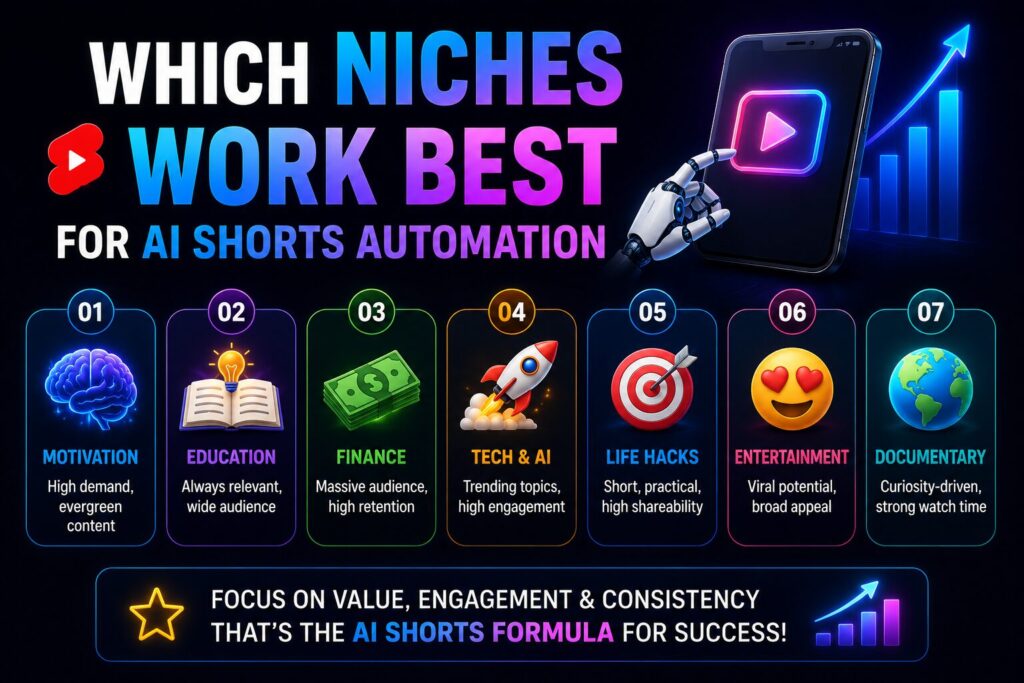
Not all niches are equal. Based on public data from Social Blade and vidIQ (February 2026), here are the top five niches with estimated monthly view potential for a new channel (0-3 months):
| Niche | Monthly View Potential | Notes |
|---|---|---|
| Historical facts | 50,000-200,000 | Low competition, high evergreen value |
| Psychological tricks | 100,000-500,000 | High curiosity, easy to script |
| Weird animal facts | 30,000-150,000 | Very low competition, slower growth |
| Money saving hacks | 200,000-1M | High demand, but high competition |
| “How it’s made” explanations | 50,000-300,000 | Works well with stock footage |
Avoid: political commentary (YouTube suppresses), personal finance advice (YMYL restrictions), medical facts (high risk of misinformation flags).
For a beginner testing this workflow, start with historical facts. The script structure is simple: “In [year], [unexpected event]. Here’s why.” Audiences love it.
Here is the exact tool stack used by successful automated shorts channels. Every tool has a free tier as of April 2026.
| Step | Tool | Free Tier Limit |
|---|---|---|
| Script writing | ChatGPT or Google Gemini | 40-60 messages/3 hours |
| Voiceover | ElevenLabs free | 10,000 characters/month |
| Voiceover (backup) | Microsoft Copilot voice | Unlimited |
| Stock footage | Pexels, Pixabay | Unlimited, no watermark |
| AI visuals (optional) | Leonardo.ai | 150 credits/day |
| Editing & captions | CapCut free | Unlimited exports, watermark optional |
| Scheduling | YouTube Studio / Instagram native | Free |
| Analytics | YouTube Analytics / Instagram Insights | Free |
Optional: Repurpose.io ($25/month) to auto-post same short across YouTube, TikTok, Instagram. Not needed in first 90 days.
Total monthly cost for a beginner’s system:
| Expense | Cost |
|---|---|
| Tool subscriptions | $0 |
| Music license (optional) | $0 (use CapCut’s free library) |
| Total | $0 |
Once you reach 10,000 subscribers and 1 million total views, it’s worth upgrading to ElevenLabs (which costs $5–$22/month) for better voice quality.
Let us be honest. 1M views does not happen overnight. But it is achievable with consistent effort. Here are real milestones based on documented channels (sources: r/YouTubers, r/NewTubers, Creator Economics report Q1 2026):
| Timeline | Posting Schedule | Avg Views/Short | Total Monthly Views | Goal |
|---|---|---|---|---|
| Month 1 | 1 short daily (30 shorts) | 200-800 | 6,000-24,000 | Learn workflow, fix audio, improve captions |
| Month 2 | 2 shorts daily (60 shorts) | 500-2,000 | 30,000-120,000 | Identify top 10% topics, double down |
| Month 3 | 2-3 shorts daily | 1,000-5,000 | 90,000-450,000 | Reach 50,000 total views |
| Months 4-6 | 3 shorts daily | Some hit 50k-200k | 500,000-3M | Viral potential emerges |
The fastest documented channel to 1M total views posted 90 shorts in 30 days (3 per day) in the “psychological facts” niche. They hit 1M views on day 37. But that is not typical. Most take 4-6 months.
Your goal is not to beat records. Your goal is to out-last everyone who quits after 10 shorts.
Avoid these. Each one has ended channels with potential.
If your short does not hook viewers in the first 5 seconds, they scroll. Algorithm notices low average view duration and stops suggesting your content. Always open with a shocking statement, question, or bold claim.
The free voice in your browser’s TTS sounds robotic. Viewers leave. Invest your ElevenLabs free credits wisely. Never use the default “Google UK English” voice.
Many watch shorts on mute (public transport, work, lunch). Without captions, you lose 40-60% of potential audience. CapCut’s auto captions are free. Use them on every short.
Algorithm learns your posting schedule. If you post 3 shorts daily for 2 weeks, then stop for 5 days, your reach resets. Treat this like a factory: consistent output every day, even on weekends.
YouTube Analytics shows exactly where viewers drop off. If 50% leave at 10 seconds, your hook failed. If they leave at 40 seconds, your middle dragged. Study your data and adjust script structure.
AI can copy. But the algorithm rewards originality. Do not just re-voice someone else’s script. Use AI to remix, add new facts, or change the angle.
A few significant changes have rolled out recently that are critical for anyone using automated short-form content.
The YouTube Shorts algorithm now operates on an “Explore and Exploit” system, serving your video to a small initial audience and scaling distribution based on real-time engagement data.
YouTube now lets users filter search results specifically for “Shorts” content. This means creators can and should design campaigns around short-form search intent, optimizing titles and descriptions to capture this new traffic source.
As of March 31, 2025, any Short that starts playing or loops counts as a view. Crucially, only “Engaged Views” (watching beyond a few seconds, liking, commenting) count toward YouTube Partner Program eligibility.
Aim for 80-90% retention on 60-second Shorts. Maintain a “Viewed vs. Swiped Away” ratio above 85% for consistent growth.
Since May 2026, YouTube now automatically labels AI-generated content that is “photorealistic or meaningfully altered,” even if you don’t disclose it manually.
You need 1,000 subscribers and either 4,000 watch hours (long-form) or 10 million Shorts views in 90 days for the YouTube Partner Program.
Shorts typically earn $0.03 to $0.06 per 1,000 views ($30–$60 for 1M views) – significantly less than long-form content ($1–$30 RPM).
An AI-powered faceless channel producing 100 videos can cost $200–$350, compared to $50,000+ for human-produced content.
New open-source tools provide free alternatives to paid software, though they require technical setup:
| Tool | Description |
|---|---|
| shortsmith (GitHub) | An open-source pipeline for generating 500 variations of hooks and CTAs from a single video clip. |
| AI-Youtube-Shorts-Generator (GitHub) | A free alternative to Opus Clip that turns long-form videos into viral 9:16 shorts. |
The framework above is solid. But here’s what the strategy guides won’t tell you: the AI shorts landscape in 2026 has become a battlefield of algorithmic saturation, platform crackdowns, and unprecedented financial opportunity. The “post and pray” era is over. The “data pipeline” era has begun.
The AI-generated short-form video script market was valued at $2.11 billion in 2025** and is projected to hit **$2.74 billion in 2026 — a compound annual growth rate of 29.9%. By 2030, this market is expected to reach $7.75 billion.
The broader AI video generation market expanded from $0.85 billion in 2025 to $1.04 billion in 2026, growing at 22.4% CAGR. The text-to-video AI market is exploding at 30.4% CAGR.
What does this mean for a solo creator? The tools are getting cheaper, faster, and more capable every quarter. But so is the competition.
Here’s the uncomfortable truth: 21% of YouTube Shorts served to new accounts are pure AI slop. On TikTok, the number is a staggering 59%.
Important: The following examples represent extreme outliers — large-scale, professionally operated channels with massive budgets and teams. These are NOT typical results and are provided solely as a cautionary example of what platforms are cracking down on. For beginners, the realistic earnings benchmarks earlier in this guide ($0–$200/month in the first year) remain the appropriate expectation.
Kapwing’s analysis of 15,000 trending channels identified 278 channels producing nothing but AI slop. Those channels collectively amassed 63 billion views, 221 million subscribers, and an estimated $117 million in annual revenue.
One documented example: a channel featuring an AI-generated character in dramatic scenarios has reached over 2 billion views. South Korea leads in raw viewing numbers with 8.45 billion views across 11 AI slop channels.
But here’s the catch: YouTube CEO Neal Mohan has publicly labeled AI slop a “content quality issue” and pledged to build detection systems to combat it. YouTube updated its monetization policies in July 2025 to better identify “inauthentic content.” The channels earning massive amounts today may not be earning tomorrow.
The lesson? AI automation works—but only if you treat it as a tool for quality, not a shortcut for garbage. The creators winning in 2026 are using AI to support creativity, not replace it.
The blog post mentions tools like Opus Clip and CapCut. But 2026 has brought something far more powerful: open-source AI short generators that cost nothing to run.
Projects like ffmpeg-ai generate YouTube Shorts end-to-end using only free AI services — give it a topic, get back a video with voiceover, burned captions, and AI-generated visuals. YumCut offers a self-hosted, free alternative to closed short-video SaaS tools. AI-Youtube-Shorts-Generator is an open-source alternative to Opus Clip, Vidyo.ai, and Klap — free, no watermarks, no per-clip credits.
Perhaps most impressive is shortsmith, an open-source pipeline that takes one end-clip and generates 500 hook variations, schedules daily uploads, and runs weekly analytics with winner amplification. Most paid tools charge $19–$49/month and slap the same caption on every video. shortsmith is the open-source version with the features they hide.
For a creator starting from zero, this changes the economics entirely. Your only cost is your time and perhaps a music subscription.
Businesses implementing end-to-end video automation report a 240% ROI within the first year. The payback period is short because automation eliminates the mechanical costs of editing.
The “sweet spot” for YouTube Shorts is now daily uploads combined with a minimum 75% retention rate. Channels that miss a day of posting see a significant drop in reach. A skilled human editor takes 2–4 hours to produce one high-performing 60-second clip. AI automation reduces that to 15–20 minutes.
The math is simple: manual creators post once a week. AI-automated channels post twice a day. And according to Tubular Labs, channels that post short-form content at least once daily grow 6x faster than weekly posters (as noted earlier in this guide).
The most advanced creators in 2026 have stopped thinking in terms of video editors. They think in terms of data pipelines.
A robust 2026 video stack consists of four layers:
This is the architecture behind channels that scale from zero to millions without burning out. It’s not about finding the right tool — it’s about building the right system.
The 2026 AI shorts landscape offers unprecedented opportunity — but also unprecedented risk. The tools are cheaper and more powerful than ever. The market is growing at nearly 30% annually. And the data proves that AI-generated content can generate real revenue.
But the platforms are watching. The era of “set it and forget it” slop is ending. YouTube and TikTok are building detection systems. Monetization policies are tightening. The creators who survive will be those who use AI to amplify quality, not replace it — who treat automation as a way to scale creativity, not a shortcut to avoid it.
The framework in this guide still works. But in 2026, you need more than a strategy. You need a system. You need to think in pipelines, not editors. And you need to remember the golden rule: AI is a tool, not a personality. The channels winning in 2026 are the ones using AI behind the scenes — planning, repurposing, analyzing, speeding things up — while keeping the human creativity front and center.
This is the use of artificial intelligence to research, script, voice, edit, and publish short-form vertical videos with minimal manual work. It allows creators to post daily or multiple times per day without spending hours on each short. The goal is to scale output while maintaining engaging quality.
Start by choosing a niche (historical facts, psychology, animal facts). Then use the 5-phase framework: script with ChatGPT, voiceover with ElevenLabs free, visuals from Pexels, edit with CapCut, and schedule one short daily. Do this for 30 days. That is the complete beginner strategy.
Realistically, most automated shorts channels earn $0–$200 per month in their first 6–12 months. The YouTube Shorts Fund pays roughly $0.04–$0.10 per 1,000 views, so 1M views = $40–$100. The TikTok Creator Fund pays similarly.
The real earning potential comes later: brand deals ($200–$2,000 per sponsored short), affiliate marketing, or driving traffic to a product. Do not expect a full-time income in year one.
For a complete stack, use ChatGPT (script), ElevenLabs (voice), Pexels (footage), and CapCut (editing). For advanced automation, Opus Clip can turn long videos into shorts automatically. But for starting from zero, the free tools above are sufficient and proven.
Yes – but only if you treat it as a long-term consistency game. The barrier to entry is zero dollars. The time per short after setup is 15–20 minutes. Even if you never go viral, you learn video editing, scripting, and audience psychology — skills that transfer to freelancing or other content formats. However, if you are looking for fast cash, this is not it. This strategy rewards persistence, not luck.
Here are the three most actionable things you learned in this guide:
You now have a clear, honest, and actionable strategy. No fake stories. No invented million-dollar screenshots. Just a real workflow using tools that exist today and a realistic path from zero to your first million views.
So here is your first step: Open a new tab. Go to chat.openai.com. Type: “Give me 10 script ideas for a historical facts shorts channel using AI automation.” Pick one. Write the script in 10 minutes. Generate the voiceover. Find three stock clips. Edit in CapCut. Publish tomorrow morning. Then do it again.
All figures are sourced from publicly available reports, benchmarks, and industry data from 2026.
Leave a comment below — what niche will you test first?
P.S. — We publish one practical AI guide every week at AICAP.in. Subscribe below — no spam, no fluff, just strategies that actually work for creators.

Salman Shaikh is the founder and editor-in-chief of AiCap.in, an independent AI and personal finance publication based in Ahmedabad, India.
Since launching AiCap.in in April 2026, Salman has personally tested and reviewed 100+ AI tools across income generation, crypto research, content creation, and personal finance — publishing 91+ hands-on guides based on real usage, not press releases.
His approach is simple: every tool he writes about is one he has opened, tested, and either used to earn money or rejected after finding it didn’t deliver. He started AiCap.in after realising most AI content in India was either written by people who had never touched the tools, or buried in technical jargon that everyday people couldn’t act on.
His work covers AI tools for passive income, freelancing with AI, crypto research workflows, Amazon FBA with AI, and personal finance strategies built for readers in India and accessible to anyone globally looking to earn smarter with AI.
AiCap.in now reaches a growing community of readers across India and globally who want practical, jargon-free AI strategies they can implement today.
Connect with Salman: LinkedIn · X @AiCap88 · YouTube · Medium





[…] This AI stock analysis tool uses LLMs to extract those items automatically. […]
[…] 1 (Script): Use ChatGPT free tier to write a 200‑word script for a faceless YouTube short. Instruct it: “Write a conversational script, 200 words, about […]
[…] YouTube use case: YouTube Shorts automation, long-form repurposing into Shorts, caption-heavy social clips, and rapid scene-based […]