Ahmedabad, Gujarat, India
Ahmedabad, Gujarat, India

Sell AI digital products on Etsy 2026 — create planners & art once, earn daily passive income. No design skills needed. Complete guide with tools & pricing.
Disclaimer: This content is for educational and informational purposes only. Earnings and results vary by individual. Always conduct your own due diligence.
“This guide covers all 7 categories of AI digital products you can sell on Etsy — planners, clipart, social media templates, educational printables, pet portraits, POD designs, and wall art. It is your complete starting map for building an Etsy passive income business with AI.
If you want to go deep specifically on AI-generated wall art — niche selection, prompt strategies, exact mockup workflows, and the $1K/month blueprint — read our dedicated guide on selling AI wall art on Etsy. That post picks up where the wall art section here leaves off.”
Most people who try to earn online quit before they find a method that works. If you have been searching for a practical answer on selling AI-generated downloads on Etsy, this guide walks through the mechanics.
The model is straightforward. You create a digital product once using AI tools, upload it to Etsy, and the platform handles delivery. There is no inventory and no shipping. When someone buys, Etsy sends them the file automatically.
The global digital products market has grown steadily, and the generative AI content creation market has expanded quickly. Tools like Midjourney, DALL·E 3, and Leonardo.ai have made it easier for individuals to create visual products. This guide breaks down how to sell AI-generated digital products, what tools sellers use, and the steps to build a shop that can generate recurring income.
Etsy does not publish category-level income guarantees for AI digital product sellers. New sellers can see sales within their first weeks or months depending on niche, listing quality, and marketing effort. By the end of this guide, you will have seven product categories, tool names, pricing strategies, and a clear action plan.
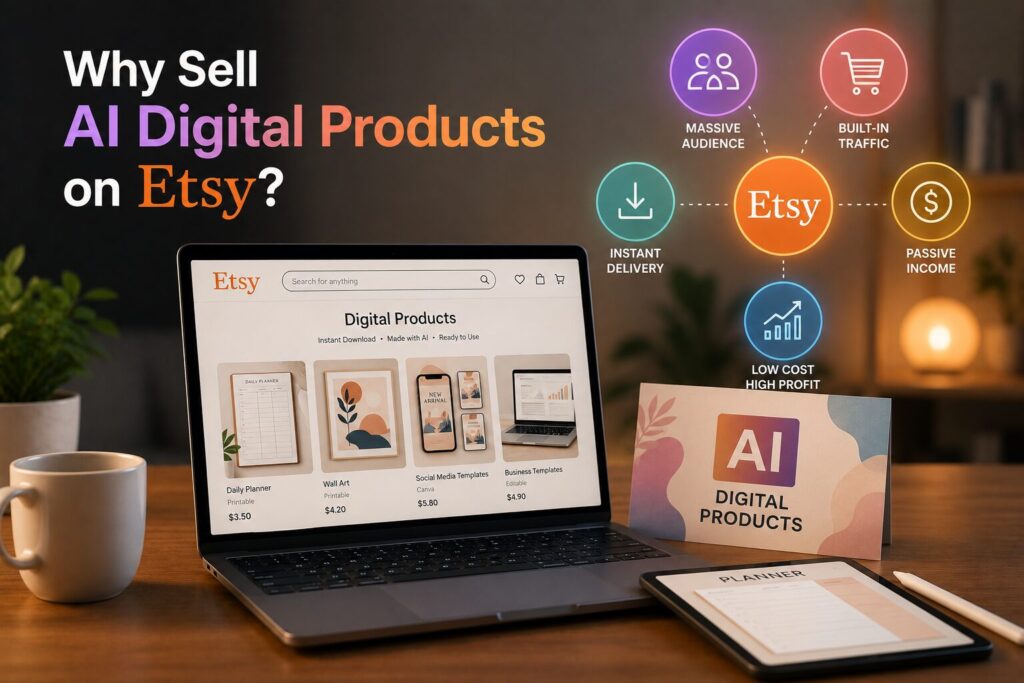
Etsy reported 86.6 million active buyers in its Q1 2026 shareholder report. When you list a digital product on Etsy, you place it in front of a marketplace already full of people in buying mode. New sellers can make sales without a social following, an email list, or a paid ads budget.
AI-powered digital products have near-zero marginal cost per sale. After creation, each additional sale costs almost nothing to fulfill. For a product priced at $10, transaction and processing fees run approximately $0.60 to $1.00, leaving a profit per sale of roughly $9. That produces profit margins that are significantly higher than physical products. There is no inventory risk, no shipping, and no fulfillment time. Delivery is instant and automated.
Etsy’s algorithm rewards fresh, visually consistent designs that align with buyer trends. Sellers using AI tools can create and test new listings faster than those working manually. This constant activity can improve visibility over time.
The generative AI content creation market has grown significantly. Etsy’s Q1 2026 shareholder report showed 5.5% GMS growth with improved buyer and seller metrics. The platform is rebuilding its search and recommendation engines around individual buyer behavior over time.
Etsy does not publish official figures on what percentage of its sellers use AI tools or what conversion premium AI-assisted listings receive. Treat any specific percentage claims you see elsewhere as estimates rather than verified platform data.
Before you start selling AI-generated digital products, you must understand the platform’s rules. Etsy allows the use of AI tools in the creative process but requires sellers to disclose within their listing description if an item is created with the use of AI. When you upload a listing, Etsy asks whether the item was handmade by you, designed by you, or generated using AI. You must be transparent. Declaring AI does not harm your shop, your ranking, or your visibility. Etsy simply wants buyers to understand how the artwork was created.
Key policy points for AI digital products:
AI prompt bundles are prohibited. Etsy prohibits the sale of AI prompt bundles on the platform. Prompts used to generate AI artwork are considered an integral part of the creative process and should not be sold separately from the final artwork. Review Etsy’s current seller policies for the exact wording.
Nudity and sexual content rules apply. Any AI-generated depictions of nudity and sexual content must follow the rules outlined in Etsy’s Prohibited Items Policy.
Correct categorization is required. AI-generated art must be listed under “Designed by a seller,” not “Made by a seller” or “Handmade.” The June 2025 update to Etsy’s creativity standards tightened this requirement: anything listed as “Made by the seller” must now be fully created by the seller.
Copyright considerations. In most countries, AI-generated art cannot be copyrighted unless you make meaningful human edits or transformations. Pure AI output alone is not protected. You can still sell AI artwork commercially, but you cannot stop others from copying raw outputs. Review the U.S. Copyright Office guidance for current rules. The most durable AI art shops do not just upload raw Midjourney generations — they enhance, remix, recolor, add typography, or combine elements to create something more original.

Not all AI-generated digital products sell equally well. Based on publicly visible Etsy search behavior and top-performing shops, these are the categories with the highest demand.
This is one of the simplest formats because it has a clear use case. Buyers want art they can print and display. Common niches include celestial nursery decor, cottagecore botanical prints, moody fantasy bedroom wall art, minimalist travel-style posters, and zodiac or spiritual decor. Prices typically range from $3 to $15 per print. Bundled collections often outperform single-file listings because they offer more perceived value and justify a higher price point.
AI-generated planners, goal trackers, budgeting sheets, and meal planners are consistently high-volume sellers. A well-designed Excel or PDF template on Etsy can sell for $5 to $40 depending on depth and design. ChatGPT combined with Canva allows you to generate complete planner sets with themed covers, interior pages, and matching stickers in hours rather than days.
Themed clipart packs ($5–25) are popular among other creators who use them for their own projects. AI art generators can produce hundreds of matching clipart elements in a consistent style, which you then package as commercial-use bundles. Niche-specific packs such as “gothic botanical clipart,” “retro summer vibes stickers,” or “fantasy creature silhouettes” tend to outsell generic “clipart bundle” listings.
Personalized pet portraits created with AI can be priced higher than standard printables. The workflow involves training AI on a pet photo or using style-transfer techniques to transform customer photos into specific artistic styles. Each sale requires manual input, but the per-item profit is higher. Pricing often ranges from $15 to $50 depending on complexity.
Canva templates, Instagram story sets, Pinterest pin templates, and TikTok caption bundles sell consistently to small business owners and influencers. You can use AI to generate the base designs, then organize them into easy-to-edit template packs. Profit margins are high because you create the template once and sell it repeatedly.
AI digital products also sell through print-on-demand integration. You upload your AI-generated designs to POD services like Printful, Printify, or Gelato, and they handle printing, shipping, and customer service. When someone orders a t-shirt, mug, poster, or phone case with your design, the POD company produces and ships it. You never touch inventory, and your only upfront cost is the AI tool subscription. Physical print-on-demand products earn lower margins than digital downloads, but require zero fulfillment work.
Teachers, homeschool parents, and tutors actively purchase educational printables. AI can generate themed worksheets, alphabet posters, math activity sheets, and language learning flashcards quickly and in bulk. A single listing with 50–100 educational printables can generate consistent daily sales with no additional work after setup.
Here is a step-by-step framework for creating AI digital products from idea to listing.
Start with the customer, not the tool. Choose a buyer niche, understand what they want to display, gift, or download, define a consistent visual style, then create products around that style. This is much stronger than opening a generator, creating whatever looks pretty, and hoping the market will figure out what your shop is for.
2026 Strategy: Use Etsy’s search autocomplete and related searches to identify underserved micro-niches. Tools like eRank and Marmalead can help validate demand before you create.
Use Midjourney ($10/month for the Basic tier), Stable Diffusion (free, open-source), or Leonardo.ai (free tier available) to create your base designs. For planners and templates, combine ChatGPT with Canva. For consistent clipart sets, generate variations using the same seed values and prompt structure. Aim to build a catalog of 50–100 listings before Etsy’s algorithm reliably surfaces your shop to organic buyers.
Raw AI outputs rarely succeed on Etsy. Take your generated images into Photoshop, Canva, or GIMP to adjust colors, fix artifacts, add typography, and combine multiple generations into one final artwork. This editing step transforms generic AI output into a unique product that stands out from thousands of similar listings. Even simple edits like adding a white border, adjusting contrast, or removing strange artifacts improve buyer perception.
Use mockup generators to turn flat artwork into product visuals that look ready to sell. Tools like Placeit, Stageflow.ai, and MyDesigns Dream AI generate realistic product photography showing your artwork framed on a wall, printed on a mug, or displayed on a phone. High-quality mockups can increase click-through rates and conversions.
Create a ZIP file containing your design files in multiple formats (JPG, PNG, PDF). Include a simple instructions file. For planner sets, organize files into clearly labeled folders. For clipart bundles, include a preview sheet showing all included elements. Professional packaging signals quality and reduces customer questions.
Your listing title must include your primary keyword. Lead with a clear primary product phrase. Use all 13 Etsy tags with relevant keywords. Write a description that answers where the buyer would use the product, what problem it solves, and why they should buy from your shop. Etsy’s algorithm now uses advanced AI to understand conversational phrases — prioritize natural language over keyword stuffing.
Etsy handles digital file delivery automatically. Once a customer purchases, Etsy sends them a download link. Make sure your files are under Etsy’s size limits (20MB per file, 5 files per listing), or use a third-party delivery service like Gumroad for larger files. Check Etsy’s current digital download guidelines for updated limits.
Here are the specific tools sellers commonly use.
Midjourney ($10/month) generates high-quality artistic images. You can generate dozens of variations in minutes with a few prompts, tailoring each to trending keywords like “cottagecore” or “dark academia.”
ChatGPT Plus ($20/month) writes listing titles and descriptions, generates keyword-rich tags, creates shop announcements, drafts customer messages, and develops brand stories. For Etsy listings specifically, ChatGPT works best when you give it detailed prompts about target keywords, product specifics, ideal customer persona, and what makes your product different.
Canva (free tier available) designs digital planners, social media templates, and combines AI-generated elements into finished products.
Leonardo.ai (free daily credits) generates commercial-use images with a generous free tier. Beginners often start here before upgrading to paid tools.
Stable Diffusion (free, open-source) offers maximum control and no recurring costs.
eRank provides keyword research tailored to Etsy’s search algorithm, showing search volume estimates, competition levels, and click rates. The standard plan starts around $10/month.
Marmalead offers AI-powered Etsy listing optimization. With Etsy’s algorithm driven heavily by buyer behavior, Marmalead’s Marma AI tool helps sellers understand where listings are strong and which changes might move the metrics Etsy cares about.
ListsGenie transforms product photos into SEO-optimized titles, descriptions, and tags for sellers managing multiple storefronts.
Placeit generates listing photos without physical product photography.
Stageflow.ai generates listing photos and automates product photography workflows.
MyDesigns Dream AI takes you from product concept to Etsy-ready listing with better visual consistency, letting you generate, refine, mock up, and organize product-ready assets without switching between tools.
Pricing AI digital products requires understanding your costs and perceived value.
| Fee Type | Amount |
|---|---|
| Listing fee | $0.20 per listing (auto-renews every time a product sells) |
| Transaction fee | 6.5% of total sale price |
| Payment processing fee | Approximately $0.25 per transaction for US sellers |
For a $10 digital product, total fees run approximately $1.10–$1.20, leaving $8.80–$8.90 profit per sale. Check Etsy’s Fees & Payments Policy for current rates.
| Product Type | Price Range |
|---|---|
| Printable Wall Art | $3 – $15 |
| Themed Clipart Packs | $5 – $25 |
| Custom Pet Portraits | $15 – $50 |
| Digital Planners & Organizers | $5 – $40 |
| Commercial-Use SVG Bundles | $8 – $30 |
| Social Media Template Packs | $10 – $25 |
| Print-on-Demand Physical Products | Base cost + markup |
The pricing psychology rule: Many digital product creators underprice their work. If your products are getting plenty of views but barely moving in profit, test higher prices. Higher prices can signal higher quality, attract better buyers, and produce more profit per sale without increasing your workload.
Bundling strategy: Creating themed collections of multiple items often drives better results than selling single files because customers perceive bundles as better value. A five-print bundle priced at $15 can outsell each individual print at $4, generating higher total revenue per transaction.
Once your first products are selling, here is how to scale your shop toward consistent monthly income.
Build to 50–100 listings minimum. Shops with established catalogs of 200+ listings have more opportunities to be found in search. Use AI to generate new products quickly and add 10–20 new listings weekly until you reach critical mass.
Optimize based on Etsy’s algorithm. Etsy’s Q3 2025 earnings report noted that a significant share of marketplace sales now comes through the Etsy app. When much of the purchase activity happens inside a fast-scrolling mobile feed, Etsy prioritizes listings that earn clicks, favorites, and sales. Strong keyword alignment, high-quality mockup photos, clear titles, and a solid conversion rate directly influence the signals Etsy uses to rank listings.
Use AI for customer service. ChatGPT can draft responses to common customer questions about file formats, printing recommendations, and usage rights. Set up saved replies for the questions you get repeatedly.
Expand to multiple product types. Once you have a successful shop selling printable wall art, add digital planners using the same aesthetic. Add social media templates. Add commercial clipart packs for other creators. Each new category attracts new buyers who may then purchase your original products.
Consider print-on-demand integration. Connect your shop to Printful or Printify to offer physical versions of your digital designs — framed prints, canvas wraps, throw pillows, phone cases. The POD service handles everything after you upload the design. This adds a higher-priced product tier without additional fulfillment work.
In Q1 2026, Etsy delivered 5.5% GMS growth with improved buyer and seller metrics. The company is rebuilding its search and recommendation engines around individual buyer behavior over time. Etsy’s mobile app, which now drives a significant share of total GMS, uses machine learning models that build buyer profiles and map past shopping behavior to Etsy’s catalog in real time.
These AI models push discovery beyond a shopper’s stated search intent, surfacing categories they have not previously browsed. This means your AI-generated digital products can appear to buyers who were not searching for them directly — but the algorithm needs fresh, relevant listings to make that happen.
Etsy reported that agentic AI traffic (buyers arriving through ChatGPT, Microsoft Copilot, and Google integrations) increased significantly year over year in Q4 2025. While it still accounts for a small share of total traffic, orders originating from ChatGPT skewed higher value than more mature acquisition channels. An Etsy App in ChatGPT is currently in development. The implications: AI-powered discovery is shaping Etsy’s marketplace, and sellers who understand this shift can benefit.
Etsy has built AI-powered listing tools and is expanding into more automated workflows, reducing the manual inputs required to describe, tag, and price a product. Two conversational AI agents shipped in Q1 2026 — one to help buyers find gifts through natural language, and one to surface performance data for sellers.
The practical takeaway: Etsy is investing in AI infrastructure. Sellers who leverage AI for product creation, listing optimization, and scaling may have an advantage as the platform’s algorithms increasingly favor shops that produce fresh, relevant content consistently.
eRank’s analysis of Etsy search trends shows that “digital products” has ranked among the top searched terms in recent periods, alongside seasonal gift terms. This is mainstream demand, not a niche keyword.
Analysis also shows that products tied to specific life events continue outperforming generic templates. Editable event templates, wedding invitations, planners, and seasonal decor bundles are among the fastest-growing categories. Printify’s 2026 research confirms that printable wall art, stickers, wedding templates, and digital products are among the strongest-performing categories.
What this means for you: Generic “clipart bundle” listings are losing ground to niche, event-specific digital products. Buyers are searching for solutions to specific problems, not just pretty pictures.
As AI-generated art floods the market, authentic human-created artwork has become more valuable. Items that show the hand of the maker can command higher prices.
This does not mean AI art is dead. It means raw AI output is becoming commoditized, while AI-assisted products with meaningful human editing, curation, and personalization can command premium prices. Emerging 2026 trends include AI-generated art combined with hand-lettered names, sketch-style pet illustrations transformed into line art prints, and AI watercolor scenes finished with human touches.
Etsy’s own policy framework rewards human contribution. Listings that show clear editing, curation, or personalization are more likely to stand out and stay compliant with Etsy’s creativity standards. The editing step is not optional — it is what separates durable shops from those that never gain traction.
Despite AI’s rapid adoption, consumer trust remains a challenge. Surveys from companies like Akeneo have found that a significant share of consumers remain skeptical of AI recommendations and brand AI claims.
This is why Etsy’s disclosure requirements matter. Sellers who clearly and honestly disclose AI use in their listings build trust with buyers. Those who hide it risk shop suspension — and, increasingly, losing customer confidence. Review Akeneo’s published research for current consumer sentiment figures.
Etsy’s updated seller policy adds more explicit guidance for items made with or involving generative AI. Key updates include:
Disclosure is mandatory. Sellers must be transparent when AI tools play a meaningful role in creating the final product.
Accurate categorization is required. Listings must be placed under “designed,” “digital,” “personalized,” or “production-assisted” categories — not presented as traditionally handmade.
Human contribution matters. Etsy emphasizes that sellers should be involved in designing, selecting, editing, or shaping what they sell — not merely reselling undifferentiated AI outputs.
AI prompt bundles are prohibited. Etsy prohibits the sale of AI prompt bundles. Prompts are considered an integral part of the creative process and should not be sold separately from the final artwork.
Digital downloads were explicitly added to the Creativity Standards on June 10, 2025, with tightened enforcement on undisclosed AI listings.
The bottom line: Etsy is not banning AI products. It is creating a framework where transparency, human contribution, and originality are rewarded.
| Strategy | Why It Works |
|---|---|
| Focus on event-specific products | Life-event templates outperform generic listings |
| Add meaningful human editing | AI plus human touch produces a more defensible product |
| Disclose AI use transparently | Builds trust and avoids policy violations |
| Upload consistently (5–10 new listings/week) | Etsy’s algorithm rewards fresh content |
| Target mobile-first buyers | A significant share of GMS comes through the app |
The opportunity is real, but it belongs to sellers who understand the platform’s evolving AI landscape and adapt accordingly.
AI digital products are downloadable digital files — such as printable wall art, planners, clipart bundles, and social media templates — created using artificial intelligence tools. You upload the file once, set a price, and Etsy handles every sale automatically. Customers download instantly after purchase. The key difference from physical products is zero inventory, zero shipping, and near-100% margin on each additional sale.
Start by choosing one product niche from the seven categories above. Create a free Etsy seller account. Use free AI tools (Leonardo.ai for images, ChatGPT free tier for descriptions, Canva free for packaging) to create your first 10 products. Optimize your listings using the pricing and SEO strategies above. Publish and let Etsy’s built-in traffic start working. You can have your first listing live within 48 hours.
Etsy does not publish category-level income guarantees. Earnings vary widely based on niche selection, listing volume, pricing, SEO, seasonality, and marketing effort. Treat any specific income claim — including those in other guides — as an estimate rather than a promise. Start with a small listing set, track what sells, and scale what works.
For images: Leonardo.ai offers generous free daily credits. For text: ChatGPT free tier. For editing and packaging: Canva free tier. For mockups: Placeit’s free trial or basic lifestyle mockups using free stock photos. Upgrade to paid subscriptions (Midjourney $10/month, ChatGPT Plus $20/month) only after you have confirmed demand and received your first sales.
Yes, with realistic expectations. AI digital products remove the biggest barrier to entry — creative skill. You do not need to be a professional artist or designer. But you do need to be honest about AI use (Etsy requires disclosure), deliver genuine value beyond basic AI output, and treat it like a real product business rather than dumping random images into a shop. If you add human editing, choose specific niches, and build a coherent shop identity, this can be worth pursuing in 2026.
Three actionable takeaways from this guide:
Start with one product niche from the seven categories above and create 10 products in that niche before expanding. Do not try to sell everything at once.
Always disclose AI use in your Etsy listings. Transparency builds trust, and Etsy requires it. Never misrepresent AI art as hand-drawn — that risks shop suspension.
Use free AI tool tiers until you have confirmed demand and received your first sales. Avoid paid subscriptions before you have paying customers.
AI digital products on Etsy are not a get-rich-quick scheme. They are a business model that combines AI efficiency with Etsy’s built-in buyer traffic. You create a digital asset once, and it can sell repeatedly. The product does not run out and does not require shipping.
The difference between people who earn and those who do not is simple: the earners start. They create their first printable. They upload their first listing. They learn from the data and iterate.
Your next step: Spend 30 minutes choosing your niche. Spend another 30 minutes generating your first five designs using Leonardo.ai or Midjourney. Create your Etsy shop. Upload your first listing by the end of this week — regardless of perfection. Momentum beats planning every time.
This guide avoids anonymous seller anecdotes and unverifiable income claims. Platform data is attributed to official or industry sources where possible. Because Etsy policies, fees, and market conditions change, verify current details through the links below before making business decisions.
| Category | Sources Used |
|---|---|
| Etsy Data | Etsy Q1 2026 shareholder report, Etsy Q3 2025 earnings report, Etsy Q4 2025 earnings report, Etsy official fees and seller policy pages |
| Industry Data | Public generative AI market reports, U.S. Copyright Office guidance, Akeneo consumer trust research, Printify research |
| Tool Data | Official tool documentation for Midjourney, DALL·E 3, Leonardo.ai, Stable Diffusion, Canva, ChatGPT, eRank, Marmalead, Placeit, Stageflow.ai, MyDesigns, Printful, Printify, Gelato |
| SEO Data | eRank public search data |
Figures in this guide are presented only when they can be attributed to platform reports, official documentation, or industry sources. Individual results vary based on niche, effort, pricing, and market conditions. Verify specific metrics through your own testing before making decisions based on this guide.
P.S. — We publish one practical AI guide every week at AICAP.in. Subscribe below — no spam, no fluff, just strategies that actually work.

Salman Shaikh is the founder and editor-in-chief of AiCap.in, an independent AI and personal finance publication based in Ahmedabad, India.
Since launching AiCap.in in April 2026, Salman has personally tested and reviewed 100+ AI tools across income generation, crypto research, content creation, and personal finance — publishing 91+ hands-on guides based on real usage, not press releases.
His approach is simple: every tool he writes about is one he has opened, tested, and either used to earn money or rejected after finding it didn’t deliver. He started AiCap.in after realising most AI content in India was either written by people who had never touched the tools, or buried in technical jargon that everyday people couldn’t act on.
His work covers AI tools for passive income, freelancing with AI, crypto research workflows, Amazon FBA with AI, and personal finance strategies built for readers in India and accessible to anyone globally looking to earn smarter with AI.
AiCap.in now reaches a growing community of readers across India and globally who want practical, jargon-free AI strategies they can implement today.
Connect with Salman: LinkedIn · X @AiCap88 · YouTube · Medium





[…] production work is overwhelming. If you have been searching for a real, no-fluff answer on how an AI podcast workflow 2026 makes five episodes a week possible—this is […]
[…] an AI content agency in 2026 with no investment — 7-day blueprint, free tools, and real client scripts that land your […]
[…] Best AI tools to turn blog posts into Instagram Reels 2026 – no editing skills. Free tiers, real workflow, step-by-step. […]
[…] AI generated wall art on Etsy for passive income. Step-by-step blueprint from niche selection to first sale. $1k/month […]
[…] This Scales: Once you create a digital product, you can sell it multiple times over several years without recreating it from scratch. All you will […]