Ahmedabad, Gujarat, India
Ahmedabad, Gujarat, India

Sell AI generated wall art on Etsy in 2026 and build a $1k/month passive income stream. Step‑by‑step blueprint from niche selection to compliant listing.
Disclaimer: This content is for educational and informational purposes only. Earnings and results vary by individual. Always conduct your own due diligence.
This guide covers all seven categories of AI digital products you can sell on Etsy — planners, clipart, social media templates, educational printables, pet portraits, print-on-demand designs, and wall art. It’s your starting map for building an Etsy digital product business with AI.
If you want to go deep specifically on AI-generated wall art — niche selection, prompt strategies, mockup workflows, and a focused growth blueprint — read our dedicated guide on selling AI wall art on Etsy. That post picks up where the wall art section here leaves off.
“This guide focuses exclusively on AI-generated wall art on Etsy — the single highest-volume digital product category in 2026. Every section goes deep: niche research, prompt engineering for print-ready art, mockup creation, SEO titles and tags, and the exact $1K/month growth blueprint.
If you are looking for a broader overview of all 7 AI digital product categories on Etsy — including planners, clipart, pet portraits, and social media templates — read our complete guide on selling AI digital products on Etsy first. This post assumes you have already decided wall art is your niche.”
Most guides on selling AI art on Etsy tell you to open Midjourney, generate a pretty image, upload it, and wait for money to arrive. Then nothing happens.
The gap between generating images and generating income is not luck. It is a product-building system: choosing a niche, creating art that fits a specific buyer need, writing listings that rank, and promoting consistently.
This guide covers what you need to know about selling AI-generated wall art on Etsy in 2026: which niches move, how to price, what Etsy requires legally, and how to build listings that convert browsers into buyers.
Yes, selling AI-generated art on Etsy is allowed in 2026, but there are disclosure requirements many sellers miss. Etsy’s seller policy requires that seller-prompted AI creations disclose the use of AI. Review Etsy’s current seller policies before listing.
Key rules to understand:
Disclosure is mandatory. Etsy requires sellers to declare within the listing description if an item was created with AI. Failure to disclose can result in listing removal or shop suspension.
AI prompt bundles are prohibited. Etsy does not allow the sale of AI prompts alone. Prompts are considered part of the creative process and should not be sold separately from the final artwork. Check Etsy’s official policy pages for the current wording.
Copyright does not protect raw AI outputs. Under current U.S. Copyright Office guidance, AI-generated artwork without substantial human modification cannot be copyrighted. Others could legally reuse the same raw image. If you significantly edit, curate, or arrange AI outputs into a cohesive artistic presentation, that human contribution may qualify for copyright protection.
Human-authored elements can be separately protected. If you add original hand-drawn linework, custom typography, or a curated multi-piece layout on top of an AI base image, the U.S. Copyright Office has indicated that those specific human-authored contributions — not the underlying AI-generated pixels — may qualify for copyright protection. This is a meaningful reason to treat the Canva or Photoshop editing pass as a creative step, not just cleanup.
Compliance is not optional. Read Etsy’s seller policies and the U.S. Copyright Office guidance before you publish.
Etsy attracts hundreds of millions of visits per month, according to third-party traffic estimates, and digital art remains a searched term. Buyers often arrive with purchase intent rather than just browsing. For AI wall art sellers, the platform offers several advantages.
Built-in search traffic. Etsy shoppers actively search for wall art, printable decor, and digital downloads. You do not need to build an audience from scratch.
Low barrier to entry. The cost to list is $0.20 per item, plus a 6.5% transaction fee and payment processing fees. There is no inventory and no shipping. Check Etsy’s Fees & Payments Policy for current rates.
High margins on digital products. A single digital wall art print can sell for $3–15, with high margin after fees. A set of four matching prints often sells for $8–15 as a bundle.
AI is permitted with disclosure. Unlike some marketplaces that restrict AI content, Etsy allows AI-generated art when sellers follow its disclosure rules.
Etsy’s Q1 2026 shareholder report stated that the platform had 86.6 million active buyers and 5.6 million active sellers, with trailing-twelve-month GMS per active buyer at $122. Mobile app usage continued to grow, with a significant share of GMS coming through mobile. Homewares and home furnishings — the category wall art sits in — remains one of Etsy’s top-performing verticals. You can review current figures through Etsy’s investor relations page.
Industry reports project continued growth in the global print-on-demand market, with some projections placing it near $39 billion by 2030. Getting in now, with AI as a creative tool, can position sellers ahead of the curve.
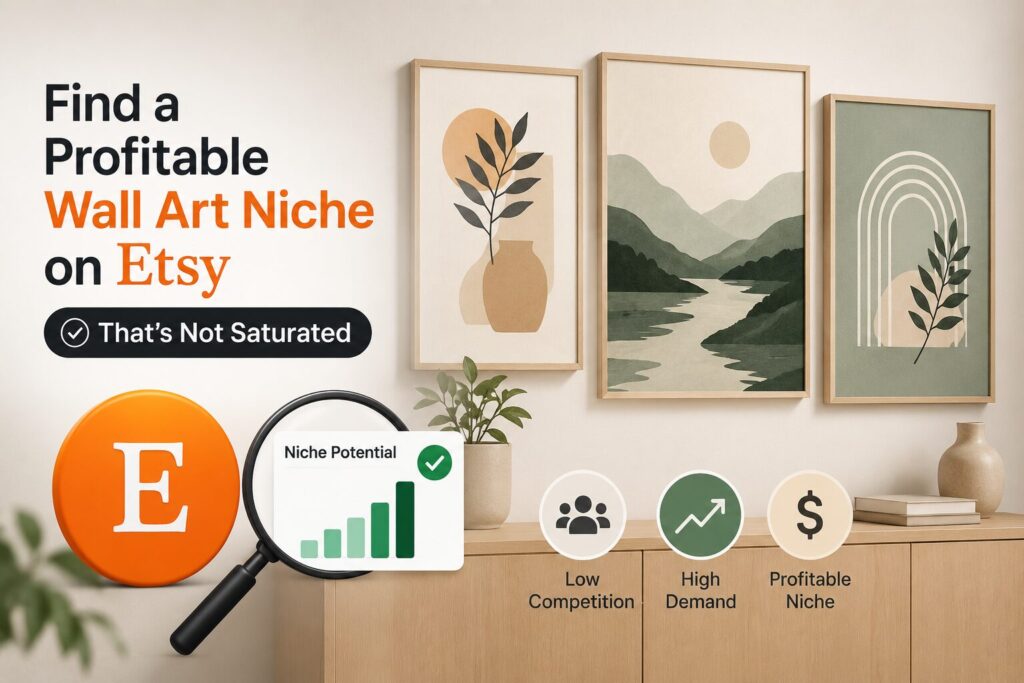
The most common mistake new sellers make is starting with the AI generator instead of the customer. Successful Etsy sellers define a niche first, then create art around it.
Step 1 – Search your broad category on Etsy. Type “wall art” or “printable wall art” into Etsy’s search bar. Look at autocomplete suggestions. These reflect real searches buyers are making.
Step 2 – Identify specific, non-obvious niches. Skip “abstract wall art” because it is too broad. Look for combinations like:
Step 3 – Check whether the niche has active shops. Click into the top listings. Look at review counts and sales signals. If multiple shops have steady sales in a specific style, demand likely exists.
Step 4 – Validate with free tools. Use eRank or EtsyHunt’s free tier to review search volume and keyword competition.
Step 5 – Commit to a visual style. Once you choose your niche, build a consistent aesthetic across all listings. The most credible AI art shops look like curated collections, not random image dumps.
| AI Tool | Best For | Pricing | Commercial Rights |
|---|---|---|---|
| Midjourney | High-quality, artistic wall art | $10–$60/month | Yes — paid plan |
| DALL·E 3 | Detailed, photorealistic prints | Included with ChatGPT Plus ($20/month) | Yes |
| Adobe Firefly | Print-on-demand + product mockups | Free tier + paid plans | Yes, with restrictions |
| Leonardo.ai | Game art, fantasy, and sci-fi wall art | Free tier + $12/month | Yes — free tier limited |
| Stable Diffusion | Complete control (self-hosted) | Free | Depends on usage |
Midjourney remains a common choice for Etsy wall art because its aesthetic leans toward artistic, painterly outputs. DALL·E 3 excels at photorealism and specific object placement, which is useful for pet portraits or custom family illustrations. Adobe Firefly is often chosen for commercial work because Adobe provides indemnification for creators using its tools under certain plans. Always verify current licensing terms on each tool’s official site.
The difference between a $3 listing and a $15 listing often comes down to perceived quality and intentionality. Higher-quality tools can produce outputs that feel more detailed and more worth paying for.
Your prompt is your product design tool. Generic prompts produce generic art. Here are 10 prompt templates organized by niche. Copy, paste, and customize.
1. Boho Botanical
Watercolor botanical illustration of [eucalyptus / monstera / fern] leaves, soft earth tones, minimalist composition, beige background, high resolution, printable wall art –ar 4:5
2. Celestial Nursery
Dreamy watercolor moon phases with stars, celestial nursery decor, soft pastel palette, ethereal glow, vintage texture, printable art for children’s room –ar 4:5
3. Dark Academia
Antique botanical sketch of [poison ivy / hemlock / belladonna], vintage paper texture, dark green ink, scientific illustration style, moody atmosphere, library aesthetic –ar 4:5
4. Minimalist Line Art
Continuous line drawing of [woman’s face / cat / abstract shape], minimalist black on white, Scandinavian wall art, modern home decor, high contrast –ar 4:5
5. Typography / Quote
[Your chosen quote] hand-lettered typography poster, modern calligraphy, neutral tones, boho wall art, minimalist frame mockup, high-res printable –ar 4:5
6. Abstract Expressionist
Large abstract art print, bold brushstrokes in [terracotta / sage / navy], gestural painting style, expressive canvas texture, contemporary living room wall art –ar 4:5
7. Cottagecore Kitchen
Vintage botanical herb print, rosemary and lavender illustration, soft sepia tones, farmhouse kitchen decor, natural paper texture, printable wall art set –ar 4:5
8. Fantasy Map
Antique-style map of [imaginary island / enchanted forest], aged parchment texture, detailed topography, compass rose, fantasy wall art for game room –ar 4:5
9. Minimalist Travel
Travel poster for [Paris / Tokyo / Iceland], minimalist geometric design, vintage travel art colors, retro typography, mid-century modern style –ar 4:5
10. Psychedelic / Retro
70s psychedelic poster design, vibrant sunset colors, groovy organic shapes, retro vibe, liquid light show aesthetic, wall art for bohemian decor –ar 4:5
For each prompt, run 10–20 variations. Upscale the best five. Use Canva or Photoshop to adjust brightness, remove artifacts, or add text overlays. The human modification step is what transforms generic AI output into a product worth buying.
Getting the art right is only part of the work. The listing itself must earn clicks and conversions.
The Title Formula :
[Primary Niche] + [Style/Color] + [Use Case] + [Format]
Example: “Celestial Nursery Wall Art, Moon Phase Printable Set, Baby Girl Room Decor, Watercolor Stars Digital Download, 5×7 8×10 11×14”
The First Photo
Use a lifestyle mockup showing the art framed and hung on a wall. Placeit and Canva offer mockup generators. Lifestyle mockups help shoppers visualize the product and can improve click-through compared with flat digital previews.
The Description Structure
Keep it to four short paragraphs. First: what the buyer gets, including file formats and sizes. Second: what problem it solves, such as bringing calm to a nursery wall. Third: style and mood. Fourth: disclosure statement, such as “This artwork was created using AI tools.”
Tags
Use all 13 tags. Include long-tail phrases like “nursery set of 3 prints” and “watercolor moon art.” Run your listing title through eRank’s tag generator to find keywords Etsy shoppers use.
Pricing Digital Wall Art Bundles
Single prints: $3–5. Bundles of 4–6 matching prints: $8–15. A single print can feel like a throwaway purchase. A bundle feels like a decor collection.
Pricing is where many sellers leave money on the table. Here is a practical approach.
Single printable print: $3–5. This is your entry point. Low enough to convert browsers, high enough to signal quality.
Bundle of 4–6 coordinating prints: $8–15. Bundles often outsell singles because they feel like a room solution.
Personalized listings: $15–30+ for custom pet portraits or family name art. Personalization justifies a premium price.
Physical prints via Printful or Printify: $20–40 plus shipping. Print-on-demand eliminates inventory risk while serving buyers who want a finished product.
Etsy fees include a 6.5% transaction fee, payment processing fees, and a $0.20 listing fee per four-month term. Check Etsy’s Fees & Payments Policy for current rates. Etsy’s Q4 2025 earnings report noted a consolidated take rate of 24.5%, with expectations around 25.5% for early 2026. That take rate includes all fees and ad revenue divided by GMS. Budget for fees upfront rather than being surprised at payout.
Etsy’s internal SEO can drive initial traffic, but scaling often requires external promotion. Pinterest is one of the most effective channels for wall art sellers because people use it to plan home decor.
It means creating digital image files using AI tools like Midjourney or DALL·E 3, listing them as instant download products, and earning money each time a buyer purchases and downloads your artwork — typically priced between $3–15 per listing.
Open an Etsy shop, choose a specific niche, generate 20–30 images using a tool like Midjourney with the prompt templates above, edit them in Canva, create mockups, write SEO-optimized titles and descriptions, disclose AI usage, and list your first five products. Add new listings consistently for your first 60 days.
Etsy does not publish category-level income guarantees for AI wall art sellers. Earnings vary widely based on niche, listing quality, SEO, pricing, seasonality, and promotion. Treat any specific income claim as an estimate, not a promise. Start with a small listing set, track what sells, and scale what works.
Midjourney paired with Canva is a common starting combination. Midjourney generates high-quality artistic outputs with relatively simple prompts. Canva handles resizing, text overlays, and mockups. No design experience is required, but editing and quality control still matter.
Yes, if you focus on product thinking rather than art thinking. Buyers care whether the art fits their wall, matches their aesthetic, and solves a decorating problem. If you can identify a specific buyer need and create art that fills it, you can build a shop without traditional design training.
Plan on Etsy’s published fees: a $0.20 listing fee per item per four-month term, a 6.5% transaction fee, and payment processing fees. If a sale comes through Etsy Ads or Offsite Ads, additional ad fees may apply. Check Etsy’s Fees & Payments Policy for current rates and build those costs into your pricing from day one.
Three things matter most in this business model.
Start with niche research, not image generation. Go to Etsy first. Find a specific, underserved sub-niche. Then create art for that audience. This step separates shops that gain traction from those that stall.
Disclose AI usage transparently. Etsy enforces this. Shops that hide AI usage risk suspension. Shops that disclose it build trust and stay compliant.
Volume and consistency drive results. AI makes it possible to create and list more products, but quality and SEO still matter. A focused shop with consistent listings and clear positioning has a better chance than a random image dump.
You do not need a design degree. You do not need a large marketing budget. You need one validated niche, a set of images generated with purpose, and a commitment to improving your listings over time.
Take the first step: open Etsy, find a niche that speaks to you, and write down five listing titles before you open an AI generator.
This guide avoids anonymous seller anecdotes and unverifiable income claims. Platform data is attributed to official or industry sources where possible. Because Etsy policies, fees, and market conditions change, verify current details through the links below before making business decisions.
| Category | Sources Used |
|---|---|
| Etsy Data | Etsy Q1 2026 shareholder report, Etsy Q4 2025 earnings report, Etsy official fees and seller policy pages |
| Industry Data | Public print-on-demand market reports, U.S. Copyright Office guidance |
| Tool Data | Official tool documentation for Midjourney, DALL·E 3, Adobe Firefly, Leonardo.ai, and Stable Diffusion |
| SEO Data | eRank and EtsyHunt public data, Etsy search behavior |
Figures in this guide are presented only when they can be attributed to platform reports, official documentation, or industry sources. Individual results vary based on niche, effort, pricing, and market conditions. Verify specific metrics through your own testing before making decisions based on this guide.
P.S. — AICAP publishes one practical AI strategy guide every week at AICAP.in — no spam, no recycled content, no hype. Just strategies people are actually using right now.

Salman Shaikh is the founder and editor-in-chief of AiCap.in, an independent AI and personal finance publication based in Ahmedabad, India.
Since launching AiCap.in in April 2026, Salman has personally tested and reviewed 100+ AI tools across income generation, crypto research, content creation, and personal finance — publishing 91+ hands-on guides based on real usage, not press releases.
His approach is simple: every tool he writes about is one he has opened, tested, and either used to earn money or rejected after finding it didn’t deliver. He started AiCap.in after realising most AI content in India was either written by people who had never touched the tools, or buried in technical jargon that everyday people couldn’t act on.
His work covers AI tools for passive income, freelancing with AI, crypto research workflows, Amazon FBA with AI, and personal finance strategies built for readers in India and accessible to anyone globally looking to earn smarter with AI.
AiCap.in now reaches a growing community of readers across India and globally who want practical, jargon-free AI strategies they can implement today.
Connect with Salman: LinkedIn · X @AiCap88 · YouTube · Medium





[…] AI clip-art on Etsy if you want a simple, beginner-friendly store with fast feedback. […]
[…] on demand AI art removes the two biggest barriers to selling merch: design skills and upfront […]
[…] strategies, exact mockup workflows, and the $1K/month blueprint — read our dedicated guide on selling AI wall art on Etsy. That post picks up where the wall art section here leaves […]