Ahmedabad, Gujarat, India
Ahmedabad, Gujarat, India
No degree? No problem. Learn AI translation freelancing in 2026 and earn ₹80,000/month. Platforms, tools, and a step-by-step blueprint included.
Disclaimer: This content is for educational and informational purposes only. Earnings and results vary by individual. Always conduct your own due diligence.
Most people who try to earn online quit before they find the method that actually works in 2026.
If you’ve been told you can’t break into translation without a linguistics degree or years of formal training — that information is outdated. The translation industry has changed completely. What mattered in 2020 is no longer the barrier in 2026.
AI translation freelancing without a degree is not a hypothetical scenario. The Institute of Translation and Interpreting recently reported that the AI era is actually increasing the need for translators — particularly those who understand how to work with AI, not against it. The skills that get paid today are different from what got paid five years ago. Language proficiency still matters. But what clients actually pay for in 2026 is the ability to take raw AI output and make it read like a human wrote it.
This guide breaks down exactly how this line of work functions in 2026 — which platforms actually pay beginners, what tools produce the best results, and the step-by-step process that turns your language ability into real income. By the end, you will have a clear, actionable framework you can start using within a week — no degree required.
Here is the reality of translation work in 2026: raw machine translation has become remarkably good, but it is not good enough on its own.
AI translation freelancing without a degree means offering language services where AI tools handle the first draft of a translation, and you — the human freelancer — refine, edit, and adapt that output for accuracy, tone, and cultural appropriateness. The industry term for this is MTPE — machine translation post-editing.
The misconception many beginners hold is that translation agencies and direct clients only want people with formal credentials. In 2026, this is simply false. Multiple job postings on ProZ.com and Upwork explicitly state “no prior AI or tech experience required” and “you don’t need a specialized technical degree” to start. What these employers actually want is a sharp eye for quality and genuine command of your working languages.
A concrete example: One freelance linguist documented their first paid project on a Japanese-to-English AI translation verification job in early 2026 — a task that involved checking AI-generated translations for coherence and accuracy, with no degree required. The freelancer’s earnings were modest at first, but the work existed and the pay was real.
This career path without formal credentials operates at the confluence of three explosive markets: the AI language tools sector (valued at $3.68 billion in 2026, growing at a 25.2% CAGR), the massive $95 billion global translation industry, and the skyrocketing demand for bilingual freelancers to train, review, and validate AI-generated content. This is far from a niche side hustle—it is a mainstream, verified income stream that expanded 7% year-over-year in 2025 alone.
The fear that AI will replace human translators is widespread. Surveys have shown that nearly 80% of French translators believe AI threatens their jobs. CNN has reported that over one-third of translators have lost work to AI, with some experienced professionals seeing their income drop by as much as 70%.
Here is what those headlines leave out.
The same forces that reduced rates for traditional human translation have created entirely new categories of paid work that did not exist three years ago. And these new categories do not require degrees — they require language ability and the ability to work with AI tools.
Consider what is actually happening on freelance platforms. An Upwork report found that after generative AI became widespread, high-value contracts worth over $1,000 in translation and related categories did not disappear — they increased in volume. Freelancers who know how to work with AI earn roughly 40% more than those who do not. The premium is not for the degree. The premium is for the skill combination of language proficiency plus AI tool proficiency.
Massive platforms are also revealing the scale of the opportunity. Reddit expanded its AI-powered automatic translation feature to 35 new regions across Europe, Asia, and Latin America in 2026 — supporting both posts and comments. YouTube made its AI auto-dubbing feature available to all users in 2026, now supporting 27 languages. LinkedIn has integrated translation tools directly into its interface for hiring and lead generation across its 900 million-plus user base.
Behind all of these features are human freelancers. Every major platform deploying AI translation at scale needs language experts to verify, correct, and improve that output. Someone has to tell the model whether a translation is accurate. Someone has to flag when cultural nuance is missed. Someone has to ensure that an AI-generated subtitle actually matches the tone of the original content.
That someone does not need a translation degree.
That someone needs to know the language well enough to spot what AI gets wrong.
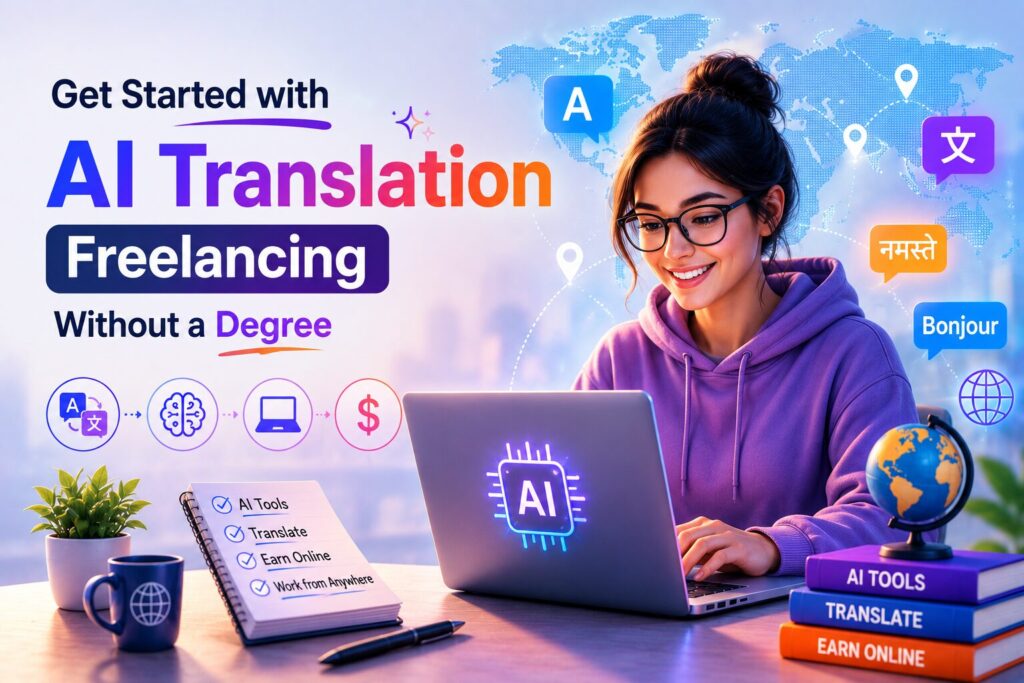
The path to earning with this workflow follows a repeatable four-step process that beginners have successfully used in 2026. No shortcuts. No paid courses required upfront. Just a structured approach that prioritizes real work over theoretical preparation.
If you grew up bilingual, lived in another country, or achieved strong proficiency through self-study — you likely have enough language ability to start. The key is honesty about your level. You do not need native-level mastery. You do need to reliably distinguish between correct and incorrect translations in your language pair.
For English-to-X translation work, a B2 or C1 proficiency level according to the Common European Framework of Reference is generally sufficient for entry-level MTPE work. For language pairs where you are translating into your native language, the bar is lower on source language proficiency and higher on target language fluency.
You do not need to spend money on tools to start. The “zero-dollar workflow” documented by language industry professionals in 2026 uses entirely free AI tools: DeepL’s free tier offers 500,000 characters per month of high-accuracy translation for European languages, Google Translate covers over 130 languages, and ChatGPT’s free version can handle nuanced content requiring context.
The workflow is simple:
Take a source text. Run it through an AI translation tool. Then read the output line by line. Ask yourself: does this sound like a human wrote it? Is the tone appropriate? Did the AI miss any cultural references or idioms? Any sentence that feels off needs to be rewritten. Any term translated inconsistently needs to be standardized.
This is the entire skill. Speed and accuracy improve with practice, but the core activity is the same at week one and year one.
Never invent portfolio samples. The translation industry is small and clients can spot fabricated work easily. Instead, find public domain texts or Creative Commons-licensed content related to an industry you understand — product descriptions, blog articles, help documentation — and translate them using your AI-assisted workflow.
Document your process. Show the raw AI output alongside your edited version. A side-by-side comparison demonstrating what you fixed and why is more valuable to potential clients than a perfect translation with no context about how you produced it.
Focus your energy where beginners actually get hired. The section below covers the specific platforms that work for this career path in 2026.
Tool selection matters because different AI translation engines excel at different content types. Using the wrong tool for a given task produces output that requires more editing — which costs you time and reduces your effective hourly rate.
Data from extensive engine testing on real client projects in 2025 and 2026 revealed clear performance patterns across the major translation tools.
DeepL remains the most accurate choice for European languages, particularly German, French, Spanish, Italian, and Dutch. Its neural network produces output with fewer grammatical errors and more natural phrasing than most alternatives. DeepL’s free tier provides 500,000 characters monthly, which is sufficient for hundreds of pages of translation work. For English-to-Japanese or English-to-Chinese, however, DeepL’s accuracy decreases compared to its performance on European language pairs.
Claude from Anthropic excels at high-nuance, brand-sensitive marketing translation. If the source text contains wordplay, cultural references, or requires a specific brand voice to be preserved, Claude typically outperforms other LLMs. The trade-off is speed and API cost compared to dedicated translation tools.
Google Translate supports over 130 languages, more than any competitor, and offers camera translation and offline mode that other tools lack. For less common language pairs where DeepL does not operate, Google Translate is often the only viable option. Its translations can be more literal than DeepL’s, but for straightforward technical documentation, this literalness is sometimes preferable.
GPT-4o/5 from OpenAI performs best for technical documentation and code localization. When translating software strings, API documentation, or technical manuals, the general-purpose LLMs often produce more consistent terminology than dedicated MT tools.
For a freelancer just starting this career path, the practical stack is: DeepL for European languages, Google Translate for wide language coverage, and ChatGPT or Claude for marketing or creative content that requires tone preservation. All three can be used within free tiers indefinitely for moderate volumes of work.
Knowing where to find work is as important as knowing how to do it. These platforms consistently list entry-level and intermediate AI translation roles that explicitly do not require degrees.
Upwork remains the largest freelance marketplace for AI translation work. A real job posted in May 2026 sought a freelancer to verify Japanese AI translations for coherence and accuracy — a perfect fit for someone starting this career path. Another listing explicitly stated: “You can use AI tools such as ChatGPT, DeepL, or Google Translate to help speed up the process, but the final translation should still be checked for accuracy.”
For beginners, focus on smaller fixed-price projects under $100 initially. These have less competition and more forgiving clients. As of 2026, Upwork has redesigned its marketplace to surface emerging AI roles based on current demand trends, making it easier to find relevant work.
ProZ.com is the professional network specifically for translators. While some job postings require experience, the platform’s AI Expo 2026 highlighted the growing demand for linguists comfortable with AI workflows. Real postings on ProZ in 2026 include AI content labeler positions where TELUS Digital explicitly stated “you don’t need a specialized technical degree or previous AI experience to start.”
The key advantage of ProZ over general freelance platforms is specialization. Clients posting on ProZ already understand what MTPE is and value it appropriately.
CrowdGen specifically allows individuals to earn money by contributing to AI technology training and improvement. A real listing from 2026 sought remote Lingala speakers to evaluate AI translations — a language pair no automated tool handles perfectly, making human expertise essential.
These micro-task platforms pay less per hour than direct client work but provide an accessible entry point. The estimated hourly earnings for some roles are $4.50 USD — modest but real, and valuable for building experience.
OneForma recruits global linguists for transcription and translation projects that train AI assistants. The Vega Transcription project mentioned in a March 2026 LinkedIn post converts multilingual audio into structured text, with flexible hours and per-task compensation that varies by language pair.
Yes. But realistic expectations matter.
Pure AI translation work, requiring no human editing, costs roughly $0.001 per word. Hybrid MTPE (Machine Translation Post-Editing)—where AI generates the draft and a human refines it—commands significantly higher rates of $0.05 to $0.10 per word. At the top end, professional human-only translation runs $0.15 to $0.30 per word, with specialized content (legal, medical, technical) frequently commanding even higher premiums.
As a beginner in this line of work, your projects will primarily fall into the MTPE category. At $0.05 per word, a 2,000-word document pays $100. At a pace of 500 words per hour—realistic for a beginner after initial practice—this translates to $25 per hour. As your speed increases to 1,000 words per hour, that same $0.05 per word rate generates $50 per hour.
The numbers add up differently depending on your language pair. A freelancer working on a high-volume language pair like English-to-Spanish might charge lower rates per word but complete more words per hour. A freelancer working on a less common pair like English-to-Vietnamese might charge higher rates but find fewer total projects.
The Institute of Translation and Interpreting has emphasized that the AI era is actually increasing the demand for translators who understand both language theory and AI capabilities. The key is positioning yourself as someone who enhances AI output, not someone who competes with it.
A freelancer’s first project might pay $20 for two hours of work. That is fine. The goal is not the first project’s payout — the goal is building a process that turns language ability into sustainable income.
The numbers paint a clear picture: this career path is not a passing trend—it is a structural market shift backed by real data. Understanding these figures changes how you evaluate the opportunity and your place within it.
The AI translation market is growing at a staggering pace. The AI in language translation market grew from $2.94 billion in 2025 to $3.68 billion in 2026—a compound annual growth rate (CAGR) of 25.2%. The broader machine translation market is projected to grow from USD 1.12 billion in 2025 to USD 1.25 billion in 2026, reaching USD 2.17 billion by 2031 at an 11.62% CAGR. Even more striking, the AI Language Translator Tool Market is forecast to reach USD 11.58 billion by 2032, growing at a 23.89% CAGR.
The global Translation and Localization Services Market, valued at USD 54.98 billion in 2025 (Statista), is projected to grow to USD 58.82 billion in 2026, with a CAGR of 7.46%, reaching USD 91.03 billion by 2032. Companies are spending $70 billion a year and growing on translation and localization (Nimdzi Insights).
The shift is happening inside the world’s largest companies. According to TransPerfect’s 2026 Business Outlook Report, 74% of enterprise leaders say AI strategies and automation are a top priority for 2026, and 65% already use AI or machine-assisted translation in their localization workflows. A further 69% are actively piloting or have embedded AI across their broader operations.
Translation has become a long-term infrastructure decision rather than a short-term experiment. A Zogby Analytics survey found that 79% of respondents plan to keep a human-in-the-loop, and 52% rely on in-house linguists for post-editing AI output. Half of respondents expect their use of AI translation to increase significantly over the next one to two years.
Translation volumes are up 30% year over year, and 40% of content now uses machine translation at some stage. Industry analysts project that by the end of 2026, the translation market will split clearly into three tiers: commodity work (AI-only), hybrid work (AI-assisted professionals), and premium work.
The demand for qualified post-editors is increasing, while pure “hands-on translators without technical affinity” are coming under pressure. This is precisely where the opportunity for this career path emerges.
The data on earnings is unambiguous. The number of workers in roles requiring explicit AI fluency has grown from 1 million in 2023 to roughly 7 million in 2025—a sevenfold increase in two years, according to LinkedIn data. Demand for AI, machine learning, and advanced programming skills rose 60% year-over-year, pushing freelance hourly rates up 44% above platform averages.
In Japan alone, searching for “AI translation outsourcing” on major platforms returns over 2,000 job listings per month as of May 2026—approximately 1.6 times the volume from May 2024. The market is clearly expanding.
Recent academic research provides concrete data on which tools perform best. A 2026 study evaluating translation accuracy of computer terms from English to Indonesian found that ChatGPT produced 18 accurate translations, 3 less accurate translations, and 0 inaccurate translations, outperforming both Google Translate and DeepL. Another study on multiword expressions found that GPT-4o statistically significantly outperforms neural machine translation systems, while DeepL and Google Translate exhibit substantial declines in performance for discontinuous multiword expressions.
For freelancers, this means tool selection matters. ChatGPT is often the safest choice when translation accuracy depends on constraint-following, particularly for UI strings, technical documentation, and code-adjacent strings that must preserve syntax.
The rates you can charge vary dramatically by language pair. Common pairs like English–Spanish or English–German sit at the lower end, while rare or high-demand combinations like English–Arabic, English–Japanese, or anything involving lesser-spoken languages push costs 20–50% higher. Technical translation costs between $0.15 and $0.35 per word in 2026, with an additional 20–40% for CJK languages (Chinese, Japanese, Korean) and 30–60% for rare language pairs.
The market is not shrinking—it is transforming. 63% of freelance translators now use automated translation in some form through post-editing or AI usage. The data confirms that AI-proficient freelancers consistently out-earn their peers — by roughly 40% according to Upwork’s 2026 data. The competitive advantage comes from combining language skills with AI tool fluency, not from formal credentials.
The numbers tell a clear story: this is a verified, growing income stream backed by billions in market investment and accelerating enterprise adoption. The question is not whether the opportunity exists—it is whether you will position yourself to capture it.
AI translation freelancing without a degree means offering language services where you use AI tools like DeepL, ChatGPT, or Google Translate to produce draft translations, then edit and refine those drafts for accuracy, tone, and cultural appropriateness. No formal degree is required because clients care more about your demonstrated ability to produce quality output than your credentials. The industry term for this work is machine translation post-editing or MTPE.
Start by auditing your actual language ability honestly. Then learn the core workflow using free AI tools — DeepL’s free tier, Google Translate, and ChatGPT’s free version. Build a small portfolio using public domain texts. Create profiles on Upwork, ProZ.com, and CrowdGen. Apply to small fixed-price projects first to build your reputation. Within four to six weeks of consistent effort, most beginners can secure their first paid project.
Entry-level MTPE rates typically range from $0.05 to $0.10 per word. At $0.05 per word with an editing speed of 500 words per hour, a beginner earns $25 per hour. With practice, editing speed increases to 800–1,000 words per hour, raising the effective hourly rate to $40–$50. At the high end, earning $0.10 per word at 1,000 words per hour yields $100 per hour. Actual earnings vary by language pair, client type, and project complexity.
DeepL offers the best balance of accuracy and ease of use for European language pairs, with a generous free tier of 500,000 characters monthly. Google Translate covers over 130 languages and provides camera translation and offline mode. For marketing or creative content that requires tone preservation, Claude or ChatGPT produce better results than dedicated MT tools. Most beginners should start with DeepL and add ChatGPT for creative or nuanced content.
Yes, provided you have realistic expectations. The translation market is growing, not shrinking, but the nature of the work has changed. Pure human translation is giving way to human-AI collaboration. Freelancers who embrace this collaboration earn more than those who resist it — Upwork data shows AI-proficient freelancers earn roughly 40% more than those who are not. The barrier to entry is language ability, not a degree, and the work can be done entirely remotely with free tools.
AI translation freelancing without a degree works because the translation industry of 2026 prizes a different skill set than the industry of 2016 valued.
The three most actionable takeaways from this guide:
The difference between people who earn in this field and those who do not is one thing: they start. You now have the roadmap. The only missing piece is action.
All figures are sourced from publicly available reports, benchmarks, and industry data from 2026.
Leave a comment below — which language pair will you start with?
P.S. — We publish one practical AI income guide every week at AICAP.in. Subscribe below — no spam, no fluff, just strategies that actually work in 2026.

Salman Shaikh is the founder and editor-in-chief of AiCap.in, an independent AI and personal finance publication based in Ahmedabad, India.
Since launching AiCap.in in April 2026, Salman has personally tested and reviewed 100+ AI tools across income generation, crypto research, content creation, and personal finance — publishing 91+ hands-on guides based on real usage, not press releases.
His approach is simple: every tool he writes about is one he has opened, tested, and either used to earn money or rejected after finding it didn’t deliver. He started AiCap.in after realising most AI content in India was either written by people who had never touched the tools, or buried in technical jargon that everyday people couldn’t act on.
His work covers AI tools for passive income, freelancing with AI, crypto research workflows, Amazon FBA with AI, and personal finance strategies built for readers in India and accessible to anyone globally looking to earn smarter with AI.
AiCap.in now reaches a growing community of readers across India and globally who want practical, jargon-free AI strategies they can implement today.
Connect with Salman: LinkedIn · X @AiCap88 · YouTube · Medium