Ahmedabad, Gujarat, India
Ahmedabad, Gujarat, India

AI personal budget management in 2026 makes saving effortless. Discover which apps do the heavy lifting and how beginners save $80–$500 without spreadsheets. Start today.
Disclaimer: This content is for educational and informational purposes only. Earnings, savings, and financial results vary by individual. Always conduct your own due diligence before making financial decisions.
Most people who try to budget quit within three weeks — not because they lack discipline, but because the method they’re using was never designed for how real life works. Spreadsheets demand your time every single day. Manual apps punish you the moment you fall behind. And generic advice like “track your expenses” ignores the fact that tracking alone has never saved anyone a single dollar.
AI personal budget management in 2026 works completely differently. If you’ve been looking for a way to actually stay on top of your money without building a system that collapses the first time you get busy — this guide is written exactly for you. It breaks down how AI personal budget management works right now, which tools are doing the real work, and how beginners are using them to save money they didn’t even know they were losing.
By the end, you’ll know exactly which approach fits your situation — and you’ll be able to start today, without a single formula or tab.
AI personal budget management is the use of machine learning and automation to handle what used to be entirely manual — tracking transactions, sorting expenses by category, identifying wasteful spending patterns, and predicting upcoming cash flow needs. Instead of you sitting down each Sunday to enter numbers, the AI connects to your bank accounts, reads every transaction the moment it happens, and builds a living picture of your financial behavior over time.
The key difference between AI personal budget management and a traditional budgeting app is intelligence that compounds. A regular app records what happened. An AI-powered tool learns from what happened, and uses that learning to surface insights, flag anomalies, and suggest specific changes — not generic advice, but recommendations built around your actual income cycles and spending habits.
As of May 2026, this technology has matured well past the experimental phase. According to Plaid’s March 2026 research on AI in financial services, 57% of U.S. consumers now expect their fintech apps to use AI, and 78% say they are open to receiving AI-based personal financial guidance. AI personal budget management is no longer niche — it’s where personal finance is going, and the tools available today are genuinely ready.
The numbers behind AI personal budget management adoption tell a sharp story. According to TD’s second annual U.S. AI Insights Report published in March 2026, 78% of Americans now use AI-enabled tools in their daily lives, with 62% specifically comfortable using AI for budgeting purposes. That comfort level is growing — not because of hype, but because the tools are delivering real outcomes.
According to FNBO’s 2025 Financial Wellbeing Study, 46% of Americans have already used AI to help with their personal finances. Among those using AI for budgeting, 48% have created or updated household budgets using AI assistance. What’s more telling is what’s happening on the savings side: according to Bankrate’s research on AI finance apps, popular tools like Cleo, Rocket Money, and Hopper are helping users save an average of $80 to $500 annually — not by providing advice, but by automatically catching waste the user never noticed.
The reason to switch now, specifically, is that AI personal budget management tools have hit a reliability threshold. Early versions miscategorized transactions constantly and required so much correction that users gave up. In 2026, top-tier tools hit 85% or higher categorization accuracy from day one — and improve further the longer they run on your data.
Understanding the mechanism behind AI personal budget management helps you use these tools far more effectively. There are three distinct AI capability tiers operating in the market right now, and knowing which tier your app uses determines what you can realistically expect from it.
The first tier is automated categorization. The AI connects to your accounts via secure banking data connectors like Plaid or MX, reads every transaction in real time, and sorts them into spending categories — groceries, rent, streaming subscriptions, dining, transport. This alone saves the average user several hours per month compared to manual tracking.
The second tier is behavioral AI. This is where AI personal budget management gets genuinely powerful. Apps operating at this tier — Copilot and Monarch Money are the clearest examples — study your transaction history over weeks and months, learn your seasonal patterns, and generate recommendations that adapt as your behavior shifts. Copilot’s AI, for instance, learns your spending patterns and tags every transaction automatically, refining its accuracy with each correction you make. After approximately fifty manual corrections, categorization becomes nearly automatic for most users.
The third tier is conversational AI. Tools like Cleo operate here — you can ask in plain language “Can I afford a weekend trip this month?” and the AI answers based on your actual income, your remaining budget, and your upcoming known expenses. Not a generic projection — your specific financial reality, answered in seconds.
Now here’s the part most guides skip entirely — and it’s the most important. The AI only produces value if you give it enough time to learn. Almost every case of “the app didn’t work for me” traces back to one behavior: switching apps before the AI had 30 to 60 days of data to work with. One tool, committed to for two months minimum, consistently outperforms five apps used for one week each.
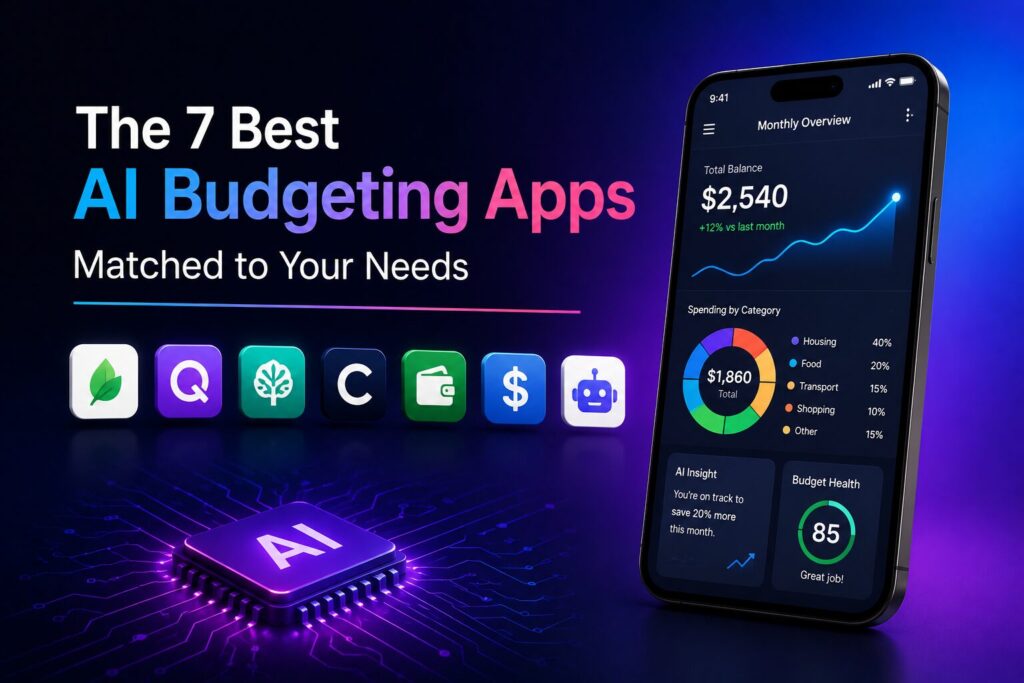
Choosing the wrong tool is the fastest way to quit AI personal budget management before it pays off. Here is an honest breakdown of what each major platform actually does well, matched to the type of user it fits.
Cleo is a conversational AI chatbot that uses plain-language interaction and, famously, a “roast mode” that calls out your bad spending habits with humor rather than judgment. Its autosave feature analyzes your cash flow and automatically sets aside amounts the algorithm determines you genuinely won’t miss. Users even create “spending fines” — automatically saving $5 every time they spend at a specific merchant. Bankrate documents that Cleo users report saving 15 to 20% more than with traditional budgeting apps because the app makes it impossible to look away from financial reality. Cleo is free to start, with a paid tier for cash advance and credit-building features.
Built by the original team behind Mint, Monarch includes an AI assistant, weekly spending recaps, net worth tracking, investment dashboards, and shared savings goals. NerdWallet’s March 2026 review lists it as the top pick for users who want strong AI categorization combined with household-level financial visibility. One subscription covers two household members.
Copilot’s AI learns your spending behavior over time and adjusts dynamically as your patterns change. It supports rollover budgets — if you underspend in a category one month, that balance carries forward rather than disappearing. It also tracks investments including crypto and real estate alongside everyday spending. Toolradar’s May 2026 analysis names Copilot as the top overall AI-powered budgeting experience for Apple users. Note: Copilot is iOS-only.
Empower aggregates bank accounts, investment accounts, and retirement funds into a single AI-powered dashboard. Its investment fee analyzer identifies exactly how much expense ratios are costing you annually — a feature most paid apps don’t include. The core tools are completely free, making it the strongest zero-cost entry point into AI personal budget management.
YNAB now includes AI enhancements layered on top of its proven zero-based methodology, where every dollar you earn is assigned a specific job before it gets spent. The AI assists with category suggestions and spending pattern analysis, but the core discipline remains user-driven. Best for people who want structure and are willing to engage actively with their budget.
Rocket Money’s AI scans your bank and credit card transactions to surface every active subscription, including ones billed annually that are easy to forget. It then offers to cancel unwanted subscriptions on your behalf. For anyone who has never audited their recurring charges, this single function often recaptures $50 to $150 per month in the first 30 days.
Origin integrates real-time financial data with AI-driven analysis across spending, savings, investments, and tax planning. It connects through Plaid, MX, and Mastercard and offers partner access at no additional cost. It is built for users whose income is variable and whose financial picture is genuinely more complex than a single salary and a few cards.
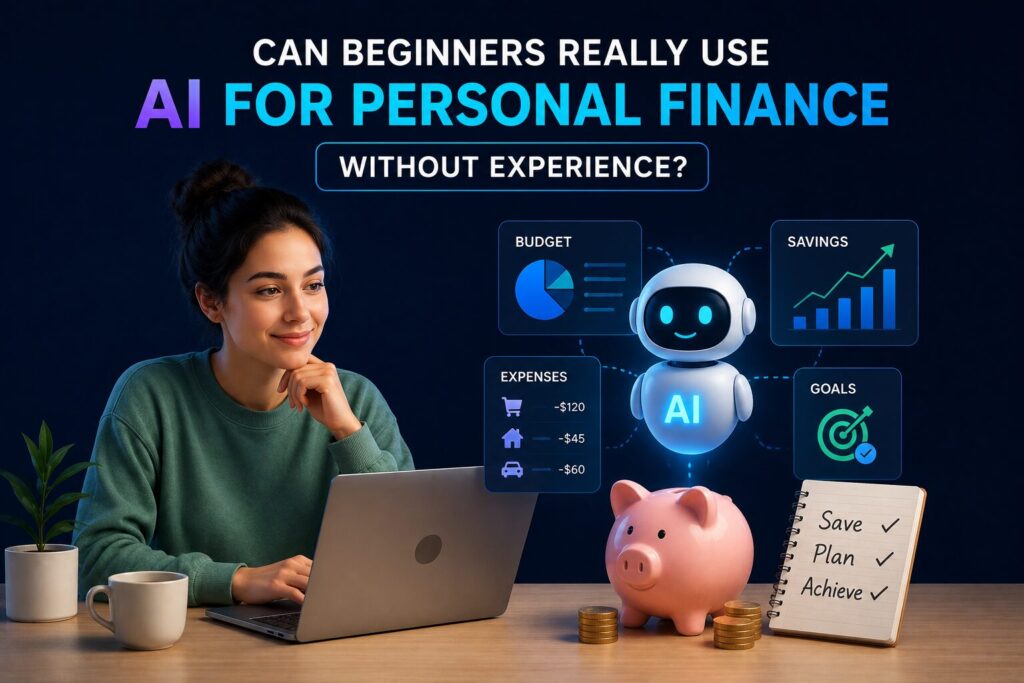
This section addresses the question that stops most people from starting — and the answer is clearer than most guides admit.
AI personal budget management was specifically engineered to remove the knowledge barrier. You do not need to understand zero-based budgeting, envelope systems, or the 50/30/20 rule to benefit from these tools. You connect your accounts, you let the AI read your data for 30 days, and then you start reading what it tells you.
The TD 2026 AI Insights Report found that 62% of Americans are already comfortable using AI for budgeting purposes — a number that includes first-time earners, students, and people who have never successfully maintained a budget before. What makes AI personal budget management accessible to beginners specifically is that the insight surfaces automatically. You don’t have to know the right questions to ask. The AI flags what matters and brings it to your attention.
The one thing beginners consistently underestimate is correction time. In the first two to four weeks, you will need to correct miscategorized transactions. Telling Copilot that your “Whole Foods” charge is groceries, not restaurants, teaches the model. Each correction compounds — the tool learns your behavior faster than you expect, and after a month, the corrections become rare.
As of May 2026, the behavioral shift is documented. According to Ipsos research, 48% of AI finance tool users have already used AI to create or update household budgets — and 29% of non-users say they plan to start using AI for budgeting within the next year.
The AI-powered personal finance landscape has undergone a dramatic transformation in 2026. What was once a niche experiment is now a mainstream movement reshaping how millions manage their money. Here’s the latest data, emerging trends, and actionable insights that every budget-conscious individual needs to know.
The numbers tell a compelling story. The AI-powered personal finance management market grew from $1.62 billion in 2025 to $1.77 billion in 2026—a compound annual growth rate (CAGR) of 9.7%. And this is just the beginning. By 2030, the market is projected to reach $2.55 billion. Budgeting software alone is expected to capture a dominant share of the market in 2026, driven by surging adoption of digital budget planners.
Nearly half of global consumers (49%) have used AI to support savings and investment decisions in the past six months, according to EY’s April 2026 Global AI Sentiment Survey of over 18,000 people across 23 countries. Perhaps more telling: 50% believe AI could help detect and prevent financial fraud, while 21% have already used AI agents for financial product recommendations.
In the U.S., the numbers are even more striking. According to Plaid’s March 2026 research, more than half of Americans used AI to manage their finances in the past 12 months, and among those users, 86% say it helps them better understand their finances (consistent with Plaid’s broader finding that most consumers are open to AI guidance).
Generational adoption tells an equally powerful story: 67% of Gen Z and 62% of Millennials now use AI for financial management. AI now supports budgeting (60%), investment planning (48%), and credit score improvement (48%) among these users.
Plaid’s research reveals exactly what users are looking for. Consumers say they expect AI to save them time (60%), reduce financial stress (58%), and take the guesswork out of financial decisions (53%). There’s a clear shift from simply tracking money to actively improving financial outcomes. Among Americans already using AI for their finances, 64% say it improved their ability to evaluate financial products, and 53% say it helped them manage day-to-day spending.
We’re moving beyond robo-advisors and entering the era of predictive behavioral finance. The concept of a “financial avatar” — a personalized digital twin designed to automate everyday decisions and provide real-time feedback — is becoming a reality. Recent data shows that AI-driven personal finance systems can improve forecasting accuracy by 50% and save users more than five hours every month on manual tracking.
The way people interact with their finances is changing fast. Perplexity, an AI-powered answer engine, reports that 75% of its users ask finance-related questions every month. Even more revealing: 35% of people now turn to general AI chatbots and 30% to AI-powered search engines for financial guidance — compared to just 13% who use dedicated financial planning apps. This suggests AI is democratizing financial advice through familiar, conversational interfaces rather than intimidating specialized platforms.
In response, AI-native budgeting apps are emerging. BudgetGPT, which launched its iOS app in January 2026 (TechCrunch), allows users to have natural conversations with their money — and has already answered more than 100,000 financial questions. Similarly, Finvasia unveiled “jAI” in May 2026 (Economic Times), a voice-based finance assistant that lets users simply speak about their finances and receive real-time, conversational guidance.
Several capabilities separate this year’s tools from earlier versions:
Predictive Alerts: Modern AI budgeting tools now alert you before you overspend — not after. Features like “planned-vs-actual tracking, AI variance explanations, and 90%-budget alerts” catch overspending before it happens.
Automated Categorization & Insights: Google’s Gemini can now automatically categorize bank transactions into categories like Food, Transportation, Rent, Entertainment, or Miscellaneous with a single prompt. It can also generate professional budget trackers, write complex formulas without coding, and spot leaks in your budget.
Voice-Enabled Assistance: Voice-based finance assistants are expanding rapidly, allowing hands-free budget management. Finvasia’s “jAI” (mentioned above) is a prime example, letting users speak naturally about their finances and receive real-time guidance without navigating menus or dashboards.
While adoption is surging, trust remains critical. 75% of consumers say it’s important to know when AI is being used in financial decisions, and 60% say they would trust it more if they understood the reasoning behind it. Financial services firms must earn that trust by putting strong guardrails around AI-driven decisions and demonstrating transparency and accountability.
AI personal budget management has moved from “nice to have” to “must have.” Whether you’re a tech-savvy early adopter or just getting started, the tools available today are more powerful, more accessible, and more personalized than ever before. The question is no longer whether to use AI for budgeting — it’s how to make it work best for you.
Knowing what breaks the process is just as valuable as knowing how to start. The most consistent failure patterns in AI personal budget management follow a recognizable sequence.
App-hopping is the number one mistake. Switching tools every few weeks resets the AI’s learning completely. Each switch means starting from zero data. Pick one app, commit to 60 days minimum, and evaluate only after the AI has had enough time to learn your patterns and produce meaningful insights.
Ignoring the uncomfortable insights defeats the entire purpose. The AI surfacing the fact that you spent $400 on food delivery last month is not an accusation — it is the data that makes change possible. Users who dismiss or ignore these insights get zero value from AI personal budget management. The savings come from confronting reality, not from installing an app.
Using cash advance features as regular income is a specific Cleo mistake worth naming directly. Cleo’s $250 cash advance is an emergency feature. Users who draw on it regularly create a cycle where they are perpetually behind, and the cost compounds. It is a safety net, not a supplement.
Expecting the app to replace action is the subtlest mistake. AI personal budget management provides clarity, patterns, and specific recommendations. Acting on those recommendations is still the user’s job. The tools that work are the ones you engage with — reading the weekly recaps, responding to alerts, adjusting categories when something looks wrong.
AI personal budget management is the use of machine learning tools to automatically track, categorize, and analyze your spending without manual data entry. Apps like Cleo, Monarch Money, and Copilot connect to your bank accounts, read transactions in real time, and generate personalized insights — turning a process that used to take hours per week into something that runs automatically in the background.
Start by picking one app based on your situation — Cleo for beginners, Monarch Money for couples, Empower if you want a free option. Connect your primary bank account and one credit card first. Let the AI run for 30 days without changing anything. After that first month, you’ll have enough pattern data for the tool to produce genuinely useful recommendations. Best AI budgeting apps 2026 are all available for download with free trials or free tiers.
According to Bankrate’s documented research on AI finance apps, popular tools like Cleo, Rocket Money, and Hopper help users save an average of $80 to $500 annually — primarily by surfacing forgotten subscriptions, identifying spending drift, and automating savings transfers. Users who actively engage with the AI’s weekly insights and act on the recommendations consistently outperform those who install the app and check it rarely.
Copilot Money is the strongest all-in AI budget tracker for users who want maximum automation with minimal manual input — it learns your patterns, auto-categorizes transactions, and tracks investments alongside everyday spending. For Android users or anyone who wants a free starting point, Empower provides solid AI-powered net worth and spending tracking at no cost. Monarch Money is the best choice if you manage finances jointly with a partner.
Yes — and beginners arguably benefit more than experienced budgeters. The AI removes the knowledge requirement entirely. You don’t need to understand budgeting frameworks or financial planning terminology to use these tools effectively. The insight surfaces automatically. What matters is committing to one tool for at least 60 days before evaluating whether it’s working — the AI gets measurably smarter with time, and first-time users who stick with one platform consistently report the clearest financial picture they’ve ever had.
Here is what you just learned, in practical terms:
AI personal budget management in 2026 has removed every barrier that made budgeting feel hard. The spreadsheet is gone. The Sunday-night data entry is gone. What’s left is a clear, automatic picture of where your money actually goes — and a tool intelligent enough to tell you exactly where to start fixing it.
The only thing that doesn’t happen automatically is starting. That part is still yours.
All figures are sourced from publicly available reports, benchmarks, and industry data from 2026.
Leave a comment below — which app are you trying first, and what’s the one spending habit you’re most curious to see the AI catch?
P.S. — We publish one practical AI guide every week at AICAP.in. Subscribe below — no spam, no fluff, just strategies that actually work.

Salman Shaikh is the founder and editor-in-chief of AiCap.in, an independent AI and personal finance publication based in Ahmedabad, India.
Since launching AiCap.in in April 2026, Salman has personally tested and reviewed 100+ AI tools across income generation, crypto research, content creation, and personal finance — publishing 91+ hands-on guides based on real usage, not press releases.
His approach is simple: every tool he writes about is one he has opened, tested, and either used to earn money or rejected after finding it didn’t deliver. He started AiCap.in after realising most AI content in India was either written by people who had never touched the tools, or buried in technical jargon that everyday people couldn’t act on.
His work covers AI tools for passive income, freelancing with AI, crypto research workflows, Amazon FBA with AI, and personal finance strategies built for readers in India and accessible to anyone globally looking to earn smarter with AI.
AiCap.in now reaches a growing community of readers across India and globally who want practical, jargon-free AI strategies they can implement today.
Connect with Salman: LinkedIn · X @AiCap88 · YouTube · Medium





[…] research and execution. Alpaca launched its official MCP server in November 2025, giving traders structured access to real-time market data, news context, […]
[…] have tried budgeting before. You set limits, tracked a few transactions, and two weeks later you forgot it existed. That […]