Ahmedabad, Gujarat, India
Ahmedabad, Gujarat, India

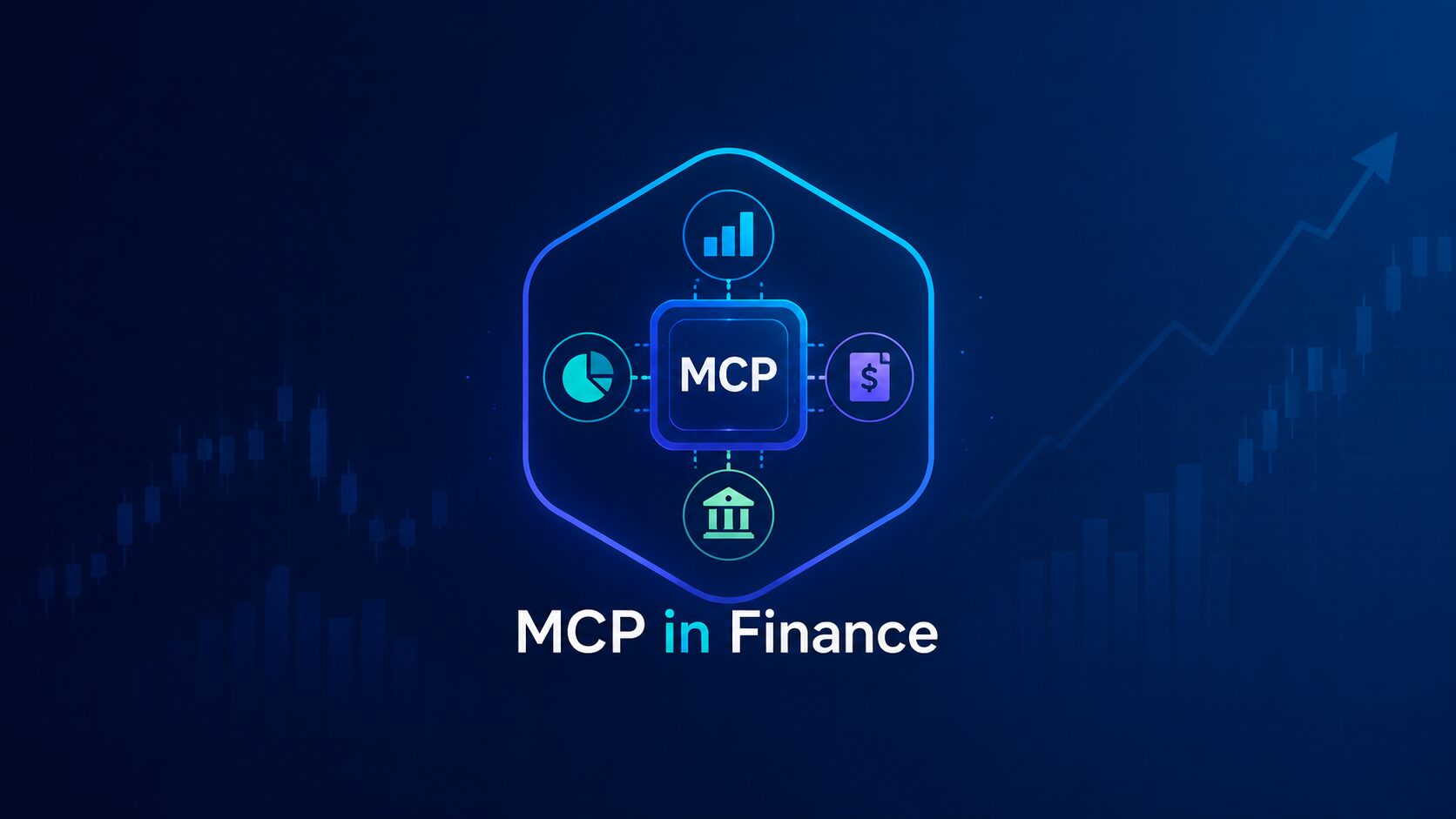
MCP in Finance explained for 2026: connect AI to live bank data, automate portfolio analysis, and earn $500–$2,000 per setup as a freelancer. Start in under an hour.
Disclaimer: This content is for educational and informational purposes only. Earnings and results vary by individual. Always conduct your own due diligence.
Most people who hear “MCP in Finance” for the first time assume it’s some complex trading algorithm or a compliance regulation. It is neither. And the difference between someone who understands this technology and someone who ignores it is about to show up directly in their monthly returns.
If you have ever wished your AI assistant could actually see your bank balance, check your portfolio, or flag an unusual transaction — that is exactly what MCP in Finance enables. It connects AI assistants directly to live financial data through a secure, standardized bridge. The full definition is covered in the next section, but the short version is this: without MCP in Finance, an AI chatbot can only answer based on what it learned months or years ago. With it, you can ask a natural language question like “Was this invoice paid?” and get a real-time answer directly from your bank account.
Here is the core idea: you connect your AI assistant directly to your financial data through a secure, standardized bridge.
MCP in Finance refers to the use of the Model Context Protocol, an open standard developed by Anthropic (the company behind Claude AI), specifically applied to financial data and systems. Think of an MCP server as a secure, permission-based bridge that connects large language models directly to live financial data — your transaction history, stock holdings, payment rails, fraud alerts, even core banking systems.
Without this technology, an AI chatbot can only answer based on what it learned months or years ago. It cannot see your actual money. It cannot verify a payment. It cannot tell you if a transaction cleared. With an MCP server, you can ask a natural language question like “Was this invoice paid?” and get a real-time answer directly from your bank account.
Banks and financial institutions have already begun adopting MCP in Finance at scale. The reason is straightforward: legacy AI models fail at the integration layer. According to a 2024 Gartner survey, 20% of institutions cite AI integration as a top-three roadblock, and 22% say it is crippling their generative AI efforts.
MCP in Finance removes that roadblock. It provides a standardized way for AI agents to access enterprise data, tools, and APIs — without custom code for every LLM provider. In December 2025, the 2026 MCP roadmap was published, focusing on horizontal scaling, enterprise readiness, and better tooling for production deployments.
Why does this matter in 2026 specifically? Because the shift from AI as a knowledge engine to AI as an action engine is happening right now. The Asian Banker published research in May 2026 stating that model context platforms will make banks’ services “AI-ready,” ensuring they are surfaced, recommended, and acted upon within the AI-first consumer landscape. Banks that ignore MCP in Finance risk being systematically overlooked by consumer AI agents that now steer purchasing and financial decisions.
Between 2025 and 2026, major financial players completed $8.05 billion in acquisitions related to this infrastructure — CapitalOne acquired Brex for $5.15 billion, Mastercard acquired BVNK for $1.8 billion, Stripe acquired Bridge for $1.1 billion. This is not experimental technology. MCP in Finance is being embedded into the core infrastructure of global finance as you read this.
You do not need to be a developer to benefit from MCP in Finance. Here is what the starting path looks like for a complete beginner in 2026.
Step one: Understand the basic architecture. An MCP server sits between your AI assistant and your financial data. It handles authentication, permissions, and audit logging. When you ask a question, the MCP server retrieves only the data you are authorized to see and returns it in a structured format the AI can understand.
Step two: Choose a compatible AI assistant. The major AI platforms — Claude Desktop, ChatGPT, Cursor, and Gemini — all support MCP connections as of 2026. Claude Desktop currently has the most mature MCP integration for financial use cases.
Step three: Connect to an existing MCP server. Several platforms now offer ready-to-use MCP servers for finance. Grasshopper Bank launched the first MCP server by a US bank in August 2025 (more on this in the platforms section below). Ramp’s MCP server has grown from 275 businesses in January 2026 to over 2,500 businesses using it for month-end close, bill reconciliation, and expense approval workflows.
Step four: Start with read-only queries. The safest entry point is asking your AI assistant to retrieve information — check a balance, review recent transactions, or pull a spending report. Ramp reports that 60% of weekly MCP users are business owners, not developers, and 62% of usage is completion-oriented work like coding transactions and attaching receipts.
Step five: Layer in actions after you understand the controls. Meow Technologies, which raised nearly $30 million from Tiger Global and QED, operates an agentic banking platform where AI agents can issue corporate cards and send payments — but by default, no agent can move money unilaterally. Every transaction requires explicit approval and leaves a full audit trail.
MCP in Finance is not a future concept. These are documented use cases running in production today, across real banks, brokerages, and fintech platforms.
Michelle Hipwood, CFO at AI startup EnFi, uses Grasshopper Bank’s MCP connector to ask Claude one simple question: “Was this payment paid or is it still outstanding?” Instead of waiting for accounting systems to sync — sometimes a day or more — she gets a real-time answer directly from her bank account. She describes the conversational interface as “way better” than the alternative for this specific, crucial task.
Zerodha, one of India’s largest stockbrokers with 7.96 million active users as of March 2025, integrated MCP with Claude AI, becoming the first broker to do so. Users can now ask for their portfolio’s Sharpe ratio, diversification score, unrealized losses, or even volatility metrics in plain English. Around 300 to 600 users try the Zerodha-Claude MCP each day, with roughly 16,000 accessing it in the past week.
FINBOURNE integrated with Claude via MCP to enable AI agents that can access live investment data, automate workflows, and perform real-time actions while maintaining enterprise-grade governance and auditability. Tom McHugh, CEO of FINBOURNE, explains that with MCP, “the model can directly query the operating layer in real time, and crucially, we get an audit trail.”
Finance teams are using Ramp’s MCP server to pull spend breakdowns by category and vendor (52% of weekly users), search bills and match invoices (38%), and audit reimbursements (14%). One controller at a logistics technology company has spent over 10 hours tuning Claude to generate financial statements, run flux analysis, conduct internal audits, and build one-click reporting — with the goal of running as much of his month-end close through Claude as possible.
Open-source MCP servers now exist specifically for fraud detection, combining Isolation Forest anomaly detection, autoencoder ensembles, and behavioral biometrics. The fraud-detection-mcp server includes 24 tools and 831 tests for financial security. Similarly, an AML Sanctions Screening MCP server connects to 13 live data sources for AML/CFT due diligence, returning structured AML Risk Tiers with supporting evidence.
Alpaca launched its official MCP server in November 2025, giving traders structured access to real-time market data, news context, portfolio details, and order actions — all through natural language prompts. Users can ask for a list of healthcare large-cap stocks, compare daily changes, or use a percentage of purchasing power to execute trades, all within a single interface.
The adoption of MCP in Finance accelerated dramatically from late 2025 through early 2026. Here is the current landscape as of mid-2026.
Fifth Third Bank introduced MCP capabilities through Newline, its embedded finance business, in December 2025. By April 2026, they had extended MCP with “Skills” — a layer that standardizes how AI models use tools and workflows. Newline processed more than $18 trillion in payments volume in 2025.
Grasshopper Bank launched the first MCP server by a US bank in August 2025, built by digital banking provider Narmi. Business banking clients can query account balances, categorize vendor spending, and receive real-time budgeting signals through Claude.
Nymbus launched an MCP server in April 2026 designed to connect AI assistants directly to core banking systems. The server currently supports 19 tools covering customer verification, account management, payments, and debit card controls.
Meow Technologies announced an agentic banking platform in April 2026 that enables AI agents to open and manage business bank accounts on behalf of users. The platform supports Claude, ChatGPT, Cursor, and Gemini through an MCP endpoint, and holds billions of dollars in assets.
SmartTrade Technologies launched smartTrade Agentic Copilot (STAC) in March 2026 with an MCP-enabled Sovereign AI architecture that allows banks to deploy advanced agentic AI while maintaining security, compliance, and latency requirements. The system operates under a client-specific governance framework where humans remain the ultimate decision-makers.
Balance released its MCP Server beta in October 2025, enabling AI agents to securely retrieve and act on live B2B payment data using natural language — from checking a buyer’s credit status to generating payment links.
This is the question most readers want answered directly, so here is an honest answer. MCP in Finance itself is not a direct income stream. You do not get paid simply for knowing what it is. However, MCP in Finance enables workflows and automations that can generate income — and that distinction matters.
Freelancers and small business owners who understand this technology can offer a new type of service: setting up AI-driven financial dashboards, automating invoice matching, or building portfolio analysis tools for clients who do not want to learn the technical side. The barrier to entry is lowering quickly. Ramp’s MCP server, for example, connects to Claude in minutes and requires no custom code from the end user.
For investors, the value is indirect but real. Zerodha users are already using Claude to analyze their portfolios, get volatility estimates, and receive stock recommendations based on their own risk parameters. One user, Kirubakaran Rajendran, a full-time algo trader since 2017, posted about using Claude to review and adjust his portfolio on Zerodha — and the interaction went viral on X. His caution is worth repeating: “With AI, it is important to make the right prompts” and “one still needs to do their own bit of research.”
A genuine side-hustle path involves learning to configure MCP servers for small businesses that lack internal finance automation. As of May 2026, only a handful of institutions have deployed MCP servers, despite the protocol layer being mature. This gap represents an opportunity for early adopters who can bridge the technical divide for non-technical clients.
MCP in Finance is the application of the Model Context Protocol — an open standard that connects AI models to external data and systems — specifically to financial services. It allows AI assistants like Claude to securely access live bank data, trading accounts, payment rails, and compliance systems through a standardized, permission-based interface.
Install Claude Desktop, find an MCP server from a provider like Ramp, Grasshopper Bank, or Alpaca, and add the server configuration to your Claude settings. Start with read-only queries — checking balances, reviewing transactions, pulling reports. Most platforms provide step-by-step setup guides that require no coding.
MCP in Finance is an infrastructure tool, not a direct income source. Freelancers setting up financial AI workflows for small businesses currently charge between $500 and $2,000 per implementation, depending on complexity. Individuals using MCP for personal portfolio analysis save time and potentially improve returns, but no verified data suggests passive income directly from MCP itself.
Claude Desktop currently has the most mature MCP integration for financial use cases, with direct support for MCP servers from Grasshopper Bank, Ramp, and FINBOURNE. ChatGPT, Gemini, and Cursor also support MCP, but Claude’s documentation and community examples for finance are more developed as of 2026.
Yes, but with a clear expectation. The learning curve is shallow — you can have your first MCP connection running in under an hour. The value comes from what you do with that connection. If you currently spend hours manually pulling financial reports, reconciling transactions, or analyzing your portfolio, MCP in Finance will save you significant time. If you have no financial data to query, the protocol itself will not generate value for you.
MCP in Finance has moved from developer preview to enterprise production in less than 18 months. Fifth Third, Grasshopper, Nymbus, SmartTrade, and Meow have all deployed MCP servers in live banking environments. Zerodha has made MCP available to millions of retail investors. Ramp has connected over 2,500 businesses to AI assistants through MCP.
The banks that win in the AI era are not necessarily the ones with the largest AI budgets. They are the ones that make their data accessible to AI agents through standardized protocols like MCP. The same principle applies to individuals. Whether you are an investor, a freelancer, or a small business owner, the ability to connect your financial data to AI assistants will become a baseline competency — not an advantage.
All figures are sourced from publicly available reports, benchmarks, and industry data from 2026.
Leave a comment below — which MCP use case are you trying first?
P.S. — We publish one practical AI guide every week at AICAP.in. Subscribe below — no spam, no fluff, just strategies that actually work.

Salman Shaikh is the founder and editor-in-chief of AiCap.in, an independent AI and personal finance publication based in Ahmedabad, India.
Since launching AiCap.in in April 2026, Salman has personally tested and reviewed 100+ AI tools across income generation, crypto research, content creation, and personal finance — publishing 91+ hands-on guides based on real usage, not press releases.
His approach is simple: every tool he writes about is one he has opened, tested, and either used to earn money or rejected after finding it didn’t deliver. He started AiCap.in after realising most AI content in India was either written by people who had never touched the tools, or buried in technical jargon that everyday people couldn’t act on.
His work covers AI tools for passive income, freelancing with AI, crypto research workflows, Amazon FBA with AI, and personal finance strategies built for readers in India and accessible to anyone globally looking to earn smarter with AI.
AiCap.in now reaches a growing community of readers across India and globally who want practical, jargon-free AI strategies they can implement today.
Connect with Salman: LinkedIn · X @AiCap88 · YouTube · Medium