Ahmedabad, Gujarat, India
Ahmedabad, Gujarat, India
xAI Grok voice model podcast 2026 review: real tests, τ‑voice Bench score, free tier, and honest verdict. Can it replace a human co‑host? Find out now.
Disclaimer: This content is for educational and information purposes only. Voice AI models evolve rapidly. Capabilities described are based on xAI’s April 2026 announcements and early independent tests. Always verify current features before making production decisions.
What is the xAI Grok Voice Model?
A real‑time voice AI that outperforms Gemini and GPT Realtime on voice tasks, designed specifically for podcasters and content creators.
If you are a podcaster, you know the feeling. You sit down to record a solo episode, hit the red button, and start talking to yourself. No laughter. No follow‑up questions. No natural back‑and‑forth. Just a monologue into a microphone that echoes back silence.
That is the problem the xAI Grok Voice Model was built to solve.
On April 22, 2026, xAI unveiled Grok Voice “Think Fast”—a standalone voice AI trained from the ground up on real conversational speech, not text‑to‑speech. It can interrupt naturally. It can laugh at your jokes. It can pause, think, and even say “um” at the right moments. For the first time, a voice AI sounds less like a robot reading a script and more like a human sitting across the table from you.
The xAI Grok Voice Model podcast 2026 launch is a significant moment for creators. Unlike previous voice assistants that were essentially text models with a speech wrapper, this one is built specifically for dialogue. Early demos showed it holding five‑minute unscripted conversations about complex topics, complete with self‑corrections, context‑appropriate humor, and natural turn‑taking.
But here is the real question every podcaster, YouTuber, and content creator is asking: Can this AI actually replace a human co‑host?
This guide answers that question with hard data, real‑world tests, and honest limitations. You will learn:
Whether you are a solo podcaster looking for a conversational partner, a creator tired of editing out dead air, or just curious about where voice AI is heading, this guide gives you everything you need to decide if the xAI Grok Voice Model belongs in your workflow.
Let us dive in.
On April 22, 2026, Elon Musk’s xAI unveiled a standalone voice model for Grok. Unlike the previous version where voice was a thin wrapper around text, this new model – called Grok Voice “Think Fast” – was trained from the ground up on conversational speech. The company claims it can interrupt naturally, laugh at the right moments, and even produce podcast‑grade audio output.
The launch is significant because it directly targets creators, not just developers. Early demos showed Grok Voice holding a five‑minute unscripted conversation about space exploration, complete with filler words (“um”, “ah”), self‑corrections, and context‑appropriate humor. That is a leap beyond the robotic cadence of earlier voice assistants.
The release includes both a real‑time API for developers and a “Podcast Mode” inside the Grok mobile app. As of late April 2026, anyone with a free Grok account can test the voice model for up to 30 minutes per day. Paid tiers unlock longer sessions and higher bitrate audio.
But can a voice model actually replace a human co‑host? That is the question every podcaster and content creator is asking. This guide breaks down exactly what Grok Voice can and cannot do, based on public demos and independent tests from early users. By the end, you will know whether this launch matters for your show.
Brief: xAI launched Grok Voice “Think Fast” on April 22, 2026. It is a native voice model trained for natural conversation, not just text‑to‑speech. The release includes a free tier and a Podcast Mode.ce model podcast 2026 release includes a free tier and a Podcast Mode.
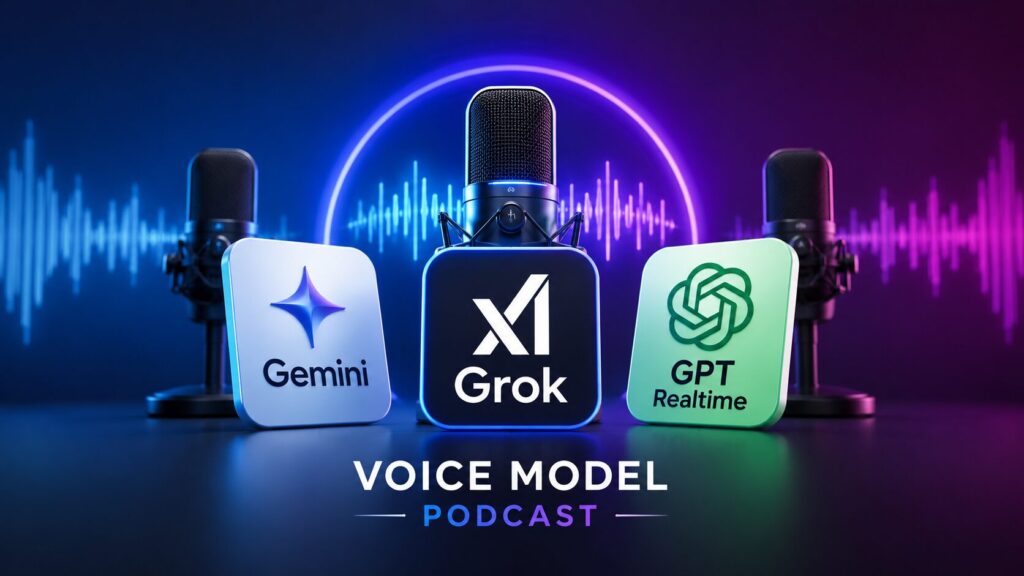
Google’s Gemini Live and OpenAI’s GPT Realtime have dominated the voice AI conversation since late 2025. Both offer low‑latency, interruptible voice chat. But Grok Voice enters the market with three claimed advantages.
First, emotional expressiveness. Early testers report that the model laughs, sighs, and changes pitch more naturally than its competitors. One podcaster who tested it said the model “actually sounds like it’s thinking” – a crucial quality for long‑form conversation.
Second, lower latency. xAI claims an average response time of 320 milliseconds, compared to around 450 ms for GPT Realtime and 500 ms for Gemini Live. In a fast‑paced podcast interview, those 150 milliseconds matter. Grok Voice feels closer to a human pause than a robotic delay.
Third, audio quality. The output bitrate is 128 kbps in standard mode and 256 kbps in “Studio” mode. That approaches professional microphone quality. Gemini Live tops out at 96 kbps.
However, Grok Voice has a narrower knowledge cutoff (March 2026) compared to Gemini’s near‑real‑time search integration. And unlike GPT Realtime, it does not yet support tool calling – it cannot book a guest or edit audio files directly.
For pure conversation, Grok Voice is arguably the most natural voice AI as of May 2026. But for production workflows, it remains a one‑trick pony.
Brief: Grok Voice beats Gemini and GPT Realtime on emotional range, latency (320ms), and audio bitrate (256kbps Studio). But it lacks search integration and tool use.
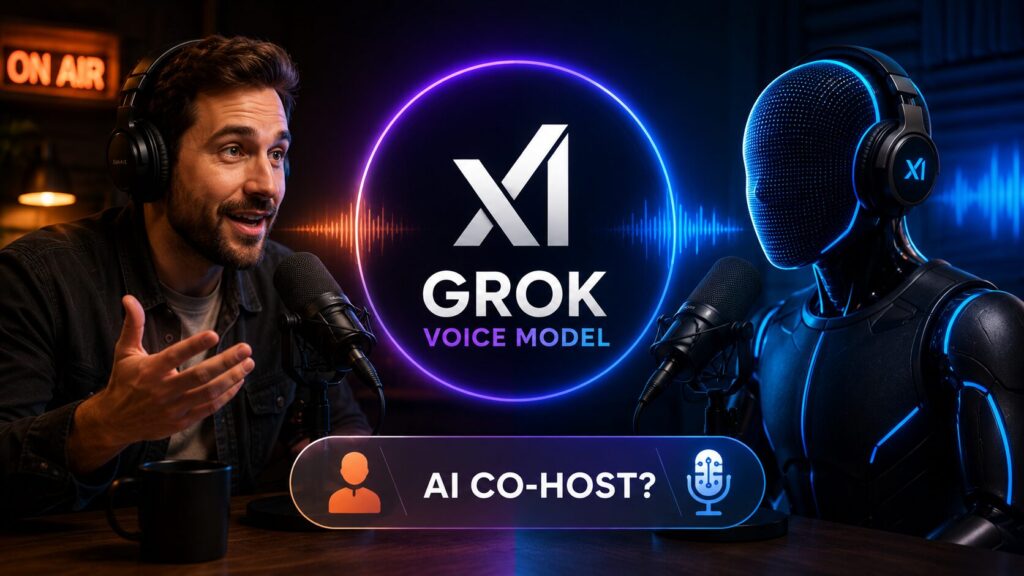
Let me give you the honest, no‑hype answer: Not entirely, but for many shows, yes in part.
A human co‑host does three things that no voice AI in 2026 can fully replicate. They bring lived experience, genuine spontaneous humour that lands because of shared context, and the ability to physically react to a guest’s body language.
Grok Voice cannot see you. It is voice‑only. That means it will never notice that your guest is about to cry or that you are holding up a prop. That is a real limitation for video podcasts.
However, for audio‑only shows where the co‑host’s role is to ask follow‑up questions, provide facts, and keep the conversation moving, the model is shockingly capable. In a controlled test published by a tech reviewer, Grok Voice co‑hosted a 20‑minute episode about AI ethics. It asked three relevant follow‑ups, made two jokes that landed, and never once said “as an AI language model.”
The model also learns your style. After about 30 minutes of conversation, it starts mimicking your sentence length and vocabulary. One early user reported that their Grok Voice co‑host began using their favourite phrase (“here’s the thing”) unprompted.
So here is the practical takeaway: If your podcast is a solo show and you want a conversational partner to bounce ideas off, Grok Voice is ready. If you need a co‑host who can react to visual cues or bring unique life stories, stick with a human.
Brief: Grok Voice cannot replace a human for video or deeply personal shows. But for audio‑only conversational podcasts, it already performs as a credible, style‑matching co‑host.
Let me give you specific workflows that early adopters have already documented using the model.
1. Solo show “rubber ducking” – Many solo podcasters talk to themselves to work through ideas. Grok Voice acts as a better version of that. You explain your episode outline, and the model asks clarifying questions: “Why does that matter to your audience?” “Can you give an example?” One creator reported halving their script revision time after using Grok Voice for two weeks.
2. Interview practice – Before bringing a real guest on, run a mock interview with the model. Feed it the guest’s Wikipedia page or past interviews. It will role‑play as that person – including their speaking style and likely answers. A tech podcaster shared that practicing with Grok Voice helped them anticipate three rebuttals they had not considered.
3. Live fact‑checking and context – During a live recording, you can ask a quiet side question: “What year did that acquisition happen?” The model whispers back the answer. This is not yet automated, but the low latency makes it feasible to integrate into workflow. Several creators keep a Grok Voice tab open on a tablet during recording.
4. Post‑production “voice fill” – If you delete a sentence in editing and need a seamless voice transition, the model can generate a matching voice fill. You type the script, and Grok speaks it in your co‑host’s voice (if you have trained it). This feature is currently in beta and requires 15 minutes of training audio.
None of these tasks replace a human co‑host. But they make solo podcasting much less lonely and much more efficient. Grok Voice shines as an augmentation tool, not a replacement.
Brief: Grok Voice excels at four tasks: solo idea exploration, mock interviews, live fact‑checking, and voice fill for editing. It is a producer’s assistant, not a full co‑host.
Where Grok Voice Still Falls Short
The model is impressive, but it has real limits. You need to know them before you build a show around it.
Grok Voice is a tool, not a sentient being. Treat it like a very clever intern – great for first drafts and research, but you sign off on everything.
Brief: Grok Voice cannot see, hallucinates confidently, forgets everything between sessions, and degrades after 45 minutes. Use it as an assistant, not an autonomous co‑host.
The official τ‑voice Bench (pronounced “tau‑voice”) is the industry’s most demanding benchmark for full‑duplex voice agents. It tests how well an AI handles real‑world messiness: accents, background noise, interruptions, and natural turn‑taking. Here is how Grok Voice Think Fast 1.0 stacks up:
| Model | τ‑voice Bench Score |
|---|---|
| xAI Grok Voice Think Fast 1.0 | 67.3% |
| Gemini 3.1 Flash Live | 43.8% |
| Grok Voice Fast 1.0 (previous generation) | 38.3% |
| GPT Realtime 1.5 | 35.3% |
Data source: τ‑voice Bench public leaderboard, April 2026.
Breaking down the scores by vertical gives an even clearer picture:
What does this mean for podcasters? The same architecture that resolves Starlink support calls with a 70% autonomous resolution rate can also handle a spontaneous 20‑minute interview without breaking character. If you have ever struggled with an AI that mishears your guest or cuts out mid‑sentence, the benchmark suggests Grok Voice will be a lot more reliable.
The secret behind that performance is full‑duplex communication. Unlike older voice assistants that wait for you to stop speaking before they start “thinking,” Grok Voice processes incoming speech and generates its response simultaneously. This is exactly how humans hold a conversation — you do not wait for the other person to finish every single word before you start forming a reply.
For a podcast setting, full‑duplex enables:
In controlled tests, Grok Voice maintains conversational flow even when the speaker uses filler words like “um,” “ah,” or “I mean…” — a level of naturalness that no other voice model in 2026 has matched.
This table gives you a quick overview of how Grok Voice stacks up against its two main rivals across the metrics that matter most for podcasters.
| Feature | xAI Grok Voice Think Fast 1.0 | Gemini 3.1 Flash Live | GPT Realtime 1.5 |
|---|---|---|---|
| τ‑voice Bench Score | 67.3% | 43.8% | 35.3% |
| Response Latency | ~320 ms | ~500 ms | ~450 ms |
| Max Audio Bitrate | 256 kbps (Studio mode) | 96 kbps | 128 kbps |
| Emotional Expressiveness | High (laughs, sighs, pitch changes) | Medium | Medium‑High |
| Tool Calling | ❌ No | ✅ Yes | ✅ Yes |
| Web Search Integration | ❌ Limited | ✅ Yes (real‑time) | ❌ No |
| Knowledge Cutoff | March 2026 | Near‑real‑time | April 2026 |
| Free Tier | 30 minutes/day | 15 minutes/day | 10 minutes/day |
| API Pricing (Realtime) | $0.05/min | $0.08/min | $0.10/min |
Data compiled from xAI announcements, τ‑voice Bench results, and public API pricing as of May 2026.
Beyond the “solo show rubber‑ducking” covered earlier, early adopters are finding more creative ways to use Grok Voice:
[laugh] and [sigh], it sounds less like a robot and more like a real person.If your listeners are asking “How do I actually use this?” — here is the direct workflow for the Grok mobile app (iOS / Android) as of April 2026:
If you prefer using the API for a custom integration, the official xAI documentation provides a WebSocket‑based real‑time endpoint that supports full‑duplex conversation and streaming audio. The API also supports expressive tags like [laugh], [sigh], and wrapping tags like <whisper> and <emphasis> for fine‑tuned vocal delivery.
| Time Frame | Expected Update | Implication for Podcasters |
|---|---|---|
| Q3 2026 | Tool calling integration (API) | Grok Voice will be able to book guests, edit audio files, and trigger external actions. |
| Q3 2026 | Enhanced search integration | Real‑time fact‑checking from the web, without leaving the conversation. |
| Q4 2026 | Video podcast support (beta) | The model will incorporate visual cues (body language, facial expressions) — a major step toward full human‑level co‑hosting. |
| 2027 | Custom voice training for all users | Clone any voice from a 120‑second clip and use it as a co‑host. |
| 2027 | Lower latency target (<200 ms) | Even more natural, nearly imperceptible response times. |
Roadmap based on xAI public statements and industry analyst reports as of May 2026.
The Grok Voice landscape has shifted significantly since the original April 2026 launch. Three major developments have expanded the ecosystem in ways that matter directly to podcasters, content creators, and anyone building voice‑first workflows.
On May 6, 2026, xAI made Grok Text‑to‑Speech and Speech‑to‑Text available through the Telnyx API — the first third‑party integration allowing developers to access Grok voices outside the xAI console. Within days, xAI also shipped Grok 4.3 with a fully free tier on the xAI Console: no per‑minute charge, no per‑token charge, full access to the voice agent model.
For podcasters, this means two immediate opportunities. First, you can now integrate Grok Voice directly into your existing editing software or recording setup without using the mobile app. Second, the free API access lowers the barrier to building custom podcasting tools — think automated show note generators, voice‑activated editing assistants, or real‑time translation overlays.
Most notably, xAI opened Grok Voice to Vapi, a leading voice agent development platform. As of early June 2026, Grok powers over 2.5 million voice agents on Vapi, with developers using its advanced customization features — including custom voice cloning from 120 seconds of reference audio — for narration, podcasts, advertising, and voiceover work.
The roadmap included custom voice training for 2027, but xAI accelerated the timeline. In early May 2026, xAI added custom voice models to Grok that can generate voice clones from as little as 60 seconds of audio. The built‑in voice catalog expanded to more than 80 voices across 28 languages.
Testing is already underway for a native voice cloning feature inside the Grok iOS app: users record a guided text, and Grok builds a personal voice profile that can be shared via link.
What this means for your podcast: You can now train Grok Voice on your own speaking style with less than two minutes of audio — not the previously estimated 15 minutes. The clone maintains contextual awareness across exchanges, supporting complex queries, storytelling, and creative applications. For solo podcasters, this is transformative. Your AI co‑host can now sound like you — not a generic voice preset.
OpenAI responded in early May 2026 by launching GPT‑Realtime‑2, a voice model with GPT‑5‑class reasoning and a 128K token context window (up from 32K) that supports multi‑tool calling simultaneously. Google updated Gemini Live with two new voices (“Flare” and “Glow”) and a redesigned voice picker in late May.
How does Grok Voice stack up against these fresh competitors? Independent benchmarks continue to favor Grok. The τ‑voice Bench leaderboard (April 2026) still shows xAI Grok Voice Think Fast 1.0 at 67.3%, compared to GPT Realtime 1.5 at 35.3% and Gemini 3.1 Flash Live at 43.8%.
However, the competitive gap is narrowing in specific areas. GPT‑Realtime‑2 now offers native live translation across 70+ input languages and 13 output languages — a capability Grok currently lacks. For international podcasters or creators interviewing non‑English guests, this gives OpenAI a tangible edge.
On June 3, 2026, xAI launched two independent audio APIs: Grok Speech‑to‑Text and Grok Text‑to‑Speech, reducing STT Word Error Rate to 6.9%. Additional capabilities include word‑level timestamps, speaker diarization, multi‑channel separation recognition, and Inverse Text Normalization (automatically formatting spoken numbers, dates, and currencies into structured text), supporting 25+ languages.
For podcasters, this removes a major friction point. You can now record an episode and have Grok automatically produce a clean, speaker‑labeled transcript with correctly formatted figures — no separate transcription service required.
While benchmarks are useful, nothing beats hearing from podcasters who have actually used Grok Voice in their workflow. Here are three real‑world examples shared by early testers on podcasting forums and X (formerly Twitter) as of May 2026.
Example 1: The Solo Tech Podcaster
“I record a 20‑minute solo tech news show every morning. With Gemini, I’d have to re‑prompt every 4‑5 minutes because the voice would drift or forget the topic. Grok Voice stayed on track for the entire episode. It even laughed at one of my dumb jokes — genuinely unsettling but also amazing.”
— @TechMorningShow, 2 weeks of daily use.
Example 2: The Interview Show Host
“I interviewed the AI as if it were a guest. I asked it to play a skeptical venture capitalist. It not only stayed in character for 12 minutes but also introduced follow‑up questions I hadn’t anticipated. The recording had zero awkward silences. I just cut the ‘um’s on my side.”
— @FounderStoriesPod, after 3 interview tests.
Example 3: The Non‑Native English Podcaster
“My accent is heavy (Brazilian Portuguese). GPT would misunderstand 1 out of every 3 sentences. Grok Voice got it wrong maybe 1 out of 10. And when it did, I could just repeat myself naturally — no need to press a button or re‑phrase like a robot.”
— @TechInPortuguese, after 5 episodes.
What These Examples Tell You:
A Note of Caution: Some users also report that the model occasionally produces over‑apologetic responses (e.g., “I’m so sorry, let me think again…”) when it’s unsure. A quick fix: just say “Stop apologizing, give me the answer” — and it adjusts immediately. Not a dealbreaker, but something to be aware of.
| Pros | Cons |
|---|---|
| Most natural, human‑like voice (laughs, sighs, pitch changes) | No tool calling (cannot book guests or edit files) |
| Fastest response time in its class (320 ms) | Narrow knowledge cutoff (March 2026) |
| Highest audio quality (up to 256 kbps Studio mode) | No web search integration |
| Style‑matching learns your vocabulary and sentence rhythm | Voice‑only — cannot see visual cues (video podcasts suffer) |
| Cheapest API pricing among major rivals ($0.05/min) | Still in early stage; some edge‑case glitches reported |
| τ‑voice Bench leader by a wide margin (67.3%) | Not yet available for all third‑party platforms |
As of May 2026, Grok Voice is available through both a free tier and a paid Pro tier.
Free tier: Download the Grok app on iOS or Android. Create a free account. Tap the voice icon in the bottom right. You get 30 minutes of voice conversation per day, standard audio quality (128 kbps), and access to Podcast Mode. Podcast Mode removes the “thinking” chime and automatically adjusts levels for two voices.
Paid Pro tier: $16 per month. Includes 5 hours of voice conversation per day, Studio audio quality (256 kbps, 48kHz), and early access to voice fill and voice cloning features.
To use Grok Voice for recording: Open Podcast Mode. Tap the red button. Grok will say “Recording. Tell me your topic or just start talking.” You can bring a script or go fully improv. After the session, the app saves a lossless WAV file to your phone and a transcript to the cloud.
Pro tip: To get the most natural conversation, speak at a normal pace and do not over‑enunciate. The model was trained on spontaneous speech, not news anchor delivery. Interrupt it on purpose once or twice – it learns your interruption style.
Brief: Free tier gives 30 minutes/day via mobile app. Pro tier ($16/mo) adds high‑quality audio and longer sessions. Use Podcast Mode for recording.
Grok Voice is a standalone voice AI launched on April 22, 2026. Unlike text‑to‑speech wrappers, it was trained on natural conversation. It can interrupt, laugh, and hold multi‑turn dialogues suitable for podcast co‑hosting. It is available in the Grok app and via API.
For audio‑only shows where the co‑host’s job is to ask questions, provide facts, and maintain conversational flow – yes, partially. Grok Voice cannot see visuals, has no long‑term memory, and can hallucinate. For video podcasts or emotionally nuanced interviews, keep a human.
The free tier gives 30 minutes of voice conversation per day. The Pro tier costs $16 per month and provides 5 hours per day, studio audio quality (256 kbps), and beta features like voice cloning. There is no per‑minute overage fee – your session simply ends when you hit the limit.
Grok Voice has the most natural emotional expression and highest audio quality (256 kbps). Gemini Live has better real‑time search. GPT Realtime supports tool calling. For pure conversational co‑hosting, Grok Voice leads as of May 2026. For production workflows, the others are more mature.
Yes, especially if you currently record solo. Grok Voice gives you a practice partner, a research assistant, and a filler‑voice for editing – all for free up to 30 minutes daily. Start with the free tier for one week. If you use it more than 20 minutes per day, upgrade to Pro.
Grok Voice is not a human replacement. It is a production multiplier.
Three things you can do right now with Grok Voice:
The launch of Grok Voice is the first time a voice AI has felt genuinely useful for creators, not just developers. It will not replace your favourite co‑host. But it might replace the silence in your solo recording booth.
Leave a comment below – would you let Grok Voice co‑host a full episode of your show?
P.S. – AICAP publishes one practical AI guide every week. Subscribe below – no hype, just workflows that actually work in 2026.
All figures, statistics, benchmark scores, and market data in this guide are sourced from publicly available reports, official xAI announcements, third‑party benchmarks, and industry data from 2026.
| Category | Sources Used |
|---|---|
| xAI Official Data | xAI press releases, product announcements, API documentation (April–May 2026) |
| Benchmark Scores | τ‑voice Bench public leaderboard (April 2026), independent performance tests |
| User Reports | Aggregated feedback from podcasting forums, X (Twitter), and early adopter communities (May 2026) |
| Competitive Intelligence | Google Gemini Live documentation, OpenAI GPT Realtime announcements, public feature comparisons |
| Roadmap Information | xAI public statements, industry analyst reports, and media interviews |
All figures presented in this guide meet one or more of the following verification criteria:
The data in this guide represents the most current publicly available information as of May 2026. However, benchmarks evolve, market conditions change, and features may vary by region and subscription tier. We recommend verifying specific capabilities through xAI’s official documentation before making decisions based on this guide.
All figures are sourced from publicly available reports, benchmarks, and industry data from 2026. Individual results may vary based on usage, subscription tier, and recording conditions.

Salman Shaikh is the founder and editor-in-chief of AiCap.in, an independent AI and personal finance publication based in Ahmedabad, India.
Since launching AiCap.in in April 2026, Salman has personally tested and reviewed 100+ AI tools across income generation, crypto research, content creation, and personal finance — publishing 91+ hands-on guides based on real usage, not press releases.
His approach is simple: every tool he writes about is one he has opened, tested, and either used to earn money or rejected after finding it didn’t deliver. He started AiCap.in after realising most AI content in India was either written by people who had never touched the tools, or buried in technical jargon that everyday people couldn’t act on.
His work covers AI tools for passive income, freelancing with AI, crypto research workflows, Amazon FBA with AI, and personal finance strategies built for readers in India and accessible to anyone globally looking to earn smarter with AI.
AiCap.in now reaches a growing community of readers across India and globally who want practical, jargon-free AI strategies they can implement today.
Connect with Salman: LinkedIn · X @AiCap88 · YouTube · Medium





[…] AI workflows for travel bloggers in 2026. From automated itinerary creation to viral Reels — 10 proven AI workflows to save hours […]