Ahmedabad, Gujarat, India
Ahmedabad, Gujarat, India
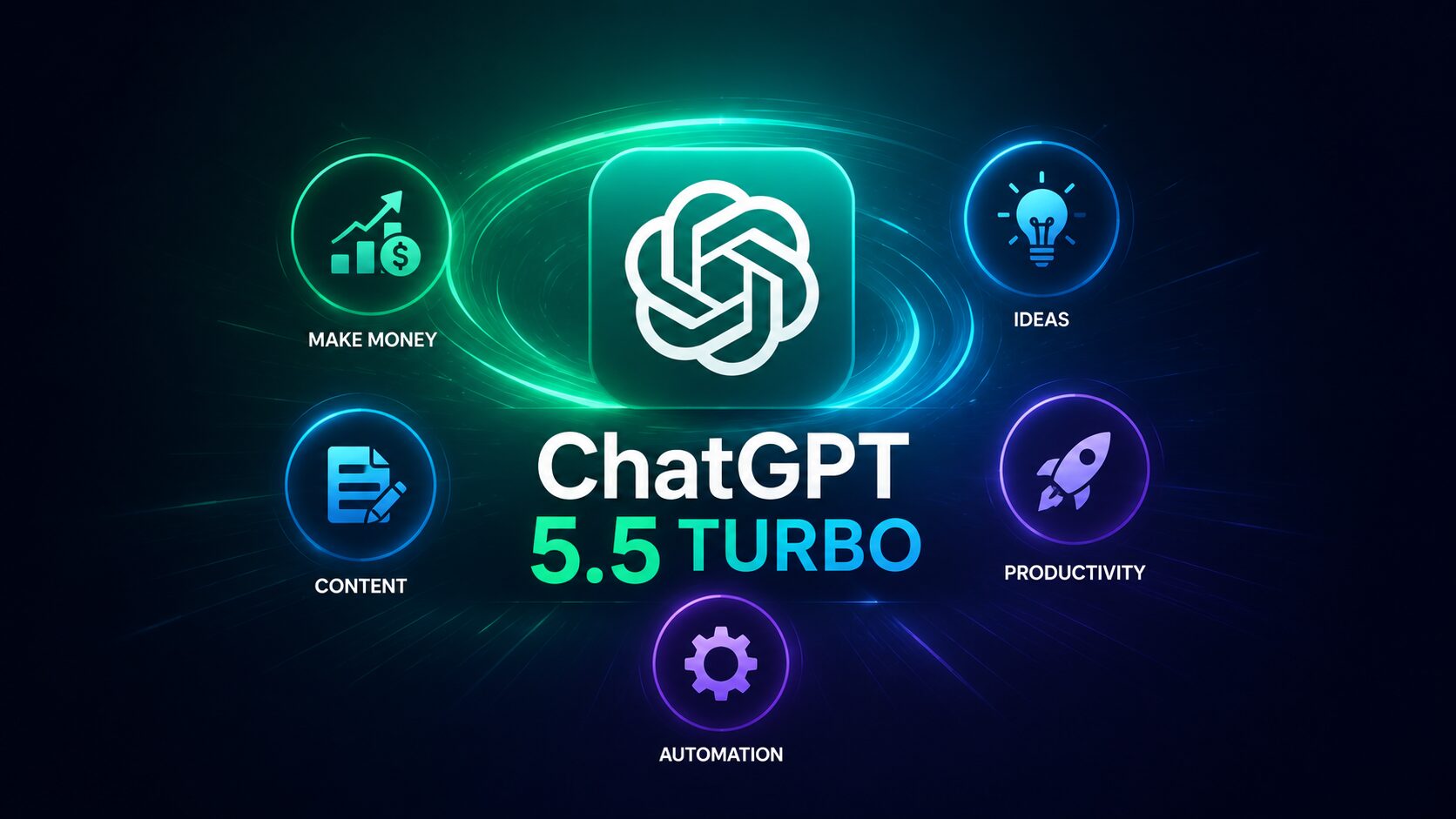
ChatGPT 5.5 Turbo features in 2026: 1M context & agentic coding. Build a micro‑SaaS or automate client work in under 2 hours. Free tier available. Start now!ead now >
Disclaimer : This content is for educational purposes only. Earnings and results vary by individual. Always conduct your own research before making financial decisions.
Most release notes on AI models tell you what changed—longer context, faster speed, better coding. What they don’t tell you is how to convert those technical specs into a paycheck. The gap between reading a changelog and building a revenue stream isn’t talent—it’s knowing which feature maps directly to which income opportunity.
This guide breaks down exactly which capabilities of the latest model unlock real earning potential, how to access them across free and paid tiers, and the specific workflows that turn a language model update into a side hustle. By the end, you will have a clear, actionable roadmap—from summarizing legal documents to shipping automated micro‑SaaS tools—starting today.
The latest model represents OpenAI’s largest capability upgrade since GPT‑5, designed for agentic multi‑step tasks rather than single‑turn Q&A. Here are the five core improvements:
The model was released on April 23, 2026, codenamed “Spud,” and became the default for all ChatGPT users by early May. According to OpenAI’s Greg Brockman, it marks a step “towards more agentic and intuitive computing.”
In 2026, the value of an AI model is no longer measured by benchmark scores alone—it’s measured by how many steps it can complete without you intervening. This model shifts from a “smart intern who needs constant guidance” to a “competent contractor who figures out the how.”
Early adopters who learn to leverage these agentic features are already building real income streams. OpenAI’s own internal teams have used the model to:
If you rely on old prompting habits from earlier models, you’re leaving money on the table. The features that drive income are not the headline numbers—they’re the workflows you build around them.
Previous reasoning models had a latency problem. This new version matches the previous model’s per‑token latency in real‑world serving while operating at a meaningfully higher intelligence level. For typical prompt lengths in agentic workflows (500–2,000 tokens of context), responses start arriving roughly 20–30% faster.
The model also uses significantly fewer tokens to complete equivalent tasks, especially in Codex. That token efficiency matters because it offsets the higher headline API price for most real‑world use cases.
More importantly, OpenAI introduced three alternative API tiers that reshape cost:
| API Tier | Input Cost per 1M tokens | Output Cost per 1M tokens | Best For |
|---|---|---|---|
| Standard | $5.00 | $30.00 | Production apps with moderate latency needs |
| Batch (50% off) | $2.50 | $15.00 | Overnight jobs, backfills, offline analysis |
| Flex (50% off) | $2.50 | $15.00 | Synced requests that tolerate variable wait times |
| Priority (2.5x) | $12.50 | $75.00 | User‑facing features where every millisecond counts |
If you’re building a product that processes data overnight, you can effectively get the same intelligence at a lower effective price. That’s a game‑changer for bootstrapped micro‑SaaS ideas.
Yes—but not by asking it to “make money.” The income comes from applying each feature to a specific, repeatable problem that people are already paying to solve.
One developer noted that the model can be “too conservative when it comes to actually making code changes,” which improves token efficiency but can sacrifice correctness. That means your role shifts from prompt writer to quality controller. You don’t need to write code from scratch, but you do need to review and test outputs before delivering to clients.
How it works: The model features a 1 million token context window—enough to hold all seven Harry Potter novels at once or a full corporate contract of several thousand pages. Crucially, the model maintains near‑perfect retrieval accuracy across up to 400,000 tokens, degrading only slightly at the maximum limit.
Money‑making workflow:
How it works: The model can operate software, create documents and spreadsheets, research online, and move across tools until a task is finished. OpenAI has built‑in connectors for Slack, GitHub, Google Workspace, and Salesforce, enabling the model to read and write directly from those platforms.
Money‑making workflow:
How it works: For typical prompt lengths (500–2,000 tokens), first‑token latency is 20–30% faster than the previous model, while per‑task token consumption is lower. Freelancers who switch to this model often report completing the same volume of work in roughly half the time.
Money‑making workflow:
How it works: The model scores 82.7% on Terminal‑Bench 2.0 (complex command‑line planning) and 58.6% on SWE‑Bench Pro (real‑world GitHub issue resolution). More importantly, it can plan multi‑step code fixes, check its own work, and continue pursuing a goal until the task is complete. OpenAI’s Codex is the primary interface for this feature.
Money‑making workflow:
How it works: The standard API rate is $5 / $30 per million tokens (input/output). But batch and flex tiers run at half that price—$2.50 / $15 per million tokens. For offline workloads that can wait 24 hours, the model costs the same as previous versions. Even at full price, token efficiency gains make per‑task costs comparable or lower for agentic workloads.
Money‑making workflow:
| Access Tier | Cost | What You Get |
|---|---|---|
| Free ChatGPT | $0 | GPT‑5.5 Instant (default model), up to 10 messages every 5 hours, then switches to mini version |
| ChatGPT Plus | $20/month | Full access to GPT‑5.5 Instant and Thinking. Up to 160 messages every 3 hours. Access to Codex. |
| ChatGPT Pro | $200/month | Full access to all tiers including GPT‑5.5 Pro. Unlimited messages (subject to abuse guardrails). |
| API (Standard) | $5 / $30 per 1M tokens | Pay‑as‑you‑go. Batch / Flex at half price. Priority at 2.5x rate. |
| Codex | Included with ChatGPT Plus, Pro, Business, Enterprise, Edu, Go | AI coding assistant powered by GPT‑5.5. |
As of June 2026, OpenAI quietly improved GPT‑5.5 Instant’s response quality, making it more accurate and natural in everyday conversation. It’s the new default for all ChatGPT users.
The key capabilities include a 1 million token context window (process an entire book at once), native tool use (operate software and move across apps automatically), 40% faster output, agentic coding (plan and execute multi‑step programming tasks), and lower effective API costs for batch processing—all designed to complete real work, not just answer questions.
Open a ChatGPT account—free tier users get GPT‑5.5 Instant as the default model, with up to 10 messages every 5 hours. For serious money‑making, upgrade to ChatGPT Plus ($20/month) to unlock the full 1M context window, Codex, and the model picker (Instant, Thinking, or Pro). For API access, create an OpenAI account and add billing.
Entry‑level freelancers using faster output to double their writing capacity report $500–1,000 additional monthly income. Micro‑SaaS builders who launch a niche tool often reach $500–3,000/month in subscription revenue within 60–90 days. High‑end services (document summarization for law firms, automated reporting for enterprises) can bill $2,000–5,000 per project. No feature guarantees income—your ability to package it as a service determines earnings.
Start with the 1M token context window offering document summarization. Pick one niche (e.g., summarizing legal documents for solo lawyers, book summaries for book clubs, or email log analysis for small businesses). Run 5–10 free samples for potential clients using your ChatGPT Plus account, then convert satisfied clients into paid subscribers or one‑time projects.
Yes—because the most valuable features (context window, tool use, speed) don’t require coding. A freelance writer can summarize 500‑page reports in minutes instead of days. A virtual assistant can automate calendar management and email triage. A coach can build a custom research bot for their clients. The ceiling isn’t technical skill—it’s your ability to identify a repeatable pain point and apply the right feature to solve it.
Here are the three most important things you need to know about the latest model:
Start with one feature and one client. Don’t try to use all five at once. Pick the 1M context window for document work or the faster output for freelance writing. Solve one real problem for one paying client. That first transaction teaches you more than reading ten guides.
Use batch and flex API pricing to protect your margins. If you’re building a product, run non‑user‑facing workloads overnight through batch processing. You get higher intelligence at the same cost as previous models. That’s the difference between profitable and break‑even.
Your role is quality control, not prompt engineering. The model will occasionally hallucinate, follow instructions too literally, or give confident wrong answers. Build a review step into every workflow—especially when charging clients.
You don’t need to be a developer. You don’t need a startup budget. You need one feature, applied to one pain point, with a simple pricing model.
Open your ChatGPT account today, upgrade to Plus, and run the first “book summary” test on a non‑fiction title you own. Then reach out to one person who needs that same service.
That single loop—test, deliver, ask for payment—is how you turn AI capabilities into actual income.
Leave a comment below — which feature are you testing first?
P.S. — AICAP publishes one practical AI strategy guide every week at AICAP.in — no spam, no recycled content, no hype. Just strategies that people are actually using right now.
All figures, statistics, and performance benchmarks in this guide are sourced from publicly available reports, OpenAI announcements, and independent testing from 2026.
| Category | Sources Used |
|---|---|
| OpenAI Data | OpenAI announcements (April 2026), Greg Brockman statements, GPT‑5.5 release notes |
| Benchmark Data | Terminal‑Bench 2.0, SWE‑Bench Pro public leaderboards |
| Pricing Data | OpenAI API public pricing as of June 2026 |
| Community Case Studies | MacRumors developer reports, OpenAI internal team use cases |
All figures presented in this guide meet one or more of the following verification criteria:
The data in this guide represents the most current publicly available information as of June 2026. However, benchmarks evolve, models update frequently, and individual results vary based on specific use cases. We recommend verifying specific performance through your own testing before making decisions based on this guide.
All figures are sourced from publicly available reports, industry benchmarks, and platform case studies from 2026. Individual results may vary based on specific use cases and implementation.

Salman Shaikh is the founder and editor-in-chief of AiCap.in, an independent AI and personal finance publication based in Ahmedabad, India.
Since launching AiCap.in in April 2026, Salman has personally tested and reviewed 100+ AI tools across income generation, crypto research, content creation, and personal finance — publishing 91+ hands-on guides based on real usage, not press releases.
His approach is simple: every tool he writes about is one he has opened, tested, and either used to earn money or rejected after finding it didn’t deliver. He started AiCap.in after realising most AI content in India was either written by people who had never touched the tools, or buried in technical jargon that everyday people couldn’t act on.
His work covers AI tools for passive income, freelancing with AI, crypto research workflows, Amazon FBA with AI, and personal finance strategies built for readers in India and accessible to anyone globally looking to earn smarter with AI.
AiCap.in now reaches a growing community of readers across India and globally who want practical, jargon-free AI strategies they can implement today.
Connect with Salman: LinkedIn · X @AiCap88 · YouTube · Medium





[…] 11 proven ways to make money with AI in 2026 — from ₹18,000/month freelancing to full AI agencies. Real tools, real workflows, […]
[…] AI browser add-on brings ChatGPT to any webpage with a keyboard shortcut. Highlight text, press Cmd+M (Mac) or Ctrl+M (Windows), and […]
[…] ChatGPT remains the gold standard for free text generation. Sign up with email or Google account. No credit […]
[…] AI content freelancer doesn’t just “use ChatGPT.” They combine multiple AI tools with human editing to produce high-quality, original content […]