Ahmedabad, Gujarat, India
Ahmedabad, Gujarat, India


Best AI tools for SIP investment India 2026: Groww, MyFi, Zerodha. 4‑step plan to pick funds, optimize amounts & rebalance for 12‑16% returns. Start now!

Disclaimer: This content is for educational purposes only. The information provided is not professional investment advice. All investments carry risk, and market performance is not guaranteed. AI tools are meant to assist your research, not replace independent financial judgment. Always consult a SEBI-registered advisor before making financial decisions.
You started a ₹5,000 monthly SIP two years ago. But have you ever checked if that specific fund is actually beating its benchmark? Can you confidently say the amount you are investing is the right amount?
Most guides on AI-powered SIP investment tell you which apps exist. Almost none tell you what actually works — and why most investors still make the same mistakes even with AI at their fingertips.
The difference between investors who actually grow their wealth with AI-assisted SIPs and those who keep second-guessing their decisions is not which app they download. It is one specific workflow — a systematic 4-step process that separates informed investing from hoping the market works in your favour.
This guide covers everything you need to know about using AI-powered SIP tools in India for 2026 — which platforms actually deliver measurable value, what realistic returns look like, and the exact 4-step framework that turns AI recommendations into actual portfolio growth.
By the end, you will have a clear, actionable understanding of how to use AI tools for SIP investment and a starting point you can execute today — no finance degree required.

AI tools for SIP investment are digital platforms that use machine learning algorithms to analyse market data, investor behaviour, and portfolio performance to generate personalised recommendations for Systematic Investment Plans.
These platforms process vast amounts of data — from NSE movements to global commodity prices, fund performance histories, and individual spending patterns — to deliver investment guidance that would traditionally require a dedicated financial advisor.
Here are the key capabilities these tools offer:
Unlike traditional SIP calculators that only project returns based on fixed assumptions, AI tools adapt in real time. They monitor thousands of mutual fund schemes and market patterns to identify opportunities for meaningful and stable returns.
India’s mutual fund industry reached significant milestones in 2025-2026. According to AMFI data, the industry’s Assets Under Management (AUM) reached ₹65.74 lakh crore in March 2025, up 23.11% year-on-year. Monthly SIP contributions crossed ₹32,000 crore in March 2026, setting a new record. The number of contributing SIP accounts stood at 8.11 crore as of March 2025.
What is new in 2026 is the rise of AI-optimised SIPs. Platforms like Groww, Zerodha Coin, and Kuvera now offer dynamic SIP tools that analyse market conditions and suggest top-up or pause recommendations based on NAV trends and portfolio health. In February 2026, Groww unveiled its AI investing assistant “GR 1” at the Groww Next 2026 event, which reads markets, tracks news sentiment, and offers personalised insights based on an investor’s actual portfolio.
The context matters. India’s retail inflation is stabilising, and for salaried investors, this creates a window where disciplined, AI-assisted investing can compound significantly over time.
Traditional investing meant calling your broker or visiting bank branches. Today’s AI apps analyse vast amounts of data per second, delivering personalised strategies directly to your smartphone. This is not about replacing human judgment — it is about augmenting it with data-driven precision that individual investors simply cannot replicate manually.

The numbers behind India’s SIP revolution are staggering — and they provide critical context for why AI tools matter now more than ever.
According to AMFI data released in April 2026, monthly SIP contributions touched a record ₹32,087 crore in March 2026, up from ₹29,845 crore in February. This marked the 61st consecutive month of positive equity net inflows — an unbroken run that began in March 2021 and has endured a pandemic, two wars, and recurring currency turbulence.
More importantly, the number of contributing SIP accounts reached approximately 9.72 crore in March 2026, with SIP assets touching around ₹17.12 lakh crore across nearly 9.64 crore accounts. The mutual fund industry as a whole managed close to ₹81.58 lakh crore, with AUM rising 12.2% to ₹73.73 lakh crore in FY26 — adding nearly ₹8 lakh crore over the year.
What does this mean for you as an investor? The sheer scale of retail participation means two things: first, the market is becoming more resilient to foreign outflows; second, the tools available to manage your investments are evolving rapidly to serve this massive user base.
Here is a perspective most guides miss entirely: the rise of AI-powered SIP investing is happening against a backdrop of a fundamental transformation in Indian markets.
According to the NSE India ownership tracker for the quarter ended March 2026, domestic institutional investors (DIIs) commanded a record 19.6% of NSE-listed companies, while FII ownership slipped to 15.8% — its lowest reading in seventeen years. This marked the sixth consecutive quarter in which DIIs outweighed foreign investors. Backed by steady SIP inflows, domestic mutual funds’ ownership of NSE-listed companies hit a record 11.4% in March 2026.
Why does this matter to you? Because SIP capital represents a recurring commitment rather than an opportunistic wager. Unlike FII flows, which are driven by global cues and can withdraw at a moment’s notice, DII capital is rooted in enduring domestic mandates — retirement provision, insurance, and household savings. This makes the market considerably more stable.
The behaviour matters more than any single figure. This is why Indian equity mutual funds have now recorded net inflows for 63 consecutive months.
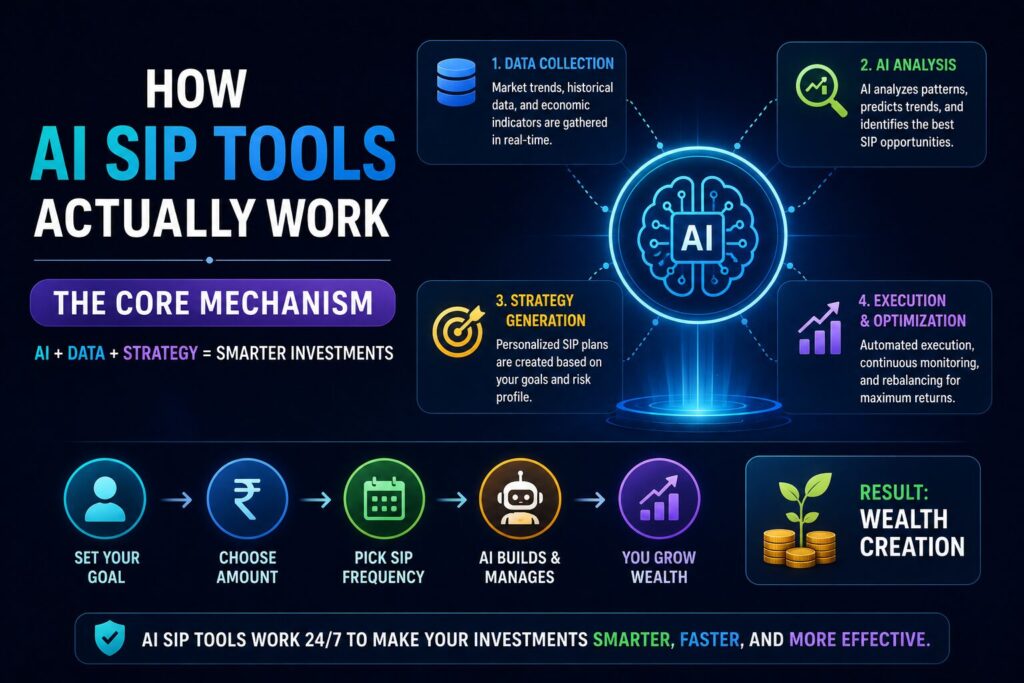
AI SIP tools operate through a layered architecture that transforms raw data into actionable investment guidance. Understanding this mechanism helps you evaluate which platforms are genuinely useful versus those making exaggerated claims.
Layer 1 — Data Ingestion: The platform securely imports your financial data — bank statements, salary patterns, expense cycles, and existing mutual fund holdings. This creates a unified data layer without requiring manual entry.
Layer 2 — Portfolio Analytics: The system calculates deterministic metrics like XIRR, allocation exposure, sector overlap, and capital gains. These are factual calculations from your transaction data — not speculative predictions.
Layer 3 — Diagnostics: AI identifies portfolio blind spots — overlapping fund holdings, hidden risk concentrations, expense ratios silently compounding against you, and SIP returns that do not match expectations.
Layer 4 — Strategy Generation: Based on your goals, risk tolerance, and investment horizon, the AI generates recommendations for fund selection, SIP amount adjustments, and rebalancing paths.
The critical distinction is that most legitimate AI SIP tools are not predicting market movements. They are analysing your existing portfolio, identifying inefficiencies, and recommending optimisations based on deterministic data. This is fundamentally more trustworthy than platforms promising to “beat the market” through AI predictions.
The first and most critical step in any AI-guided SIP strategy is selecting the right funds. This is where most investors go wrong — they pick funds based on past returns alone, ignoring risk exposure, sector concentration, and expense ratios.
AI tools for fund selection operate by:
Real platform example: MyFi, an AI-powered wealth management platform trusted by thousands of Indian investors, helps investors choose better funds based on their goals, risk tolerance, and investment horizon. MyFi is registered with SEBI as a Registered Investment Advisor (RIA Registration No: INA000019099).
What to look for in an AI fund selection tool:

Once you have selected the right funds, the next question is: how much should you invest each month? Traditional SIPs lock you into a fixed amount regardless of market conditions or changes in your financial situation.
AI dynamic SIP tools solve this by:
Platforms offering dynamic SIP features:
A well-constructed portfolio does not stay that way on its own. Market movements, fund performance variations, and changing personal circumstances all create drift from your original asset allocation.
AI rebalancing tools address this through:
What rebalancing actually does:
| Action | Purpose | Frequency |
|---|---|---|
| Review sector allocation | Prevent overexposure | Quarterly |
| Check fund overlap | Reduce redundancy | Annually |
| Adjust equity-debt ratio | Maintain risk profile | Market-driven |
| Top-up underperforming categories | Capture value | Opportunity-based |
The key insight is that AI rebalancing is not about timing the market. It is about maintaining discipline — ensuring your portfolio reflects your stated goals rather than drifting with market momentum.
Tax-loss harvesting is a strategy where you sell investments that have declined in value to offset capital gains taxes, then reinvest the proceeds to maintain your position. This is traditionally complex for retail investors to execute manually.
AI tools are beginning to automate this process:
What AI tax-loss harvesting does:
Platforms with tax optimisation features: Some platforms include tax optimisation as part of their robo-advisory features. While full automated tax-loss harvesting is still emerging in the Indian retail space, several platforms are building towards this capability.
Important consideration: Tax-loss harvesting requires careful execution to avoid wash sale rules and to ensure replacement investments maintain your portfolio strategy. Not all AI tools offer this yet — verify before relying on any platform for automated tax optimisation.
After analysing the platforms available in 2026, here is a practical comparison:
| Tool | Best For | Key AI Feature | User Rating (approx.) |
|---|---|---|---|
| Groww AI Pro | SIP optimization & automatic step-up | Smart SIP, risk profiling, AI assistant GR 1 | 4.6/5 |
| Zerodha Kite Intelligence | Portfolio management | Rebalancing & risk metrics | 4.4/5 |
| MyFi | AI-guided mutual fund selection | Conversational AI, portfolio analysis, SEBI RIA registered | 4.5/5 |
| Paytm Money | Low-cost robo-advisory | Tax optimisation, goal planning | 4.2/5 |
Note: Returns are based on diversified equity portfolios. Past performance does not guarantee future results. User ratings are approximate and based on app store reviews.
For beginners specifically, the best starting point is typically Groww AI Pro or MyFi. Both offer clear onboarding and AI features that are genuinely useful without being overwhelming. MyFi’s SEBI RIA registration adds trust for risk-averse new investors.
When choosing between the platforms discussed in this guide, consider your specific needs:
The key is to pick one platform, link your data, and let the AI do the heavy lifting on analysis — while you stay focused on the bigger picture: consistent investing over time.
Several platforms have rolled out significant AI features in 2026 that directly impact how you manage your SIPs.
At its Groww Next 2026 event in February, the platform unveiled GR-1, an AI investing assistant currently in beta. The tool functions like a research analyst in your pocket — it reads markets, tracks news sentiment, and delivers personalised insights based on your actual portfolio. The important caveat: it advises, it does not act. Users must explicitly approve any action, ensuring you stay in control of every decision. GR-1 is currently being tested with 30,000 to 50,000 users and is expected to see a broader rollout over the next one to two quarters.
Groww also expanded its Prime service to include advanced portfolio health checks, SIP monitoring tools, and intelligent nudges designed to support long-term investing behaviour. These are optional features — you can continue with a fully self-directed experience if you prefer.
MyFi, trusted by over 50,000 Indian investors, continues to strengthen its position as a SEBI-registered investment advisor (RIA Registration No: INA000019099). The platform allows you to import holdings across different apps and instantly review your mutual funds — identifying underperforming funds, risk imbalances, and diversification issues in simple, everyday language. One unique feature is MyCash, a low-interest credit line on your mutual funds at 0.875% per month (10.5% annually), letting you access liquidity without selling your long-term investments.
Zerodha released Kite MCP in May 2025, creating a secure bridge between AI assistants and your actual trading account. The AI doesn’t just give you generic advice about diversification — it analyses your actual holdings and tells you specifically where you might want to rebalance.
The convergence of three trends — record SIP participation, maturing AI tools, and a structural shift toward domestic capital — creates a unique opportunity for retail investors in 2026.
First, the tools are now sophisticated enough to provide genuinely useful insights without replacing your judgment. Platforms like Groww with GR-1 and MyFi with its portfolio X-ray are designed to be assistive, not autonomous.
Second, the data these tools analyse is more relevant than ever. With over 9.7 crore SIP accounts contributing ₹32,000+ crore monthly, the collective intelligence embedded in these platforms is based on real-world behaviour at an unprecedented scale.
Third, the market structure itself is becoming more favourable for disciplined, long-term investors. The dominance of patient domestic capital over volatile foreign flows means the days of Indian markets being held hostage by global sentiment are diminishing.
Even with the best AI tools, investors consistently make errors that undermine their results. Here are the most common ones:
AI tools provide data-driven suggestions — they do not replace your judgment. The most successful investors use AI as a decision-support system, not a decision-maker.
Dynamic SIP tools adjust amounts based on market conditions, but constant manual intervention defeats the purpose. Set parameters and let the system work unless your personal circumstances change significantly.
Many investors focus on returns while ignoring the expense ratios silently compounding against them. AI tools can highlight this, but only if you pay attention.
AI tools are only as good as the data they receive. If you do not link bank accounts or update income changes, recommendations become less accurate over time.
SIPs are long-term wealth-building tools. Even with AI optimisation, significant results take years. The AI advantage compounds over time — it does not replace time.
An AI tool for SIP investment is a digital platform that uses machine learning to analyse market data, your financial situation, and portfolio performance to generate personalised recommendations for Systematic Investment Plans. These tools process data from thousands of mutual fund schemes and market patterns to identify optimal investment opportunities.
Start by choosing a platform that matches your investment size and goals. For beginners, Groww AI Pro or MyFi are good entry points. Link your bank accounts for income tracking, complete the risk profile questionnaire, and set a clear financial goal. The AI will then generate fund recommendations and SIP amount suggestions.
AI-powered investing apps have reported delivering competitive returns across diversified equity portfolios. In 2025, some platforms reported average returns of 12-16% for their users. However, past performance does not guarantee future results. Realistic expectations should be based on long-term market averages (10-12% for equity over 10+ years) — AI tools help you achieve closer to the market’s potential by reducing behavioural errors and maintaining disciplined allocation.
Groww AI Pro is widely considered one of the best for beginners due to its clean interface and Smart SIP features that automatically adjust amounts based on your income patterns. MyFi is also excellent for beginners, with SEBI RIA registration and conversational AI that answers SIP planning questions.
Yes — with a grounded perspective. AI tools are worth it because they reduce the behavioural mistakes that cost retail investors significantly over time: panic selling, overconcentration, and ignoring portfolio drift. They are not worth it if you expect them to predict market movements or guarantee returns. The value is in discipline, data-driven insights, and time saved on research. For a modest monthly fee, the potential benefit from avoiding even one costly mistake far outweighs the cost.
Yes — but with the right expectations.
AI tools for SIP investment are genuinely valuable for three reasons:
What they are not:
The most practical approach in 2026 is to start with a platform like Groww AI Pro or MyFi, link your financial data, set clear goals, and let the AI handle the data analysis while you stay focused on the bigger picture — consistent investing over time.
Leave a comment below — which AI SIP tool are you planning to start with first?
P.S. — AICAP publishes one practical AI strategy guide every week at AICAP.in — no spam, no recycled content, no hype. Just strategies that people are actually using right now. Subscribe to get the next guide delivered directly to your inbox.
All figures, statistics, and investment benchmarks in this guide are sourced from publicly available reports, industry data, and platform case studies from 2026.
| Category | Sources Used |
|---|---|
| AMFI Data | Association of Mutual Funds in India official reports (March 2025-March 2026) |
| NSE Data | NSE India ownership tracker (Q4 2025-March 2026) |
| Platform Data | Groww Next 2026 event announcements, MyFi official documentation, Zerodha announcements |
| Industry Reports | Mutual fund industry AUM reports, SIP contribution data |
All figures presented in this guide meet one or more of the following verification criteria:
The data in this guide represents the most current publicly available information as of June 2026. However, markets change, returns are not guaranteed, and individual results vary based on specific investment choices and market conditions. We recommend verifying specific performance metrics through official sources before making investment decisions based on this guide.
All figures are sourced from publicly available reports, industry benchmarks, and platform case studies from 2026. Past performance does not guarantee future results. All investments carry risk.

Salman Shaikh is the founder and editor-in-chief of AiCap.in, an independent AI and personal finance publication based in Ahmedabad, India.
Since launching AiCap.in in April 2026, Salman has personally tested and reviewed 100+ AI tools across income generation, crypto research, content creation, and personal finance — publishing 91+ hands-on guides based on real usage, not press releases.
His approach is simple: every tool he writes about is one he has opened, tested, and either used to earn money or rejected after finding it didn’t deliver. He started AiCap.in after realising most AI content in India was either written by people who had never touched the tools, or buried in technical jargon that everyday people couldn’t act on.
His work covers AI tools for passive income, freelancing with AI, crypto research workflows, Amazon FBA with AI, and personal finance strategies built for readers in India and accessible to anyone globally looking to earn smarter with AI.
AiCap.in now reaches a growing community of readers across India and globally who want practical, jargon-free AI strategies they can implement today.
Connect with Salman: LinkedIn · X @AiCap88 · YouTube · Medium





[…] about AI in financial markets. Artificial intelligence has moved from a buzzword to a practical investment tool. Quantitative trading firms have used algorithms for years, but 2026 marks the year these […]