Ahmedabad, Gujarat, India
Ahmedabad, Gujarat, India
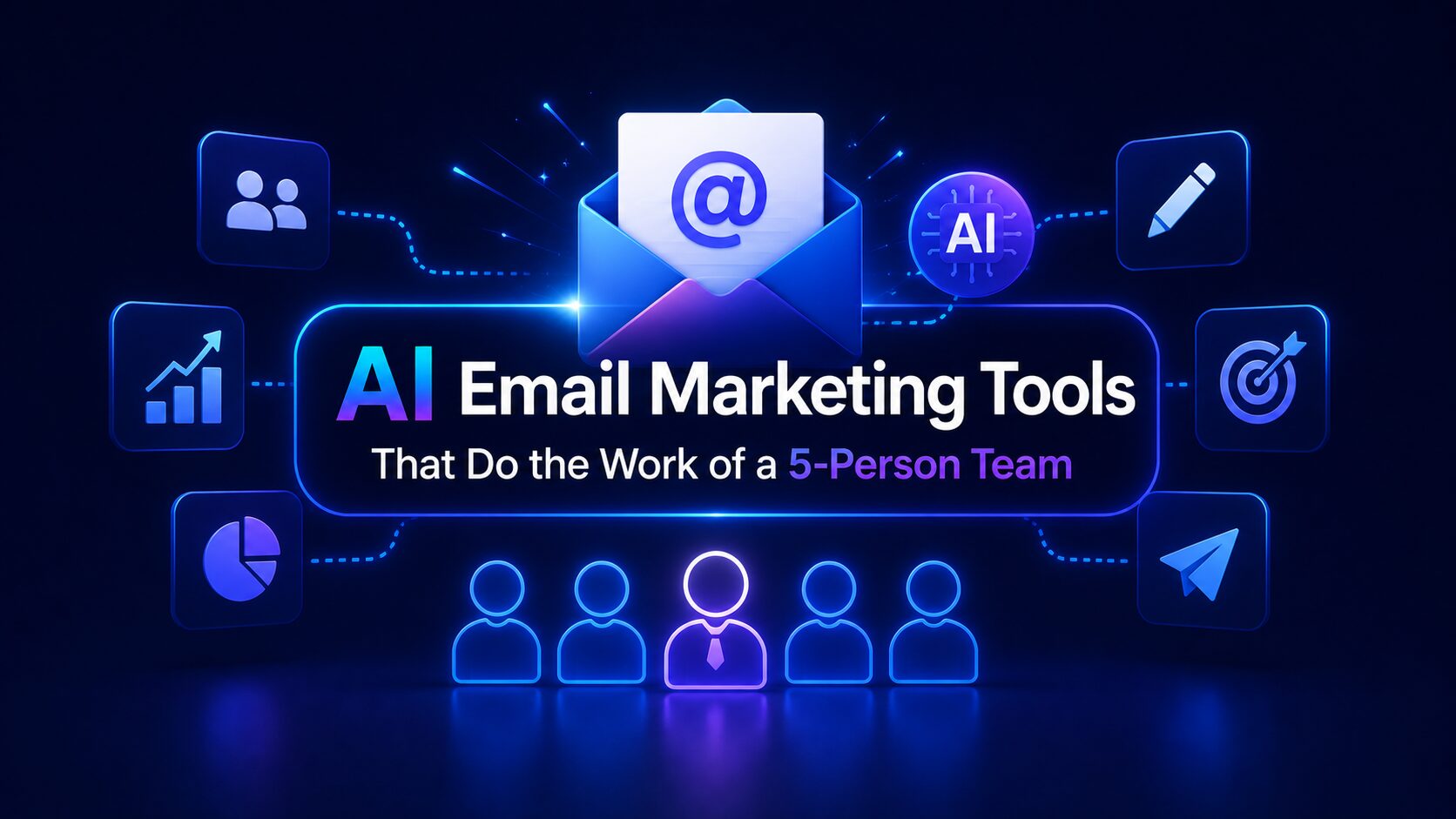
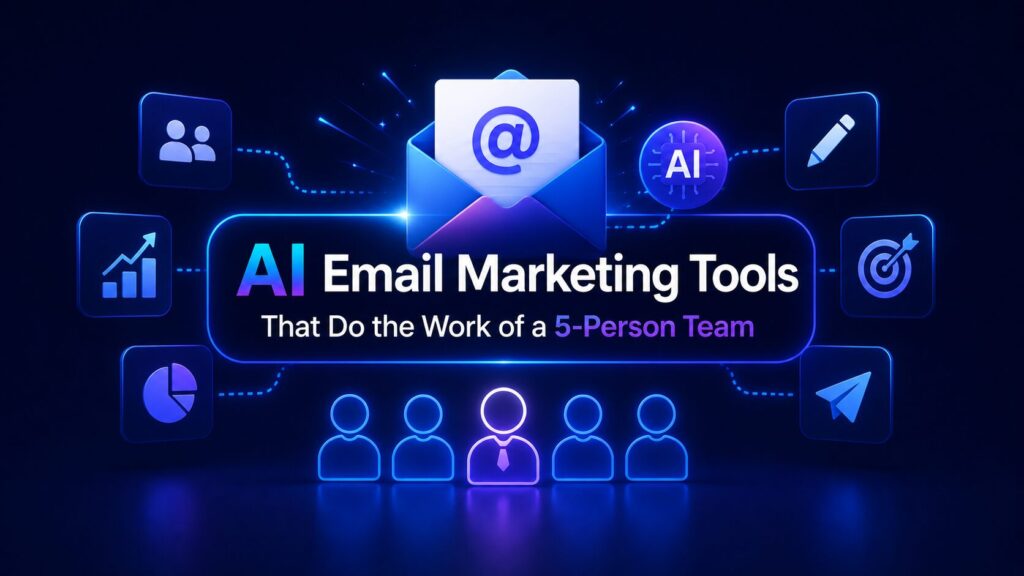
Segmented AI email campaigns generate 760% more revenue. See the exact AI tools (Klaviyo, HubSpot & more) that replace a 5-person marketing team in 2026.
Disclaimer: Results depend on your email list quality and strategy. AI tools assist — they don’t replace good marketing fundamentals.
Here is a simple test. Send a generic, non-personalized email blast today. Watch your open rate crumble to below 5 percent.
Generic marketing emails are dead. AI-powered personalization is now the baseline expectation. And if you are still building campaigns manually, you are already losing to competitors who have automated the work of entire teams.
The best AI email marketing tools in 2026 do more than write subject lines. They predict customer behavior. They generate full campaign sequences from a single sentence. They optimize send times for every individual subscriber. And they integrate deeply with CRM data to create hyper-personalized content that actually drives revenue.
This guide breaks down the platforms that are quietly replacing five-person teams. You will learn exactly which tools deliver the highest ROI, how to build your own automation stack, and why 75 percent of advanced adopters are crushing their competitors.
By the end, you will have a clear playbook to automate your entire email operation.

Let me show you a number that should scare every marketer still building campaigns manually.
Segmented email campaigns generate 760 percent more revenue than generic blasts. And AI-powered personalization increases click-through rates by 41 percent. Yet most businesses are still sending the same message to everyone.
Here is what has changed since 2025.
The global email marketing industry is valued at $13.72 billion in 2026 and is projected to grow to $22.93 billion by 2031. Data from 2025 reveals that automated email campaigns generated 30% of total email revenue while constituting only 2% of total send volume, delivering 16 times the revenue per send compared to standard campaigns. This performance gap signals a structural advantage rather than a fleeting trend.
The gap between teams using AI-powered tools and those still operating manually is widening fast. Advanced AI adopters are 75 percent more likely to achieve an ROI above 45:1 compared to early-stage adopters. But here is the catch. Only 12 percent of organizations have actually achieved deep AI integration.
The opportunity is sitting right in front of you. Most of your competitors are still using AI for basic content generation while ignoring the higher-impact applications like optimization, segmentation, and deliverability.
Now here is the part most guides skip entirely — and it is the most important.
AI is not just helping you create emails anymore. AI is now filtering, summarizing, and prioritizing emails before your subscribers even see them. You are now competing with how AI decides what is worth showing in the first place. And fewer than a third of marketers have a strategy for AI-driven inboxes.
Before we dive into specific tools, you need to understand how AI email marketing tools actually replace human teams. The technology stacks into four distinct layers.
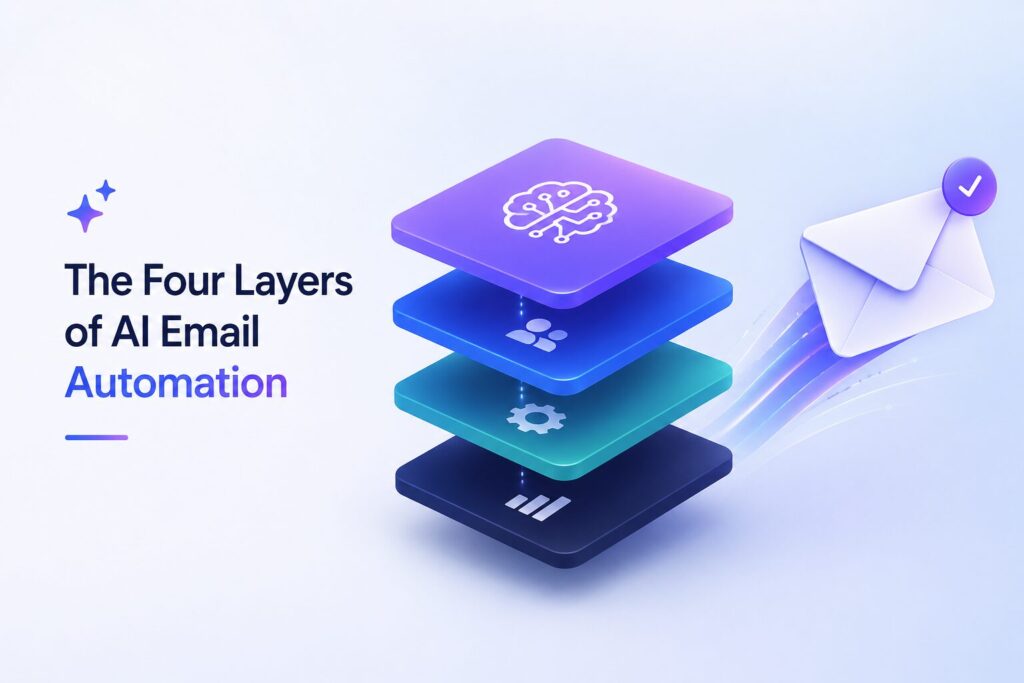
This is the layer most people know. AI tools that write subject lines, body copy, and calls-to-action. Gmail’s Help Me Write feature now pulls context from your Google Drive and Gmail history to personalize drafts. It also analyzes your past emails to mimic your writing style. What used to require a copywriter now happens automatically.
Sending the same email to your entire list is professional suicide. Platforms in this layer analyze customer behavior data — product browsing, cart adds, purchase frequency — and automatically build meaningful segments. They identify high-value loyal customers, at-risk customers, high-intent browsers, and discount-responsive groups without any manual work.
This is where AI replaces coordination teams. Tools in this layer generate full campaign sequences from a single prompt. They use machine learning to automate cold outreach, personalize drip sequences, and optimize send times. The best platforms let you describe an automation in plain English, and the AI builds the flow structure automatically, including triggers, conditions, and actions.
Your beautiful email means nothing if it never reaches the inbox. Nearly 18 percent of marketing emails fail to reach recipients. Enterprise-grade platforms now monitor subscriber experience and deliverability, flagging issues before they impact campaign performance. They even show how you stack up against competitors and surface missed revenue opportunities.
Now let me walk you through specific platforms you can deploy today.
Klaviyo has positioned itself as the AI-native platform for ecommerce. Its Flows AI feature allows marketers to describe an automation sequence in plain language and have the platform build the flow structure automatically. Klaviyo leads on ecommerce-specific AI including predictive analytics, behavioral segmentation, and AI-driven product recommendations. Use Klaviyo if you run an online store and need AI that understands purchase behavior.
HubSpot has embedded AI across its entire CRM ecosystem. Its Breeze AI suite connects email intelligence with CRM data, pipeline management, and cross-team workflows. HubSpot Sales Hub provides email tracking and predictive lead scoring. Use HubSpot if your email marketing is tied directly to your sales pipeline.
Mailchimp focuses on making AI accessible to smaller teams with limited technical resources. Its AI tools are the easiest to use and the most affordable, making them ideal for solo marketers who want smart automation without a steep learning curve. Use Mailchimp if you are just starting and need simplicity over advanced features.
Validity Engage launched in February 2026 as a next-generation AI platform built for enterprise marketing teams. It comprises four specialized AI agents:
| Agent | Function |
|---|---|
| Ignite Agent | Automatically flags and fixes rendering, code, and compliance risks before sending |
| Guardian Agent | Monitors subscriber experience and deliverability |
| Expression Agent | Generates on-brand copy and variants for subject lines, body, and CTAs |
| Insight Agent | Shows how senders stack up against competitors and surfaces missed revenue opportunities |
The platform is trained on more than 2.5 billion data points every day — representing the majority of global commercial email traffic. Use Validity if you are sending email at massive scale and need deliverability intelligence.
Lavender is built specifically for cold email. It lives inside your Gmail or Outlook and scores your draft in real time based on reply rate data from thousands of successful sales emails. It tells you exactly why your score is low — subject line too long, opening line about you instead of the prospect, email too long for mobile. Pricing starts at $29 per month for the Individual plan.
Salesforge is a B2B multi-channel outreach platform that runs email and LinkedIn in the same sequence. Its Agent Frank automatically finds prospects, sends messages, and books meetings. Pricing starts at $48 per month for 5,000 emails.
Jasper AI is best for newsletters and nurture campaigns with strong templates starting at $49 per month. Copy.ai offers a generous free tier and specializes in short-form sequences and email modes.
Customer.io launched an AI Agent in 2026 to help lifecycle teams remove technical blockers and automate tedious tasks. Teams are already building custom workflows like Accessibility Audit automations.
The data from 2026 is clear. AI-powered email tools deliver measurable ROI when used correctly.
On average, email marketing delivers an impressive ROI of $36 for every $1 spent — a figure that climbs to $45 in the retail and e-commerce sectors according to 2026 industry benchmarking data. Among companies that actively track their email performance, a remarkable 60% report returns exceeding $10 per dollar invested. Even more striking, more than 1 in 10 businesses achieve returns as high as 40:1 ($40 for every $1 spent).
But the real gap is between basic and advanced AI adoption. Marketing teams that have deeply integrated AI into their workflows are 75 percent more likely to achieve ROI above 45:1 from their email campaigns.
AI-driven email marketing campaigns yield around 13 percent increases in click-through rates and up to 41 percent revenue improvements compared to non-AI approaches.
Advanced AI adopters are also 54 percent more likely to follow Web Content Accessibility Guidelines and 52 percent more likely to comply with the European Accessibility Act. By using AI to accelerate campaign generation and analysis, they meet growing production targets even when adding headcount is not an option.
The gap between teams who have built the right AI infrastructure and those who have not is widening. Email rewards the programs that have built the right infrastructure.
This is the single most important shift in 2026. And most marketers have not adjusted.
AI is now filtering, summarizing, and prioritizing emails before a user looks at them. You are competing with how AI decides what is worth showing in the first place. Fewer than a third of marketers have a strategy for AI-driven inboxes.
At Google I/O on May 19, 2026, Google confirmed a Gemini-powered inbox view that surfaces prioritized to-do items and message highlights rather than presenting email in standard chronological order. Gmail is using AI to sort, categorize, and prioritize messages. Apple Intelligence is summarizing emails before anyone opens them. This isn’t a future prediction—it is happening right now.
The implication is brutal but simple. You are no longer competing for attention against other emails. You are competing with how AI decides what is worth showing in the first place. And fewer than a third of marketers have a strategy for AI-driven inboxes. Forty-eight percent of marketers are already concerned about AI filtering deciding which messages get seen. Seventeen percent say it is already impacting deliverability.
What does this mean for your email strategy?
First, relevance has replaced timing as the primary driver of ROI. What outperforms the cleverest AI-written hook is strategy, sequencing, and intent.
Second, generic, non-contextual AI copy can drop engagement by 20 to 30 percent.
Third, automated emails have outperformed scheduled campaigns every year since 2021 — by two times or more.
You do not need every tool in this guide. Here is a realistic one-week plan to replace a five-person team with AI-powered platforms.
Sign up for Jasper AI or Copy.ai. Generate your first 10 email subject lines, three complete newsletter drafts, and five abandoned cart sequences. Use the tool’s built-in templates. Do not manually write anything for two days.
In your email platform (Klaviyo, HubSpot, or Mailchimp), activate the AI segmentation features. Let the platform automatically build customer segments based on behavior. Do not manually tag anyone. Trust the AI’s groupings.
Use Klaviyo’s Flows AI or HubSpot’s Breeze AI to describe your ideal customer journey in plain English. Let the platform build the automation flow. Test it on a small segment of your list.
Sign up for Validity Engage or a similar deliverability tool. Run a full audit of your email infrastructure. Fix any authentication issues (SPF, DKIM, DMARC). Schedule weekly AI deliverability reports.
By the end of one week, you will have automated content creation, segmentation, campaign building, and deliverability monitoring. That is the work of a five-person team, running on autopilot.
According to Customer.io‘s 2026 Customer Messaging Report, 61 percent of marketers now use AI to write and draft copy. That sounds impressive until you look at the next number: only 45 percent are using AI for campaign optimization and just 37 percent for performance analysis.
The majority of teams are using AI-powered tools as glorified typewriters. They generate copy faster but fail to optimize when to send, who to send to, or what to measure. This is why only 23 percent of teams believe AI substantially improves their email programs. Using AI to generate content is a good starting point, but it is not where the biggest impact happens.
The winners in 2026 are using AI across all four layers — content, segmentation, orchestration, and deliverability — not just the first one. They are using AI to segment audiences based on behavior and preferences, and to make predictive or automated deliverability adjustments. They understand that these platforms are not about writing faster. They are about thinking smarter.
Campaign Monitor introduced AI Email Booster in early 2026, which analyzes email content directly inside the email builder and surfaces clear, actionable recommendations to improve performance. No separate dashboard. No learning curve. Just practical AI built directly into the workflow.
Ongage now integrates directly with AI assistants through its new MCP server, allowing users to connect to AI clients like Claude, Cursor, and VS Code to query campaign analytics, create and schedule emails, manage segments, and monitor automation workflows — all through simple conversational prompts. This is the direction every platform is heading: away from dashboards and toward conversation.
Mailjet launched an AI-Powered Email Template Generator that creates personalized email campaigns by automating custom templates with tailored copy, subject lines, and brand-consistent designs. For small teams, this eliminates hours of manual design work.
Here is the uncomfortable truth that no AI platform will tell you. If your data is incomplete, outdated, or poorly structured, AI does not improve your output. It scales the problem. Good email programs get better. Weak ones get exposed.
The 2026 email marketing landscape rewards the programs that have built the right infrastructure. That means clean data, clear segmentation logic, and a willingness to use AI across every layer of your operation — not just the copywriting layer.
The tools are ready. The question is whether you are.
The best platforms for small businesses are Mailchimp for beginners (easiest and most affordable), Klaviyo for ecommerce stores (predictive analytics and behavioral segmentation), and HubSpot for sales-driven businesses (CRM-native AI). Campaign Monitor also offers AI guidance features built for small and mid-size businesses.
Start by picking one platform that matches your business type. Ecommerce stores should choose Klaviyo. B2B sales teams should choose HubSpot. Solo marketers should choose Mailchimp. Spend one week learning the AI features. Then automate one campaign workflow — abandoned cart, welcome series, or re-engagement. Track your open rates and click-through rates. Add additional tools as you see results.
Email marketing delivers an average ROI of $36 for every $1 spent — a figure that rises to **$45 in retail and e-commerce** according to 2026 industry benchmarking data. Among companies that actively measure ROI, 60% report returns above $10 per $1 spent, with more than 1 in 10 achieving exceptional returns as high as 40:1. Notably, advanced AI adopters are 75% more likely to achieve ROI above 45:1. That said, your actual returns depend on your list size, product margins, and how effectively you implement AI-driven segmentation and personalization.
For cold email outreach, Lavender is the best platform because it scores your drafts in real time against successful sales emails and provides specific feedback on what to fix. For automated prospecting and meeting booking, Salesforge with Agent Frank handles multi-channel outreach across email and LinkedIn. Apollo is also strong for high-volume outbound sequencing with a free tier available.
Yes — but with realistic expectations. These platforms save time and improve performance, but they do not replace understanding your audience or testing your messaging. The best approach for a beginner is to start with Mailchimp’s free tier, use its AI subject line generator and send-time optimization, and run A/B tests on every campaign. Measure your open rates and click-through rates before and after using AI features. Most beginners see a 20 to 30 percent improvement in engagement within 60 days. The key is not treating AI as magic — it is treating AI as a powerful assistant that still needs your direction.
The email marketing landscape in 2026 belongs to teams who have embraced AI-powered platforms.
Here is your action plan:
Do not try all of these platforms at once. Pick one tool that fits your business size. Automate one workflow this week. Measure your results. Add a second tool next month.
The teams winning in 2026 are not hiring more email marketers. They are deploying AI-powered platforms that do the work of five people. That can be you.
All figures are sourced from publicly available reports, benchmarks, and industry data from 2026.
Leave a comment below — which tool will you test first?
P.S. — We publish one practical AI income guide every week at AICAP.in. Subscribe below — no spam, no fluff, just strategies that actually work.

Salman Shaikh is the founder and editor-in-chief of AiCap.in, an independent AI and personal finance publication based in Ahmedabad, India.
Since launching AiCap.in in April 2026, Salman has personally tested and reviewed 100+ AI tools across income generation, crypto research, content creation, and personal finance — publishing 91+ hands-on guides based on real usage, not press releases.
His approach is simple: every tool he writes about is one he has opened, tested, and either used to earn money or rejected after finding it didn’t deliver. He started AiCap.in after realising most AI content in India was either written by people who had never touched the tools, or buried in technical jargon that everyday people couldn’t act on.
His work covers AI tools for passive income, freelancing with AI, crypto research workflows, Amazon FBA with AI, and personal finance strategies built for readers in India and accessible to anyone globally looking to earn smarter with AI.
AiCap.in now reaches a growing community of readers across India and globally who want practical, jargon-free AI strategies they can implement today.
Connect with Salman: LinkedIn · X @AiCap88 · YouTube · Medium





[…] a smart AI email marketing funnel 2026 on autopilot. Copy the ready 5‑email sequence. Turn subscribers into buyers while you […]
[…] AI summarize emails instantly with free tools for Gmail & Outlook in 2026. Save hours daily with ChatGPT and Copilot. Step-by-step setup guide inside. Read now. […]
[…] cold email advice sounds impressive until you actually launch a […]