Ahmedabad, Gujarat, India
Ahmedabad, Gujarat, India
Turn AI voice cloning into income in 24 hours – free tools, real pricing, no code. Get your first paying client within 48 hours. Start today.
Disclaimer: This content is for educational and informational purposes only. Earnings and results vary by individual. Always conduct your own due diligence. AICAP.in is not affiliated with ElevenLabs, Supertone Play, Vocloner, or any platform mentioned in this guide.
Most people trying to earn online end up competing on price. Logo design. Article writing. Basic video editing. Thousands of freelancers fight for the same low-paying gigs.
There is a better way. In 2026, AI voice cloning has become remarkably realistic. With just a short audio sample, tools like ElevenLabs, Supertone Play, and Play.ht can replicate a voice and generate natural-sounding speech. Businesses, YouTubers, and course creators pay for this because it saves them studio time and delivers consistent, professional audio.
Turning AI voice cloning into income means offering legitimate voice services: cloning a client’s voice so they can produce bulk narration, licensing a high-quality synthetic voice for ads and audiobooks, or building voice-based digital products. The barrier to entry is lower than ever — free AI voice tools exist, and most platforms require no code and no technical skills.
This guide is a practical, beginner-friendly roadmap. It covers seven real ways to make money with AI voice cloning, which free tools to start with, and the common mistakes that kill results before they start. It does not promise a specific income figure or a guaranteed timeline — those depend on your effort, niche, and execution. What it does promise is a clear, no-fluff path from setup to your first paying client.
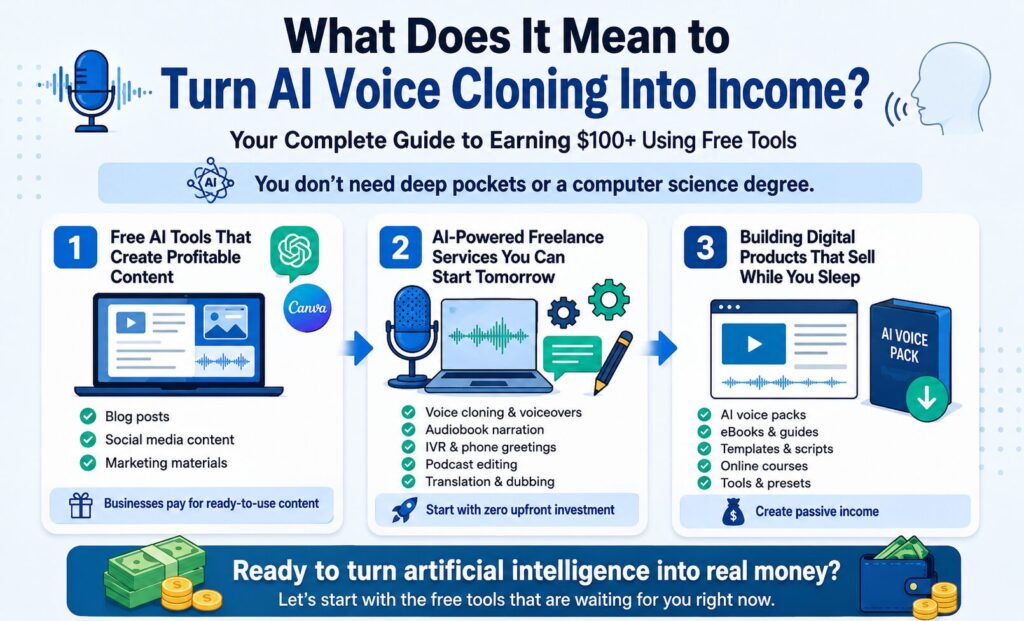
Most people who try to earn online end up competing on price. Logo design. Article writing. Basic video editing. Thousands of freelancers fight for the same $10 gigs.
There is a better way. In 2026, AI voice cloning has become remarkably realistic. With a short sample of audio, tools like ElevenLabs, Play.ht, and Supertone Play can replicate a voice and generate new speech that sounds natural. Businesses, YouTubers, and course creators pay real money for this because it saves them studio time and gives them consistent, professional audio.
Turning this skill into income means offering legitimate voice cloning services: cloning a client’s voice so they can produce bulk narration, or licensing a high-quality synthetic voice for ads, audiobooks, and explainer videos.
If you have been searching for a practical plan to build this into a paying service, this guide walks through the setup, the platforms, and the pricing models. It does not promise a specific income figure or a guaranteed timeline — those depend on your effort, niche, and execution.
Can beginners really make money with voice AI in 2026? Yes, in the right conditions. But it helps to be specific about what that means.
Voice cloning is the process of creating a digital replica of a human voice using artificial intelligence. The clone can then speak any text you feed it, in multiple languages, while preserving the original speaker’s tone, accent, and emotional range.
Here are the key elements that make this opportunity real in 2026:
Platforms now pay creators directly. ElevenLabs operates a Voice Library / marketplace that pays voice owners when their clones are used. The company has publicly reported paying out millions of dollars to voice creators, though the exact figures change over time — check ElevenLabs’ official announcements for current numbers.
Free tools exist with commercial use rights. Some platforms, including Supertone Play, offer free voice cloning with commercial use allowed. Verify current terms directly, since licensing can change.
No code or technical skills required. Most platforms are browser-based with simple upload-type-download workflows.
One recording can generate recurring income. Unlike traditional voice work where you get paid once per session, cloned voices listed on marketplaces can earn royalties each time they are used.
The barrier to entry is lower than it was a few years ago. But the gap between “trying it” and “making money from it” is still significant — and most guides skip the actual work required to cross that gap.
Voice cloning relies on deep learning models trained on thousands of hours of human speech. When you upload a recording, the AI analyzes your voice’s unique characteristics — pitch, timbre, rhythm, and emotional inflection — and creates a digital model that can reproduce those characteristics with new text.
The process typically follows this workflow:
Critical rule: The quality of your output depends almost entirely on the quality of your input. A clean recording in a quiet space with minimal background noise will produce a clone that sounds natural and passes platform verification. A poor recording produces robotic or muffled output that no one will pay for.
This is one of the most direct paths to passive income with voice technology. Platforms like ElevenLabs operate voice marketplaces where creators upload their cloned voices and earn when another user generates speech with them.
How it works: You upload a Professional Voice Clone (which typically requires 30+ minutes of clean audio), set your licensing terms, and wait for approval. Once live, you earn royalties based on usage. Royalty rates vary by plan and change over time — check ElevenLabs’ current Voice Library terms for the exact payout structure and minimum payout threshold.
Getting started: Professional voice cloning usually requires a paid plan. After uploading and getting approved, you may be able to downgrade while keeping your voice live. Verify current plan requirements on the platform’s site.
What to expect: Income from voice marketplaces depends on how often your voice is used, which is influenced by quality, language, style, and demand. Some creators earn modest amounts; others with distinctive, in-demand voices earn more. There is no guaranteed monthly figure.
One recording session can generate products you sell repeatedly. Create voice-based digital products and sell them on platforms like Gumroad, Whop, or Payhip.
Products that sell:
Why this works: Customers purchase once, you deliver instantly. No shipping, no inventory, no recurring time investment after the initial creation.
Global creators need multilingual content, and AI dubbing makes it possible to translate and localize videos into multiple languages without additional filming.
Services you can offer:
Pricing model: Charge monthly retainers or per-video pricing. Recurring revenue is where this becomes scalable, but it requires building trust with each client first.
Small businesses often miss calls. AI voice bots can help address that.
Using platforms like Vapi, Bland AI, or Retell AI, you can create voice agents that handle:
Revenue models: Setup fees, monthly hosting, and referral commissions. Pricing varies by market and scope — research what local businesses in your area are willing to pay before quoting.
Voice cloning enables faceless content creation at scale. You can generate scripts, clone a voice, and produce videos without showing your face or recording audio.
The workflow:
Monetization: YouTube AdSense, TikTok Creator Fund, brand sponsorships, and affiliate marketing. Note that YouTube’s monetization policies require original, valuable content — see our dedicated guide on AI voice cloning for YouTube for the compliance details.
This is the most straightforward service-based approach. Businesses, creators, and agencies need professional narration for videos, explainers, ads, and onboarding content.
What clients actually pay for: Not access to a tool — they pay for the finished audio that fits their use case, with the right pacing, clean editing, proper formatting, and reliable delivery.
Starting point: Voiceovers for YouTube videos, explainer videos, and ads are often the easiest services to sell first because the deliverable is clear and buyers already understand the value.
Typical earnings: Freelance voiceover rates vary widely by niche, experience, and client. General freelance rate surveys place voiceover work in a broad range. Check current marketplaces like Fiverr or Upwork to see what comparable services are charging in your category.
Using open-source tools, you can create a complete AI influencer — generate consistent character images, clone a voice, and create lip-synced talking videos.
The tech stack:
Use cases:
Earnings potential: AI influencers can monetize through brand sponsorships, affiliate marketing, and selling digital products. Sponsorship rates vary widely based on follower count, engagement, and niche. Treat any specific per-post rate as an estimate rather than a guarantee.
How to start: Create a consistent character design using Stable Diffusion. Clone a voice that matches the character’s personality. Generate short talking videos using lip-sync tools. Post consistently on one platform for 30 days, then repurpose content across others.
| Tool | Best For | Free Tier | Key Limitation |
|---|---|---|---|
| Supertone Play | Quick cloning with commercial use | Free tier available | Verify current terms; interface and language support vary |
| Vocloner | Multilingual projects | Free tier available | Personal use only on free tier; verify current limits |
| ElevenLabs | Professional marketplace earnings | Limited free tier | Paid plan required for commercial rights and marketplace access |
Supertone Play offers a low barrier to entry — short recording requirements, free registration, and commercial use allowed on its free tier at the time of writing. It is useful for testing whether voice cloning works for your use case. Verify current terms before using it for paid client work.
Vocloner is a web-based platform powered by open-source Coqui AI models. It offers two cloning modes: TTS Classic (faster, English-optimized) and XTTS (supports multiple languages with higher quality). Check the platform for current free-tier limits and licensing.
ElevenLabs is a leading platform for professional voice cloning and marketplace earnings. The free tier is limited, but a paid plan unlocks professional cloning and marketplace access. Check ElevenLabs’ current pricing and commercial licensing terms before publishing.
Recommendation: Start with a free tool to validate your workflow. If you are getting results and want to pursue commercial work, upgrade to a paid plan that includes commercial rights.
Mistake #1: Focusing on the tool instead of the service. Clients do not pay for access to ElevenLabs or any other platform. They pay for finished audio that fits their use case and arrives on time.
Mistake #2: Using poor-quality audio samples. Output sounds robotic or muffled on poor-quality samples. Record in a quiet space, maintain a consistent distance from the microphone, and speak clearly with controlled pacing.
Mistake #3: Ignoring consent and ethics. Voice cloning without explicit consent is risky and unethical. Always secure permission and define clear usage rights. Cloning someone else’s voice without authorization can violate platform policies and, in some jurisdictions, laws.
Mistake #4: Expecting instant passive income. Creators earning meaningful amounts on voice marketplaces invested time in quality recordings, clear voice cards, and optimization. Passive income is earned, not automatic.
Mistake #5: Overlooking platform terms. Some free tiers restrict commercial use. Always check licensing terms before using a cloned voice for paid work.
Voice cloning is a technology that creates a digital replica of a human voice using artificial intelligence. The clone can then speak any text, in multiple languages, while preserving the original speaker’s tone, accent, and emotional range. It typically requires at least a short sample of audio, with longer samples producing more accurate results.
Start with a free tool like Supertone Play or Vocloner. Record a clean 10–30 second audio sample in a quiet space, upload it, and test the output. If the quality meets your needs, explore monetization paths — listing your voice on a marketplace, offering voiceover services, or creating voice-based digital products.
Earnings vary widely. Voice licensing income depends on how often your voice is used. Freelance voiceover rates vary by niche, experience, and client. There is no universal income figure that applies to every creator. Start with small projects and scale as you build reputation and quality. Treat any specific income claim — including those in other guides — as an estimate rather than a promise.
It depends on your needs. Supertone Play offers low-friction onboarding with commercial use allowed on its free tier at the time of writing. Vocloner offers a free tier with multilingual support but restricts commercial use on the free plan. ElevenLabs offers a limited free tier with paid plans for commercial work. Always verify current terms directly.
Yes, but with realistic expectations. The technology is mature enough to produce commercially viable output in many cases, and some platforms pay creators for voice usage. The barrier to entry is low — free tools, no code, no studio required. However, success requires quality recordings, understanding what clients actually pay for (finished audio, not tool access), and consistent effort. It is a real opportunity, not a get-rich-quick scheme.
Voice cloning has moved from science fiction to a commercially viable skill in 2026. Platforms are paying creators for voice usage. Free tools have lowered the financial barrier to entry.
The three most important things to take away:
Start with quality. Your recording quality determines your clone quality. Clean audio in a quiet space is non-negotiable.
Focus on the service, not the tool. Clients pay for finished audio that solves their problem, not for access to a platform.
Choose one path and execute. Voice marketplace, voiceover services, digital products, or AI voice bots. Pick one, master it, then expand.
The technology is ready. The platforms are paying. The next step is yours.
Salman Shaikh is the founder and editor-in-chief of AiCap.in, an independent AI and personal finance publication based in Ahmedabad, India. Since launching AiCap.in in April 2026, Salman has personally tested and reviewed 100+ AI tools across income generation, crypto research, content creation, and personal finance — publishing 91+ hands-on guides based on real usage, not press releases.
His approach is simple: every tool he writes about is one he has opened, tested, and either used to earn money or rejected after finding it didn’t deliver. He started AiCap.in after realising most AI content in India was either written by people who had never touched the tools, or buried in technical jargon that everyday people couldn’t act on.
AiCap.in now reaches a growing community of readers across India and globally who want practical, jargon-free AI strategies they can implement today.
This guide avoids anonymous seller anecdotes and unverifiable income claims. Platform data is attributed to official or industry sources where possible. Because platform policies, tool pricing, and market conditions change, verify current details through the links below before making business decisions.
Figures in this guide are presented only when they can be attributed to platform reports, official documentation, or industry sources. Individual results vary based on niche, effort, pricing, and market conditions. Verify specific metrics through your own testing before making decisions based on this guide.
P.S. — AICAP publishes one practical AI strategy guide every week at AICAP.in — no spam, no recycled content, no hype. Just strategies that people are actually using right now.

Salman Shaikh is the founder and editor-in-chief of AiCap.in, an independent AI and personal finance publication based in Ahmedabad, India.
Since launching AiCap.in in April 2026, Salman has personally tested and reviewed 100+ AI tools across income generation, crypto research, content creation, and personal finance — publishing 91+ hands-on guides based on real usage, not press releases.
His approach is simple: every tool he writes about is one he has opened, tested, and either used to earn money or rejected after finding it didn’t deliver. He started AiCap.in after realising most AI content in India was either written by people who had never touched the tools, or buried in technical jargon that everyday people couldn’t act on.
His work covers AI tools for passive income, freelancing with AI, crypto research workflows, Amazon FBA with AI, and personal finance strategies built for readers in India and accessible to anyone globally looking to earn smarter with AI.
AiCap.in now reaches a growing community of readers across India and globally who want practical, jargon-free AI strategies they can implement today.
Connect with Salman: LinkedIn · X @AiCap88 · YouTube · Medium