Ahmedabad, Gujarat, India
Ahmedabad, Gujarat, India
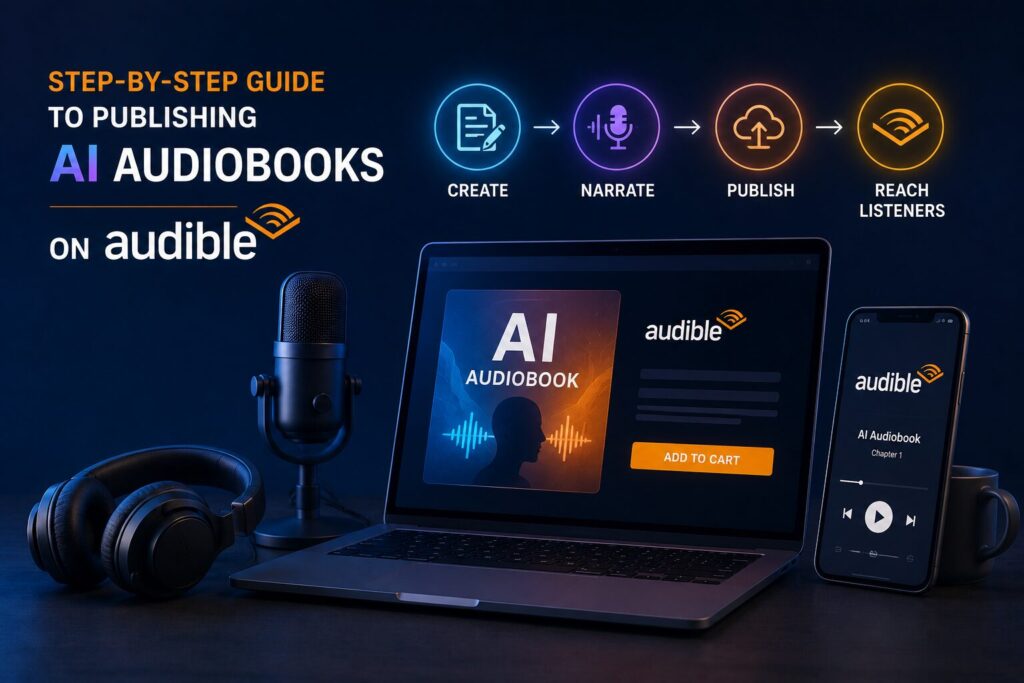
Publish AI audiobooks on Audible 2026 following 2025-2026 ACX rules. Learn to earn passive royalties with ElevenLabs, KDP Virtual Voice & ACX Voice Replica. Step-by-step guide.
Disclaimer: This content is for educational and informational purposes only. Earnings and results vary by individual. Always conduct your own due diligence.
Most people who try to earn online quit before they find the method that actually works. If you’ve been searching for a real, no-fluff answer on publishing AI-narrated audiobooks — this is it.
AI audiobooks mean using AI tools to generate professional narration instead of hiring expensive voice actors. You write a manuscript, run it through AI voice software, do basic editing, upload to ACX (Audiobook Creation Exchange), and collect royalties every time someone buys or streams your book on Amazon, Audible, or Apple Books.
Here’s the crazy part: there are 150 million books in the world, but only about one million have been converted to audio. That’s a massive opportunity sitting right in front of you. The US audiobook market hit $2.22 billion in 2024 (up 13% year-over-year). Digital accounts for 99% of revenue. ACX itself reports that nearly one in three titles in Audible’s million-title catalog come through their platform.
This guide breaks down exactly how to publish AI-narrated audiobooks, which tools top creators actually use, and how to earn passive royalties without ever stepping near a recording booth. By the end, you’ll have a clear, actionable plan to launch your first AI audiobook.
Here’s what most people don’t realize about audiobook production in 2026. Traditional production costs roughly $200 per finished hour for narration, plus another $200 per finished hour for post-production. It takes about four hours of work to produce one finished hour of audio. For a ten-hour book? That’s $4,000 upfront plus months of waiting.
Now here’s the part most guides skip entirely — and it’s the most important. Publishing AI-narrated audiobooks completely changes this math. Instead of spending $4,000 and waiting months, you can generate the same ten-hour audiobook for under $100 using AI tools. Production time? Measured in days, not months.
Once uploaded, each audiobook becomes a passive income asset. You don’t touch it again. It sells while you sleep. You earn royalties on every purchase and every stream without any ongoing work.
The opportunity goes way beyond traditional fiction. There’s a “hidden audio market” that traditional studios ignore: midlist and niche nonfiction, business content with short relevance windows, and academic texts. Traditional studios can’t justify producing these titles, but AI audiobook creators can. The Audiobook Publishers Association found that 72% of listeners want audiobooks on their preferred platform, and 63% value library access. AI lets you meet that demand profitably.
Let’s cut through the noise. The audiobook industry is now an $11 billion global market in 2025, growing at a 26.6% CAGR. The global audiobooks market hit $11.18 billion in 2025 and is projected to hit $14.15 billion in 2026 — a CAGR of 26.56% that will push it to $71.80 billion by 2033. Audible alone hosts over 1 million titles.
Here’s the data you actually need to know:
| Metric | Number |
|---|---|
| Global Audiobook Market (2025) | $11.18 billion |
| Projected Market (2026) | $14.15 billion |
| CAGR (through 2034) | 26.56% |
| Audible Titles | 1+ million |
| AI-Narrated New Releases | 23% |
| US Market Revenue (2024) | $2.22 billion |
The 50 Million Minute Milestone: In June 2026, Audible revealed listeners have streamed more than 50 million minutes of AI-generated content on the platform. According to Audible executive Lee Jarit, these listens are largely coming from books that may never have been recorded in audio form otherwise. That’s not curiosity — that’s genuine engagement with synthetic narration.
Listeners are actually finishing these books. Many of the AI-generated titles attracting listeners are precisely those overlooked books that previously had no audio version.
AI Adoption Stats You Need to Know:
Audible’s AI Infrastructure: Audible now offers more than 160 AI voices and dialects and is developing tools that let publishers direct virtual narrators the same way they’d guide a human performer in a studio. The company is offering publishers an end-to-end solution: hand over a manuscript, and Audible handles everything — from production and translation all the way to distribution across all global marketplaces.
International Growth Opportunities: Audible launched in 11 new localized services in 2026, including Belgium, the Netherlands, and Sweden. Dutch, Turkish, and Arabic are major focuses right now. The Arabic market? 400 million Arabic speakers in the world and only a couple thousand audiobooks. Audible now has around 8,000 titles available in Arabic. That’s a massive opportunity if you can produce content in underserved languages.
You can’t just generate an AI audiobook and upload it to ACX. There are specific rules you must understand first.
ACX currently does not accept general AI-narrated audiobook submissions from rights holders. The standard rule states: “Your audiobook must be narrated by a human unless otherwise authorized. Unauthorized use of text-to-speech, AI, or automated recordings in ACX is prohibited.”
In May 2026, ACX announced a U.S.-only beta program for voice replicas. Here’s how it works:
Compensation: Narrators using voice replicas can receive a per-finished-hour fee or a blended payment including both a fee and royalties. Rights holders can now skip the audition phase and make direct offers for voice replica narration.
Amazon’s KDP Virtual Voice lets you publish an AI-narrated audiobook directly on Amazon outside the ACX system, keeping full rights and avoiding ACX’s contract restrictions. KDP currently offers a 40% royalty rate for audiobooks with virtual voice.
The Bottom Line: If you want to publish AI-narrated audiobooks through ACX, your current legal pathway is to work with a narrator in the Voice Replica beta, or become a narrator yourself and create your own voice replica. Standalone text-to-speech uploads are still prohibited.
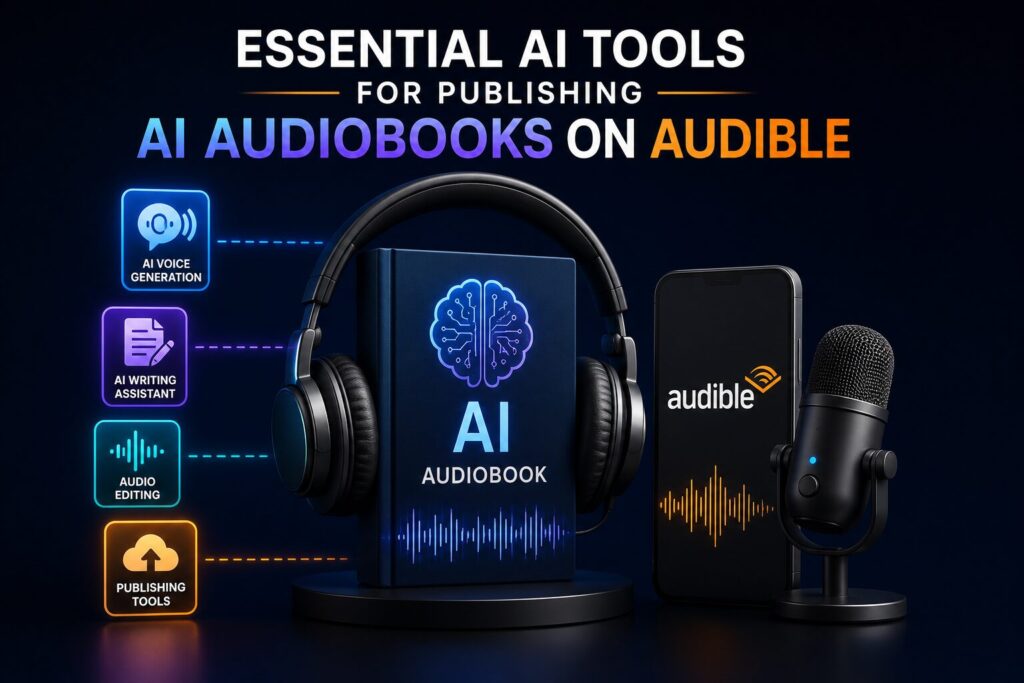
Here are the specific tools top creators actually use for publishing AI-narrated audiobooks.
| Tool | Starting Price | Best For |
|---|---|---|
| ElevenLabs | $5/month | Natural-sounding narration, emotional modulation, voice cloning |
| Narration Box | Usage-based | Complete workflow from script to publishing |
| PlayHT | $31/month | High-quality voices with extensive customization |
| Murf.ai | $19/month | Multi-character fiction, character distinction |
| Notevibes | $29/month | Dedicated audiobook platform |
| Google Cloud TTS | $4/million chars | Testing concepts on a tight budget |
ElevenLabs is the clear winner for most creators. The platform has demonstrated its capability for high-quality, multi-character narration and emotional modulation at scale. ElevenLabs pays performers every time their voice is used.
Pro Tip: Before paying for subscriptions, test Google Cloud Text-to-Speech ($4 per million characters) or Microsoft Edge’s built-in natural voices. Validate your concept first, then invest in premium tools.ols.
Your manuscript must contain only the words you want spoken aloud. Every character will be treated as narration. Remove visual-only elements, formatting artifacts, and anything not intended for audio. Write out numbers (“twenty-five” instead of “25”) and spell proper nouns phonetically where possible.
Time: 1-2 hours
Select an AI voice from your chosen platform. For ElevenLabs, start with pre-made voices before investing in custom voice cloning. Generate your audiobook in segments of 2,000-3,000 words at a time. This preserves context and allows for easier error correction.
Time: 2-4 hours
Even the best AI voices require editing. Check for mispronounced words, especially unusual names or technical terms. Many AI platforms allow pronunciation guides — add phonetic spellings to your script. Listen to each chapter in full before moving to the next.
Time: 2-3 hours per chapter
ACX requires specific technical standards:
Most AI tools export audio that meets these standards, but verify with free software like Audacity before uploading.
Time: 30 minutes
ACX expects each chapter as a separate audio file. Name files sequentially and keep each chapter under 120 minutes. For longer chapters, split into logical sections.
Time: 30 minutes
Create an ACX account if you haven’t already. Ensure you’re working with a narrator who participates in the Voice Replica beta, or verify your chosen distribution method (KDP Virtual Voice) is permitted. Complete all metadata fields accurately.
Time: 1 hour
ACX typically takes 10-14 business days to review submissions. They check audio quality, metadata consistency, and content appropriateness. Pass rate improves significantly when you follow technical specifications exactly.
Time: 10-14 days (waiting)
Choose your distribution model. Exclusive distribution to Audible, Amazon, and Apple Books gives higher royalty rates. Non-exclusive distribution gives wider reach but lower rates. Opt into the All-You-Can-Listen (AYCL) program to earn through subscription pools.
Time: 30 minutes
Total Time to Publish: 5-10 days active work + 10-14 days waiting
Here’s what most guides don’t tell you. Audible calculates royalties on “Net Sales,” which is heavily adjusted down from the list price. On a $19.95 audiobook, an ACX exclusive author receives roughly $7.98 per à la carte purchase — which works out to 50% of a heavily discounted internal figure, not $19.95.
Then there’s the credit system. Audible subscribers pay a flat monthly fee for credits, meaning a $25 audiobook earns the same royalty as a $10 one when purchased with a credit. And there’s the return window: Audible allows returns within seven days even after a full listen, and authors receive no compensation for returned titles.
| Metric | Number |
|---|---|
| List Price | $19.95 |
| Net Sale Price (Adjusted) | ~$15.96 |
| Exclusive Royalty Rate | 50% |
| Royalty Per Sale | ~$7.98 |
| Sales Needed for $1,000 | 126 copies |
| Sales Needed for $5,000 | 627 copies |
Scaling Potential: Creators with portfolios of 10-20 AI audiobooks report monthly royalties ranging from $2,000 to $10,000. The highest earners focus on underserved niches like business non-fiction and specialty instructional content.
New Royalty Rates (Starting May 26, 2026):
The AYCL Opportunity: For the first time, ACX creators can earn from any consumption type and opt into Audible’s all-you-can-listen offerings. Your earnings are calculated based on listener engagement, not just sales.
For most creators publishing AI-narrated audiobooks, ElevenLabs ($5/month) delivers the best combination of natural-sounding speech, emotional modulation, and easy workflow. The platform has been proven capable of handling high-quality, multi-character narration at scale.
If your budget is extremely tight: Google Cloud Text-to-Speech charges only $4 per million characters — viable for shorter books or testing concepts.
For multi-character fiction: Murf.ai ($19/month) provides better voice differentiation and character management.
For a complete all-in-one platform: Narration Box simplifies the entire workflow from script to submission.
The beginner playbook: Start with ElevenLabs. Generate one chapter to test quality. If satisfied, produce the full audiobook. Only invest in multiple tools after confirming market demand.
Yes, but with realistic expectations. Publishing AI-narrated audiobooks removes the biggest barrier to entry — the $4,000+ upfront cost of professional human narration. For under $100 and a few days of work, you can have a finished audiobook.
But here’s the catch: you must work within ACX’s current rules. Either become a narrator and join the Voice Replica beta, or partner with a beta participant.
The APA’s consumer research shows willingness to try AI narration fell from 77% (2023) to 70% (2025) . Listeners are becoming more selective. The winners will be those who deliver true performance quality, not just “good enough.” ACX’s voice replica tool lets narrators maintain high quality by enabling detailed editing of pronunciation errors and pacing.
If you treat AI as a tool that amplifies your content rather than replacing human judgment entirely, publishing AI-narrated audiobooks is absolutely worth pursuing. The market is growing rapidly. Most books still lack audio versions. The opportunity window is open.
AI audiobooks are audiobooks produced using AI voice generation instead of human narration. You prepare a manuscript, run it through AI voice software like ElevenLabs, edit the output, and upload to ACX. Once approved, you earn royalties on every purchase or stream.
Start by either becoming an ACX narrator yourself (free to sign up) or partnering with a narrator in ACX’s Voice Replica beta. Prepare your manuscript by removing visual elements and formatting artifacts. Choose an AI voice tool, generate your narration in segments, edit for errors, and ensure audio meets ACX technical specifications. Upload through the beta program. Total setup time is typically 5-10 days for a standard-length book.
Under the new 2026 royalty model, exclusive distribution earns a 50% royalty rate on net sales. A $19.95 audiobook selling 100 copies monthly generates roughly $798 monthly royalty, which exceeds $9,500 annually from one title. Creators with catalogs of 10-20 AI audiobooks report $2,000-$10,000 monthly. The legacy royalty model is being phased out by December 31, 2026.
For the full tool comparison, see the “Best AI Tools for Audiobook Narration” section above. In short: ElevenLabs ($5/month) is widely considered best for natural-sounding, emotionally expressive narration suitable for long-form audiobooks. For multi-character fiction, Murf.ai ($19/month) offers better character distinction. For a complete all-in-one platform, Narration Box simplifies the entire workflow. For extremely tight budgets, Google Cloud Text-to-Speech charges $4 per million characters. Start with ElevenLabs’s free tier to test quality.
Yes, but with proper expectations. AI audiobooks remove the $4,000 upfront cost barrier of traditional narration, making audiobook creation accessible to anyone. However, you must follow ACX’s current rules — general AI narration uploads are prohibited. Work through the Voice Replica beta pathway or use KDP Virtual Voice. The audiobook market is growing rapidly, most books lack audio versions, and AI tools make production affordable and fast. If you deliver genuine quality and choose underserved niches, the passive income potential is significant.
Here are the three most actionable takeaways from this guide:
AI audiobooks are not a get-rich-quick scheme. They are a genuine business opportunity combining AI efficiency with a rapidly growing market. The difference between creators who earn passive income and those who don’t is simple: the earners start. They prepare their manuscript. They generate their first chapter. They learn, iterate, and publish.
You have everything you need right now — seven clear steps, exact tool names, pricing models, and a realistic understanding of ACX’s rules.
Your next step: Spend 30 minutes today preparing a manuscript section for AI narration. Remove visual elements and formatting artifacts. Sign up for ElevenLabs’ free tier and generate your first chapter tomorrow. Listen critically. Make notes for improvements. Publish your title within two weeks. Momentum beats planning every time.
All figures are sourced from publicly available reports, benchmarks, and industry data from 2026.
Leave a comment below — which niche are you targeting for your first AI audiobook?
P.S. — We publish one practical AI guide every week at AICAP.in. Subscribe below — no spam, no fluff, just strategies that actually work.

Salman Shaikh is the founder and editor-in-chief of AiCap.in, an independent AI and personal finance publication based in Ahmedabad, India.
Since launching AiCap.in in April 2026, Salman has personally tested and reviewed 100+ AI tools across income generation, crypto research, content creation, and personal finance — publishing 91+ hands-on guides based on real usage, not press releases.
His approach is simple: every tool he writes about is one he has opened, tested, and either used to earn money or rejected after finding it didn’t deliver. He started AiCap.in after realising most AI content in India was either written by people who had never touched the tools, or buried in technical jargon that everyday people couldn’t act on.
His work covers AI tools for passive income, freelancing with AI, crypto research workflows, Amazon FBA with AI, and personal finance strategies built for readers in India and accessible to anyone globally looking to earn smarter with AI.
AiCap.in now reaches a growing community of readers across India and globally who want practical, jargon-free AI strategies they can implement today.
Connect with Salman: LinkedIn · X @AiCap88 · YouTube · Medium