Ahmedabad, Gujarat, India
Ahmedabad, Gujarat, India
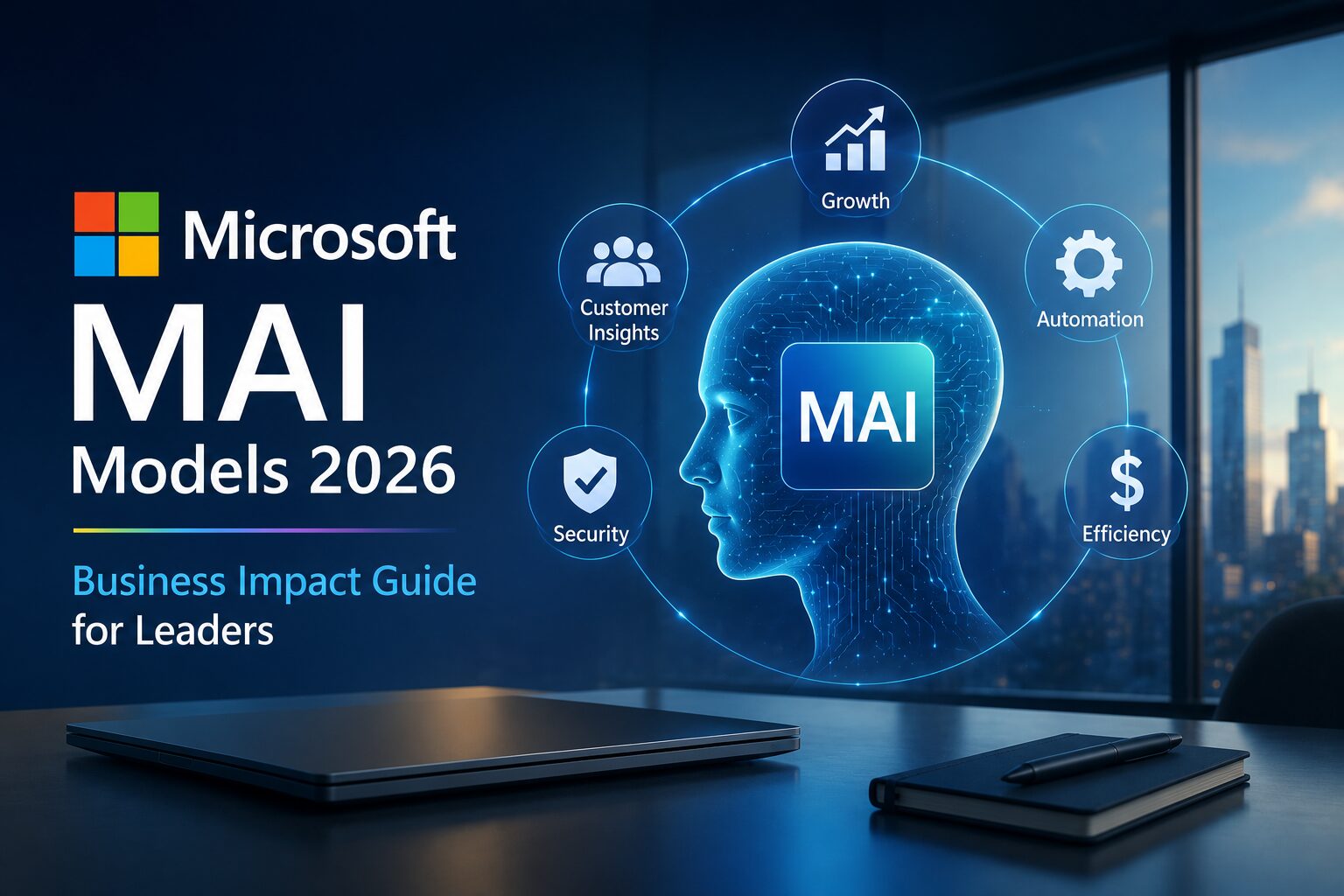
Microsoft’s new MAI models could cut your AI bill by 25–50%. See pricing, specs & access for MAI-Transcribe-1, MAI-Voice-1 & MAI-Image-2.
Disclaimer: This content is for educational and informational purposes only. Results vary based on implementation and business context.
Most business owners who want to use AI get stuck comparing expensive options from OpenAI and Google. The difference between a profitable AI deployment and an expensive experiment often comes down to which model you choose at what price. If you have been searching for a real, no-fluff answer on Microsoft MAI models 2026 — this is it.
These models represent Microsoft’s first complete family of in-house artificial intelligence models. On April 2, 2026, Microsoft AI announced three new proprietary models: MAI-Transcribe-1 for speech-to-text transcription, MAI-Voice-1 for voice generation, and MAI-Image-2 for image creation. These are not third-party integrations or resold OpenAI services. They are Microsoft-built, trained from the ground up, and designed to compete directly with OpenAI and Google on both quality and price.
The models are already powering Microsoft products like Copilot, Bing, and PowerPoint, and are now available to every business through Microsoft Foundry.
By the end of this guide, you will understand exactly what these models are, why Microsoft built them, how they compare to existing options, and what they mean for your business budget.
Here is what most people do not understand about Microsoft’s strategy. For years, Microsoft relied heavily on OpenAI for its AI capabilities. That relationship came with escalating costs. According to industry analysis, each 10 percent increase in OpenAI pricing costs Microsoft $50-100 million annually.
By 2026, Microsoft expects its new MAI models to capture 50-60 percent of Copilot inference workloads, retaining $2-3 billion in annual margin that currently flows to OpenAI.
Now here is the part most guides skip entirely — and it is the most important. The MAI initiative represents a fundamental strategic shift. Microsoft is moving from being primarily an infrastructure provider to becoming an integrated AI-native enterprise.
With Azure consuming $120 billion in annual capital expenditure and Microsoft 365 boasting 450 million active users, the company has both the infrastructure and distribution channels to make these models successful without external dependence.
Keep reading — the most practical section is coming up next, with detailed breakdowns of each model.
The first model in the MAI family is MAI-Transcribe-1, Microsoft’s dedicated speech-to-text transcription model. This is not an incremental update. It is a complete rethinking of what transcription should cost and how fast it should run.
MAI-Transcribe-1 converts spoken audio into text across the top 25 most-used languages, including Mandarin, Hindi, Spanish, Arabic, and Swahili. According to Microsoft testing, the model achieves a 3.8 percent word error rate on the industry-standard FLEURS benchmark, outperforming competing models like GPT-Transcribe (4.2 percent) and Gemini 3.1 Flash (4.9 percent).
The batch transcription speed of MAI-Transcribe-1 is 2.5 times faster than Microsoft’s existing Azure Fast offering. A task that previously took 25 minutes now finishes in 10. The model also operates at approximately 50 percent lower GPU costs than leading alternatives.
For any business that handles audio content, MAI-Transcribe-1 changes the economics of transcription. Meeting transcriptions that were once too expensive to process at scale become affordable. Video captioning for social media content becomes automated. Customer support call analysis that required manual review can now run continuously.
Contact centers, media companies, educational platforms, and market research firms are the primary beneficiaries.
| Feature | MAI-Transcribe-1 | OpenAI Whisper API |
|---|---|---|
| Cost per hour | $0.36 | ~$0.60 |
| Benchmark error rate | 3.8% | 4.2% |
| Speed vs. Azure Fast | 2.5x faster | N/A |
For a business transcribing 1,000 hours of content monthly, the difference is $240 per month — $2,880 annually — in favor of Microsoft’s offering.
The second pillar of the MAI family is MAI-Voice-1, a voice generation model that produces natural, expressive speech with emotional variation and speaker identity preservation across long audio passages.
MAI-Voice-1 generates realistic speech that captures emotional nuance, pacing, and personality. Unlike robotic alternatives, this model produces audio that actually sounds like a human speaking. Microsoft has also added custom voice creation directly in Foundry, allowing developers to create a unique synthetic voice from just a few seconds of audio sample.
The model can generate 60 seconds of high-quality audio in a single second on a single GPU. This speed makes real-time voice applications possible. Interactive voice agents no longer require awkward pauses while waiting for audio generation. Podcast production that used to take hours of recording time can be scripted and generated in minutes.
MAI-Voice-1 is already live in production. Copilot’s Audio Expressions feature uses this model, and it powers voice generation across Microsoft’s consumer products.
For businesses building voice agents, customer service chatbots with natural speech output, or audio content at scale, MAI-Voice-1 is immediately available as part of the MAI family.
| Feature | MAI-Voice-1 | OpenAI TTS API |
|---|---|---|
| Cost per 1M characters | $22 | ~$30 |
| Speed | 60 sec audio in 1 sec | Standard |
| Custom voice creation | Yes (in Foundry) | Limited |
The 25-30 percent cost reduction matters at volume.
The third pillar of the MAI family is MAI-Image-2, the second generation of Microsoft’s in-house image generation model, already ranking among the top three models on the Arena.ai leaderboard.
MAI-Image-2 generates text-to-image content optimized for professional creative work. Microsoft built the model specifically for photographers, designers, and visual storytellers who demand natural lighting, accurate skin tones and textures, and clear in-image text for diagrams, layouts, and graphics.
Users experience at least 2x faster generation times on Foundry and Copilot compared to earlier models, based on real-world production traffic data. A marketing team that previously waited 10 seconds per image now waits 5. For campaigns requiring hundreds of variations, this speed difference translates directly to faster time-to-market.
WPP, one of the world’s largest marketing and communications groups, is among the first enterprise partners building with MAI-Image-2 at scale.
“MAI-Image-2 is a genuine game-changer. It’s a platform that not only responds to the intricate nuance of creative direction, but deeply respects the sheer craft involved in generating real-world, campaign-ready images.”
— Rob Reilly, Global Chief Creative Officer, WPP
This endorsement from a major creative agency validates the MAI family for enterprise creative workflows.
| Feature | MAI-Image-2 (Standard) | MAI-Image-2-Efficient |
|---|---|---|
| Input cost (per 1M tokens) | $5 | $5 |
| Output cost (per 1M tokens) | $33 | $19.50 |
| Best for | High-quality creative work | Volume production |
The Efficient variant, released in April 2026, offers a 41 percent price reduction from the standard output pricing.
All MAI models are exclusively available through Microsoft Foundry (formerly Azure AI Studio). Foundry is Microsoft’s platform for developing AI agents and applications. It provides guardrails, governance features, and enterprise-grade controls for compliant deployment.
Every developer and business can build with these models through Microsoft Foundry. The models are also available via the MAI Playground in the US for direct experimentation. Microsoft has made these models accessible through Hugging Face for download, fine-tuning, and commercial use.
Foundry maintains integrations with multiple model providers, including OpenAI, Anthropic, and now Microsoft’s own MAI family. Developers can orchestrate mixed workflows combining different models for different tasks. A business could use MAI-Transcribe-1 for transcription, GPT-5.5 for complex reasoning, and MAI-Image-2 for creative generation — all within the same Foundry environment.
Let me summarize the pricing comparison for the MAI family versus competitors:
| Model | MAI Price | Competitor Price | Savings |
|---|---|---|---|
| MAI-Transcribe-1 | $0.36/hour | $0.60–$1.20/hour | 25-50% |
| MAI-Voice-1 | $22/1M chars | $30–$50/1M chars | 25-30% |
| MAI-Image-2 | $5 input / $19.50–$33 output | $40–$60/1M tokens | up to 50% |
For a business spending $5,000 per month on AI model API calls, switching to the MAI family could reduce that bill to $2,500–$3,000 per month while maintaining or improving quality.
That is not a marginal saving. That is a budget transformation.
These new models are not the only change coming from Microsoft this year. The company is also consolidating its AI agent development frameworks.
On April 3, 2026, Microsoft released Agent Framework 1.0, a unified open-source platform that brings together the best of Semantic Kernel (26,000+ GitHub stars) and AutoGen (50,400+ GitHub stars). Both previous frameworks have been moved to maintenance mode, with all new development happening in the unified Agent Framework.
For businesses building autonomous AI systems, this consolidation matters. Gartner projects that 40 percent of enterprise workflows will be managed by autonomous AI agents by the end of 2026.
Agent Framework 1.0 supports multiple model providers including Microsoft Foundry, Azure OpenAI, Anthropic Claude, Amazon Bedrock, and Google Gemini, all through a single API surface.
The combination of the MAI family for core AI capabilities and Agent Framework 1.0 for orchestration means businesses can now build production-grade AI systems entirely within the Microsoft ecosystem. The models are cheaper. The framework is stable. The infrastructure is ready.
Microsoft MAI models are Microsoft’s first complete family of in-house artificial intelligence models, announced on April 2, 2026. The family includes MAI-Transcribe-1 (speech-to-text transcription across 25 languages), MAI-Voice-1 (natural voice generation with custom voice creation), and MAI-Image-2 (fast, high-quality image generation). These models are built from the ground up by Microsoft, available exclusively through Microsoft Foundry, and are already powering products like Copilot, Bing, and PowerPoint.
Access Microsoft MAI models through Microsoft Foundry (formerly Azure AI Studio). Sign up for an Azure account, navigate to Foundry, and select the MAI model family. The models are also available via the MAI Playground in the US for testing. For developers, Microsoft has released model weights on Hugging Face supporting download, fine-tuning, and commercial use. Pricing starts at $0.36 per hour for MAI-Transcribe-1, $22 per 1 million characters for MAI-Voice-1, and $5 per 1 million tokens for MAI-Image-2 input.
These models generally offer comparable or superior quality at significantly lower prices. MAI-Transcribe-1 achieves a 3.8 percent error rate on the FLEURS benchmark, outperforming GPT-Transcribe (4.2 percent) and Gemini 3.1 Flash (4.9 percent). MAI-Image-2 ranks among the top three models on Arena.ai. Pricing is 25-50 percent lower than comparable OpenAI services. Microsoft is positioning its models not as premium alternatives but as price-performance leaders for production-scale deployments.
Contact centers and customer support operations benefit from MAI-Transcribe-1 for call transcription and analysis. Media and content companies benefit from MAI-Voice-1 for audio content production. Marketing agencies and creative shops benefit from MAI-Image-2 for campaign asset generation. Any business currently paying OpenAI or Google API rates for speech, voice, or image models should evaluate these models for potential cost savings of 25-50 percent.
For businesses with significant speech, voice, or image generation workloads, yes. The cost savings alone typically justify evaluation. A company spending $10,000 monthly on OpenAI’s transcription and image APIs could save $3,000–$5,000 monthly by switching to the MAI family. For businesses primarily using text-based LLMs (not multimodal), the equation is different — Microsoft’s MAI focus is currently on speech and vision, not general text. Evaluate based on your actual usage patterns.
You now have a complete understanding of Microsoft MAI models 2026 and what they mean for your business.
Three actions to take right now:
Keep building. The difference between businesses that benefit from these models and those that do not is not technical sophistication. It is awareness and action. You now have the awareness.
Now take the next step. Open Foundry. Test a model today. Your AI budget will thank you.
All figures are sourced from publicly available reports, benchmarks, and industry data from 2026.
Leave a comment below — which of the three Microsoft MAI models will you test first for your business?
P.S. — We publish one practical AI business guide every week at AICAP.in. Subscribe below — no spam, no fluff, just strategies that actually work for AI adoption in 2026 and beyond. Go test.

Salman Shaikh is the founder and editor-in-chief of AiCap.in, an independent AI and personal finance publication based in Ahmedabad, India.
Since launching AiCap.in in April 2026, Salman has personally tested and reviewed 100+ AI tools across income generation, crypto research, content creation, and personal finance — publishing 91+ hands-on guides based on real usage, not press releases.
His approach is simple: every tool he writes about is one he has opened, tested, and either used to earn money or rejected after finding it didn’t deliver. He started AiCap.in after realising most AI content in India was either written by people who had never touched the tools, or buried in technical jargon that everyday people couldn’t act on.
His work covers AI tools for passive income, freelancing with AI, crypto research workflows, Amazon FBA with AI, and personal finance strategies built for readers in India and accessible to anyone globally looking to earn smarter with AI.
AiCap.in now reaches a growing community of readers across India and globally who want practical, jargon-free AI strategies they can implement today.
Connect with Salman: LinkedIn · X @AiCap88 · YouTube · Medium