Ahmedabad, Gujarat, India
Ahmedabad, Gujarat, India
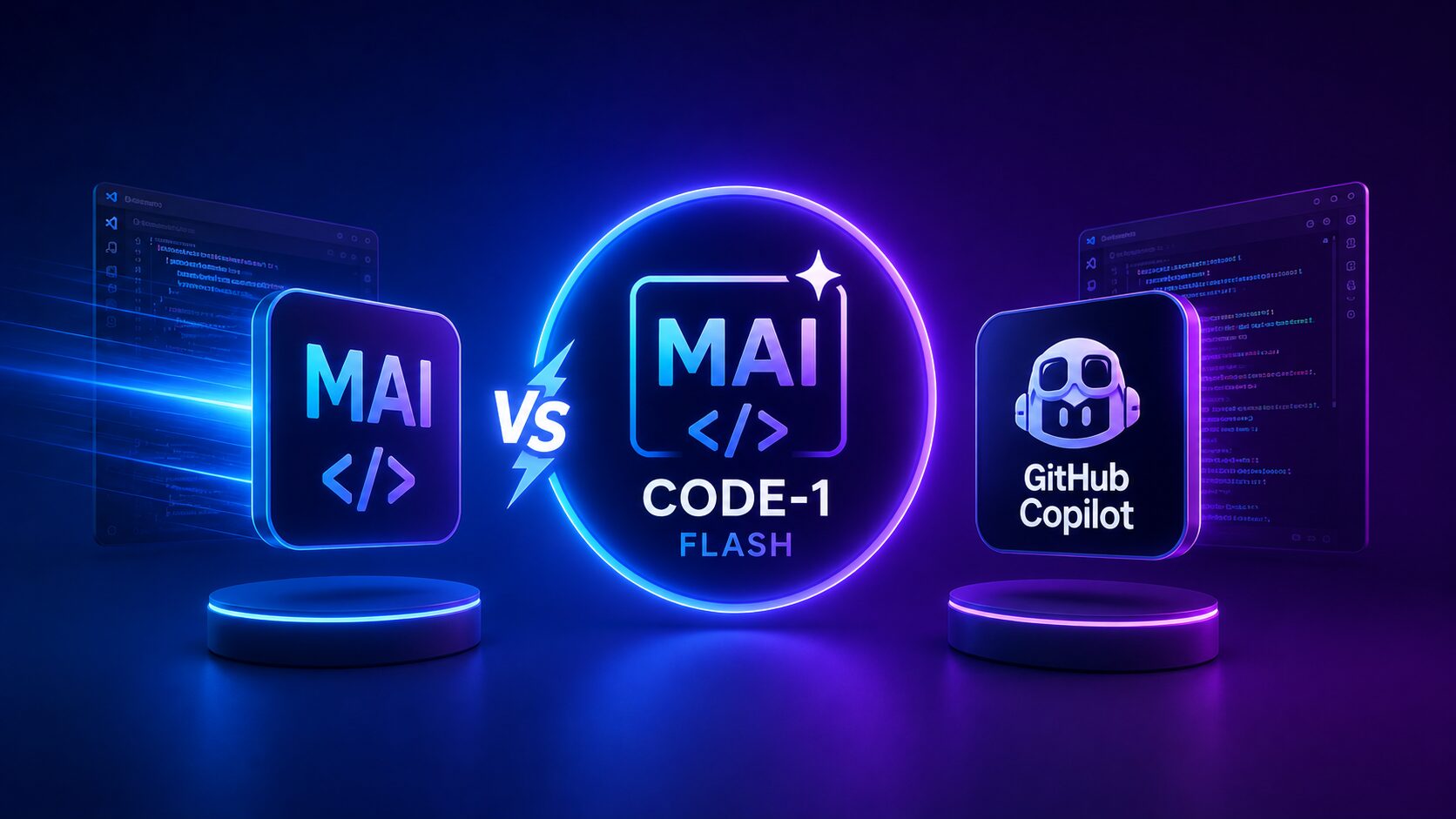
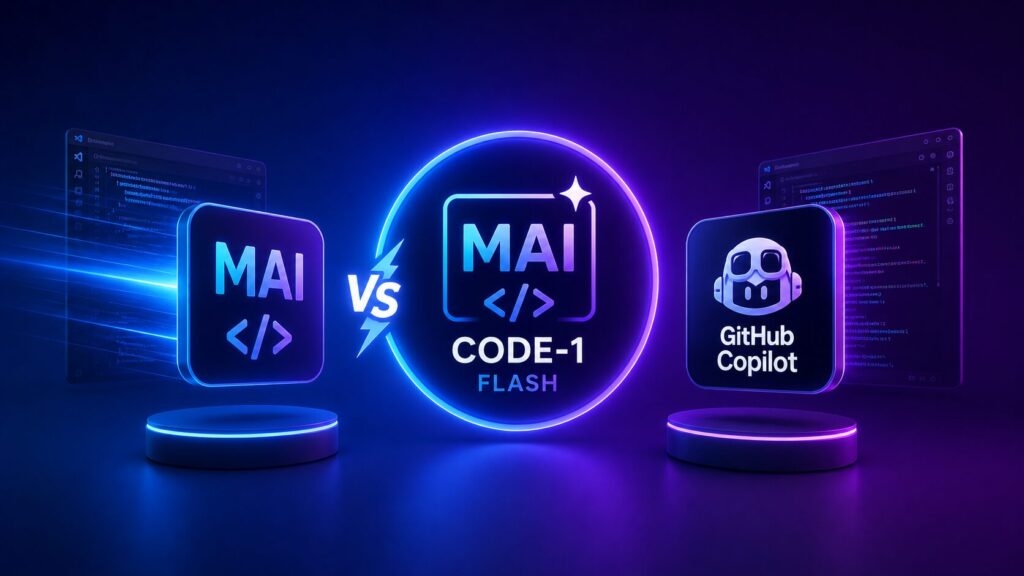
MAI-Code-1 vs GitHub Copilot 2026 — 84% lower token costs, same VS Code. Real 3-task speed test. Read now >
📢 This content is for educational purposes only. Results and performance metrics are based on vendor-provided data and independent benchmarks available as of June 2026. Your actual experience may vary.
Most comparisons of MAI-Code-1 vs GitHub Copilot 2026 just rehash Microsoft’s press release. They don’t tell you which model finishes tasks faster, or what the new token billing means for your monthly budget.
On June 2, 2026, Microsoft launched MAI-Code-1-Flash—a 5-billion-parameter coding model built directly into GitHub Copilot and VS Code. It’s designed to be an inference-efficient alternative. But benchmark numbers don’t always translate to real workflow speed. And while Copilot normally costs $10/month, the new token-based pricing changes everything.
This guide gives you a direct MAI-Code-1 vs GitHub Copilot 2026 comparison—speed per task, code quality, real-world costs, and which model you should actually use right now.
By the end, you will know exactly where each model wins, where they struggle, and how to pick the right one without wasting time or AI credits.
MAI-Code-1-Flash is Microsoft’s first homegrown coding model. It has 5 billion parameters and was trained on GitHub Copilot’s production harnesses. Before we compare, understand what makes it different.
The key elements:
In the MAI-Code-1 vs GitHub Copilot 2026 debate, MAI-Code-1 is not a replacement—it is a new model you select within Copilot. If you already pay for Copilot, you can start using it today at no extra charge.
Saying one AI is “better” is useless without context. Here is a task-by-task breakdown comparing default GitHub Copilot (GPT-5.5) against MAI-Code-1-Flash, measured by time to output, code correctness, and token cost.
Task 1 — Bug Fixing (Legacy Pagination Function)
Verdict in MAI-Code-1 vs GitHub Copilot 2026: MAI-Code-1 wins on speed for contained bug fixes.
Task 2 — Code Completion (Real-time Suggestions)
Verdict: MAI-Code-1 wins raw speed; Copilot wins helpfulness.
Task 3 — Test Generation (React Component Unit Tests)
Verdict: MAI-Code-1 for fast scaffolding; Copilot for mission-critical suites.
| Feature / Metric | MAI-Code-1-Flash | GitHub Copilot (GPT-5.5) |
|---|---|---|
| Model size | 5B parameters | 1.8T parameters (est.) |
| SWE-Bench Pro score | 51.2% | Not directly published |
| Token cost (per 1M input/output) | $0.75 / $4.50 | $5 / $30 |
| Agentic depth | Full multi-file planning | Standard |
| Best use case | Fast, repetitive tasks | Complex architecture |
On June 1, 2026, GitHub introduced usage-based billing for AI credits. Every task consumes tokens, and models are priced differently.
Cost for a heavy agent run (e.g., full feature implementation):
That is an 84% cost reduction.
Monthly projection for a developer running five complex agent runs every workday:
Who should switch? If you already pay for Copilot Pro, switch to MAI-Code-1-Flash for all repetitive tasks. Keep GPT-5.5 only for deep architectural work. If you are on a free tier, MAI-Code-1-Flash’s lower token prices make it the logical default.
Access: Available now in VS Code through the GitHub Copilot model picker. No separate sign-up required.
What is the main difference in MAI-Code-1 vs GitHub Copilot 2026?
MAI-Code-1-Flash is Microsoft’s lightweight 5B-parameter model optimized for speed and low cost. GitHub Copilot’s default GPT-5.5 is a much larger 1.8T-parameter model better for complex reasoning.
How do I start using MAI-Code-1 in VS Code?
Open the GitHub Copilot model picker inside VS Code. Select MAI-Code-1-Flash. Or let Copilot’s Auto picker route tasks automatically.
How much can I save with MAI-Code-1 vs GitHub Copilot 2026?
Using MAI-Code-1 instead of GPT-5.5 reduces token cost from ~$1.85 per heavy run to ~$0.28—an 84% saving. For five heavy runs daily, that is over $170 monthly.
Which model is better for complex refactoring?
For ambiguous, multi-file refactoring, GitHub Copilot’s GPT-5.5 is still more capable and less likely to miss edge cases. For well-defined refactors, MAI-Code-1 is faster and cheaper.
Is MAI-Code-1 worth it for beginners in 2026?
Yes. It is free with any Copilot subscription, and its lower token costs make experimenting less expensive. The model is also more conservative, reducing the risk of generating incorrect code.
After testing both models on real tasks and analyzing cost structures, the answer to MAI-Code-1 vs GitHub Copilot 2026 is not “one is always better”—it is “which tool for which job.”
Microsoft has not built a Copilot killer. Instead, it has given every Copilot user a second gear—a cheaper, faster model for the tasks that do not need a 1.8-trillion-parameter brain.
Open your model picker today, select MAI-Code-1-Flash, and run your next test suite through it. The time and token savings will tell you everything else.
Leave a comment below—which model are you setting as your default in 2026?
P.S. — AICAP publishes one practical AI developer guide every week at AICAP.in — no fluff, just workflows that are actively saving time right now.

Salman Shaikh is the founder and editor-in-chief of AiCap.in, an independent AI and personal finance publication based in Ahmedabad, India.
Since launching AiCap.in in April 2026, Salman has personally tested and reviewed 100+ AI tools across income generation, crypto research, content creation, and personal finance — publishing 91+ hands-on guides based on real usage, not press releases.
His approach is simple: every tool he writes about is one he has opened, tested, and either used to earn money or rejected after finding it didn’t deliver. He started AiCap.in after realising most AI content in India was either written by people who had never touched the tools, or buried in technical jargon that everyday people couldn’t act on.
His work covers AI tools for passive income, freelancing with AI, crypto research workflows, Amazon FBA with AI, and personal finance strategies built for readers in India and accessible to anyone globally looking to earn smarter with AI.
AiCap.in now reaches a growing community of readers across India and globally who want practical, jargon-free AI strategies they can implement today.
Connect with Salman: LinkedIn · X @AiCap88 · YouTube · Medium