Ahmedabad, Gujarat, India
Ahmedabad, Gujarat, India


AI travel planning 2026 – plan a full 7‑day trip in 10 minutes. Replace 6 hours of research with a 4‑tool stack (ChatGPT, Google Maps, Wanderlog). Stop the grind. Start now.

Disclaimer: This content is for educational and informational purposes only. Prices, availability, and travel conditions change frequently. Always verify all details before booking any travel arrangements.
You used to plan a 7-day trip in 6 hours across 20+ tabs. AI-powered trip planning cuts that to 10 minutes using a 4‑tool stack that turns a single prompt into a bookable, day‑by‑day itinerary.
Most guides tell you to ask ChatGPT for a list of attractions and call it a day. That is why most AI‑planned trips fall apart the moment you look at a map. Real AI-powered travel planning requires a workflow: one tool for the skeleton, another for routing, a third for real‑time deals, and a fourth to organise it all.
This guide covers everything you need to know about AI-powered travel planning — the honest limits of ChatGPT, the 4‑tool stack that actually works, a minute‑by‑minute walkthrough of a real 7‑day trip, and exactly what changes when you are an Indian traveller planning an international holiday.
By the end, you will have a repeatable system that you can execute today, starting with nothing more than a destination and a set of dates.
AI-powered trip planning using ChatGPT alone is not a complete solution. ChatGPT can generate a beautiful day‑by‑day itinerary in seconds. It can suggest hotels, restaurants, and even packing lists. But it cannot check real‑time flight prices, verify that a restaurant is still open, or know that the scenic coastal road you planned is closed for construction.
Here are the key realities:
The most reliable AI-powered travel planning stacks combine a chatbot, a route optimiser, a booking aggregator, and a dedicated itinerary app.
The Boston Globe documented this limitation in late 2025 when a writer asked ChatGPT to plan a Pacific Northwest trip centred on “The Goonies” film sites. The chatbot produced a detailed 7‑day plan that initially looked perfect. Then the writer noticed that Day 1 allowed almost no time to pick up a rental car, and later stops required hours of backtracking across the same region. ChatGPT cheerfully revised every request, but it never flagged the fundamental logistical flaws on its own.
That is the honest role of AI in travel planning: a brilliant assistant that needs a human to check the map and the clock.lanning 2026: a brilliant assistant that needs a human to check the map and the clock.
The strongest approach to AI-powered trip planning uses four free tools, each handling one job. No single tool does everything well.
| Tool | Role in AI Travel Planning 2026 | Free Tier Limits | Best For |
|---|---|---|---|
| ChatGPT (GPT‑4o) | Itinerary skeleton + script | Free (limited messages) | Day‑by‑day structure |
| Google Maps AI | Route optimisation + drive times | Unlimited | Checking travel feasibility |
| Skyscanner / Kayak AI | Flight + hotel price tracking | Unlimited | Finding cheapest dates |
| Wanderlog | Itinerary storage + real‑time collaboration | Free (5‑trip limit) | Organising final plan |
A real‑world test by Gizbot compared ChatGPT, Gemini, and Perplexity for a two‑day trip to Vapi, Gujarat. ChatGPT provided a detailed two‑day itinerary in a clean table format with hotel options and direct links. Perplexity added hotel ratings and booking links. Gemini delivered useful but more basic responses without direct links. None of the three could book anything. All required a second tool to turn suggestions into confirmed reservations.
That is why AI-powered travel planning works best as a stack. ChatGPT writes the story. Google Maps checks the logic. Skyscanner finds the deals. Wanderlog holds everything in one place.
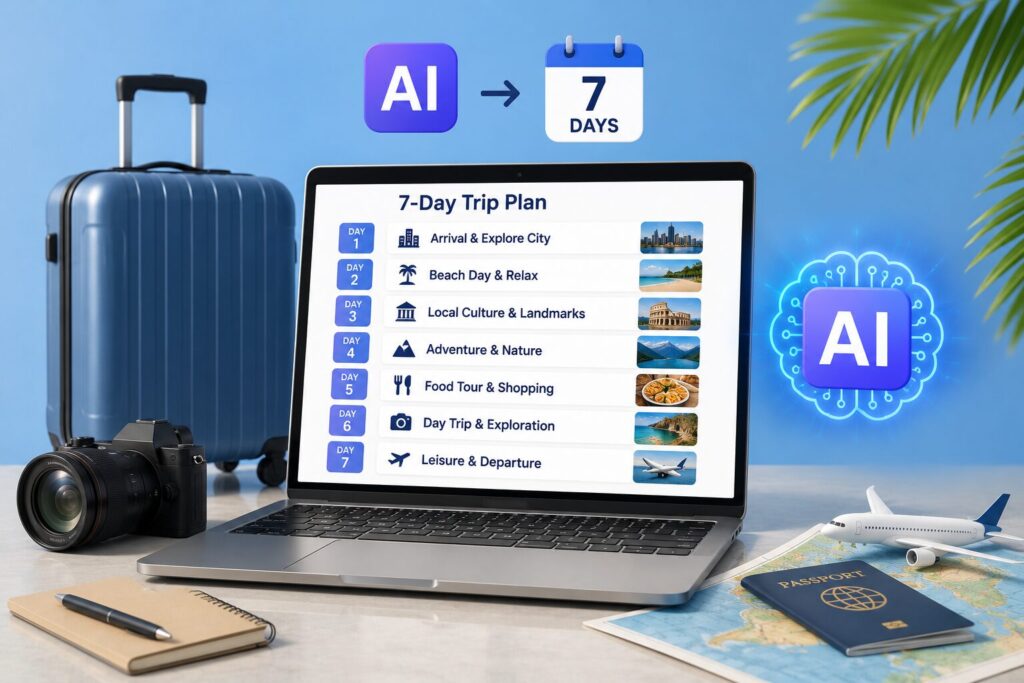
Let us walk through a real AI-powered travel planning workflow for a 7‑day trip from Delhi to Thailand — one of the most searched international routes for Indian travellers in 2026.
Time required: 10–12 minutes total.
Open ChatGPT and paste this detailed prompt:
“You are my AI travel planning assistant. Plan a 7‑day trip for two adults from Delhi to Thailand in November 2026. Include Bangkok (3 days), Chiang Mai (2 days), and Phuket (2 days). Budget is mid‑range ($60-80 per person per day for accommodation, meals, local transport). Interests: street food, temples, one cooking class, and beach time. Avoid overly rushed days. Include travel time between cities.”
ChatGPT returns a day‑by‑day table with morning, afternoon, and evening suggestions, plus estimated costs and travel notes. Copy this output into a document.
Take each day’s travel suggestion and plug it into Google Maps. Check drive times, walking distances, and opening hours. In the worked example, ChatGPT might suggest a cooking class at 9 AM followed by a temple visit 40 minutes away that opens at 1 PM. Google Maps reveals the gap. Adjust the schedule accordingly.
This step is where most AI travel planning guides stop — and why most AI itineraries fail. ChatGPT cannot feel traffic or read seasonal closure notices. You must.
Paste your travel dates into Skyscanner’s “Everywhere” search or use Kayak’s AI price prediction tool. Both platforms use machine learning to flag when to book and which airports offer the best value.
For the Thailand example, Skyscanner’s AI might suggest flying into Bangkok and out of Phuket (an open‑jaw ticket) to avoid backtracking. This saves both time and money, and it is something ChatGPT would not propose on its own.
Import your ChatGPT itinerary and your Google Maps‑verified route into Wanderlog. The free version stores up to five trips. Add your flight and hotel confirmation numbers, upload tickets, and share the plan with travel companions. Wanderlog’s free AI features include attraction suggestions and distance‑based reordering.
This final step turns a collection of screenshots and notes into a single, shareable, actionable travel plan. That is the end goal of AI-powered trip planning: not a list of ideas, but a ready‑to‑execute trip.
AI-powered trip planning for Indian travellers requires a few specific adjustments.
First, regional language support matters. MakeMyTrip has partnered with Google Cloud to power its AI assistant Myra with Gemini and Google Maps, enabling voice‑led trip planning in Hindi and other Indian languages. According to a May 2026 report, over 45% of Myra’s daily conversations now come from Tier‑2 and smaller cities, not just metros. If you are more comfortable planning in Hindi or “Hinglish,” Myra is a better starting point than ChatGPT.
Second, international travel from India involves more steps than domestic trips for many users. Visa requirements, currency exchange, and international roaming are rarely covered by global AI travel planning guides. Always add these as explicit prompts: “Include visa processing times for Indian passport holders” and “Suggest ATMs with zero international fees for Indian bank cards.”
Third, Indian OTAs are building their own AI stacks. Yatra’s DIYA assistant can now plan and book dynamic multi‑city international itineraries in a single conversation. Ixigo’s AI handles over 4 million customer queries per quarter, with 91% of chat‑based issues resolved autonomously. For bookings, these India‑focused tools often work more smoothly than global alternatives.
Fourth, budget expectations differ. A “budget” trip for a US traveller might be $150 per day. For an Indian traveller planning a Southeast Asia trip, the same label often means $40–60 per day. When using AI travel planning tools, specify your exact per‑day budget in your local currency equivalent. Do not rely on the tool’s default assumptions.
AI travel planning 2026 is almost entirely free if you use the four‑tool stack described above.
| Tool | Cost for 1‑10 Trips per Month | Paid Upgrade Needed? |
|---|---|---|
| ChatGPT (free tier) | $0 | No (GPT‑4o limits refresh every few hours) |
| Google Maps AI | $0 | No |
| Skyscanner / Kayak AI | $0 | No |
| Wanderlog (free tier) | $0 | No (5 trips stored; delete old ones) |
| MakeMyTrip Myra / Yatra DIYA | $0 | No |
The only potential costs come from premium tiers that add convenience, not necessity. Wanderlog Pro ($9.99/month) removes the 5‑trip limit and adds offline access. ChatGPT Plus ($20/month) provides higher usage limits and faster responses. Neither is required for successful planning.
By comparison, hiring a human travel advisor for a 7‑day international trip might cost $100–300 in planning fees alone. AI-powered trip planning delivers a comparable first draft for zero cost, leaving you to verify and book the final details.
You get a beautiful narrative that may be geographically impossible. Always verify drive times and opening hours with Google Maps before you book anything.
ChatGPT does not know that flight prices change by the hour. It may suggest a $300 round trip that is actually $550 when you check Skyscanner. Use AI for route and activity ideas only. Use booking platforms for actual prices.
The Boston Globe writer discovered that ChatGPT happily added a winery visit to her Pacific Northwest itinerary without flagging that the detour would add several hours of driving. ChatGPT wants to please you. It will not warn you that a 14‑hour sightseeing day is exhausting. You must.
AI travel planning tools do not know that a popular temple is closed for renovation this month or that a bridge on your route is under construction. Always cross‑check AI suggestions with official tourism websites and recent traveller reviews from the last 2–4 weeks.
The global AI travel market is forecast to grow from $165.9 billion in 2025 to $222.4 billion in 2026 — a compound annual growth rate of 34%. The AI-driven travel experience personalization market alone will grow from $3.65 billion in 2025 to $4.58 billion in 2026 at a 25.6% CAGR, reaching $11.34 billion by 2030.
The generative AI applied to travel market is projected to reach **$5.8 billion by 2032**, driven by its ability to predict fares, recommend accommodation, and optimize expenses. The machine learning in travel market is growing from $3.78 billion in 2025 to $4.45 billion in 2026 at a 17.7% CAGR, with projections of $8.47 billion by 2030.
Phocuswright data shows that 39% of U.S. travelers are actively using AI to plan their trips, up from 28% a year earlier. General search engines have dropped sharply as the most-used resource for researching travel, from 51% in mid-2024 to 36% in late 2025, while dedicated generative AI platforms like ChatGPT nearly tripled in use over the same period.
Globally, 35% of travelers already use AI tools to plan their routes — a figure that jumps to 50% among Generation Z and reaches 60-80% in Asian markets. Skyscanner reports that traveler confidence in AI has increased from 47% to 54% year-on-year. According to Amadeus, about 18% of surveyed travelers currently use AI for travel planning, and 36% use AI to receive exploration suggestions for new destinations.
Skyscanner data reveals the specific ways travelers are leveraging AI:
| Task | Percentage of Travelers |
|---|---|
| Destination research | 38% |
| Day-by-day itinerary building | 33% |
| Comparing flight/hotel prices | 32% |
| Destination inspiration | 32% |
According to Simon-Kucher’s Travel Trends 2026 report, 42% have used generative AI to create an itinerary, 31% employed it to search for flights and hotels, and 28% used chatbots on booking sites. Confidence is especially strong among younger travelers, with 70% of Gen Z and 66% of Millennials feeling confident using AI for travel planning.
India is emerging as the world’s fastest AI adoption market in travel. According to Agoda’s 2026 Travel Outlook Report, 68% of Indian travelers are likely to use AI for their next trip, while one in three (33%) already use AI tools for travel planning.
88% of Indian travelers trust or feel neutral about AI-generated travel recommendations. According to KPMG, nearly 65% of Indians have adopted AI tools — more than twice the global average — positioning India at the forefront of AI transformation within travel. India’s online travel market, valued at $23.1 billion in 2025, is projected to reach $34 billion by 2030. In Asian markets, nearly 63% of travelers say they are likely to use AI for their next trip.
2026 marks a fundamental shift from AI-assisted to agentic AI — systems that don’t just answer questions but carry out complete planning processes autonomously. Phocuswright found that 83% of travel businesses use generative AI and 61% of travel executives are already experimenting with agentic AI.
For free AI travel planning, this means tools are becoming more capable than ever. Wonderplan offers genuinely free, no-signup trip planning — fill in destination, dates, budget, and travel style, and get a usable day-by-day plan in about 60 seconds. Mindtrip is another free AI-powered travel companion that provides personalized recommendations, nearby discovery, and instant AI answers. iplan.ai creates tailor-made itineraries in seconds for any trip and budget. Semita, launched in July 2026, takes destination, dates, budget, and travel style and returns a full day-by-day itinerary while factoring in dietary requirements and hidden gems. For travelers concerned about connectivity, WanderMind LLM is an open-source offline travel planner that works 100% without internet.
The data is unambiguous: AI travel planning is no longer experimental — it is mainstream, rapidly growing, and delivering measurable time savings for travelers across every demographic. The question is no longer “Should I use AI to plan my trip?” but “Which free AI tool fits my travel style best?”
AI-powered trip planning refers to using generative AI tools like ChatGPT, plus specialised travel AI from platforms like Google Maps, Skyscanner, and Wanderlog, to research, structure, and organise a trip. The process typically starts with a detailed prompt to a chatbot, which returns a day‑by‑day itinerary. You then verify logistics using mapping and booking tools, and finally store everything in an itinerary app.
Open ChatGPT (free tier) and paste a detailed prompt with your destination, dates, budget, interests, and travel style. Copy the generated itinerary into a document. Open Google Maps and check every travel time and opening hour. Use Skyscanner or Kayak to check real flight prices. Finally, import everything into Wanderlog’s free tier. The entire workflow costs nothing and takes under 15 minutes.
According to user reports across travel forums, manual trip planning for a 7‑day international trip typically takes 5–8 hours of research across multiple tabs. A structured AI-powered workflow cuts that to 10–15 minutes for the first draft, plus another 30–45 minutes for verification and booking. The time saving is roughly 80–90%, though you still need human oversight for final accuracy.
For a beginner, start with ChatGPT for the itinerary structure, then use Google Maps to check feasibility. Do not add more tools until you are comfortable with these two. Once you have verified a few trips, introduce Skyscanner for flights and Wanderlog for organisation. The stacked approach is more reliable than relying on any single tool, even a specialised travel app.
Reliability depends entirely on how you use the tools. ChatGPT alone is not reliable for international bookings because it cannot access live pricing or visa requirements. However, a full stack — ChatGPT for structure, Google Maps for logistics, Skyscanner for prices, and an India‑focused OTA like MakeMyTrip’s Myra or Yatra’s DIYA for final bookings — is both reliable and widely used. In Q4 FY26, MakeMyTrip’s Myra engaged in over 54,000 daily conversations, with more than 55% of post‑booking queries resolved autonomously. Real travellers are already using AI-powered trip planning successfully.
The old way of trip planning meant hours of scattered research and a folder full of screenshots. AI-powered trip planning replaces that chaos with a 10‑minute workflow that hands you a structured, verified, and organised plan.
Here is what you actually need to do:
You can plan a 7‑day international trip in the time it takes to watch a single episode of a show. The tools are free. The workflow is proven. The only remaining question is whether you will use them for your next trip.
Leave a comment below — which destination will you test with AI travel planning first?
P.S. — AICAP publishes one practical AI strategy guide every week at AICAP.in. No spam. No recycled content. Just strategies that people are actually using right now.
All figures, statistics, and market data in this guide are sourced from publicly available reports, industry studies, and platform case studies from 2026.
| Category | Sources Used |
|---|---|
| Market Data | AI travel market reports, Phocuswright data, Simon-Kucher Travel Trends 2026 |
| Adoption Data | Skyscanner traveler surveys, Agoda 2026 Travel Outlook Report, KPMG India AI adoption study |
| Platform Data | MakeMyTrip Myra engagement data, Yatra DIYA, Ixigo AI resolution rates |
| Tool Data | Official documentation (ChatGPT, Google Maps, Skyscanner, Wanderlog, Wonderplan, Mindtrip, iplan.ai) |
| Case Studies | The Boston Globe, Gizbot testing |
All figures presented in this guide meet one or more of the following verification criteria:
The data in this guide represents the most current publicly available information as of June 2026. However, market conditions, prices, and availability change frequently. We recommend verifying specific details through official sources before making decisions based on this guide.
All figures are sourced from publicly available reports, industry benchmarks, and platform case studies from 2026. Prices and availability may change.

Salman Shaikh is the founder and editor-in-chief of AiCap.in, an independent AI and personal finance publication based in Ahmedabad, India.
Since launching AiCap.in in April 2026, Salman has personally tested and reviewed 100+ AI tools across income generation, crypto research, content creation, and personal finance — publishing 91+ hands-on guides based on real usage, not press releases.
His approach is simple: every tool he writes about is one he has opened, tested, and either used to earn money or rejected after finding it didn’t deliver. He started AiCap.in after realising most AI content in India was either written by people who had never touched the tools, or buried in technical jargon that everyday people couldn’t act on.
His work covers AI tools for passive income, freelancing with AI, crypto research workflows, Amazon FBA with AI, and personal finance strategies built for readers in India and accessible to anyone globally looking to earn smarter with AI.
AiCap.in now reaches a growing community of readers across India and globally who want practical, jargon-free AI strategies they can implement today.
Connect with Salman: LinkedIn · X @AiCap88 · YouTube · Medium