Ahmedabad, Gujarat, India
Ahmedabad, Gujarat, India

File your ITR without a CA and maximize your refund. Use AI tools like Kar Saathi, ClearTax & Quicko. File in under 10 minutes. Start now.
Disclaimer: This content is for educational and informational purposes only. Tax laws are subject to change and interpretation. Please consult a qualified tax professional for advice specific to your financial situation.
Most taxpayers dread the annual ritual of sorting through Form 16, collecting investment proofs, and decoding complicated tax rules. If you have been searching for a real, no-fluff answer on how artificial intelligence simplifies this entire process — this is the guide you need.
The timing is critical. April 1, 2026, marked the implementation of the new Income Tax Act, 2025, replacing the decades-old 1961 Act. At the same time, Budget 2026 introduced changes to ITR deadlines, capital gains rates, and penalty structures. Navigating these changes without guidance is risky, but with AI-powered tools, you can file your return in under 10 minutes from your phone — without a CA.
This guide breaks down exactly how AI-powered tax filing works, from the government’s new Kar Saathi chatbot to the best third-party platforms, and shows you step-by-step how to maximise your refund. By the end, you will have a clear, actionable framework — ready to apply today.
Here is the core idea: you use artificial intelligence to prepare, review, and submit your Income Tax Return with minimal manual effort.
AI ITR filing refers to the use of artificial intelligence tools and platforms to prepare, review, and submit your Income Tax Return. This includes the government’s official AI chatbot Kar Saathi, third-party platforms like ClearTax, Quicko, and TaxBuddy that use AI to auto-fill data and flag errors, and AI-powered features that help you choose the right tax regime, claim all eligible deductions, and maximise your refund. Instead of spending hours deciphering tax jargon or paying a CA for basic returns, you can now file your ITR in under 10 minutes from your phone.
The difference between manual filing and AI-powered filing is the difference between hours of confusion and a guided, step-by-step process that takes minutes.
Here is what most taxpayers do not understand about filing returns in 2026. The government has introduced a brand-new Income Tax Act, 2025, which came into effect on April 1, 2026. At the same time, the Budget 2026 has introduced changes to ITR deadlines, capital gains rates, and penalty structures. Navigating these changes without guidance is risky.
Now here is the part most guides skip entirely — and it is the most important. AI-powered tax filing is not just about automation. It is about accuracy and maximising your refund. AI tools can instantly compare the old and new tax regimes based on your specific income and deductions, automatically import data from Form 26AS and AIS, identify mismatches before they trigger a notice, and suggest deductions you might have missed. According to industry data, taxpayers using AI-assisted platforms are significantly less likely to receive demand notices, and many report higher refunds simply because the AI flagged overlooked deductions.
The new Income Tax Act, 2025, has also simplified compliance: the number of rules has been reduced from 510 to 333, and forms have been cut from 399 to 190 — nearly a 52% reduction. However, even with fewer forms, the complexity of choosing between regimes and calculating capital gains remains. That is where AI-powered tax filing becomes invaluable. It acts as your virtual tax assistant, available 24/7, helping you file correctly, on time, and with maximum refund.
Keep reading — the most practical tools and your exact step-by-step workflow are coming up next.
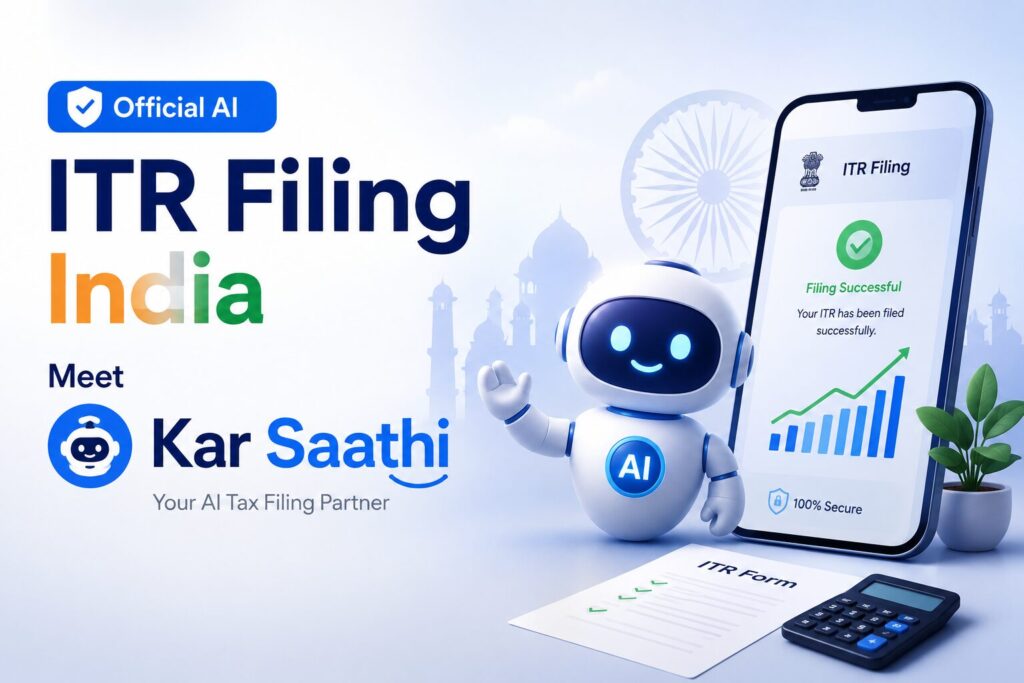
The Indian government has launched its own AI-powered assistant to help taxpayers file returns without hassle. Kar Saathi (meaning “Tax Companion”) is an AI chatbot integrated directly into the Income Tax Department’s revamped e-filing portal.
Kar Saathi is more than just a general-purpose AI chatbot like ChatGPT. It is an intelligent 24×7 virtual assistant designed specifically for tax-related queries. You can ask it questions such as:
The chatbot uses advanced natural language processing to deliver accurate, context-aware responses in both Hindi and English, making it especially helpful for first-time filers and salaried individuals. It can also assist with e-verification, refund tracking, notice responses, and explaining provisions under the new Income Tax Act, 2025 in simple terms.
Kar Saathi is embedded within the official e-filing portal of the Income Tax Department (incometax.gov.in). You will find it as a chat widget on the homepage or relevant sections. Basic queries can be asked without logging in, but for account-specific issues — such as refund status or notices — the system may require authentication through your PAN-linked account. Always ensure you are accessing the official government domain, as phishing risks typically rise during the filing season.
Despite its convenience, taxpayers should treat AI-generated responses as guidance rather than final advice. Kar Saathi will not compile your taxes for you — it is there to answer queries and resolve doubts. Complex cases such as capital gains, business income, or cross-border taxation may still require professional consultation. Critical decisions should be cross-checked with official notifications, forms, or professional advice.
The broader objective of Kar Saathi is to reduce dependency on physical offices and middlemen while improving the overall taxpaying experience. It is a significant step towards digital transformation and easier voluntary tax compliance.ards digital transformation and easier voluntary tax compliance.

While Kar Saathi answers your questions, third-party platforms actually prepare and file your return. These platforms combine AI automation with user-friendly interfaces, making AI-powered tax filing accessible to everyone.
ClearTax is India’s most trusted ITR filing platform for salaried individuals. Its AI Assistant greets you as soon as you start filing and helps resolve doubts instantly. You can ask the AI Assistant questions about which ITR to file, HRA, capital gains, home loan deductions, Section 80C, medical insurance, and even crypto income.
Key AI features:
With features like Form-16 auto-upload and smart tax-saving suggestions, you can file your ITR in under 3 minutes — no paperwork, no confusion.
Quicko is purpose-built for traders and investors. It allows you to auto-import equity, intraday, and F&O transactions directly into the platform to calculate and file capital gains tax in minutes. Quicko has already enabled preparation of ITR for Assessment Year 2026-27, with submission expected to go live shortly. It also offers a virtual meeting feature called MEET, where users can speak to tax experts for personalised guidance. For investors with complex capital gains, Quicko is an excellent choice.
TaxBuddy offers expert-assisted ITR filing along with 24/7 post-filing support and free resolution of income tax notices for returns filed through the platform. Its USP is a combination of AI-driven automation and access to tax professionals, making it well-suited for freelancers, small business owners, and anyone who would rather not go it alone. Plans start from ₹999 per year for salary with one house property.
EZTax has introduced new AI-enabled capabilities focused on simplifying reconciliation of AIS, broker statements, and pre-filled tax data for self-filing taxpayers. The platform offers AIS Upload for Capital Gains, AIS Reconciliation, and automated Income Tax Rule Alerts to identify mismatches before submission. Self-service plans start at ₹249 plus taxes, while expert-assisted plans start at ₹999 plus taxes.
myITreturn is consistently cited as beginner-friendly for its step-by-step approach. It auto-reviews every return for accuracy before submission and prompts users for OTP authentication to auto-submit, with acknowledgements typically arriving within 10 minutes from the Income Tax Department.
Here is your exact step-by-step framework for AI-powered tax filing. This workflow is designed for salaried individuals with income from salary, house property, and investments.
Before starting, keep these documents ready:
For salaried individuals with simple returns, start with ClearTax (free DIY). For traders and investors, use Quicko. For those who want expert backup, choose TaxBuddy or EZTax.
Log in to your chosen platform. Upload your Form 16. The AI will auto-fill most of your personal information, salary details, and TDS data. For investors, platforms like Quicko allow you to auto-import equity and mutual fund transactions directly.
This is where AI-powered tax filing truly shines. The platform will automatically compute your tax liability under both the old and new regimes based on your income and deductions. Here is a quick comparison:
New Tax Regime (Default) — FY 2026-27:
| Income Slab | Tax Rate |
|---|---|
| Up to ₹4,00,000 | 0% |
| ₹4,00,001 to ₹8,00,000 | 5% |
| ₹8,00,001 to ₹12,00,000 | 10% |
| ₹12,00,001 to ₹16,00,000 | 15% |
| ₹16,00,001 to ₹20,00,000 | 20% |
| ₹20,00,001 to ₹24,00,000 | 25% |
| Above ₹24,00,000 | 30% |
Section 87A rebate ensures zero tax up to ₹12 lakh taxable income under the new regime. The new regime also offers a higher standard deduction of ₹75,000 (compared to ₹50,000 in the old regime).
Old Tax Regime (Optional) — FY 2026-27:
| Income Slab | Tax Rate |
|---|---|
| Up to ₹2,50,000 | 0% |
| ₹2,50,001 to ₹5,00,000 | 5% |
| ₹5,00,001 to ₹10,00,000 | 20% |
| Above ₹10,00,000 | 30% |
The old regime allows multiple deductions: Section 80C (up to ₹1.5 lakh), Section 80D (health insurance), home loan interest (up to ₹2 lakh for self-occupied property), HRA, LTA, and donations under Section 80G.
Which regime to choose? The new regime is beneficial for individuals with minimal deductions, while the old regime works better if your total deductions are substantial — often exceeding ₹5-7 lakh depending on your income. Let the AI calculate both and pick the lower tax liability.
Enter all your investment and expense details. The AI will prompt you for common deductions you might have missed: Section 80C (PPF, ELSS, LIC, tuition fees), Section 80D (medical insurance premiums), home loan interest, and rent paid (HRA). For salaried individuals, remember that the standard deduction of ₹75,000 under the new regime (or ₹50,000 under the old regime) is automatically applied.
This is the most critical step that most taxpayers skip. Log in to the Income Tax portal (incometax.gov.in) and download your AIS. Review every entry. The AIS now captures a much wider range of transactions — mutual fund purchases, high-value cash deposits, property registrations, and foreign remittances. If anything is wrong, submit feedback correction inside AIS before filing. Keep a record of what you disputed and why. Mismatches between your ITR and AIS are the number one trigger for automated notices.
Before submitting, let the AI do a final check. The platform will alert you to any missing information, mismatched data, or potential errors. Once satisfied, e-verify your return using Aadhaar OTP, net banking, or DigiLocker. E-verification is mandatory; without it, your return is not considered filed.
After filing, you can track your refund status through the Income Tax portal or your chosen AI platform. Refunds are typically processed within 2-4 weeks after e-verification. For faster refund processing, ensure your bank account is pre-validated on the Income Tax portal.
Getting a refund means you have paid more tax than your actual liability. AI-powered tax filing helps you identify every opportunity to reduce your tax liability and increase your refund.
Many taxpayers blindly stick to the old regime because they have always used it. In 2026, the new regime offers significantly lower rates and a higher rebate. Let the AI compute your tax liability under both regimes. For incomes up to ₹12 lakh, the new regime offers zero tax — an effective saving of up to ₹60,000 compared to the old regime. For higher incomes, run the numbers carefully. The deduction threshold for the old regime to be more beneficial varies by income level. Use the AI-powered regime calculator available on most platforms.
As noted above, under the new tax regime, if your taxable income does not exceed ₹12 lakh, you are eligible for a rebate of up to ₹60,000, making your tax liability zero. For salaried individuals, with the ₹75,000 standard deduction, you can earn up to ₹12.75 lakh and still pay zero tax. This is one of the most overlooked benefits by taxpayers filing on their own.
Section 80C allows deductions up to ₹1.5 lakh. Common eligible investments include PPF, ELSS mutual funds, LIC premiums, tuition fees, and home loan principal repayment. Ensure you have proofs for all claims. The AI platform will prompt you to enter each category.
Medical insurance premiums paid for yourself, spouse, children, and parents are deductible under Section 80D. Up to ₹25,000 for self and family (₹50,000 for senior citizens) and an additional ₹25,000-₹50,000 for parents. Many taxpayers forget to claim this.
Underreporting income is a serious offence. Budget 2026 tightened the penalty structure: genuine underreporting (honest mistake) attracts a penalty of 50% of the tax on undisclosed income, while deliberate misreporting can lead to up to 200% of the tax. With expanded AIS data, the department can easily detect mismatches. Always declare income from all sources — savings account interest, fixed deposit interest, capital gains, rental income, and freelance income.
If your employer deducted excess TDS, you can claim a refund by filing your ITR. AI platforms automatically compute refundable TDS by comparing your total tax liability with total TDS deducted as per Form 26AS. Do not let the government hold onto your money interest-free — file early to get your refund sooner.
Before filing, ensure your bank account is pre-validated on the Income Tax portal. Refunds are directly credited to your primary bank account. Incorrect bank details are a common reason for refund delays.
Even with AI-powered tax filing, mistakes happen. Here are the most common errors taxpayers make during Assessment Year 2026-27.
This is one of the most confusing filing seasons in years. Assessment Year (AY) 2026-27 covers income earned in Financial Year 2025-26 (April 1, 2025, to March 31, 2026) and is governed by the old Income Tax Act, 1961. If you are filing in July 2026 for income earned up to March 31, 2026 — you are filing AY 2026-27 under the old act. Tax Year 2026-27 is income earned in FY 2026-27 under the new act, with returns due in 2027. Do not confuse the two.
Budget 2024 changed equity STCG and LTCG rates from July 23, 2024, onwards. The old rates no longer exist in ITR-2 for AY 2026-27 — those fields have been removed. The only applicable rates now are STCG at 20% and LTCG at 12.5% (above ₹1.25 lakh). The date-split reporting (before/after July 23, 2024) is also removed. AI platforms automatically apply the correct rates.
Mismatches between your ITR and the AIS are the number one trigger for automated notices. Log in at incometax.gov.in → AIS tab. Review every entry before filing. If something is wrong, submit feedback correction inside AIS itself before filing. Keep a record of what you disputed and why.
Budget 2026 extended the deadline for non-audit business and professional taxpayers filing ITR-3 and ITR-4 from July 31 to August 31, 2026. However, this extension does not cover ITR-1 and ITR-2 filers, who still have the July 31 deadline. Know your category.
With expanded AIS data, the department can detect underreported income automatically. The penalty for genuine underreporting is 50% of tax on undisclosed income. Deliberate misreporting can attract up to 200% of the tax. Always declare all income.
Filing without e-verification is incomplete. Your return is considered invalid until e-verified. Use Aadhaar OTP for the fastest verification.
Knowing the deadlines is crucial for AI-powered tax filing. File late and you will face penalties and lose your refund.
| Category | Due Date (AY 2026-27) | Applicable ITR Forms |
|---|---|---|
| Individuals (No Audit) | July 31, 2026 | ITR-1 & ITR-2 |
| Non-Audit Business / Professionals | August 31, 2026 | ITR-3 & ITR-4 (New) |
| Audit Cases & Companies | October 31, 2026 | All Applicable Forms |
Budget 2026 has revised income tax return filing dates for certain taxpayers. The time limit to file a revised return is extended from 9 months to 12 months from the end of the relevant year. However, if the revised return is filed after 9 months, a fee of ₹1,000 (for income up to ₹5 lakh) or ₹5,000 (for other cases) will be payable. The deadline for belated and revised returns has been extended from December 31 to March 31 of the assessment year, but the late fee is not waived.
Do not wait until the last week. File early to avoid the rush and to receive your refund sooner.
The shift toward AI-powered tax filing in India is not a trend—it is a structural transformation backed by real data and government mandate. Understanding these numbers changes how you evaluate AI tax tools and the opportunity they represent.
Consider the sheer magnitude of India’s tax system in 2026. The Income Tax Department processes over 75 million income tax returns annually. The GST Network handles more than 1.4 billion invoices every month across 14 million registered businesses. TDS statements covering approximately 120 million deductees are filed each quarter. The sheer volume makes manual processing not just inefficient but practically impossible.
The filing numbers tell a compelling story. For Assessment Year 2025-26, total ITRs filed reached 9.4 crore — a new record. 7.8 crore (83%) were filed before the due date. Perhaps most telling: 62% of taxpayers used third-party platforms like ClearTax, Quicko, or CA software, while only 38% filed directly on the ITD portal. The market has clearly voted for AI-powered assistance.
The numbers at India’s top firms are staggering. At Deloitte India, up to half of its 5,000-member tax team uses proprietary AI platforms in daily work. At EY India, more than 75% of its 6,500 tax professionals regularly use AI tools. At PwC India, around 1,500 employees generate more than 10,000 AI queries daily. PwC has already crossed over 1.3 million queries on its AI system this year, with query volumes growing nearly 30% every 45 days.
As Sunil Badala, Head of Tax at KPMG India, puts it: “AI is no longer a differentiator in tax; it is fast becoming the baseline.” Firms that fail to embed AI deeply into their workflows risk falling behind.
The productivity improvements are measurable. AI tools have made GST matching nearly flawless at 98% accuracy (up from 80% before), GST returns now take just three days instead of 18, and automated tools have cut down demand notices by up to 60%.
ClearTax has helped 30 million users file taxes through its platform, assisted 400,000 gig workers through AI, and helped them receive a total of ₹50 crores in tax refunds. The average time to file ITR-1 (salaried, simple) on ClearTax is now just 18 minutes with Form 16 auto-import. For ITR-2 (salaried with capital gains), it takes 42 minutes.
The government is driving this transformation. The new Income Tax Act, effective April 2026, creates a rule-based, AI-enabled tax ecosystem aimed at reducing disputes, improving certainty, and enhancing compliance. CBDT Chief Ravi Agrawal confirmed that AI will support enforcement and taxpayer services.
Early results are already visible. Targeted AI-based nudges led to 1.11 crore taxpayers filing updated returns, with a revenue impact of over ₹8,800 crore. Disclosures included foreign assets worth about ₹99,000 crore and foreign income of about ₹6,500 crore. The department plans to scale AI-based risk assessment, strengthen digital forensics, and expand AI support for taxpayer services.
The Annual Information Statement (AIS) now covers 18+ financial data types. Pre-filled data accuracy has reached 94% (up from 78% in 2022). For Assessment Year 2025-26, 42 lakh notices were issued for AIS-ITR mismatches — 78% of these were for unreported bank interest or dividend income, both clearly visible in AIS. Reviewing your AIS before filing is no longer optional—it is essential.
AI ITR filing refers to using artificial intelligence tools to prepare, review, and submit your Income Tax Return. This includes the government’s Kar Saathi AI chatbot for guidance, and third-party platforms like ClearTax, Quicko, and TaxBuddy that use AI to auto-fill data, choose the right tax regime, claim deductions, and maximise refunds. With these tools, salaried individuals can file their ITR in under 10 minutes without a CA.
Start by gathering your documents — PAN, Aadhaar, Form 16, bank details, AIS, and investment proofs. Choose a platform: ClearTax (free for salaried individuals), Quicko (best for traders and investors), or TaxBuddy (best for expert backup). Log in, upload your Form 16, and let the AI auto-fill your data. The AI will compute your tax under both regimes and suggest which one saves you more tax. Enter all deductions, review, and submit. E-verify using Aadhaar OTP. You can complete the entire process in one sitting.
The potential savings depend on your income and deductions. Under the new tax regime, if your taxable income does not exceed ₹12 lakh, you are eligible for a rebate under Section 87A of up to ₹60,000, making your tax liability zero. For salaried individuals, with the ₹75,000 standard deduction, you can earn up to ₹12.75 lakh and pay zero tax. AI also helps you claim all eligible Section 80C, 80D, and home loan deductions that you might otherwise miss.
For salaried individuals with simple returns, ClearTax’s free DIY filing is the best choice. For traders and investors with capital gains, Quicko is purpose-built and offers auto-import of transactions. For freelancers, small business owners, or those who want expert backup, TaxBuddy offers AI-driven automation plus access to tax professionals. EZTax is excellent for AIS reconciliation. Use the official Kar Saathi chatbot on the Income Tax portal for quick answers to procedural questions.
Absolutely. AI-powered tax filing removes the biggest barriers to filing your own return — confusion over forms, lack of clarity on deductions, and fear of making mistakes. AI platforms guide you step-by-step, auto-fill most data, compute your tax under both regimes, and alert you to errors before submission. For salaried individuals with income from salary and investments, you can confidently file without a CA. For complex cases like business income or cross-border taxation, AI can still assist, but you may want expert review.
Here are the three most actionable takeaways from this guide:
AI-powered tax filing is not a futuristic concept — it is here, and it is accessible to every taxpayer. The government has provided Kar Saathi for guidance, and multiple private platforms offer AI-powered filing for free or at low cost. The difference between taxpayers who file confidently and those who struggle is simple: the confident ones use the tools available to them. They choose the right platform, reconcile their AIS, claim all eligible deductions, and file before the deadline.
You have everything you need right now — a clear workflow, a list of trusted platforms, key deadlines, and strategies to maximise your refund.
Your next step: If you have not yet filed your ITR for AY 2026-27, gather your documents this week. Choose a platform from the list above. Let the AI guide you through the process. E-verify immediately after filing. Track your refund status through the portal. And if you found this guide helpful, share it with someone who still pays a CA for a simple salary return.
All figures are sourced from publicly available reports, benchmarks, and industry data from 2026.
Leave a comment below — which AI ITR filing platform are you using this year?
P.S. — We publish one practical AI guide every week at AICAP.in. Subscribe below — no spam, no fluff, just strategies that actually work.

Salman Shaikh is the founder and editor-in-chief of AiCap.in, an independent AI and personal finance publication based in Ahmedabad, India.
Since launching AiCap.in in April 2026, Salman has personally tested and reviewed 100+ AI tools across income generation, crypto research, content creation, and personal finance — publishing 91+ hands-on guides based on real usage, not press releases.
His approach is simple: every tool he writes about is one he has opened, tested, and either used to earn money or rejected after finding it didn’t deliver. He started AiCap.in after realising most AI content in India was either written by people who had never touched the tools, or buried in technical jargon that everyday people couldn’t act on.
His work covers AI tools for passive income, freelancing with AI, crypto research workflows, Amazon FBA with AI, and personal finance strategies built for readers in India and accessible to anyone globally looking to earn smarter with AI.
AiCap.in now reaches a growing community of readers across India and globally who want practical, jargon-free AI strategies they can implement today.
Connect with Salman: LinkedIn · X @AiCap88 · YouTube · Medium





Looking for effective strategies to increase my website’s organic traffic. Any advice?
Great question! To boost organic traffic, I recommend starting with three core pillars:Target long-tail keywords: Find specific phrases your audience searches for that have lower competition. Optimize your on-page SEO: Ensure your meta titles, descriptions, headers, and images are fully optimized around your target keywords. Update existing content: Refreshing your older, high-performing blog posts with new data and insights can give them a quick ranking boost.