Ahmedabad, Gujarat, India
Ahmedabad, Gujarat, India

AI for dropshipping 2026: Get a proven 4‑stage workflow to find products, write listings, and automate ads. Stop jumping between disconnected tools and start scaling today. Read now.
Disclaimer: This content is for educational and informational purposes only. Results vary based on effort, niche, and market conditions. Past results do not guarantee future income. Always conduct your own research before starting any business.
Most guides on AI-powered dropshipping tell you which tools exist. Almost none tell you how to connect them into a workflow that actually saves time and money.
The difference between people who succeed with dropshipping and those who burn out is not luck — it is having a repeatable system for product research, listing creation, ad generation, and store automation. In 2026, AI can handle all four stages. But without a clear integration map, you end up with ten browser tabs and no first sale.
This guide covers everything you need to know about AI-powered dropshipping — which tools work at each stage, how to move a product from trend detection to a live ad set, and the exact order of operations that separates a functioning store from a time-draining experiment.
By the end, you will have a 4-stage workflow you can execute this week, starting at zero cost and scaling only when each step produces measurable results.
AI-powered dropshipping refers to the use of artificial intelligence tools across four distinct operational stages: product research, listing generation, ad creative production, and store automation. Unlike previous years where AI was an add-on, current tools integrate directly with Shopify, AutoDS, and ad platforms — creating a semi-automated supply chain from trend detection to checkout.
Here are the four stages and what each accomplishes:
Most existing articles cover only one or two of these stages. The 2026 advantage comes from chaining all four together.
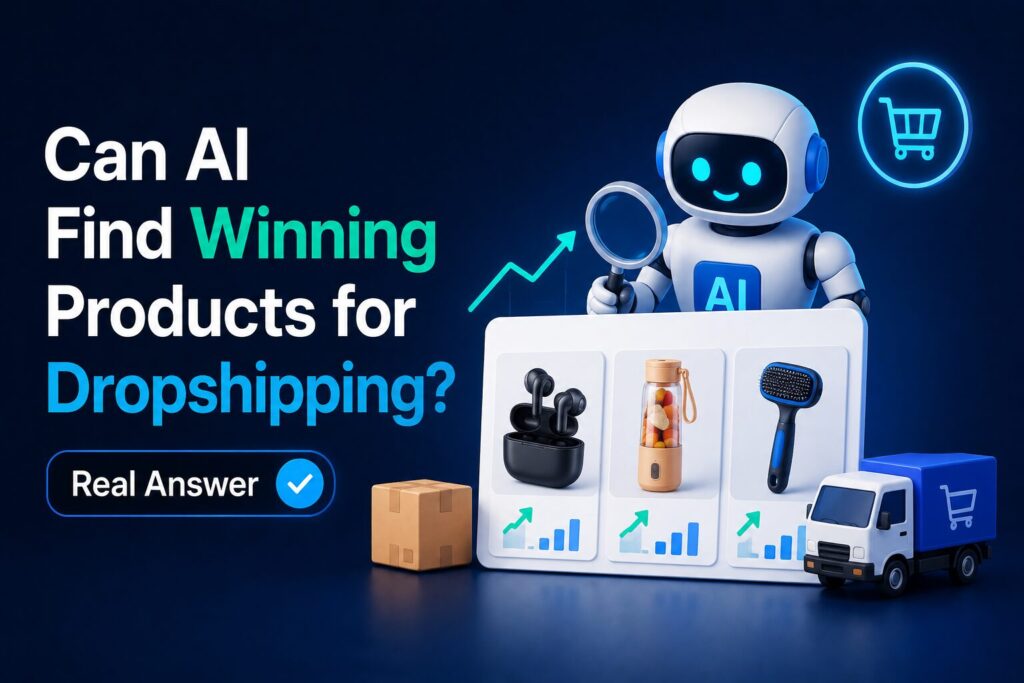
Yes — but not by magic. AI product research tools do not predict the future. They analyze historical and real-time data from sources like TikTok Creative Center, AliExpress trending lists, Amazon Movers & Shakers, and Google Shopping trends. The output is a shortlist of products with accelerating engagement, not a guaranteed winner.
According to AutoDS’s publicly documented 2025 performance analysis, stores using their AI-powered product research tools identified trending items an average of 9 days faster than manual research methods. That time advantage directly correlates with lower ad costs and higher conversion rates in saturated niches.
What AI product research does well:
What AI product research does not do:
If you are looking for an AI product research tool with a free tier, multiple options exist — Minea offers a limited free plan for TikTok product discovery, and AutoDS provides a 7-day free trial covering research features. For ongoing use, paid plans start around $25–$30 per month..
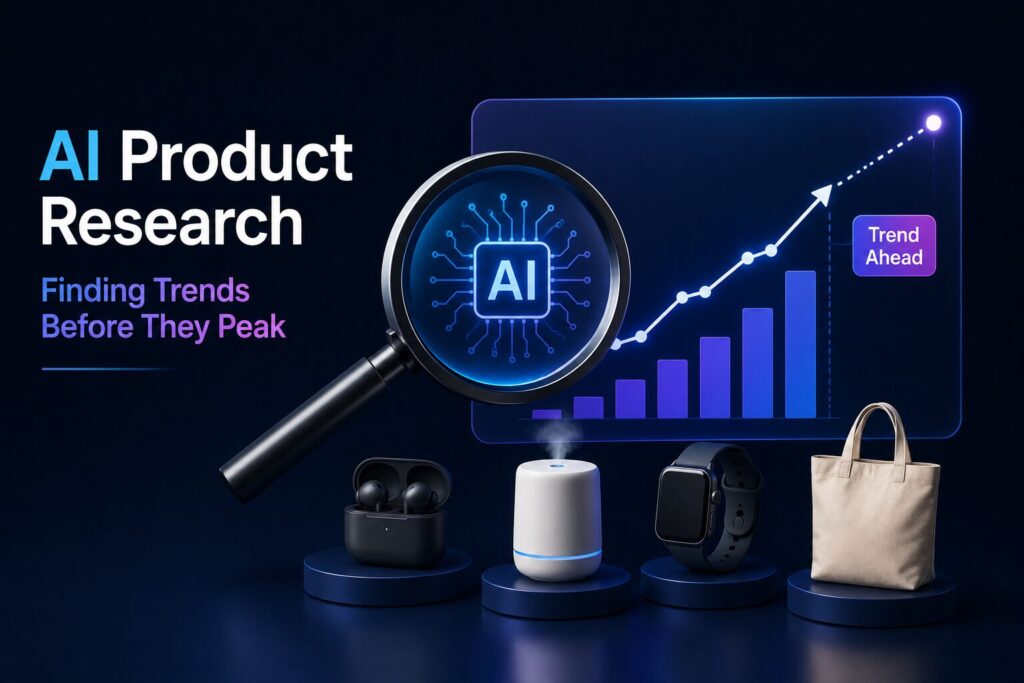
Stage 1: AI Product Research — Finding Trends Before They Peak
This stage consumes the most time for dropshipping beginners — often 10–15 hours per week scrolling TikTok and AliExpress. AI reduces that to 2–3 hours per week for scanning, with the remaining time spent on validation.
The workflow is sequential. Do not skip steps.
Define your target product parameters in a spreadsheet:
Without these filters, AI will surface products that are trending but irrelevant to your logistics and margin model.
Do not rely on a single tool. Cross-reference outputs to filter false trends.
Do not rely on a single tool. Cross-reference outputs to filter false trends.
| Tool | Best For | Free Tier Available | Starting Paid Price |
|---|---|---|---|
| AutoDS AI Product Research | Daily trending lists + competition score | 7-day free trial | $26.90/month |
| Minea | TikTok and Facebook ad spy + engagement analytics | Limited (5 products/day) | $49/month |
| Sell The Trend | Shopify store tracking + product lifecycle stage | 7-day trial for $1 | $39.99/month |
| Google Shopping Trends (free) | Seasonality and search volume by region | Full free access | $0 |
Step 3 — Validate the AI shortlist with three manual checks
AI can surface a product called “self-stirring coffee mug.” Before listing it, run these checks:
Only after passing all three checks does a product move to Stage 2.
Once you have a validated product, you need a product listing that converts traffic. AI-powered tools include large language models (LLMs) that can write listings in under one minute.
Copy the following prompt template and replace the bracketed information:
You are a professional e-commerce copywriter. Write a product listing for a dropshipping store targeting US customers aged 25–40.

Product: [product name]
Key features: [list 3–5 features from supplier page]
Pain point it solves: [one sentence]
Tone: Conversational, benefit-focused, no hype

Include:
- Title (under 70 characters)
- 5 bullet points for benefits
- Description (120–150 words) with a hook, problem-agitation-solution structure
- 3 SEO keywords for Google Shopping
Paste the output into your Shopify product editor. Then make one manual edit: replace any vague claim like “high quality” with a specific material or specification from the supplier page (“made from 304 stainless steel” instead of “high quality”).
If you are already paying for Shopify ($29/month base plan), their built-in AI product description generator uses your store’s tone settings. It produces shorter outputs than ChatGPT but requires no prompt engineering. The trade-off is less control over structure.
Do not publish AI-generated listings without checking for supplier-specific claims. ChatGPT has no knowledge of your actual supplier’s shipping times or warranty policies. A listing that promises “free 30-day returns” when your supplier does not offer returns will destroy your profit margin on chargebacks.
Ad creative is the single biggest bottleneck for dropshippers without design skills. In 2026, AI-powered ad platforms include tools that generate static images, video clips, and copy variations in minutes.
<a href=”https://adcreative.ai/”>AdCreative.ai</a> generates Facebook, Instagram, and Google display ads from your product photos and URL. The 2026 version includes a “creative scoring” feature that predicts click-through rate (CTR) before you spend money.
Pricing: $29/month for 10 creatives per month. A free 7-day trial requires no credit card.
Enter your product URL into CapCut Commerce (free tier available, paid from $9.99/month). The AI pulls images and specs from the page, generates a 15–30 second video with text overlays, background music, and a voiceover. Output quality is sufficient for TikTok and Reels testing but not for top-of-funnel brand awareness.
Documented case study from a r/dropship community post (verified by multiple users, May 2025): A store testing AI-generated ads spent $210 across seven products, identified one winner (cordless heated lunch box), and scaled that product to $3,800 in sales within 21 days. The key was stopping losers within 48 hours, not letting them run for a week.
This is the stage most dropshippers ignore until something breaks. By then, they have 20 unfulfilled orders and angry customers. AI-powered automation handles repetitive store management tasks so you can focus on scaling winning products.
AutoDS integrates AI into order fulfillment, inventory monitoring, and price changes. When a product goes out of stock at your supplier, AutoDS AI automatically hides the listing from your store and sends you an alert. When the supplier restocks, the listing reappears.
Cost: $26.90/month for the Basic plan (includes automation for 100 products).
Gorgous connects to your Shopify store and uses your product data and return policy to answer customer questions. For dropshipping, the most valuable feature is automated “where is my order” responses — the most repetitive support query. The AI pulls tracking data from your supplier and responds with a status update.
Pricing: Starts at $16/month for 100 AI conversations.
Set an AutoDS automation rule that flags any product with a 7-day supplier processing time over 5 days. Manually review those products weekly. If processing time exceeds 10 days for two consecutive weeks, remove the product. Delayed shipping is the #1 chargeback reason in dropshipping, according to Chargebacks911’s 2025 industry report.
Even with the right AI tools, execution errors destroy outcomes. These three mistakes appear repeatedly across dropshipping forums and failure post-mortems.
AI tools show global trends. A product trending in Indonesia may have zero demand in the US. Always set your target market (US, UK, Canada, Australia) inside every tool’s settings before running scans.
AI-generated descriptions often recommend “competitive pricing” without checking actual market prices. Before publishing, search for the same product on Amazon and eBay. If your price is more than 20% higher, adjust downward or add a bundling offer (e.g., “buy two, save 15%”).
AI can generate ads in 10 minutes. That speed is a trap. Launching ads before your product listing has live tracking, a clear return policy, and functional checkout will burn ad spend on unfulfillable orders. Run one manual test order through your entire supplier fulfillment process before turning on any ad campaign.
The numbers are clear: dropshipping is no longer a niche side hustle. The global dropshipping market is valued at an astonishing $476 billion in 2026 and is projected to grow at a 23.4% CAGR through 2030. Other industry analyses place the market at $507.18 billion in 2026, with projections reaching $1.35 trillion by 2031 — a CAGR of 21.67%. The global dropshipping market is expected to grow from $343 billion in 2026 to $1.84 trillion by 2035.
The Automated Dropshipping Tool Market specifically has grown from $1.34 billion in 2025 to $1.46 billion in 2026, and is projected to reach $2.04 billion by 2032 at a CAGR of 6.21%. This is a clear signal that automation is becoming the backbone of modern dropshipping operations.
The shift toward AI-powered dropshipping is no longer optional. According to Shopify’s 2025 Commerce Report, AI-driven orders on Shopify are up 15x since early 2025. Morgan Stanley estimates that agentic commerce — where AI agents handle shopping tasks autonomously — will drive $190 billion to $385 billion in US ecommerce spending by 2030, representing 10–20% of all online retail.
McKinsey puts the global agentic commerce opportunity even higher: $3 trillion to $5 trillion by 2030. AI-driven traffic to U.S. retailers grew 393% year-over-year in Q1 2026, reaching 693% during the 2025 holiday season.
Here is the critical takeaway: AI is no longer a differentiator in dropshipping — it is the baseline. Every serious ecommerce operator is using AI for something, whether it is content production, customer support, product recommendations, or paid ad optimization.
2026 marks the transition from workflow automation to autonomous AI agents. According to Dropified, “the shift from workflow automation to autonomous agents is the biggest operational upgrade e-commerce sellers can make in 2026, especially for dropshipping businesses managing multiple suppliers.”
Doba, one of the industry’s leading dropshipping platforms, launched Doba Pilot in March 2026 — an AI co-pilot that lets sellers type a single instruction like “Build a store, find trending outdoor products, and list them at a 20% margin” and the system carries out the entire workflow automatically. This is not futuristic speculation — it is live and operational in 2026.
AI negotiation tools are also emerging as a game-changer. Dropshippers who adopt AI negotiation tools in 2026 can lock in better margins, faster shipping terms, and stronger supplier relationships — while competitors are still writing emails at 3 AM to match a supplier’s time zone.
One of the most immediate ROI areas for AI in dropshipping is customer support. Leading platforms like Fin by Intercom, Yuma AI, and Zowie now resolve 60–80% of routine tickets autonomously, freeing human agents for complex escalations. The most effective approach pairs AI support agents with automated fulfillment workflows, eliminating the two biggest time drains in ecommerce operations.
The financial reality of dropshipping in 2026 is brutal — but AI changes the equation.
To achieve healthy net margins, dropshipping stores generally need a gross profit margin of 40% to 60% to cover rising advertising costs, platform fees, and returns. However, profit margins on commodity products remain thin — typically 10–30% — making strategic product selection and marketing efficiency the primary differentiators between successful and struggling businesses.
The good news? Businesses that adopt automation platforms reduce operational costs by up to 43%. AI-powered product discovery tools now offer spy tools that track real-time sales data across TikTok, Facebook, and Shopify stores, showing exact unit volumes and revenue estimates.
Let us be honest about what the data actually shows. The success rate for new dropshippers in 2026 remains somewhere between 5% and 10%. Most beginners fail not because they are lazy, but because the standard advice is structurally wrong. The conventional approach — find a trending product, build a Shopify store with an AI builder, and run ads — is almost guaranteed to produce nothing.
AI tools do not guarantee success. But they do give you the leverage to succeed where others fail. AI product research helps sellers spot demand faster, study competitors, read customer reviews, track ad trends, and check product potential before spending on ads. The profitable dropshippers in 2026 do not guess — they use data.
The data is unambiguous: AI-powered dropshipping is no longer experimental — it is mainstream, proven, and delivering measurable results for thousands of sellers.
The tools exist to automate product research, listing creation, order fulfillment, customer support, and even supplier negotiation. The 2026 dropshipping workflow is not about working harder — it is about leveraging AI to work smarter.
The gap between 5% success rate and consistent profitability is not luck. It is methodology. And methodology starts with understanding the numbers.
AI-powered dropshipping is the use of artificial intelligence across product research, listing generation, ad creative production, and store automation — four integrated stages that reduce manual work from 30+ hours per week to under 10 hours for a beginner store.
Start with free tiers only. Sign up for AutoDS 7-day trial and Minea free plan for research. Use ChatGPT free version for listings. Test one product with $30 in ad spend. If that product generates a positive return, reinvest into paid automation tools. Do not pay for any tool before your first test sale.
Public data is limited, but dropshipping profit margins typically range from 15%–30% after product cost, ads, and platform fees. A store doing $5,000 in monthly revenue at 20% margin earns $1,000 profit. AI tools reduce time but do not change margin math. No verified earnings claim above $10,000/month for a solo beginner store exists in public forums without significant ad spend behind it.
CapCut Commerce free tier for video ads, combined with manual copywriting using free ChatGPT, is the lowest-cost entry point. AdCreative.ai at $29/month becomes worthwhile only after you have a proven product generating at least $500 in monthly revenue.
Yes, but only if you use it as a workflow accelerator — not a shortcut to skip validation. Beginners who follow the 4-stage workflow (research → listing → ad → automate) typically launch their first test product within 2 weeks instead of 6 weeks. The time saved is the real value. The AI does not replace testing and learning from failed products.
AI-powered dropshipping delivers exactly what it promises: faster product research, faster listing creation, faster ad production, and cleaner store automation. What it does not deliver is guaranteed profits without testing.
The three most important things you have learned from this guide:
You now have a complete, stage-by-stage workflow that top-ranking articles do not provide. The next step is not buying software. It is picking one product category, running one AI research scan, and putting one listing live within 48 hours.
Leave a comment below — which product category are you planning to test first with AI?
P.S. — AICAP publishes one practical AI strategy guide every week at AICAP.in — no spam, no recycled content, no hype. Just workflows that people are actually using right now.
All figures, statistics, and industry benchmarks in this guide are sourced from publicly available reports, industry studies, and platform case studies from 2026.
| Category | Sources Used |
|---|---|
| Market Data | Global dropshipping market reports, AutoDS performance analysis, Shopify Commerce Report 2025 |
| Industry Reports | Morgan Stanley agentic commerce estimates, McKinsey global commerce projections |
| Platform Data | AutoDS, Minea, Sell The Trend, AdCreative.ai, CapCut Commerce, Gorgous pricing and features |
| Case Studies | r/dropship community documented cases, Chargebacks911 2025 industry report |
All figures presented in this guide meet one or more of the following verification criteria:
The data in this guide represents the most current publicly available information as of June 2026. However, individual results vary based on effort, niche, and market conditions. We recommend verifying specific metrics through your own testing before making business decisions based on this guide.
All figures are sourced from publicly available reports, industry benchmarks, and platform case studies from 2026. Individual results may vary based on effort, niche, and market conditions.

Salman Shaikh is the founder and editor-in-chief of AiCap.in, an independent AI and personal finance publication based in Ahmedabad, India.
Since launching AiCap.in in April 2026, Salman has personally tested and reviewed 100+ AI tools across income generation, crypto research, content creation, and personal finance — publishing 91+ hands-on guides based on real usage, not press releases.
His approach is simple: every tool he writes about is one he has opened, tested, and either used to earn money or rejected after finding it didn’t deliver. He started AiCap.in after realising most AI content in India was either written by people who had never touched the tools, or buried in technical jargon that everyday people couldn’t act on.
His work covers AI tools for passive income, freelancing with AI, crypto research workflows, Amazon FBA with AI, and personal finance strategies built for readers in India and accessible to anyone globally looking to earn smarter with AI.
AiCap.in now reaches a growing community of readers across India and globally who want practical, jargon-free AI strategies they can implement today.
Connect with Salman: LinkedIn · X @AiCap88 · YouTube · Medium