Ahmedabad, Gujarat, India
Ahmedabad, Gujarat, India
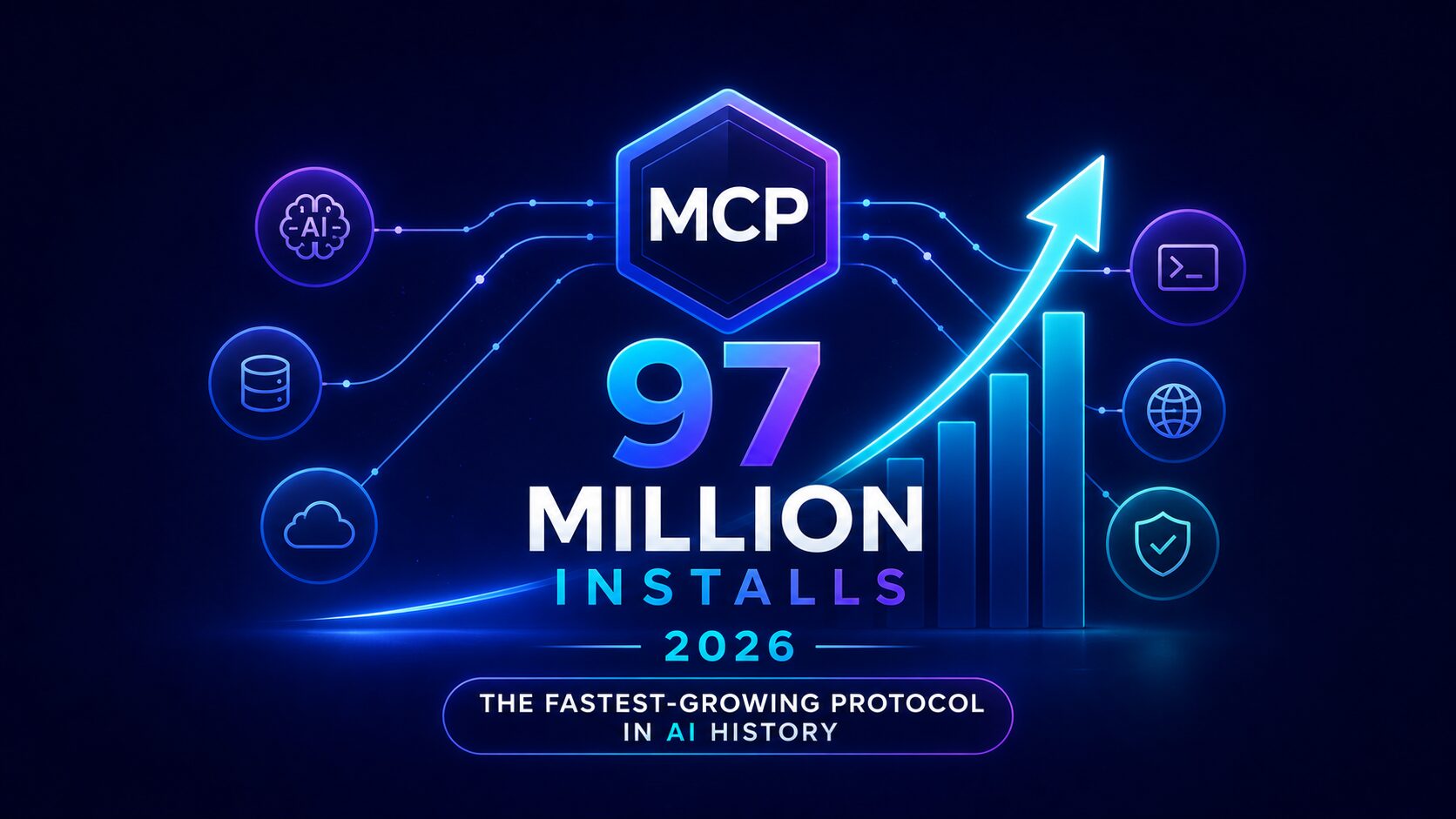
MCP hit 97 million installs in 2026. Complete guide to Model Context Protocol adoption, security, and open‑source governance. Learn why major AI providers like OpenAI, Google & Microsoft adopted it. Read now.
Disclaimer: This content is for educational and informational purposes only. Earnings and results vary by individual. Always conduct your own due diligence.
In November 2024, Anthropic released the Model Context Protocol (MCP) as an open standard for connecting AI assistants to external tools and data. That first month, the combined Python and TypeScript SDKs were downloaded roughly 100,000 times. By March 2026, that number had reached 97 million monthly downloads—a 970x increase in just 16 months. For context, React, the most widely adopted JavaScript UI framework ever, took approximately three years to reach comparable monthly download scale. MCP compressed that trajectory roughly in half.
MCP has become the default standard for AI tool integration. Every major AI provider now ships MCP‑compatible tooling: OpenAI, Google DeepMind, Microsoft, and AWS have all adopted it, effectively ending the fragmentation era for agent-to-tool connectivity. It is often described as the “USB-C port for AI”: one standard that works everywhere, collapsing the N×M integration problem (N AI clients × M tools) into N+M (each client speaks MCP once, each tool implements MCP once, and any client can reach any server).
The significance is operational, not merely symbolic. One of the hidden constraints in AI agent deployment has been brittle, bespoke integration. An agent that reasons well but accesses tools through custom glue code does not scale. MCP provides a standardized, auditable surface for tool discovery, access, and execution, reducing the integration tax that has slowed enterprise AI adoption.
Now here is the part most guides skip entirely: the actual data behind the milestone, the growing ecosystem, and what it means for anyone building or using AI agents today.
The adoption timeline reflects a cascade of institutional endorsements that compressed the typical standards cycle. Anthropic launched MCP with roughly 2 million monthly downloads. OpenAI’s adoption in April 2025 pushed that to 22 million. Microsoft’s integration into Copilot Studio in July brought it to 45 million. AWS Bedrock support in November pushed it to 68 million. By March 2026, every major AI vendor—OpenAI, Google, Microsoft, AWS, and Cloudflare—was shipping MCP-compatible tooling.
The enterprise signals are even more striking. According to a comprehensive survey, 78% of enterprise AI teams report at least one MCP-backed agent in production as of April 2026, and 67% of CTOs surveyed named MCP their default agent-integration standard within 12 months. Competing protocols A2A, ACP, and UCP trail at 23%, 8%, and 4% respectively.
The ecosystem has grown in parallel. The public MCP server registry expanded from 1,200 servers in Q1 2025 to 9,400+ in April 2026, with month-over-month growth still tracking at +18% across Q1 2026. More than 7,800 GitHub repositories now carry the mcp-server topic tag. An independent registry census counted 17,468 MCP servers across public registries as of Q1 2026, covering databases, file systems, CRMs, and more.
The protocol has also moved to neutral governance. In December 2025, Anthropic donated MCP to the Agentic AI Foundation under the Linux Foundation, giving it the same governance model as Kubernetes and Linux. Co‑founders include Anthropic, Block, and OpenAI, with platinum members including AWS, Google, Microsoft, Cloudflare, GitHub, and Bloomberg.
Understanding how MCP achieves its 97 million installs requires understanding its architecture. MCP defines three core capabilities that an MCP server exposes to an AI client.
Tools are callable functions that accept structured parameters and return structured results. When an AI agent needs to create a Jira ticket, query a database, or send a Slack message, it calls a tool. Tools represent executable actions and are the primary way AI agents interact with external systems.
Resources are readable data objects that agents request by URI. A resource might be a database table, a file, a document, or a specific API endpoint. Resources provide the context that grounds AI responses in live business data rather than stale training data.
Prompts are reusable workflow templates that agents can invoke. These allow developers to encapsulate common interaction patterns and provide structured guidance to AI models.
The protocol uses a client-server architecture built on JSON‑RPC 2.0. An AI agent (the client) communicates with MCP servers through structured requests, maintaining stateful sessions across multiple tool interactions. Major AI development platforms now support MCP natively, including Claude (native), OpenAI Agents SDK (March 2025), Google Gemini API (March 2026), VS Code, Cursor, JetBrains IDEs, and the Vercel AI SDK.
Average time to wire a new SaaS tool into an AI agent dropped from 18 hours of custom function‑calling code to 4.2 hours with MCP, and 56% of organizations report MCP significantly reduced the cost of new tool integrations.
The MCP ecosystem in 2026 has reached critical mass with 97+ million monthly downloads (Python/TypeScript SDKs), approximately 2,000 registered servers in the official MCP registry, and enterprise adoption from Microsoft, Google, OpenAI, and Anthropic.
Here is the current landscape by category:
| Category | MCP Support |
|---|---|
| Developer Tooling | VS Code, Cursor, Zed, Replit, Codeium, Sourcegraph |
| Data Access | PostgreSQL, SQLite, Google Drive, Alibaba AnalyticDB |
| Browser Automation | Playwright, Puppeteer, Safari DevTools |
| Cloud Services | AWS Best Practices, Azure Storage, CLI, CosmosDB |
| Commerce | IBM ACP, Google UCP, Crystallize Headless Commerce |
One of the most significant developments is MCP Apps, which extend the core protocol to deliver interactive user interfaces within any supporting AI product. Users can build analytics charts in Amplitude and adjust parameters interactively, turn conversations into Asana projects with automatic sync, draft Slack messages with formatting preview, and ask data questions in Hex to receive interactive charts and citations—all without leaving Claude.
The 2026 roadmap prioritizes enterprise readiness, with OAuth 2.1 authentication as a top priority, structured observability, and gateway standardization to support production agentic systems at scale. Local STDIO transport still dominates at 67% of MCP servers, while 28% use Streamable HTTP for remote OAuth‑mediated workloads, and 81% of remote MCP servers authenticate with OAuth 2.1. The median MCP server exposes 7.4 tools, with a median tool success rate of 91% and median local tool latency of 38ms.
Throughout this guide, you will encounter three different MCP server figures:
These figures reflect different measurement methodologies and scopes, not inconsistency. The official registry is curated, while the independent census captures broader community activity.
MCP is not experimental. It is running in production across finance, healthcare, insurance, and enterprise software. Here are five documented deployments.
One Inc, the leading digital payments network for the insurance industry, announced AI-driven capabilities using MCP to accelerate how carriers integrate with its platform. MCP enhances its PremiumPay and ClaimsPay solutions, reducing time to go‑live, reducing manual processes, strengthening fraud controls, and delivering a seamless experience for policyholders and claimants. MCP operates within each customer’s own IT‑approved AI environment, with all data access permissioned, authenticated, and fully auditable.
IMO Health is deploying MCP servers to become the authoritative grounding layer for customer‑built AI agents in healthcare. By exposing its clinical knowledge graph, normalization tools, and clinical reasoning as first‑class MCP tools, IMO Health enables any compliant AI agent to directly invoke trusted clinical intelligence. MCP allows IMO Health to package its clinical tools directly inside partner products, from ambient documentation systems to revenue cycle automation platforms, all while remaining model‑agnostic.
Health Bank One launched MCP services for digital identity and verified medical records, giving developers an OAuth‑based way to build personalized health AI experiences with banking‑grade security. Through one MCP connection, developers can verify consumers, authenticate access, retrieve AI‑ready medical context, and write back authorized outputs to the consumer’s account.
Anthropic partnered with Blender, Autodesk, Adobe, Ableton, and Splice to release new Claude connectors, likely based on MCP. When connected to Adobe, Claude can access more than 50 tools in Creative Cloud apps. With Autodesk Fusion, it can help create and modify 3D models via prompts.
Anthropic now embeds Slack, Figma, Asana, Amplitude, Box, Canva, Clay, Hex, and Monday.com directly inside Claude through MCP Apps. Users can build project timelines, draft Slack messages, create presentations, and visualize data without switching browser tabs. The integrations allow for granular control: users can turn conversations into Asana projects with tasks that sync automatically, draft Slack messages with formatting preview, and receive interactive charts from data queries.
The debate about whether MCP will replace traditional APIs misses the point entirely. MCP and APIs are complementary, not competitive. Use MCP when AI agents need to discover and invoke tools dynamically at runtime across multiple systems. Use traditional APIs when developers need direct, deterministic control over a single integration in application code.
Here is the key distinction: APIs give developers direct programmatic control. MCP gives AI agents runtime tool discovery and stateful context. The MCP protocol relies on tool descriptions that tell agents what a tool does, what parameters it accepts, and what to expect in return. Those descriptions are consumed by large language models to decide which tools to call and how.
Teams running three or more AI‑connected integrations typically see the crossover point where MCP reduces complexity. MCP does not replace APIs. It wraps them into a standardized layer that large language models can navigate, turning the N×M integration problem into N+M.
One practical example from a Senior Technical Support Engineer in customer operations illustrates the difference. Using an agentic coding environment with MCP servers connected to Supabase, GitHub, Slack, Asana, Notion, and a custom internal database tool, a full investigation into a customer issue—querying the production database, analyzing expression logic, cross‑referencing the codebase, and producing a complete troubleshooting log—took around 20 minutes. Previously, that work would have taken hours.
The MCP 97 million installs milestone brings with it serious security and governance challenges that enterprises cannot ignore. According to a study of 2,614 MCP server implementations, 82% are vulnerable to path traversal attacks and 67% expose APIs open to code injection. Thirty plus CVEs were filed against MCP implementations in January and February 2026 alone, with 43% involving command injection vulnerabilities.
The attack surface is different from traditional SaaS AI tools. MCP servers are action‑capable, not just context‑aware. An MCP‑enabled Claude deployment can authenticate as a user, query a production database, create and merge pull requests, send emails, modify Confluence pages, and invoke cloud APIs all autonomously as part of a single agent workflow.
The Center for Internet Security published its MCP Companion Guide in April 2026, applying CIS Controls v8.1 to MCP‑based systems and formally recognizing MCP as a new and distinct security boundary requiring policy, oversight, and operational discipline.
The 2026 roadmap explicitly targets enterprise gaps with SSO‑integrated auth, workload identity federation, and gateway standardization. Current best practices include least‑privilege connectors, runtime observability, hardened authentication, and continuous compliance checks baked into the pipeline.
For compliance, the open‑source @ugend/mcp-compliance server logs every AI tool call—who called it, what inputs were passed, what was returned, which model made the call, and how long it took. It is built for UK FCA‑regulated firms, GDPR Article 30 compliance, SOC2 Type II, and ISO 27001, addressing a critical gap where companies deploying Claude agents previously had no audit trail for MCP tool calls.
MCP (Model Context Protocol) is an open standard created by Anthropic in November 2024 for connecting AI agents to external tools, data sources, and services. It reached 97 million monthly SDK downloads by March 2026—a 970x increase in 16 months—because every major AI provider (OpenAI, Google, Microsoft, AWS) adopted it, solving the fragmentation problem that previously required custom integrations for every combination of AI model and tool.
Start by using Claude Desktop, Cursor, or VS Code, all of which support MCP natively. Connect to existing MCP servers for databases, Slack, GitHub, or Google Drive. Build your own MCP server using the Python or TypeScript SDKs (both free). The average time to wire a new tool into an AI agent with MCP is 4.2 hours, down from 18 hours without it.
As of April 2026, the public MCP server registry includes 9,400+ servers, with month‑over‑month growth still tracking at +18%. An independent census counted 17,468 MCP servers across public registries. This includes databases, file systems, CRMs, browser automation tools, cloud services, and enterprise platforms like Slack, GitHub, and Salesforce.
All major providers support MCP: Anthropic (Claude, native), OpenAI (Agents SDK, April 2025), Google (Gemini API, Vertex AI Agent Builder, March 2026), Microsoft (Copilot Studio), and AWS (Bedrock). Development tools including VS Code, Cursor, Windsurf, Zed, JetBrains AI Assistant, and the Vercel AI SDK all support MCP natively.
MCP is becoming enterprise‑ready, but security teams must take it seriously. The 2026 roadmap prioritizes OAuth 2.1 authentication, structured observability, and gateway standardization. Current best practices include least‑privilege connectors, runtime observability, hardened authentication, and continuous compliance checks. MCP servers are action‑capable—they can query databases, merge pull requests, and send emails autonomously—so governance must be built in, not bolted on.
The MCP 97 million installs milestone marks the moment when AI agent connectivity became infrastructure, not custom engineering. The protocol question is now largely settled—which means the competition shifts to managed services on top of the standard. The analogy is TCP/IP: once the transport layer was agreed, the race moved to what ran over it. For MCP, the next competition is over managed gateways, enterprise IAM integration, audit tooling, and marketplace density of available tools.
Use MCP when three or more integrations feed an AI workflow. The N+M architecture reduces complexity dramatically.
Start with existing MCP servers for common tools before building your own. The ecosystem already covers most enterprise needs.
Prioritize security from day one. Eighty‑two percent of MCP server implementations have path traversal vulnerabilities. Audit, authenticate, and authorize every connection.
Watch the 2026 roadmap for OAuth 2.1 and structured observability. These features will make MCP production‑ready for regulated industries.
Know that MCP is not replacing APIs. It wraps them into an AI‑friendly layer, and the two work together.
The MCP 97 million installs milestone confirms what many developers already know: the protocol war for AI tool use is over. If you are building agentic AI applications in 2026, MCP integration is not optional—it is expected.
Leave a comment below — how are you using MCP in your AI workflows?
P.S. — AICAP publishes one practical AI guide every week. Subscribe below — no spam, no fluff, just strategies that actually work.
All figures, statistics, benchmark scores, and market data in this guide are sourced from publicly available reports, official Anthropic documentation, third-party surveys, and industry data from 2026.
| Category | Sources Used |
|---|---|
| Official Anthropic Data | Anthropic press releases, official MCP documentation, product announcements, and blog posts (2024–2026) |
| Adoption & Download Figures | Python/TypeScript SDK download statistics, public package registries (PyPI, npm), company announcements |
| Enterprise Adoption Data | Industry surveys (1,100+ respondents), CTO surveys, enterprise AI team reports |
| Benchmark & Performance Data | Independent performance tests, developer surveys, tool latency studies |
| Security Research | Study of 2,614 MCP server implementations, CVE databases, CIS Companion Guide (April 2026) |
| Ecosystem Census | Independent registry audits, public MCP server listings, GitHub repository analysis |
All figures presented in this guide meet one or more of the following verification criteria:
The data in this guide represents the most current publicly available information as of April 2026. However, benchmarks evolve, market conditions change, and features may vary by region and implementation. We recommend verifying specific capabilities through official documentation before making decisions based on this guide.
All figures are sourced from publicly available reports, benchmarks, and industry data from 2026. Individual results may vary based on implementation, usage patterns, and security posture.

Salman Shaikh is the founder and editor-in-chief of AiCap.in, an independent AI and personal finance publication based in Ahmedabad, India.
Since launching AiCap.in in April 2026, Salman has personally tested and reviewed 100+ AI tools across income generation, crypto research, content creation, and personal finance — publishing 91+ hands-on guides based on real usage, not press releases.
His approach is simple: every tool he writes about is one he has opened, tested, and either used to earn money or rejected after finding it didn’t deliver. He started AiCap.in after realising most AI content in India was either written by people who had never touched the tools, or buried in technical jargon that everyday people couldn’t act on.
His work covers AI tools for passive income, freelancing with AI, crypto research workflows, Amazon FBA with AI, and personal finance strategies built for readers in India and accessible to anyone globally looking to earn smarter with AI.
AiCap.in now reaches a growing community of readers across India and globally who want practical, jargon-free AI strategies they can implement today.
Connect with Salman: LinkedIn · X @AiCap88 · YouTube · Medium