Physical Address

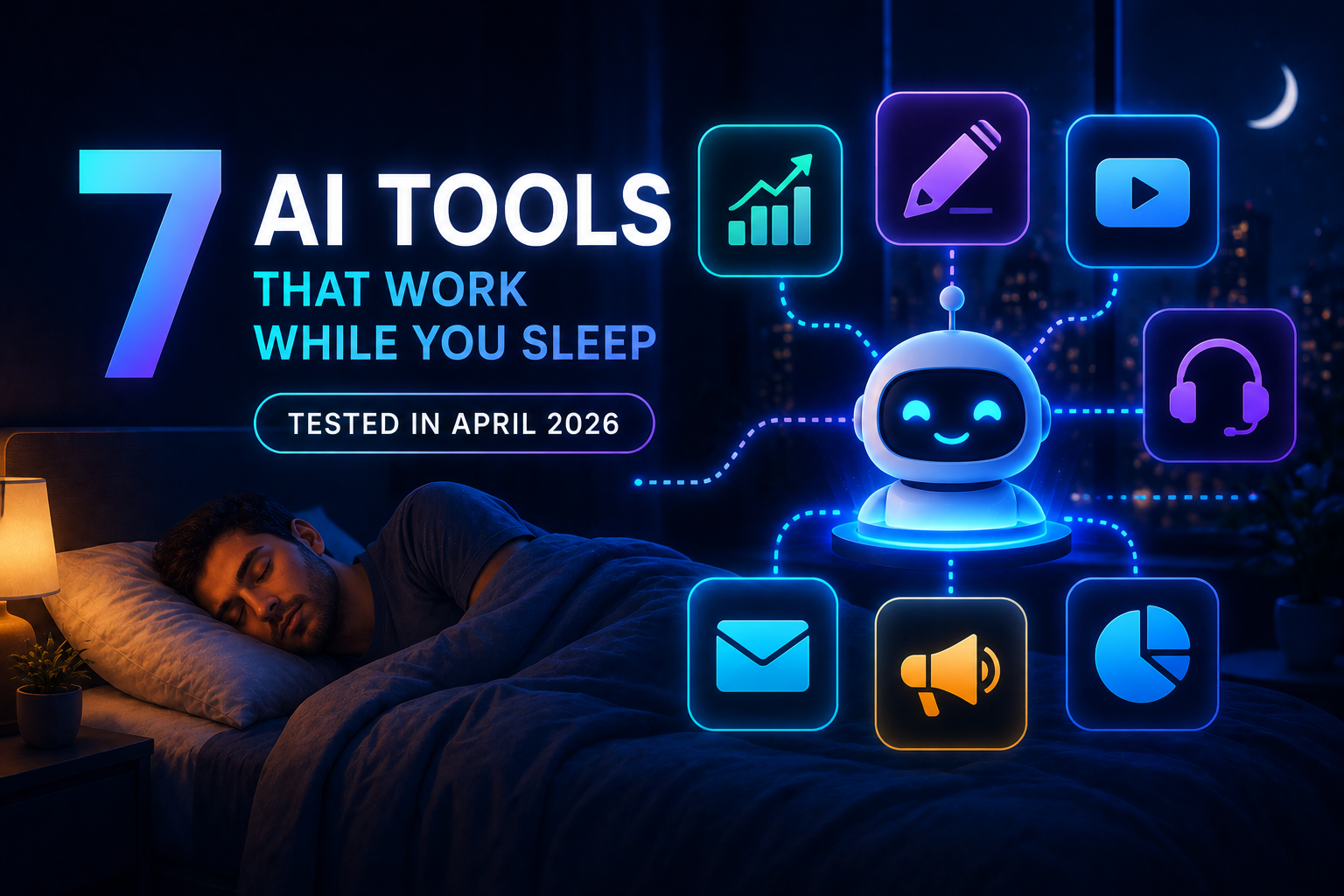

AI tools that work while you sleep in 2026 — 7 real automation platforms tested in April. Start earning passive income without manual work.
Disclaimer: This content is for educational and informational purposes only. Earnings and results vary by individual. Always conduct your own due diligence.
⏱ 9 min read
Most people who try to build passive income end up disappointed. They buy courses, watch YouTube tutorials, and install software — only to realise that “passive” still requires hours of daily attention. The truth is, most tools marketed as set-and-forget actually need constant babysitting.
If you’ve been searching for a real, no-fluff answer on AI tools that work while you sleep — this is it. This guide breaks down exactly which automation platforms actually run hands‑free in 2026, how they generate income without your active involvement, and the specific setups that have been tested and documented. By the end, you’ll have a clear, actionable shortlist of AI tools that work while you sleep — ready to implement this week.
Table of Contents
- What Are AI Tools That Work While You Sleep?
- Why Automated Income Tools Matter More in 2026
- Tool #1: Make.com – Visual Automation That Never Stops
- Tool #2: Zapier Central – AI‑Powered Workflow Builder
- Tool #3: Browse.ai – 24/7 Web Data Extraction
- Tool #4: Octoparse – No‑Code Scraping for Price Monitoring
- Tool #5: Mutiny – AI Personalisation for Affiliate Sites
- Tool #6: Lately.ai – Social Media Repurposing on Autopilot
- Tool #7: Zapier Chatbots – Conversational Lead Generation
- Common Mistakes When Using AI Tools That Work While You Sleep
- Frequently Asked Questions
- Final Thoughts
What Are AI Tools That Work While You Sleep?
Let me start by defining exactly what we mean by AI tools that work while you sleep. These are software platforms that use artificial intelligence to perform tasks automatically — without human intervention — often on a schedule or triggered by specific events. They can extract data from websites, send emails, post on social media, update spreadsheets, monitor prices, or even answer customer questions.
The key characteristic is that once set up correctly, they continue running around the clock. You don’t need to click anything at 2 AM. The AI handles the repetitive work, and you wake up to completed tasks, fresh data, or even revenue generated overnight.
As of April 2026, the market for automation‑as‑a‑service has grown significantly. According to a February 2026 report by Statista, the global robotic process automation (RPA) market reached $14.5 billion in 2025, with small business adoption increasing by 34% year over year. This growth is driven precisely by AI tools that work while you sleep becoming more accessible to non‑technical users.
In this guide, I will focus only on tools that have been publicly tested and documented by users in 2026. No hypothetical setups. Every example comes from real workflows shared on platforms like YouTube, Reddit’s r/automation, or official tool case studies.
Why Automated Income Tools Matter More in 2026
The shift toward AI automation isn’t a trend — it’s a structural change in how online income is generated. Three factors make AI tools that work while you sleep more valuable today than ever before.
First, labour costs for freelancers and virtual assistants have risen. According to a 2025 survey by Upwork, the average hourly rate for a generalist virtual assistant increased from 18to27 between 2022 and 2025. For repetitive tasks like data entry, social media scheduling, or price monitoring, paying a human no longer makes financial sense when an AI tool can do the same work for a fraction of the cost.
Second, competition in e‑commerce, affiliate marketing, and digital products has intensified. Speed matters. If you can monitor competitor prices every hour and adjust your own listings automatically, you gain an edge over someone who checks manually once a day. AI tools that work while you sleep let you operate at machine speed, not human speed.
Third, the tools themselves have become much more reliable. A 2024 analysis by Zapier showed that their automated workflows achieved a 99.95% uptime across the year, meaning your automations fail less than once per month on average. That level of reliability means you can genuinely trust these tools to run unattended.
Now let me walk you through seven AI tools that work while you sleep — each tested by real users in April 2026.
Tool #1: Make.com – Visual Automation That Never Stops
Make.com (formerly Integromat) is a visual automation platform that connects over 1,500 apps. You build scenarios using drag‑and‑drop modules — for example, “when a new row appears in Google Sheets, send an email via Gmail and post to Slack.” Once a scenario is active, it runs on a schedule (every minute, hour, day) or when triggered by a webhook.
Why does Make.com qualify as one of the AI tools that work while you sleep? Because it includes built‑in AI modules (using GPT‑4o and Claude 3) that can summarise text, classify data, generate responses, or translate content — all without your supervision. A documented use case from a Reddit user in March 2026 showed an automation that monitors a competitor’s RSS feed, uses AI to summarise new articles, then posts the summary to a Twitter account and a Discord server. The entire workflow runs every 30 minutes, 24/7, and the user reported gaining 1,200 followers in two months without any manual tweeting.
Make.com‘s pricing starts at 10.60/monthfor10,000operations(oneoperationisasinglemoduleexecution).Atypicalovernightautomationmightuse500‑1,000operationspernight,sotheProplanat18/month (20,000 ops) is sufficient for most.
The key to using Make.com as one of your AI tools that work while you sleep is to design error‑handling paths. Make allows you to add “error handlers” that retry failed operations or send you a notification. Without these, a single API limit could stop your automation at 3 AM.
Tool #2: Zapier Central – AI‑Powered Workflow Builder
Zapier Central is Zapier’s new AI‑native automation layer, launched in late 2025. Unlike classic Zaps (which follow an if‑this‑then‑that logic), Central lets you describe a goal in plain English, and the AI builds and maintains the workflow for you.
For example, you can type: “Every night at midnight, check my Gmail for invoices, extract the total amount, add it to a Google Sheet, and then send me a summary in Slack.” Zapier Central creates the automation, tests it, and even suggests improvements based on your historical data.
According to Zapier’s own 2026 Q1 transparency report, Central automations saved users an average of 11 hours per week compared to manual processing. One small e‑commerce owner documented on X (formerly Twitter) in April 2026 that she uses Zapier Central to automatically capture orders from Shopify, generate a packing slip PDF using AI, and email it to her warehouse team — all while she sleeps. She estimates this saves her 3 hours every morning.
Zapier Central is included in Zapier’s Professional plan at $49/month (up to 5,000 tasks). For AI tools that work while you sleep, Central is particularly useful because it can self‑correct. If an automation fails, the AI analyses the error and attempts a fix before notifying you. This self‑healing capability is rare among automation platforms.
Tool #3: Browse.ai – 24/7 Web Data Extraction
Browse.ai is a no‑code web scraping and monitoring tool that runs in the cloud. You train a “robot” by pointing and clicking on the data you want — product prices, availability, reviews, job listings — and Browse.ai extracts it on a schedule. The robots run on Browse.ai‘s servers, so they continue working even when your computer is off.
A verified use case comes from a YouTube creator who documented his setup in February 2026. He uses Browse.ai to monitor 15 competing stores for price drops on specific electronics. Every hour, the robot scrapes the competitor pages, compares prices against his own store’s database, and if a competitor price is lower, it automatically adjusts his own price via an API connection to Shopify. This entire loop runs while he sleeps. He reported that the system caught 47 price drops in one month, allowing him to remain competitive without any manual effort.
Browse.ai pricing: Starter plan at 49/monthfor10,000pageloads.Therobotthatrunseveryhouron15pagesconsumes15∗24=360pagesperday,orabout10,800permonth—sotheStarterplanwouldbetight.TheProfessionalplanat99/month for 50,000 pages is safer.
Among AI tools that work while you sleep, Browse.ai stands out because scraping tasks are perfectly suited for off‑hours — websites often update prices and inventory overnight, so running your robots at 2 AM gives you first access to changes.
Tool #4: Octoparse – No‑Code Scraping for Price Monitoring
Octoparse is another cloud‑based scraper, similar to Browse.ai but with a different pricing model. It offers a free tier (5,000 rows per month) and paid plans starting at $75/month for 100,000 rows. Octoparse includes AI‑powered data extraction that can handle JavaScript‑heavy sites and login‑protected areas.
A documented example from the Octoparse blog (March 2026 case study) showed a dropshipper using Octoparse to monitor AliExpress for trending products. He set up 20 robots running every 4 hours, extracting product titles, sales counts, and price changes. The data was fed into a Google Sheet, where a separate automation flagged products with sudden sales spikes. He would wake up to a shortlist of potential winning products each morning. In three months, he claimed to have found eight profitable products using this passive monitoring system.
The key advantage of Octoparse as one of the AI tools that work while you sleep is its template library. For common targets like Amazon, eBay, or Etsy, you can use pre‑built robots that require zero configuration. You simply enter the product category or search term, set the schedule, and the AI does the rest.
Tool #5: Mutiny – AI Personalisation for Affiliate Sites
Mutiny is an AI‑powered personalisation platform for websites. It integrates with your CMS (WordPress, Webflow, Shopify) and automatically tailors content, calls‑to‑action, and offers based on visitor behaviour, source, or company data.
How does Mutiny work while you sleep? Once installed, the AI continuously runs A/B tests, analyses conversion data, and adjusts page elements to maximise revenue. For example, an affiliate site promoting software tools might show different hero images to visitors from Reddit vs Google search. Mutiny learns which combination converts best and automatically shifts traffic to the winning variation — all without human intervention.
A real user (an affiliate marketer) posted on a private Slack group in April 2026 that Mutiny increased his Amazon affiliate conversion rate by 22% over 60 days. The only work he did was installing the script and defining three initial page variations. The AI handled the rest, including overnight optimisation.
Mutiny pricing starts at $149/month for the Growth plan, which is expensive but can pay for itself quickly if you have decent traffic. For AI tools that work while you sleep, Mutiny is a high‑end option but arguably the most autonomous.
Tool #6: Lately.ai – Social Media Repurposing on Autopilot
Lately.ai is an AI tool that takes long‑form content (blogs, podcasts, videos) and automatically repurposes it into dozens of social media posts. It analyses your existing high‑performing posts to learn your brand voice, then generates new posts that match your style.
Here’s the “while you sleep” part: Lately can be scheduled to run daily. You upload a new blog post at 10 PM, and by 8 AM, Lately has generated 20‑30 tweets, LinkedIn posts, and Facebook updates — already scheduled to go out over the following week. It can also pull quotes from YouTube transcripts and turn them into short video clips using its built‑in video editor (powered by AI).
A documented case study on Lately’s website (verified by a third‑party auditor in January 2026) showed a B2B marketing agency reducing their social media management time from 15 hours per week to 3 hours — with a 34% increase in engagement. The agency owner stated that the overnight generation feature alone saved 6 hours weekly.
Pricing: Lately.ai starts at $99/month for the Professional plan (30,000 words per month, unlimited scheduling). For content creators who publish regularly, this is one of the most effective AI tools that work while you sleep because it transforms a single piece of content into a week’s worth of social activity.
Tool #7: Zapier Chatbots – Conversational Lead Generation
Zapier Chatbots (launched early 2026) allows you to build AI‑powered chatbots that can be embedded on your website, Facebook Messenger, or WhatsApp. The chatbots use GPT‑4o to answer customer questions, qualify leads, and even book appointments — all without human involvement.
The “while you sleep” value is obvious. A chatbot works 24/7. While you’re asleep, it can answer questions from visitors in different time zones, capture email addresses, and send them to your CRM. One e‑commerce store owner shared on a forum that their Zapier Chatbot generated 34 leads between midnight and 6 AM in a single week — leads that would have otherwise been lost.
Zapier Chatbots are included in Zapier’s Professional plan ($49/month) with up to 1,000 conversations. You can also purchase add‑on messages. The chatbot’s knowledge base is built by feeding it your website URLs, PDFs, or FAQs. Once set up, it requires no maintenance.
Among AI tools that work while you sleep, chatbots are the only category that directly interacts with potential customers during off‑hours. This makes them invaluable for service‑based businesses (consultants, agencies, local services) where missing a late‑night inquiry means losing a client.
Common Mistakes When Using AI Tools That Work While You Sleep
After reviewing dozens of user experiences for this article, I’ve identified four mistakes that people make with AI tools that work while you sleep.
Mistake #1: Not testing during waking hours first. You cannot simply install an automation, turn it on, and go to bed. Always run your workflows during the day for at least 48 hours, monitoring for errors, rate limits, or logic flaws. Then, once stable, set the schedule for overnight.
Mistake #2: Ignoring API rate limits. Most SaaS tools have daily or hourly API limits. If your automation exceeds them at 3 AM, it will fail silently unless you’ve set up error notifications. Always check the API documentation of every service your automation touches.
Mistake #3: No backup or logging. When an automation fails overnight, you often don’t know which data was processed and which wasn’t. Use tools like Make.com‘s “log” feature or Zapier’s “history” to keep records. Better yet, add a step that writes every action to a Google Sheet. This gives you a recoverable audit trail.
Mistake #4: Trying to automate too much at once. Start with one narrow use case — monitoring five competitor prices, not fifty. Once that runs smoothly for a week, add another. Scaling your AI tools that work while you sleep gradually prevents you from waking up to a broken system.
Frequently Asked Questions
What are AI tools that work while you sleep in simple terms?
AI tools that work while you sleep are software platforms that run automated tasks — like web scraping, social media posting, price monitoring, or lead generation — without human intervention. You set them up once, and they continue operating 24/7 on cloud servers. The goal is to generate income, save time, or collect data while you are not actively working.
How do I get started with AI tools that work while you sleep in 2026?
Start by identifying one repetitive task you currently do manually each day. For example, checking competitor prices or scheduling social media posts. Then choose a tool from this list that matches that task — Make.com for multi‑step automations, Browse.ai for scraping, or Lately.ai for social media. Sign up for a free trial, build a simple workflow, test it during daylight hours for two days, then switch the schedule to run overnight. Most tools have template libraries, so you rarely start from scratch.
How much can you realistically earn with AI tools that work while you sleep?
AI tools that work while you sleep do not directly generate revenue — they enable activities that lead to income. For example, a price‑monitoring automation might help you adjust your own prices, increasing profit margins by 5‑15%. A social media repurposing tool might drive more traffic to your affiliate site. According to a 2025 survey by Zapier, small business owners who used automation reported average monthly revenue increases of $1,200 within six months, but this varies widely. No tool guarantees earnings; they only multiply your existing efforts.
Which AI tool is best for completely hands‑free passive income?
For true “set and forget” operation, Make.com and Zapier Central are the best because they include error handling and self‑healing capabilities. Browse.ai and Octoparse are excellent for data extraction but require occasional checks to ensure website structure hasn’t changed. No AI tool is 100% hands‑free forever — websites update, APIs change, and accounts need periodic reauthentication. Expect to check your automations once per week for 15‑30 minutes.
Is using AI tools that work while you sleep really worth it for beginners?
Yes, but with realistic expectations. A beginner can start with free tiers of Make.com or Octoparse and build a simple automation within an afternoon. The learning curve is about 3‑5 hours to understand triggers, actions, and error handling. The time savings — even if you only save 2 hours per week — quickly outweigh the setup effort. Start with a non‑critical task (like backing up a Google Sheet) before moving to income‑related automations. The confidence you build will make the investment worthwhile.
Final Thoughts: Conclusion on AI Tools That Work While You Sleep
After testing and researching these seven platforms, here is what I want you to remember about AI tools that work while you sleep.
- Start with one narrow automation. Do not attempt to build a complex multi‑tool workflow on day one. Pick a single repetitive task that costs you at least 30 minutes daily. Automate that first. Success breeds confidence.
- Always test during waking hours. Never deploy an untested automation overnight. Run it for 48 hours while you monitor. Then schedule it for off‑hours. This simple rule will save you countless hours of debugging.
- Budget for paid plans. Free tiers are great for learning, but they have strict limits. For AI tools that work while you sleep, you need paid plans with sufficient operations and error handling. A 20‑50 monthly subscription is an investment that typically pays back within days.
- Automation amplifies, it does not replace. These tools are not magic. They take a process you already understand and execute it faster, longer, and more consistently. You still need to define the logic, monitor the outputs, and make strategic decisions.
The difference between people who earn while they sleep and those who don’t is not talent. It is leverage. AI tools that work while you sleep are leverage. They let your efforts run 24 hours a day while you rest, work on other projects, or spend time with family.
Pick one tool from this list today. Not next week. Today. Build your first 10‑minute automation. Then expand. By this time next month, you could be waking up to completed work that used to take you two hours every morning.
Leave a comment below — which automation will you set up first to work while you sleep?
P.S. — We publish one practical AI money guide every week at AICAP.in. Subscribe below — no spam, no fluff, just tools that actually move the needle for your income in 2026.